You open your lab results and one line is flagged, and you wonder what is MCHC in blood test terms. The rest of the complete blood count looks fine, but there’s that acronym with a small L or H beside it.
So, what is MCHC in blood test results? It stands for mean corpuscular hemoglobin concentration. In plain words, it tells you how densely hemoglobin is packed inside your red blood cells. A typical adult result lands around 32 to 36 g/dL, though labs differ a little.
Here’s the reassuring part. One off-range MCHC blood test result is common, and it often has a fixable explanation. Below, you’ll see how the number is calculated, what a low MCHC or a high MCHC can point to, and the practical next steps.
What is MCHC in blood test results?
Hemoglobin is the protein that carries oxygen inside your red blood cells. MCHC measures how concentrated that protein is within a given volume of those cells, according to MedlinePlus.
Picture a glass of fruit squash. The glass is the red blood cell. The syrup is hemoglobin. Same glass, more or less syrup. That’s MCHC.
Why does it matter? Because anemia isn’t one disease. It’s a label for too few healthy red blood cells or too little hemoglobin, and the cause varies a lot. Your hemoglobin number tells you how much oxygen-carrying protein you have. MCHC tells you how that protein is packed into your red blood cells, which helps sort anemia into types: pale cells, as in iron deficiency, or dense cells, which point toward red blood cell breakdown.
Two details help. First, MCHC is about concentration, not the total amount. A large red blood cell can hold plenty of hemoglobin and still have a normal MCHC. Second, it’s a calculated value. The lab analyzer measures hemoglobin and hematocrit directly, then works out MCHC from them.
You’ll find it on a CBC, short for complete blood count, usually beside MCV, MCH and RDW. Together those four are called red blood cell indices. A CBC is a routine blood test used to check overall health, look for conditions such as anemia, find the cause of symptoms like weakness, tiredness or bruising, and monitor conditions that affect blood counts, as the Mayo Clinic explains. You can eat and drink as usual beforehand unless you’re having other tests that need fasting.
How MCHC is calculated (with a worked example)
The formula is short: hemoglobin divided by hematocrit, times 100. Hematocrit is the share of your blood volume made up of red blood cells.
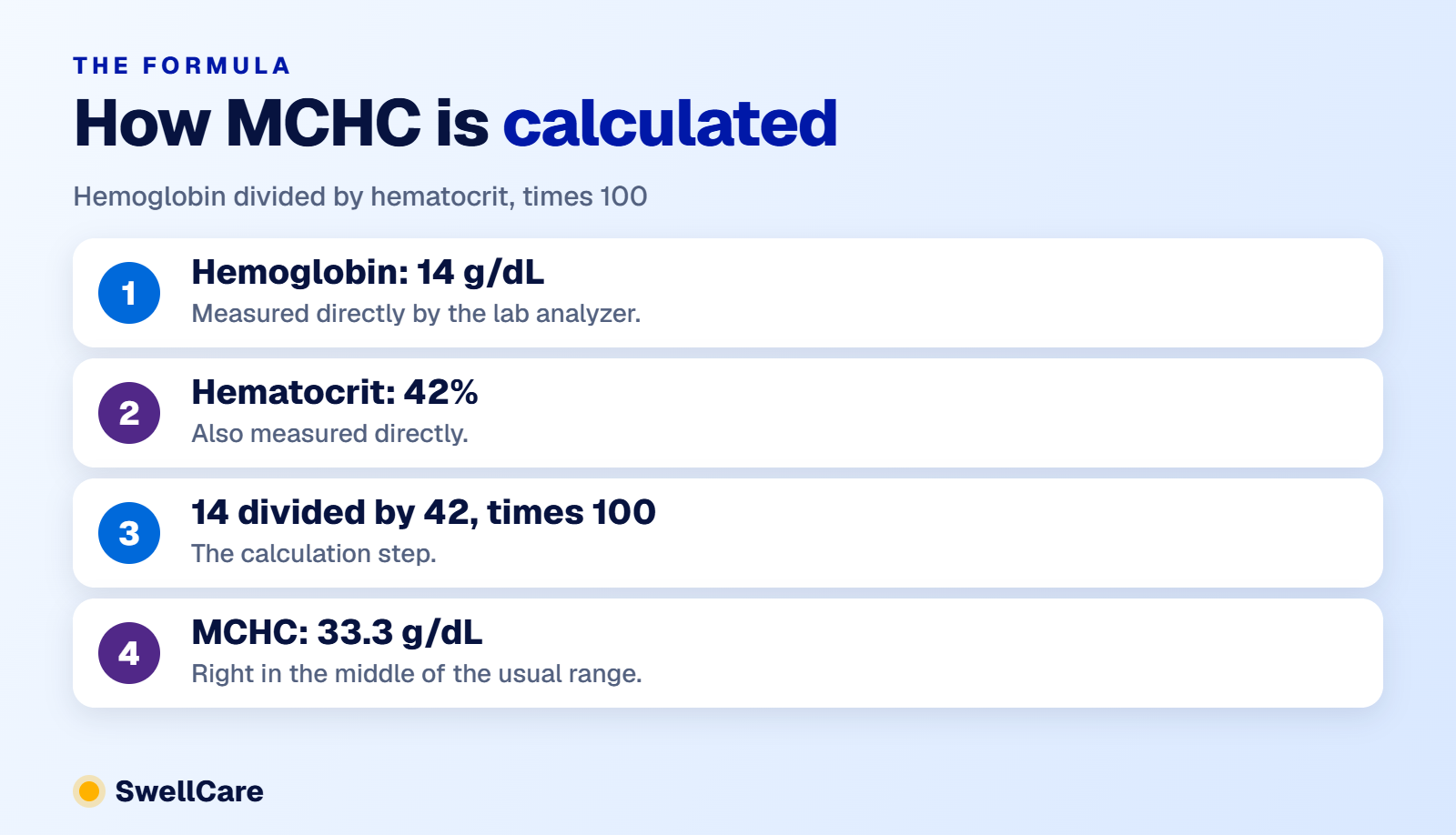
Say your hemoglobin is 14 g/dL and your hematocrit is 42%. Divide 14 by 42 and you get 0.333. Multiply by 100 and the result comes out at 33.3 g/dL. Right in the middle of the usual range. The StatPearls chapter on blood counts says hemoglobin is normally limited to a density of roughly 34% per cell.
For context, the Mayo Clinic lists typical adult hemoglobin as 13.2 to 16.6 g/dL for men and 11.6 to 15 g/dL for women. Typical hematocrit runs 38.3% to 48.6% for men and 35.5% to 44.9% for women.
Because MCHC is a ratio, it can look off even when hemoglobin alone looks fine. That’s why clinicians never read it in isolation.
Normal MCHC range on a blood test
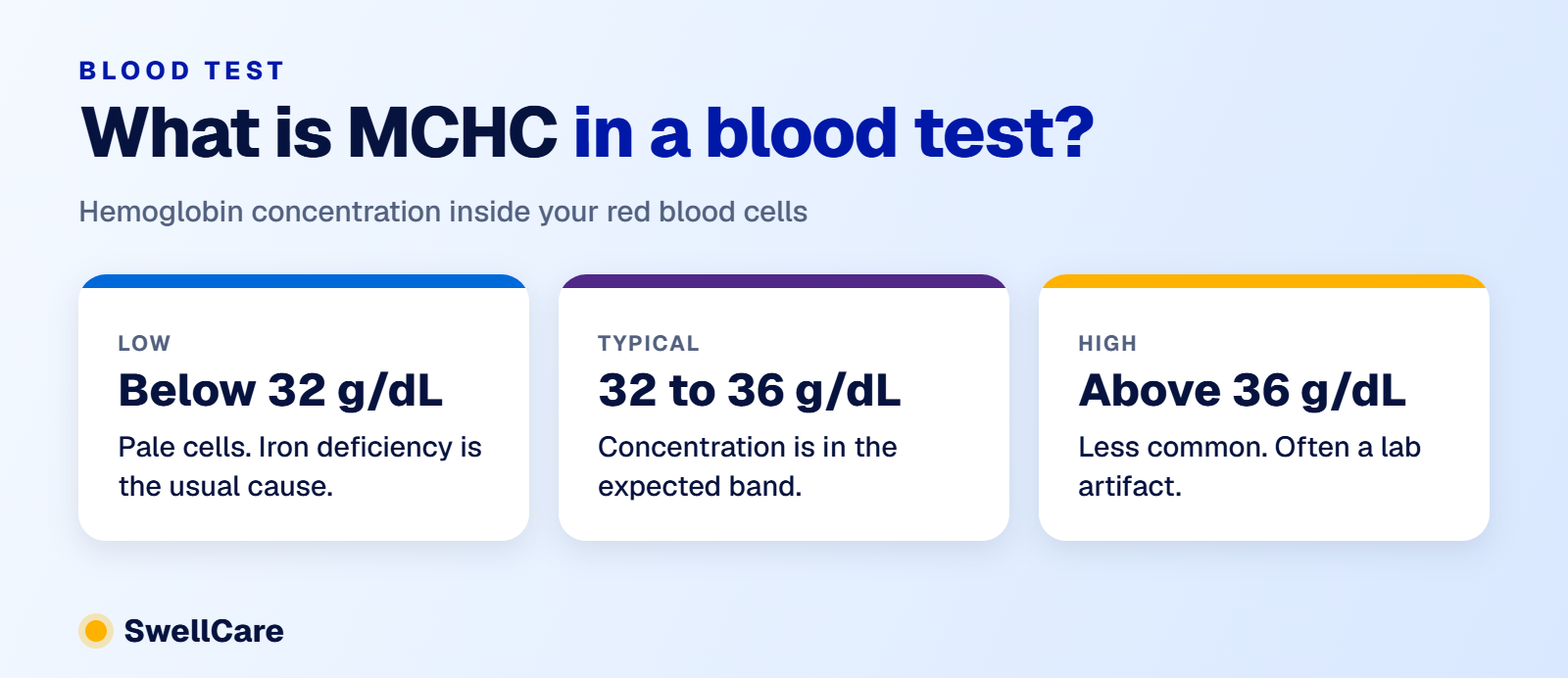
So what is MCHC in blood test numbers supposed to look like? A typical adult range is about 32 to 36 g/dL, which equals 320 to 360 g/L. Labs differ a little, and StatPearls stresses that reference intervals are lab-specific. So the reference range printed on your own report is the one that counts.
| Result | Typical adult MCHC | What it suggests |
|---|---|---|
| Low | Below 32 g/dL | Hemoglobin is thinly spread in red blood cells (hypochromia) |
| Typical | 32 to 36 g/dL | Concentration is in the expected band |
| High | Above 36 g/dL | Cells look unusually dense, or the sample was affected by a lab artifact |
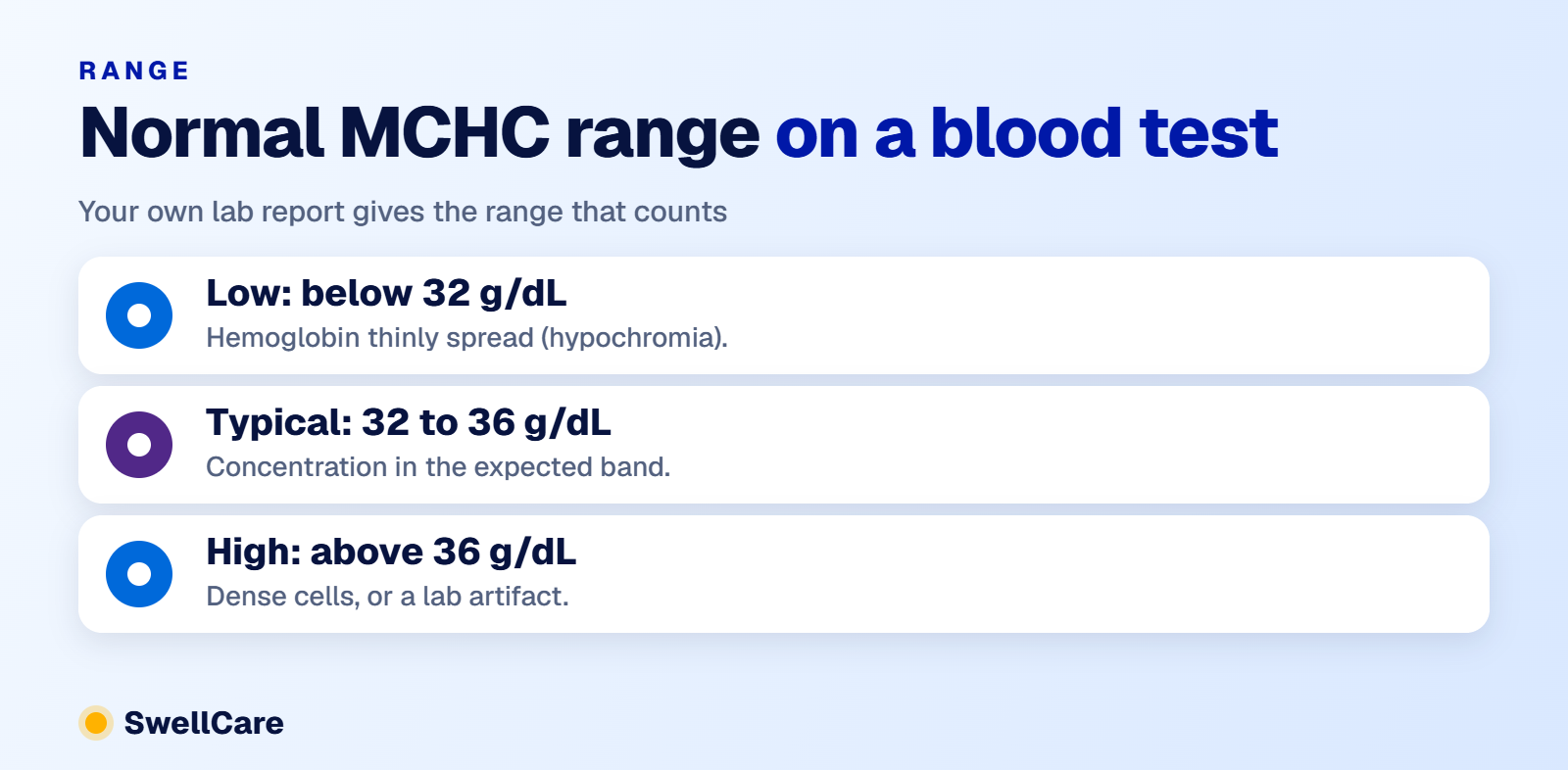
Sitting a hair outside the normal range, say 31.8 or 36.2, rarely means much alone. A reference range is a statistical band, and some healthy people fall just outside it.
Age and life stage matter for the bigger picture. Pregnancy raises your iron needs, which is one reason clinicians watch blood counts closely then. If you’re pregnant or caring for a child, ask your clinician how to read the result for your situation.
What a low MCHC means
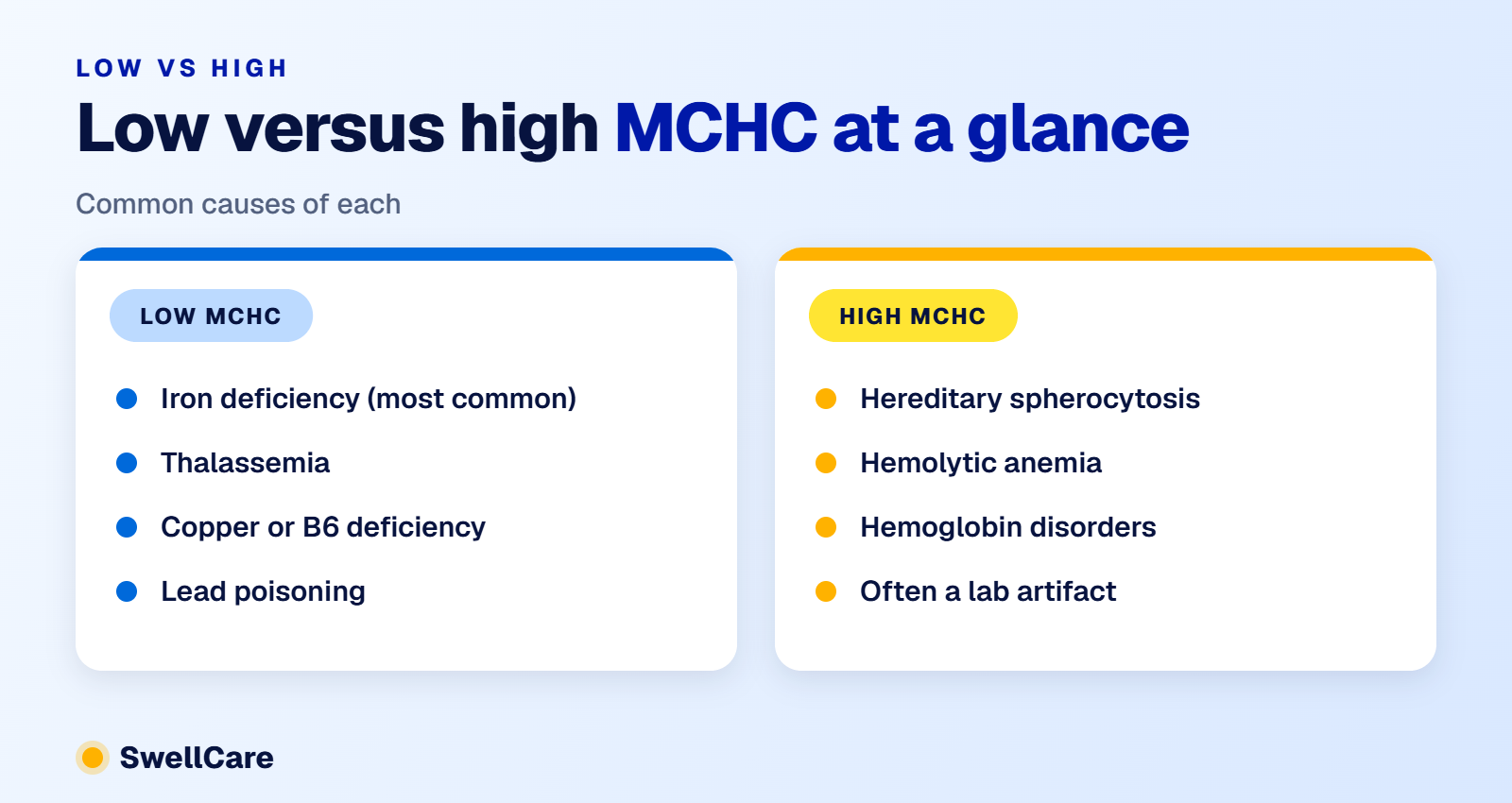
A low MCHC means each red cell carries less hemoglobin than expected for its volume. Under a microscope the red blood cells look pale. The medical word is hypochromia. That’s the more common flag of the two.
Iron deficiency is the usual suspect
Your body needs iron to build hemoglobin. Run short, and the red blood cells come out pale. According to StatPearls, iron deficiency is the most common cause of a low MCHC, and MedlinePlus lists iron deficiency anemia first for the same reason.
The National Heart, Lung, and Blood Institute (NHLBI) describes where the iron goes missing: blood loss from heavy periods or from bleeding in the digestive tract, regular aspirin or NSAID use, and poor absorption from conditions like Crohn’s disease, celiac disease or stomach surgery. In iron deficiency anemia, both blood iron and ferritin, your stored iron, come back low.
Mild cases often cause no symptoms. Bigger drops can bring fatigue, shortness of breath, dizziness, cold hands and feet, and pale skin.
Other causes of a low MCHC
Thalassemia, an inherited group of blood disorders, is the other cause MedlinePlus names. StatPearls adds a few less common ones: copper deficiency, vitamin B6 deficiency and lead poisoning. A surge of very young red blood cells (reticulocytes) can pull MCHC down too, since those cells carry less hemoglobin per volume than mature ones.
Blood loss deserves a special mention. Slow, steady loss, such as heavy periods or a bleeding ulcer you can’t see, drains iron long before you feel dramatic symptoms. That’s why a low MCHC with low ferritin makes clinicians ask about periods, stool color and NSAID use.
A low result doesn’t tell you which of these causes is behind it. Follow-up testing does.
What a high MCHC means
A high MCHC is the rarer finding. Red blood cells can only hold so much hemoglobin, so a truly high value is less common than a low one. And per StatPearls, lab artifacts are more common than real causes. So a high MCHC deserves a calm, careful second look rather than alarm.
Real causes of a high MCHC
MedlinePlus ties a high MCHC to hemolytic anemia, where red blood cells are destroyed faster than your body can replace them, and to hereditary spherocytosis, a rare genetic disorder that causes anemia and gallstones. Hereditary spherocytosis runs in families, so tell your clinician if relatives have had anemia or gallstones. Spherocytosis changes the shape of red blood cells, making them rounder and denser, which is why the value climbs. Hemolysis can also be autoimmune, which doctors call autoimmune hemolytic anemia.
Hemoglobin disorders can raise it too, per StatPearls, through a different route: the hemoglobin itself is abnormal. Symptoms overlap with other types of anemia: tiredness, weakness, headache, dizziness and pale skin.
When a high MCHC is a lab artifact
Sometimes the number is wrong, not your blood. Fatty (lipemic) samples, red blood cells that clump together in the tube, a very high white blood cell count, and red blood cells that burst during the draw can all push the calculated value up.
Dehydration gets blamed a lot. It concentrates hemoglobin and hematocrit together, so the ratio often holds steady. Don’t assume dehydration is the answer until other causes are ruled out.
When the value is unexpectedly high, StatPearls recommends a look at a blood smear to check cell shape and rule out artifacts. A repeat draw is often the first move.
MCHC vs MCH, MCV and RDW
People mix these up constantly, and no wonder. They sit in a row on the report and the names are nearly twins. Each one answers a different question.
| Index | What it measures | Typical adult range |
|---|---|---|
| MCV | Average size of one red blood cell | About 80 to 100 fL |
| MCH | Average hemoglobin weight in one red blood cell | About 27 to 33 pg |
| MCHC | Hemoglobin concentration inside red blood cells | About 32 to 36 g/dL |
| RDW | How much cell size varies | About 11.5% to 15% |
The RDW range comes from StatPearls. The other ranges are typical values, and your lab may print slightly different numbers.
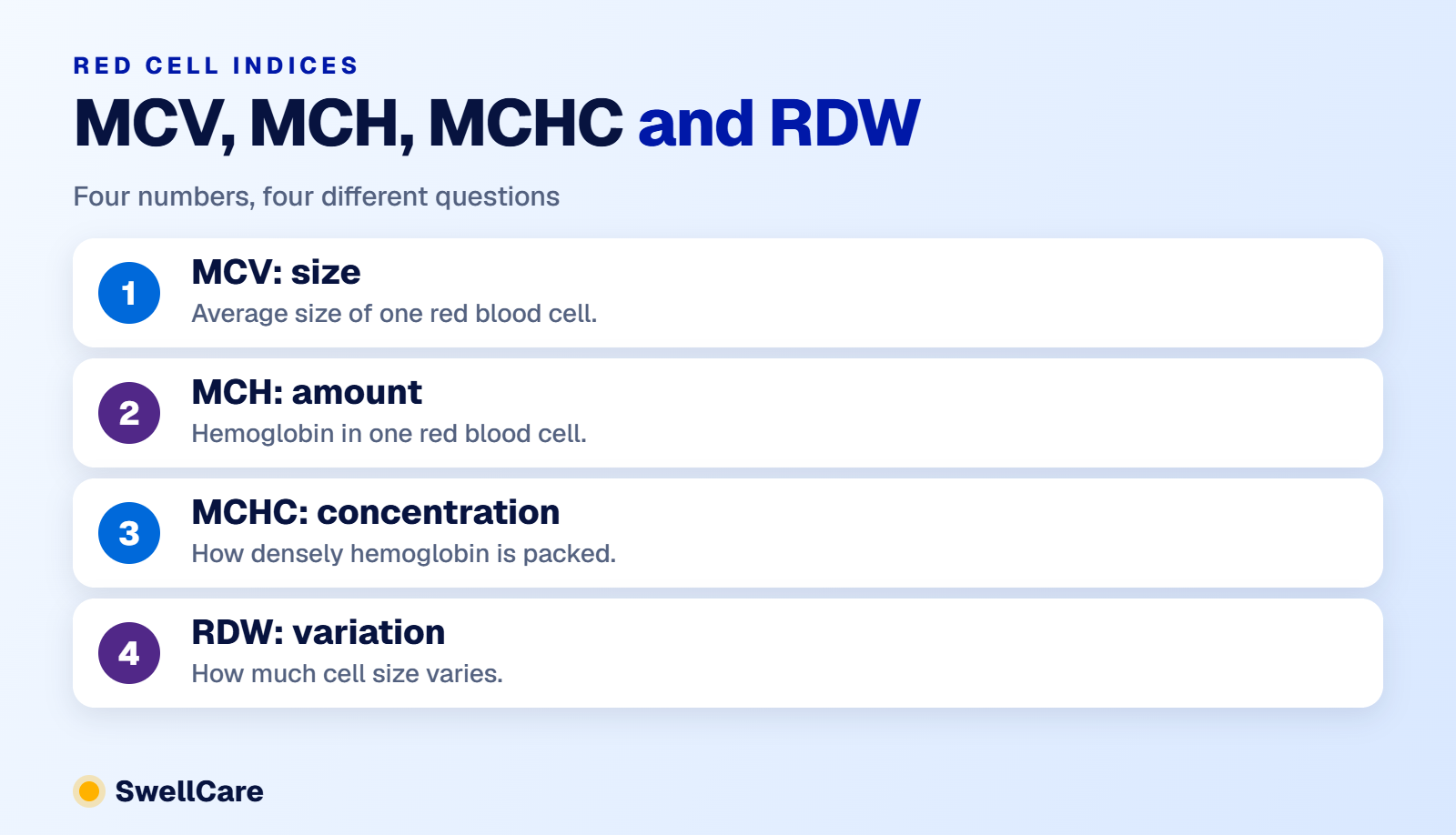
Short version of what is MCHC in blood test reports next to its neighbors: it’s concentration, while the other three cover size, amount and spread. MCH and MCHC look alike, but MCH is an amount per cell and MCHC is a concentration. A big cell can have a high MCH and a normal MCHC. MCV explains the gap, since larger cells hold more hemoglobin in total, so MCH tracks closely with MCV.
The pattern across the set tells the story. A low MCV with a low MCHC points toward iron deficiency or thalassemia. A high MCV points toward low folate or vitamin B12, chemotherapy or liver disease. A high RDW means your red blood cells vary a lot in size, and clinicians use RDW alongside the other indices to confirm a diagnosis. Low vitamin B12 or folate tends to show up in MCV more than in MCHC, so a normal MCHC doesn’t rule them out.
What to do about an abnormal MCHC
Start by not panicking, especially if you’re only a little outside the normal range. A result just outside the reference range isn’t necessarily a reason for concern, and a clinician can tell you whether yours is.
Then work the problem in this order:
- Look at the whole CBC. Check hemoglobin, hematocrit, MCV and RDW. An abnormal result with normal hemoglobin tells a very different story from one with anemia.
- Ask about follow-up tests. Depending on the pattern, a clinician may order iron studies and ferritin, vitamin B12 and folate levels, a reticulocyte count or a blood smear. If a high result repeats, tests for hereditary spherocytosis or tests for hemoglobin disorders such as thalassemia or sickle cell disease may come next.
- Repeat if it looks like an artifact. A single odd high value often settles on a second draw.
- Fix the cause, not the number. For iron deficiency, NHLBI says oral iron is the most common treatment, and restoring iron levels often takes three to six months.
Food helps, too. NHLBI lists beans, eggs, lean red meat, salmon, fortified cereals and dark leafy greens as iron-rich choices. Vitamin C foods such as oranges and tomatoes help you absorb iron, while black tea can get in the way.
One caution. Don’t start high-dose iron on your own because an MCHC came back low. Iron you don’t need isn’t harmless, and a supplement can delay finding a hidden source of blood loss. Test first, then treat.
When to see a doctor about your MCHC result
If you’re pregnant, mention a low result promptly, because pregnancy raises iron demand and anemia matters more then.
Book a visit if your result is out of range and you have symptoms of anemia. MedlinePlus lists trouble breathing, weakness or tiredness, headache, dizziness, an irregular heartbeat, pale skin, and cold hands and feet.
Chest pain or serious trouble breathing needs same-day emergency care, not a portal message.
If you feel fine, a mildly abnormal result is still worth mentioning at your next appointment so someone can read it next to your other values. Bring your previous results if you have them. Trends matter more than a single snapshot.
Want help making sense of a lab report? SwellCare’s online urgent care offers clinician-led, non-emergency care around the clock by video or chat, so you can talk through your results from home. A virtual visit can’t draw blood, so your clinician will point you to a lab when tests are needed, and prescriptions are never guaranteed. See how it works.
Questions people ask about MCHC
What is MCHC in blood test results, in one sentence?
MCHC, or mean corpuscular hemoglobin concentration, is the average concentration of hemoglobin inside your red blood cells, reported in grams per deciliter. It comes from a CBC and is calculated from hemoglobin and hematocrit. Typical adult results run about 32 to 36 g/dL. Low values often point to iron deficiency, while high values are rarer and sometimes a lab artifact.
What does a low MCHC mean?
It means your red blood cells hold less hemoglobin than expected for their volume. Iron deficiency is the most common reason, followed by thalassemia and other less common causes. A low result alone isn’t a diagnosis. Your clinician will compare it with hemoglobin, MCV and often a ferritin level.
Can dehydration affect MCHC levels?
Not much, in most cases. Dehydration concentrates hemoglobin and hematocrit together, and since the value is a ratio between them, it often stays close to normal. If your result is high, look at artifacts, hemolysis and red cell shape disorders before blaming a lack of water.
What is MCV in a blood test?
MCV stands for mean corpuscular volume, the average size of your red blood cells. A typical adult range is about 80 to 100 femtoliters, though labs differ. Small red blood cells suggest causes like low iron or thalassemia. Large red blood cells suggest low folate or vitamin B12, chemotherapy or liver disease.
What does a high RDW mean?
RDW, or red cell distribution width, shows how much your red blood cells vary in size. A high value means a mix of small and large red blood cells. On its own it doesn’t name a cause, so clinicians pair it with MCV and MCHC to narrow down the type of anemia.
Is a slightly abnormal MCHC dangerous?
Usually not. A result just outside the lab’s reference range of about 32 to 36 g/dL, with normal hemoglobin and no symptoms, is often a lab variation or a small shift worth rechecking. It becomes more meaningful when hemoglobin is low, other indices are off, or you feel unwell. A family history of conditions such as sickle cell disease or thalassemia is another reason to take it seriously.
Do I need to fast for an MCHC test?
No. It’s part of a CBC, and per the Mayo Clinic you can eat and drink as usual beforehand. The exception is when your clinician is ordering other tests at the same visit, such as certain cholesterol or glucose panels. If so, ask whether fasting applies.
Trusted references
Public-health, research, and medical-society resources related to this guide.