Your lab portal pings. You open it, scan down the list, and one line stops you: eGFR 72, flagged. Nobody has called. Is that bad?
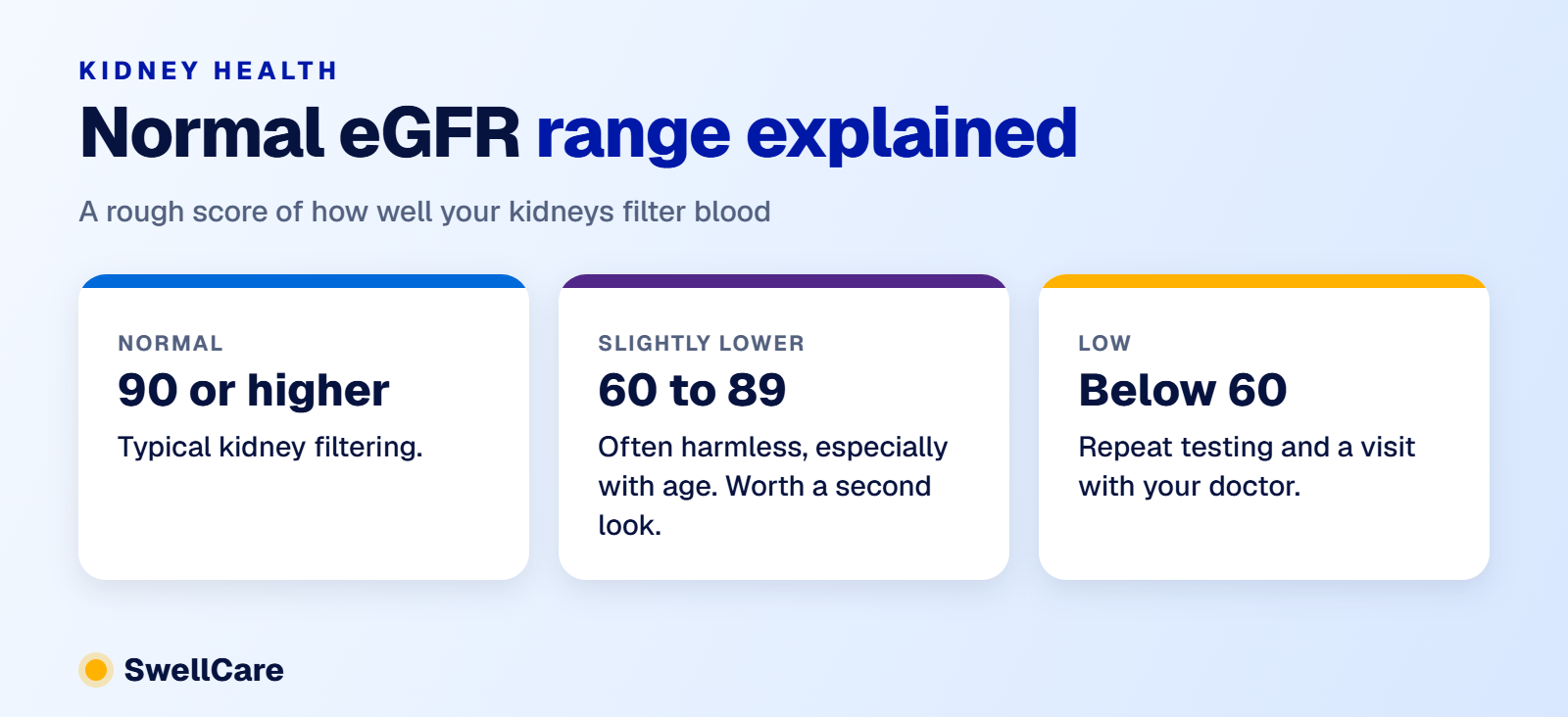
Here’s the short answer to what is the normal range for eGFR in blood tests. An eGFR of 90 or higher counts as normal. A 72 sits in the 60 to 89 band, which is common, often harmless in older adults, and worth a second look rather than a panic. The rest of this guide shows you how to read the number, what can nudge it, and what to do next.
What is the normal range for eGFR in blood tests?
Ninety or higher. That’s the figure the National Kidney Foundation uses for a normal eGFR, reported in milliliters per minute per 1.73 square meters of body surface. Think of it as a rough score of kidney function: how much blood your kidneys clean every minute.
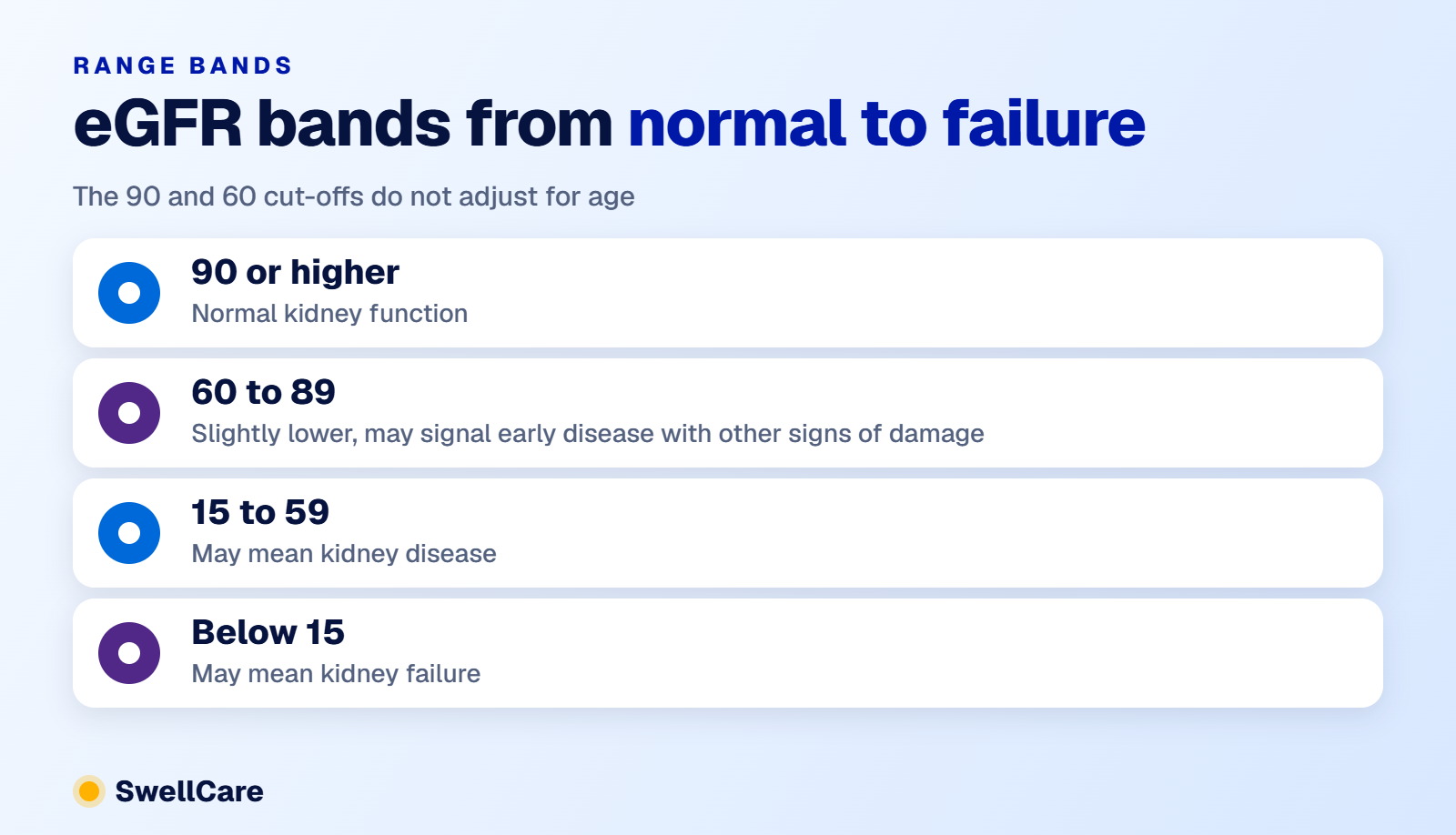
Most labs print results in these bands:
| eGFR result | What it usually suggests |
|---|---|
| 90 or higher | Normal kidney function |
| 60 to 89 | Slightly lower; may signal early kidney disease if other signs of damage show up |
| 15 to 59 | May mean kidney disease |
| Below 15 | May mean kidney failure |
Notice how often the word “may” appears. That’s deliberate. One number can’t diagnose anything. According to the American Kidney Fund, an eGFR that stays below 60 for three months or longer is what points toward chronic kidney disease. A single low reading after a stomach bug and two days of barely drinking? That’s usually just a bad week.
What your eGFR number is actually measuring
eGFR stands for estimated glomerular filtration rate. Glomeruli are the tiny filters inside each kidney, and the glomerular filtration rate is how fast they clear waste from your blood.
Labs can’t count that directly. So they measure creatinine, a waste product your muscles produce, and run it through a formula along with your age and sex. The result is an estimate.
Your report may list serum creatinine right beside the eGFR. A higher serum creatinine usually means the kidneys are clearing less, so the two numbers tend to move in opposite directions. Creatinine alone says little about kidney function until it’s converted into an eGFR that accounts for your age and sex.
A measured GFR (mGFR) does exist, using a tracer that the kidneys filter out of the blood, but MedlinePlus says it’s complicated and not widely available, so it’s usually reserved for special cases such as kidney donation.
Two details are worth knowing.
Since 2021, the standard CKD-EPI creatinine equation no longer includes race. The NKF and the American Society of Nephrology recommended that change in a September 2021 report, and it can shift a person’s number or even their stage. The second detail is cystatin C, another blood marker used to check creatinine. MedlinePlus notes that, unlike creatinine, it isn’t affected by muscle size, age or diet, which makes it a handy double-check on a creatinine-based result.
Normal eGFR by age
Kidneys slow down with age, even in healthy people. That’s why a 70-year-old with an eGFR of 75 and a 25-year-old with the same 75 aren’t in the same boat.
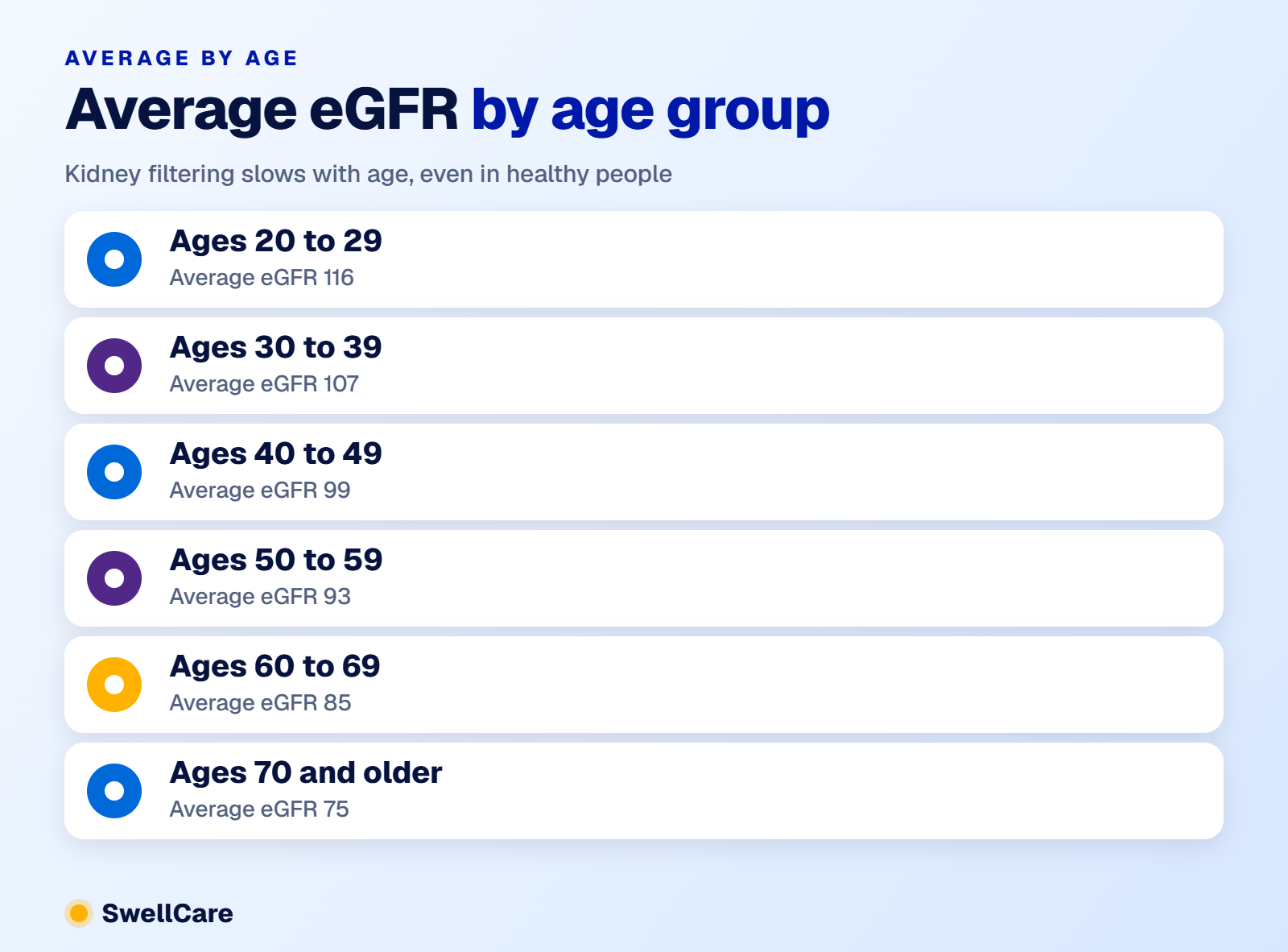
The NKF lists these average eGFR values by decade:
| Age | Average eGFR |
|---|---|
| 20 to 29 | 116 |
| 30 to 39 | 107 |
| 40 to 49 | 99 |
| 50 to 59 | 93 |
| 60 to 69 | 85 |
| 70 and older | 75 |
So an 85 at age 65 sits right on the average. The same 85 at age 28 deserves a closer look. Here’s the catch: the usual cut-offs of 90 and 60 don’t adjust for age. Some experts argue they should, since a fixed 60 can over-label healthy older adults and miss early trouble in young ones. Your clinician weighs the number against your age, your urine tests and your risk factors.
Stages of chronic kidney disease by eGFR
When an eGFR stays low and there’s other evidence of kidney damage, doctors place you in a stage from 1 to 5.
| Stage | eGFR | What it means |
|---|---|---|
| 1 | 90 or above | Normal filtering, with other signs of damage such as protein in the urine |
| 2 | 60 to 89 | Mild drop in filtering, with damage |
| 3a | 45 to 59 | Mild to moderate loss |
| 3b | 30 to 44 | Moderate to severe loss |
| 4 | 15 to 29 | Severe loss |
| 5 | Under 15 | Kidney failure |
Stages 1 and 2 trip people up. Your eGFR alone can’t put you there. Without kidney damage, a result of 60 to 89 isn’t kidney disease at all. Doctors run a urine albumin test to look for protein leaking out, or check for changes on imaging.
Ask which stage, if any, fits your results. A stage only applies when signs of kidney damage or a low eGFR have lasted three months or more. Early chronic kidney disease rarely causes symptoms, which is exactly why testing matters if you live with diabetes, high blood pressure or a family history of kidney failure.
Why one eGFR result can mislead you
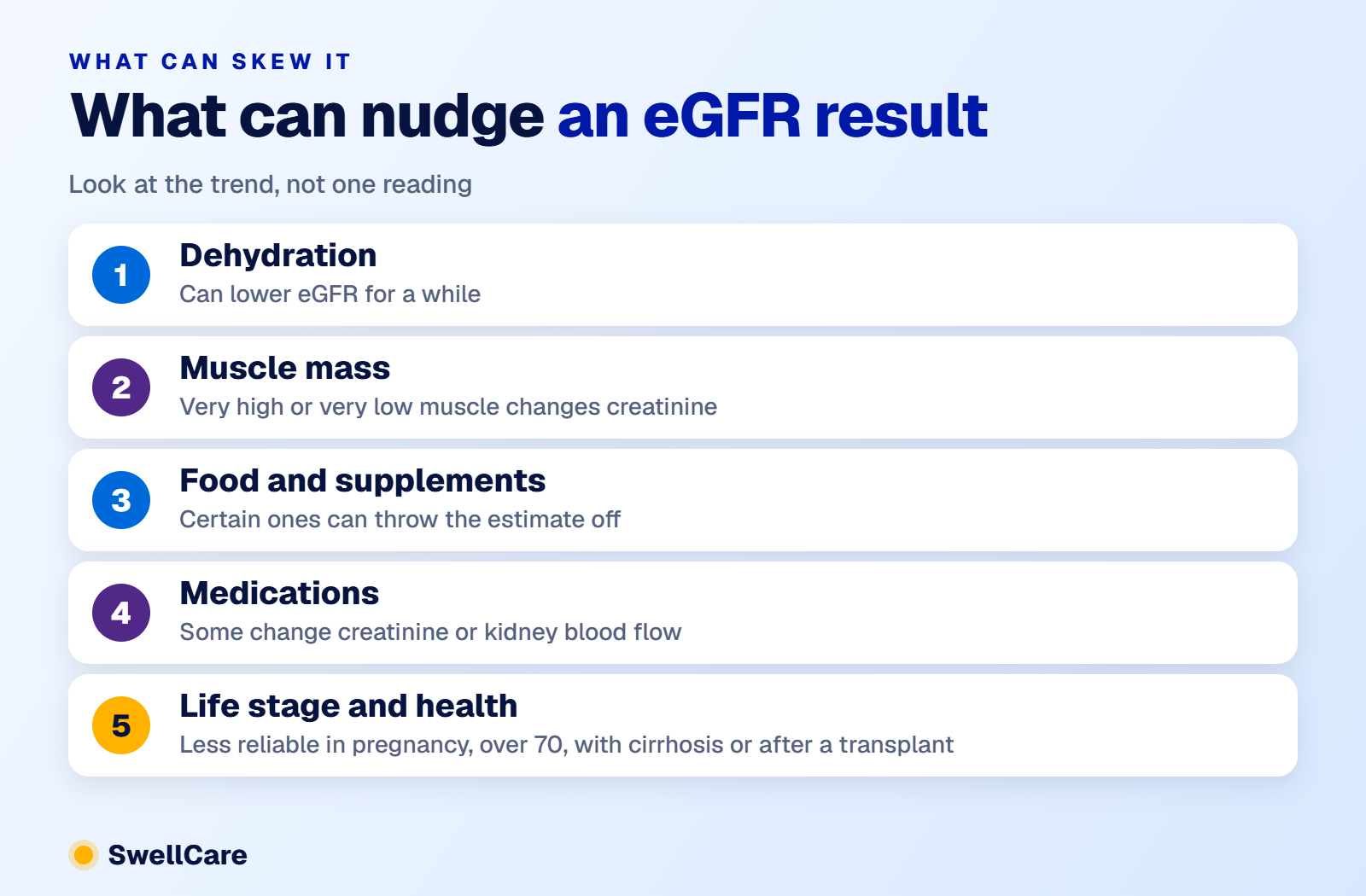
Creatinine is the weak link. Anything that changes how much of it your body makes, or how much water you’ve had, can move the estimate.
- Dehydration. Too little fluid can lower your eGFR for a while. It often bounces back once you rehydrate.
- Muscle mass. Very muscular people make extra creatinine and can look worse on paper than they are. Low muscle mass does the reverse.
- Food and supplements. The American Kidney Fund notes that certain foods and supplements can throw the estimate off.
- Medications. Some medicines change creatinine or kidney blood flow. Don’t stop one without asking your prescriber.
- Life stage and health. The NKF says the estimate can be less reliable in pregnancy, after age 70, and with cirrhosis, nephrotic syndrome or a past organ transplant.
What matters more than any single result is the trend in your kidney function. Two or three readings over several months tell a far truer story than one, and your kidney health isn’t summed up by a single draw.
What to do with your eGFR result
So, what is the normal range for eGFR in blood tests? It’s 90 or higher, but the real question is where your number is heading. Start by not changing anything drastic. Skipping medications or overhauling your diet over one flagged line helps no one. Try this instead:
- Ask about repeating the eGFR test. The NKF suggests asking your doctor whether to recheck in about three months to see whether it stays below 90.
- Ask for a urine albumin test. Albumin is a protein healthy kidneys keep out of urine, so finding it there can flag trouble even when your eGFR looks fine.
- Look at blood pressure and blood sugar. Diabetes and high blood pressure are two of the biggest risk factors for kidney damage.
- Ask about cystatin C. It’s useful if your muscle mass is unusual.
- Gather your paperwork. Bring a list of all your medications, vitamins and supplements, plus older lab results.
If a low result holds up, your doctor may talk with you about medicines that can protect the kidneys, such as ACE inhibitors, ARBs or SGLT2 inhibitors, along with nutrition advice and a referral to a kidney specialist. Talk of dialysis or a transplant comes later, at stages 4 and 5. Dialysis is only considered when the kidneys are close to failing.
Between tests, protect your kidney health the unglamorous way: stay active, keep blood pressure and blood sugar in check, and don’t smoke.
When to see a doctor
Book a visit if your eGFR comes back under 60, drops sharply between tests, or stays under 90 on a repeat. Don’t wait if you notice swelling around the ankles or eyes, foamy urine, changes in how often you need the bathroom, constant tiredness, itching, muscle cramps or nausea. These symptoms usually show up later, so treat them as a reason to call. If your result lands at stage 3 or below, ask for a referral to a nephrologist, a kidney specialist.
Chest pain, trouble breathing or confusion are emergencies. Call 911.
Get your eGFR explained with SwellCare
A number you don’t understand is just anxiety with decimals. If you’re still asking what is the normal range for eGFR in blood tests for your own body, a clinician can help. SwellCare’s online urgent care offers clinician-led, non-emergency care by video or chat, so a licensed clinician can explain your result in plain language and help you decide on next steps, so a flagged eGFR doesn’t sit unread in your portal. Prescriptions are never guaranteed, and SwellCare is not for emergencies. You can also browse the Health Journal for more guides like this one, including what MCH means on a blood test.
Questions people ask about eGFR
Is an eGFR of 89 considered normal?
Technically it falls one point below the 90 cut-off, in the 60 to 89 band. By itself, that usually isn’t a problem, especially as you get older. Without protein in your urine or other signs of kidney damage, an 89 isn’t kidney disease. Your doctor will likely just keep an eye on the trend.
Can eGFR improve?
Sometimes, yes. If dehydration, a medication or a short illness pulled your number down, it can rebound. Controlling blood pressure and blood sugar, staying active, avoiding smoking and following a kidney-friendly eating plan can help protect what you have. Permanent kidney scarring doesn’t reverse, but you can often slow the decline.
What is the definition of GFR?
GFR, or glomerular filtration rate, is the amount of blood your kidneys’ tiny filters clean each minute. A measured GFR uses a tracer. An eGFR is the estimate your lab calculates from a creatinine blood test, your age and your sex, and it’s the version most people see.
Do I need to fast before an eGFR test?
It depends, so follow your provider’s instructions. MedlinePlus says you may be asked to fast or avoid certain foods, such as meat, for several hours, depending on what else is being tested. Tell your clinician about all your medicines, and don’t stop any unless they tell you to.
Does a low eGFR always mean kidney disease?
No. A single low result can come from dehydration, an illness, medication or unusual muscle mass. Chronic kidney disease is usually diagnosed when eGFR stays below 60 for three months or more, or when other signs of damage show up, such as protein in the urine.
Trusted references
Public-health, research, and medical-society resources related to this guide.