You wake at 2 a.m., scratching. By morning there are red marks on your skin, and now you’re staring at the mattress, wondering what you’ve brought home.
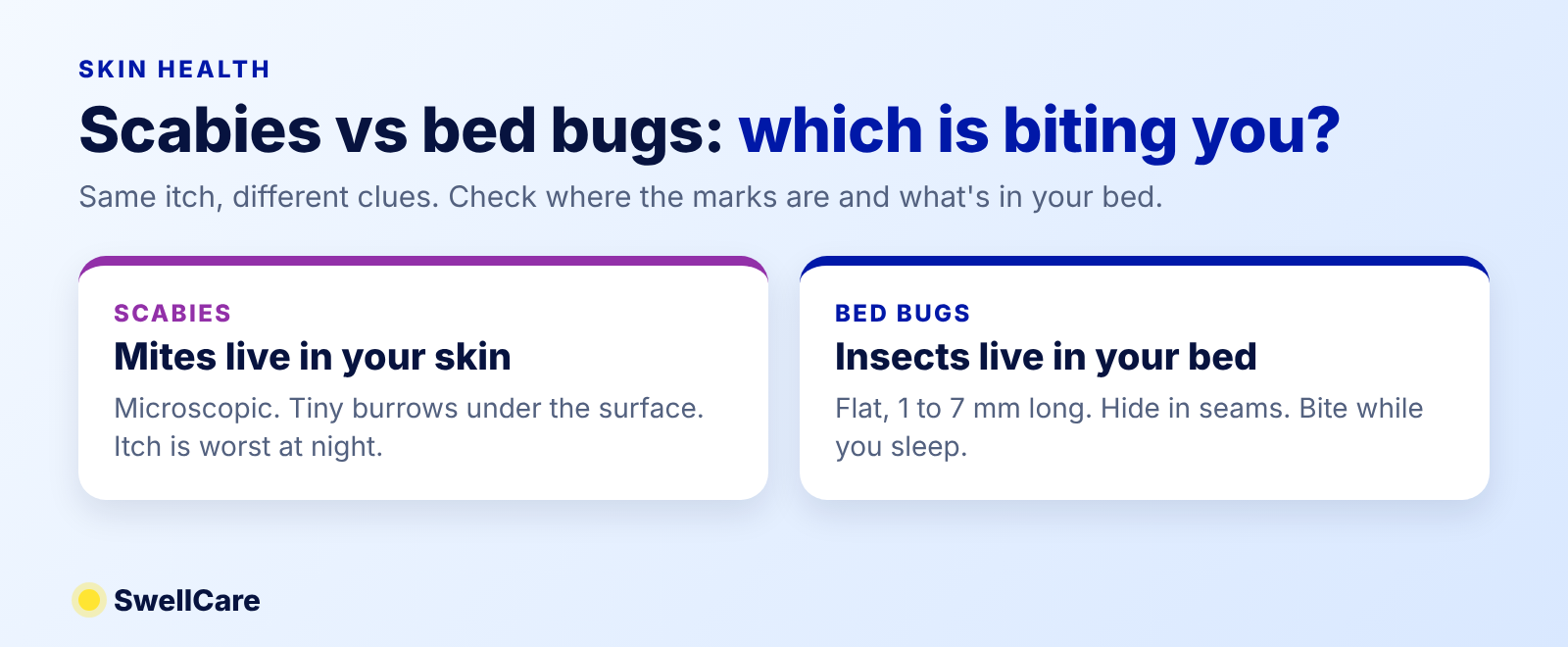
Here’s the short answer. Scabies is caused by mites that live inside your skin. Bed bugs are insects that live in your bedroom and feed on you at night. The itch can feel identical, but the clues don’t. Scabies vs bed bugs comes down to where the marks appear, how they’re arranged, and who else in the house is scratching.
Get it right and you pick the right fix. Get it wrong, and you can spend weeks treating the wrong infestation.
Scabies vs bed bugs at a glance
Start with this table. It sorts scabies from bed bugs by clues you can check tonight, and the sections below explain each row.
| Clue | Scabies | Bed bugs |
|---|---|---|
| What it is | Microscopic scabies mites that dig burrows in skin | Flat, reddish-brown insects, about 1 to 7 mm long |
| Can you see it? | No | Yes, bed bugs show up under a flashlight, in mattress seams and cracks |
| Typical marks | Pimple-like rash and tiny burrows | Red, itchy welts, sometimes in a line |
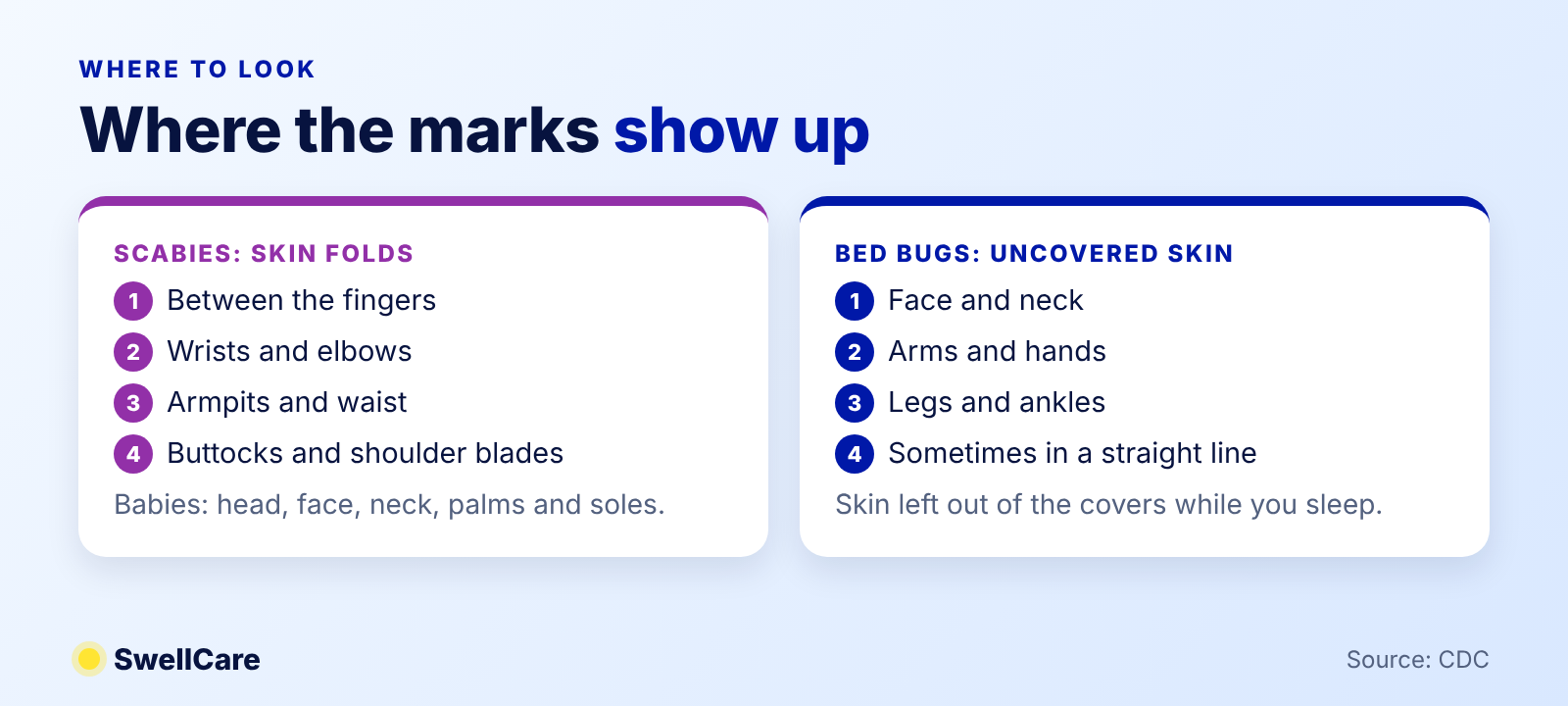
| Where on your body | Finger webs, wrists, elbows, armpits and waist, mostly in skin folds | Areas left uncovered while you sleep |
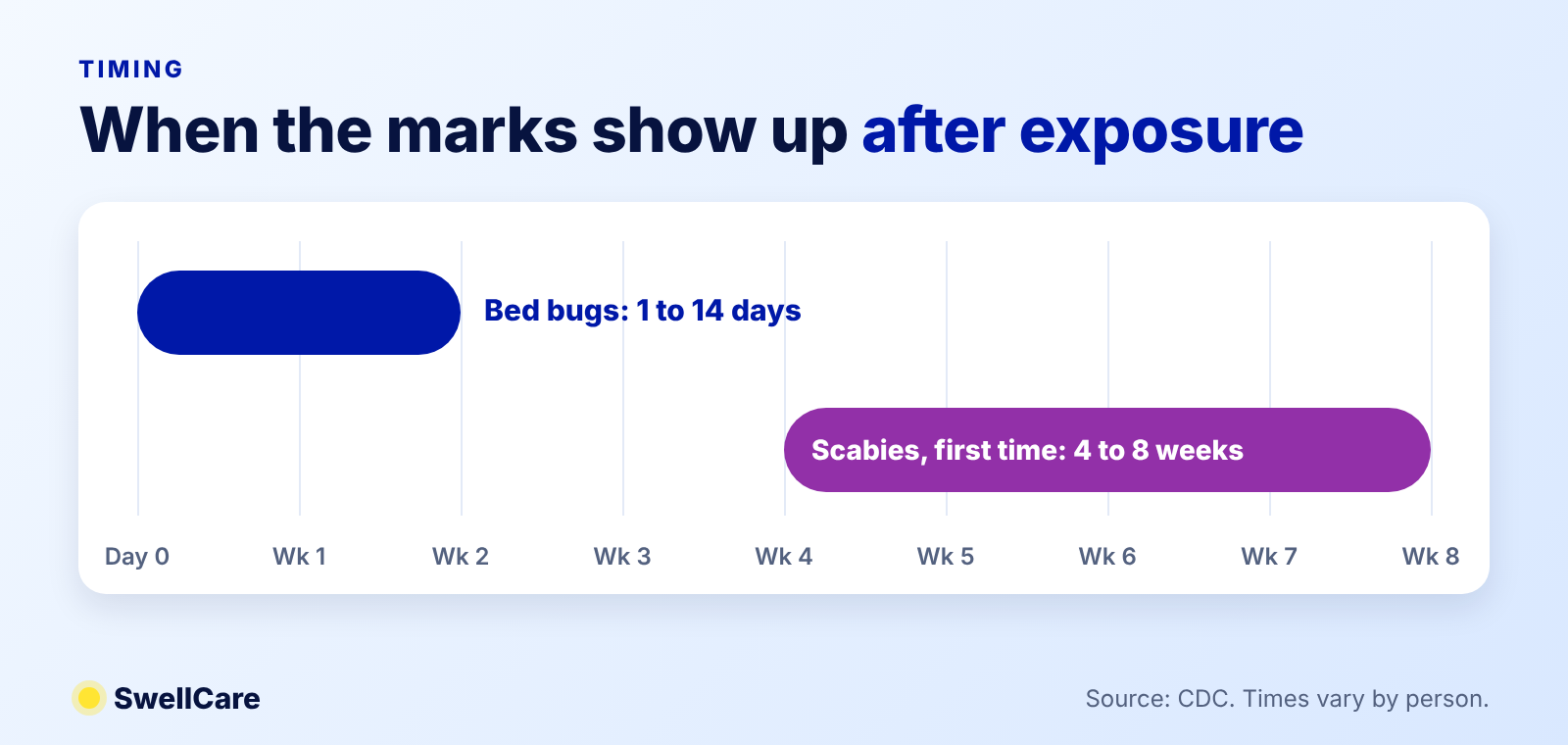
| When symptoms start | 4 to 8 weeks after first exposure | A day to several days, sometimes up to 14 |
| How it spreads | Close contacts, even without a shared bed | Anyone sleeping in the infested room |
What scabies looks and feels like
Scabies mites tunnel into the top layer of your skin and lay eggs there. Your immune system reacts to the mites and their waste, and that reaction is the itch you feel. The itch is intense, and it’s worse at night.
The rash looks like small pimples. Tiny burrows, made by the female mite just under the skin, may be visible, and they’re your best clue. Check the finger webs for burrows first. Scabies mites themselves are microscopic. The CDC lists the usual spots: between the fingers, in the folds of the wrist, elbow, knee and armpit, and around the waist, buttocks and shoulder blades (CDC on scabies). In babies and young kids, the rash often shows up on the head, face and neck, or on the palms and soles.
Timing is the trick. After a first exposure, scabies symptoms can take four to eight weeks to appear. You can pass mites to others before you feel a thing, so a scabies infestation can move through a family before anyone knows what it is.
How does it spread? Scabies spreads mostly through long, direct contact between bodies. Less often, mites spread via shared towels, clothing or bedding. Scabies is contagious, and outbreaks are common in crowded places like nursing homes and shelters.
What bed bug bites look like
Bed bugs are small, flat and wingless. They hide in the seams of mattresses and box springs, in bed frames and headboards, and in cracks near where you sleep. Bed bugs hide by day and bite by night, feeding on blood while you sleep. They can go months without a blood meal, and unlike scabies mites, they don’t dig burrows.
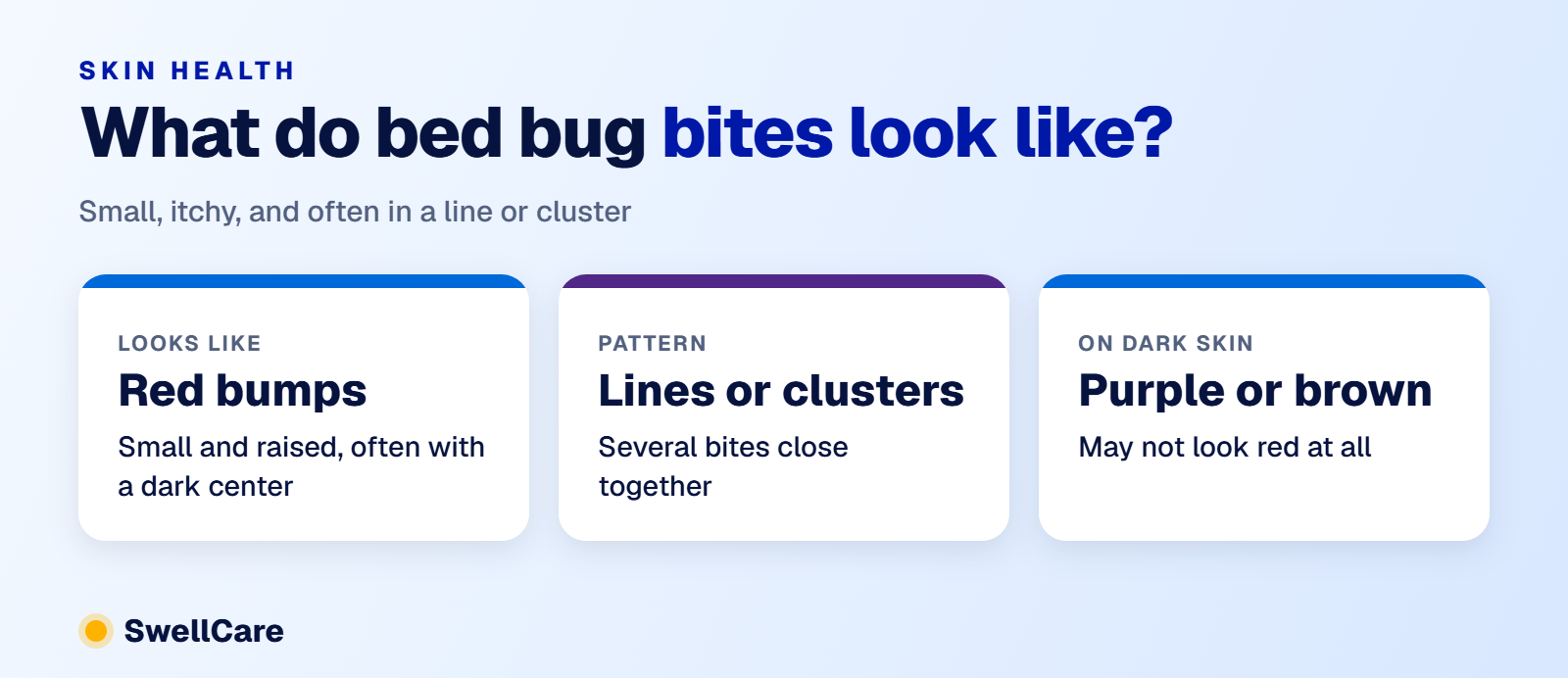
Bed bug bites can pass for mosquito or flea bites (see what bed bug bites look like). You may see a small, raised red patch that itches. Sometimes the bites sit in a straight line. Sometimes they’re scattered. Some people don’t react at all, which is why one partner can be covered in welts while the other sleeps fine. A small bed bug infestation can leave just a few scattered marks, so the symptoms are easy to dismiss.
The delay is longer than you’d think. Most people notice marks one to several days after being bitten, and for some it takes up to 14 days. That gap makes it hard to pin the bed bug bites on a particular night or hotel.
No disease has been tied to bed bugs. The real harm is poor rest and, rarely, an allergic reaction (CDC on bed bugs).
Clues in your bedroom, not on your skin
This is where scabies vs bed bugs stops being a guessing game. Scabies leaves nothing to find in the room, because the mites are microscopic. Bed bugs do.
Grab a flashlight and check the folds of your sheets and the bed frame. You’re hunting for rust-colored specks of dried blood, shed bug skins, and live bugs along seams and headboards. Some people notice a sweet, musty odor. Tiny eggs are harder to spot.
Don’t skip this check because your home is spotless. Even luxury hotels get bed bugs, so cleanliness doesn’t rule out an infestation. And bite marks and welts alone aren’t proof of one. Live bed bugs are. Without bugs or other signs, you can’t call it.
Can you have scabies and bed bugs at the same time?
Yes. They’re unrelated, so two separate infestations can overlap. If you treat scabies and keep itching, bed bugs may still be there.
How scabies and bed bugs are treated
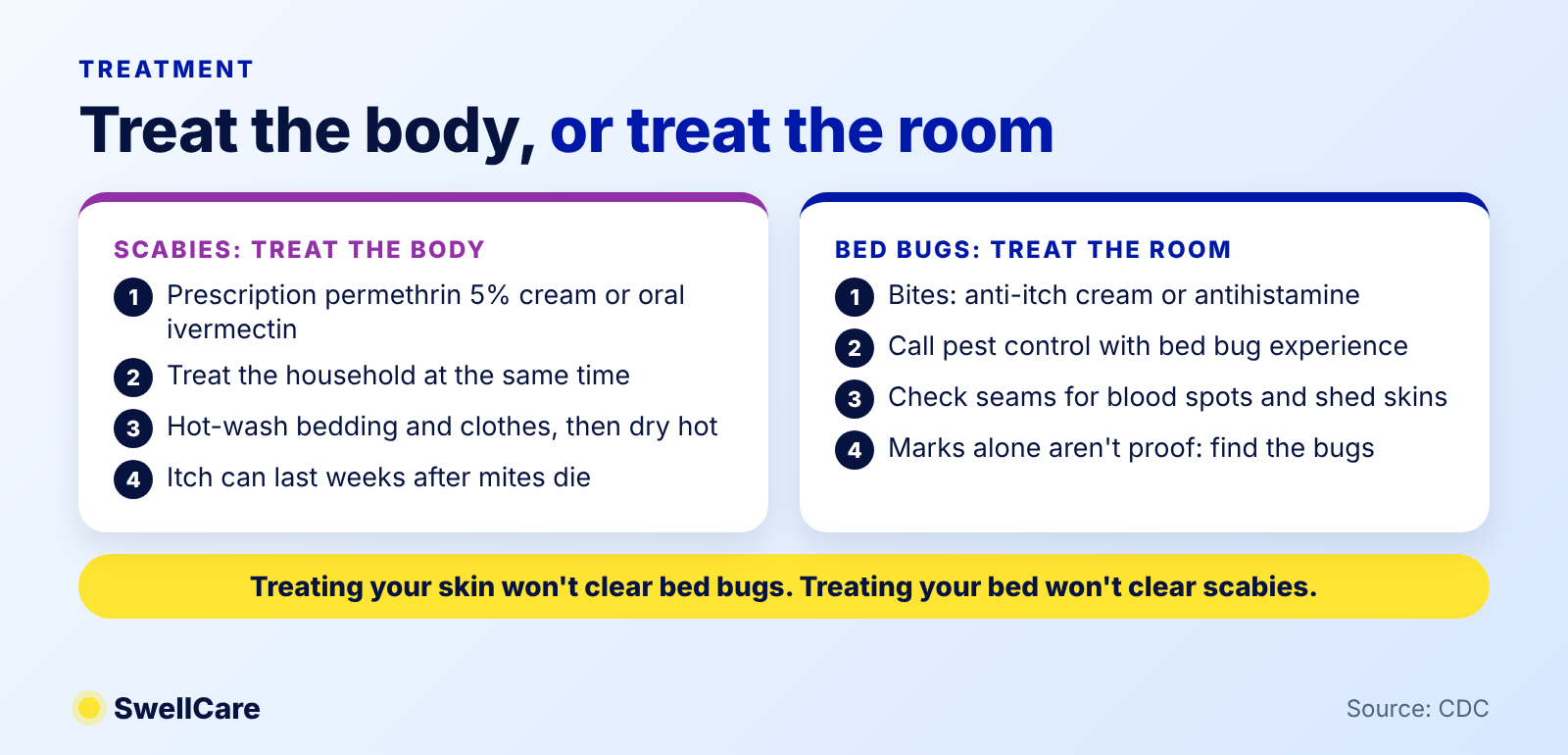
Scabies treatment and bed bug control don’t overlap. One happens on your body, the other happens in your room.
Scabies treatment
Scabies needs a prescription. No over-the-counter product has been tested and approved for human scabies, according to the CDC’s clinical care guidance.
The usual first choice is permethrin 5% cream, applied from the neck down and washed off after 8 to 14 hours. One round often works, but a second application about a week later may be needed. Oral ivermectin is the other main choice: two doses, 7 to 14 days apart. Both have similar results, though ivermectin isn’t FDA-approved for scabies. If permethrin isn’t an option, a clinician may suggest ivermectin.
Everyone in the household and any close contacts should get treatment at the same time, even if they don’t itch yet, because scabies spreads quietly. Otherwise, the mites pass back and forth.
Then comes the laundry. Towels, clothing and bedding that touched your skin in the three days before treatment go in the wash: water hotter than 122°F for at least 10 minutes, then a hot dryer. Things that can’t be washed go in a sealed plastic bag for at least 72 hours to a week. Scabies mites rarely survive more than two to three days away from skin, so you don’t need to throw out your mattress or fog the house.
One warning: the itching can last for several weeks after the mites and eggs are dead. That’s normal. If you’re still itching two to four weeks later, or new burrows appear, you may need another round.
Bed bug treatment
For the bites, you usually don’t need medical treatment. Antiseptic cream can ease the itching, and an antihistamine may help. Bed bugs won’t leave on their own. Try not to scratch, because scratched bites invite infection. A mild hydrocortisone cream is another common choice, and an oral antihistamine can take the edge off nighttime scratching.
The infestation is a different job. The CDC advises calling a professional pest control company with bed bug experience, and these companies typically use an insecticide. Treating the bites won’t touch the bugs, and spraying insecticide on your mattress won’t touch scabies.
When to get checked by a clinician
If scabies is on the table, see a doctor. You need a prescription anyway, and a clinician can tell it apart from eczema or hives (here’s how to know if a rash is serious). Diagnosis often means a skin scraping, which is examined under a microscope for a mite, eggs or waste. The sooner you have a diagnosis, the sooner treatment can start, and the sooner prevention for your household can begin. A negative scraping doesn’t rule it out, since a healthy person may carry fewer than 10 to 15 mites.
Go sooner if you notice signs of infection, such as pus, spreading redness or fever. Scratching can lead to a secondary infection. Swelling of the face or trouble breathing after a bite is an emergency.
Take extra care if you’re older, have a weakened immune system, or can’t feel or scratch the itch. These groups are at risk for crusted scabies, a severe and highly contagious form that can lack the classic rash and itch.
Not sure which one you have? A licensed clinician at Swell can review your symptoms online and tell you what to do next, including whether you need an in-person exam. Tell them where the marks are, whether you’ve seen bed bugs, when the itching started and who else at home is affected.
Questions people ask about scabies vs bed bugs
Do scabies mites jump or fly from person to person?
No. Scabies mites can’t jump or fly. They crawl, and scabies spreads mainly through prolonged contact between bodies. Sharing towels, clothing or bedding can pass the mites on less often. Off the body, they last two to three days at most.
Why do bed bug bites appear in a straight line?
Bed bugs often bite more than once as they feed along exposed skin, so marks can line up. A line isn’t proof, though. Look for blood spots, shed skins or live bugs near your bed to confirm.
Is itching from scabies worse at night?
Yes, usually. Intense itching that peaks at night is a classic sign of scabies. Bed bug bites also itch, but they tend to show up as red welts on exposed areas, while scabies clusters in skin folds and between the fingers. If the itching keeps you up, ask a doctor about scabies.
Can bed bugs transmit diseases?
Health agencies haven’t linked bed bugs to the spread of illness. Their bites can cause itching and lost sleep, and rarely, allergic reactions. An antihistamine can ease mild itching, but see a healthcare provider if you suspect an allergic reaction.
Trusted references
Public-health, research, and medical-society resources related to this guide.