You open your lab results and one line is flagged: WBC, low. Your stomach drops a little. Here’s the short answer. Most low white blood cell count causes are temporary or fixable, like a recent virus, a new medicine or a vitamin shortfall. A smaller group points to the bone marrow and needs a specialist. What tells you how worried to be isn’t the headline number. It’s the neutrophil count, whether you have a fever, and what else is going on in your body.

What a low white blood cell count actually means
White blood cells are your immune system’s front line. They’re made in the bone marrow, travel in the blood and go after bacteria and viruses, plus anything else that shouldn’t be there.
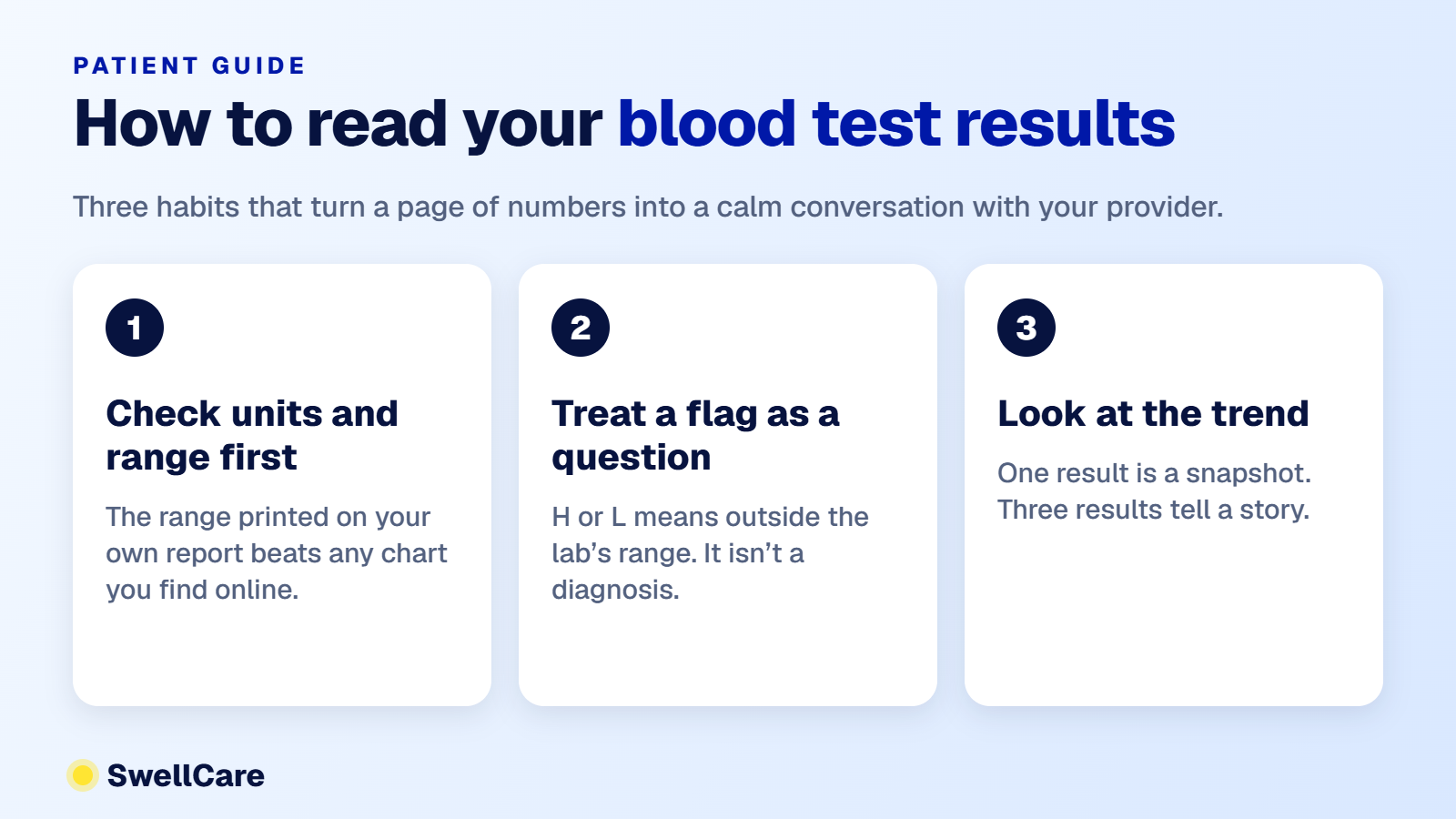
A complete blood count (CBC) counts them. Typical adult results fall somewhere around 4,500 to 11,000 per microliter of blood, according to Harvard Health. Labs draw the line a little differently, and many flag anything under roughly 4,000 to 4,500. Your report prints its own reference range, so check that first.
Doctors call a low result leukopenia. Within it, the cell type matters most. Neutrophils are the biggest group of white blood cells, and a shortage is called neutropenia. Lymphocytes come second. Your clinician will usually look at the absolute neutrophil count, or ANC, because it predicts infection risk better than the total.
One low reading isn’t a diagnosis. Counts bounce around with illness, medicines and even the time of day.
Low white blood cell count causes, from common to rare
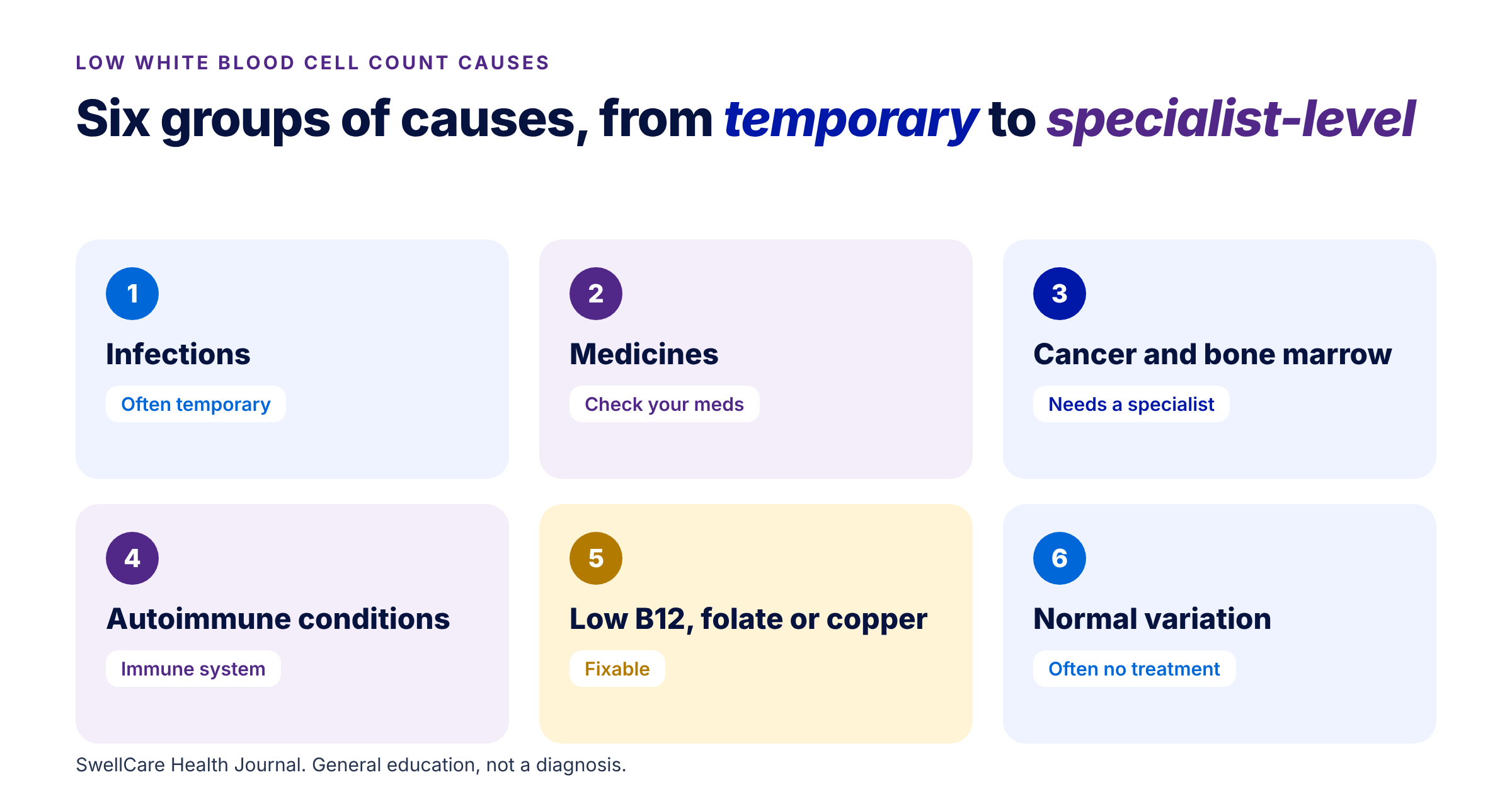
Think of the causes in six groups. The first few are the ones we see most. The later ones are less likely, but they’re the reason a persistent low count deserves a proper look.
Viral infections and other illnesses
Viruses are a classic trigger. Mononucleosis and even a common cold can pull the count down for a few weeks while the body fights back. Harvard Health lists viral infections among the usual suspects, and viral leukopenia is often gone on a repeat test.
Some infections hit harder. HIV, hepatitis, tuberculosis and severe bacterial infection such as sepsis can lower the count or use cells up faster than the marrow can replace them, per Cleveland Clinic.
Medicines that lower your count
This one surprises people. A long list of prescriptions can suppress the count, including the antipsychotic clozapine, antithyroid drugs, the antibiotic trimethoprim-sulfamethoxazole, carbamazepine, methotrexate and some anti-inflammatory painkillers, according to StatPearls. Cancer drugs are the best-known example.
If a new medication lines up with your low result, tell your healthcare professional. Don’t stop it on your own. A review of everything you take is usually the first step.
Cancer, cancer treatment and bone marrow problems
Chemotherapy damages fast-dividing cells, including the ones that make blood. Radiation therapy aimed at large areas of bone can do the same. About half of people on chemotherapy develop neutropenia, and counts usually bottom out within the first two weeks after a dose, Cleveland Clinic reports.
Leukemia and lymphoma, along with other marrow disorders, can crowd out healthy cell production. Aplastic anemia, where the marrow stops making enough blood cells, shows up on Mayo Clinic’s list of causes too. These are the rarer explanations. They’re also why a count that stays low gets a closer look.
Autoimmune conditions
Lupus and rheumatoid arthritis can push counts down, and so can Crohn’s disease, because the immune system mistakenly attacks its own cells. An enlarged spleen, sometimes linked to liver disease, can also trap white cells before they do their job.
Low vitamin B12, folate or copper
Bone marrow needs raw materials. When vitamin B12, folate or copper runs short, production slows. The good news is that this is among the easiest causes to fix once a blood test finds it.
A normal variation for some people
Some healthy people simply run lower. Benign ethnic neutropenia, also called the Duffy-null pattern, is most often seen in people of African, Caribbean or Middle Eastern descent. The American Academy of Family Physicians says these people don’t have a higher infection risk, and that extensive testing isn’t recommended if they feel well and the count is only mildly low.
Symptoms: usually none until an infection shows up
A low count rarely causes symptoms by itself. You find out on a blood test, or because you keep catching things.
Warning signs come from the infections the low count lets in. Watch for a fever, chills, a sore throat that won’t quit, mouth sores, a cough that’s getting worse, burning when you pee, or a skin infection that spreads. Tiredness is common but vague. The NHS also lists repeated infections that are slow to clear as a clue.
When to worry about a low white blood cell count
Severity follows the neutrophil count, not the total. These are the ranges the American Family Physician journal and Cleveland Clinic use for adults.
| Absolute neutrophil count (per microliter) | Level | What it usually means |
|---|---|---|
| 1,000 to 1,500 | Mild | Often harmless. Repeat the test and look for a cause. |
| 500 to 1,000 | Moderate | Infection risk rises. Needs a prompt workup. |
| Under 500 | Severe | High infection risk. Same-day medical attention. |
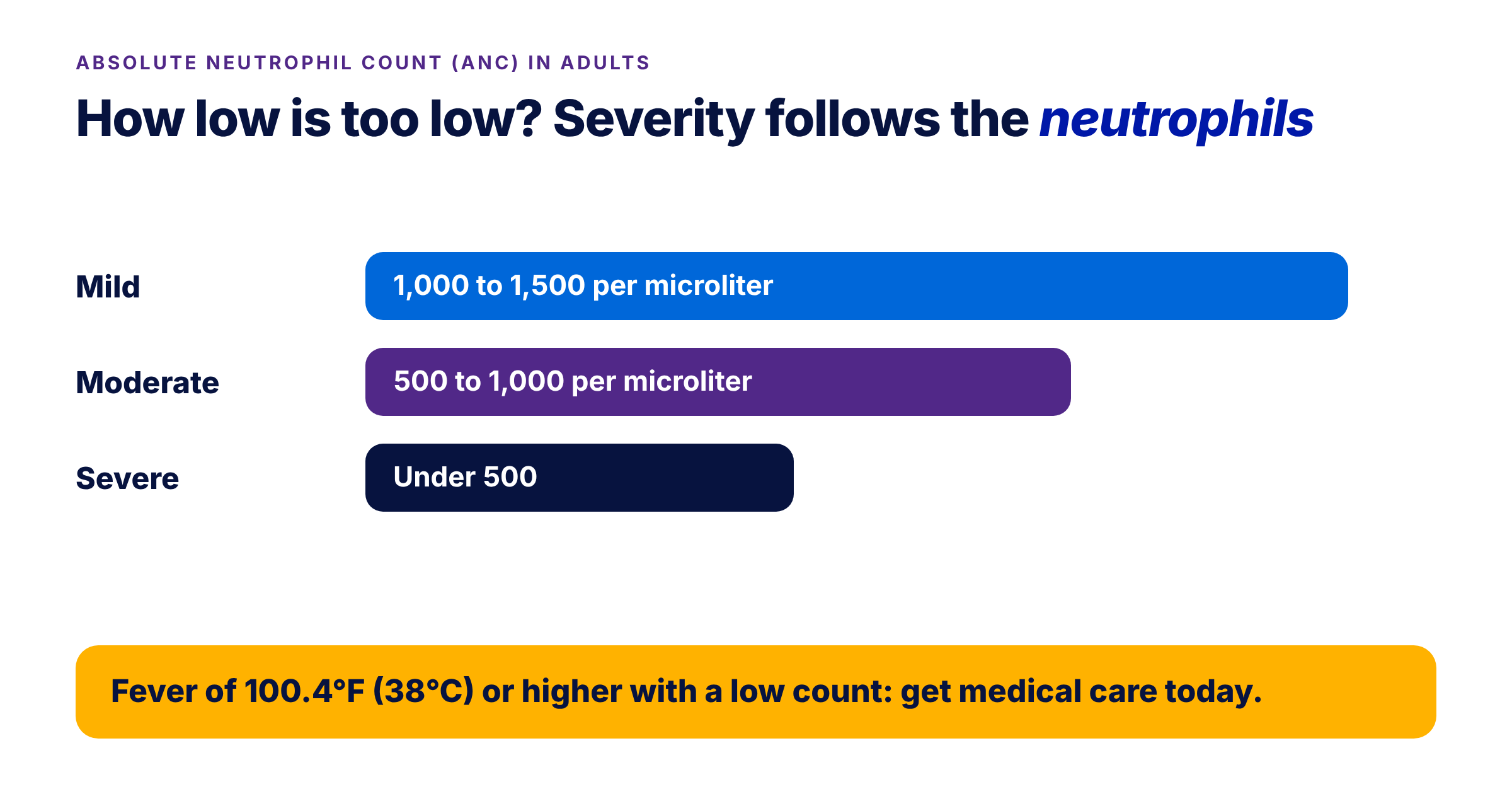
The number that matters most isn’t on the lab report. It’s 100.4°F (38°C). A temperature at or above that with a known low count is a medical emergency, particularly if you’re on chemotherapy. Febrile neutropenia is treated with IV antibiotics, usually in the hospital, and early care lowers the risk of sepsis.
Get same-day care if you have any of these with a low count: fever, shaking chills, trouble breathing, a stiff neck, confusion, vomiting or diarrhea you can’t stop, or new belly or rectal pain. Cleveland Clinic lists these as reasons to contact your care team immediately. Call 911 or go to the nearest emergency room if you feel seriously unwell.
If you feel fine and the count is only mildly low, you probably have time. Book a follow-up and repeat the test within a few weeks.
How doctors find the cause
It starts with questions. What medicines are you on? Were you sick recently? Do you have a history of autoimmune disease, cancer treatment or a family tendency toward low counts?
Then comes a repeat blood test. A CBC with a differential splits the white cells into types. A blood smear lets someone look at the cells under a microscope. Many clinicians also check vitamin levels, and may test for HIV or hepatitis if there’s a reason to.
If the cause still isn’t clear and the count keeps falling, a hematologist may do a bone marrow biopsy. Most people never get that far.
What treatment looks like
Treatment follows the cause. Often the answer is to stop or change a medication. A viral dip usually needs time. Vitamin deficiencies are replaced. Steroids may calm an autoimmune attack on neutrophils.
For people in cancer treatment, a drug called granulocyte colony-stimulating factor (G-CSF) can push the marrow to make more neutrophils. Antibiotics treat infections that slip through. And some forms, like benign ethnic neutropenia, need no treatment at all.
There’s no food or supplement that reliably raises your count unless you’re actually deficient. Be wary of any product that promises otherwise.
Protecting yourself while you wait for answers
If your count is low, a few habits cut your risk of picking up something. Wash your hands often. Stay current on flu and COVID-19 shots. Keep away from people who are sick, and care for cuts quickly. Cook meat and eggs thoroughly, and skip hot tubs and open water. Use an electric razor, which lowers the chance of nicks.

Get your result looked at by a clinician
A flagged lab result is easier to face with a healthcare professional who can read the whole picture. At Swell, clinicians review labs and follow-up and can help you decide what to repeat, what to ask and how urgent your result really is. If you’re feeling sick right now, see urgent care options or learn how it works. Swell isn’t emergency care, so with a fever and a known low count, head to the ER.
Questions people ask about a low white blood cell count
What is a dangerously low white blood cell count?
Doctors worry most when the neutrophil count falls under 500 per microliter, or under 1,000 and dropping. Any fever of 100.4°F (38°C) or higher with a low count is urgent, whatever the exact number.
Can stress or anxiety cause a low white blood cell count?
Everyday stress isn’t a recognized cause of a truly low count. A fresh dip in your results is more likely tied to a virus, a medicine or a nutrient shortage, so don’t let a stressful week be the whole explanation.
Can a low white blood cell count go back to normal?
Yes, often. Counts that drop after a viral illness or a medication frequently recover once the trigger passes or the drug is changed. Causes like marrow disease or an inherited pattern take longer, but many are well managed.
How can I raise my white blood cell count?
Treat the cause. That might mean stopping a drug, correcting a vitamin shortage, or using G-CSF during cancer treatment. Healthy sleep and a balanced diet support your body, but no home remedy replaces a clinician’s plan.
Is a low white blood cell count always a sign of cancer?
No. Cancer is one of the rarer causes. Viral infections, medicines and nutrient gaps, plus normal variation, account for most mild results. A persistent or severe low count still deserves a full evaluation, so don’t skip the follow-up.
Trusted references
Public-health, research, and medical-society resources related to this guide.