Your lab portal just pinged. There’s a number next to “TSH,” maybe flagged high, maybe low, and nobody has told you what it means for your thyroid.
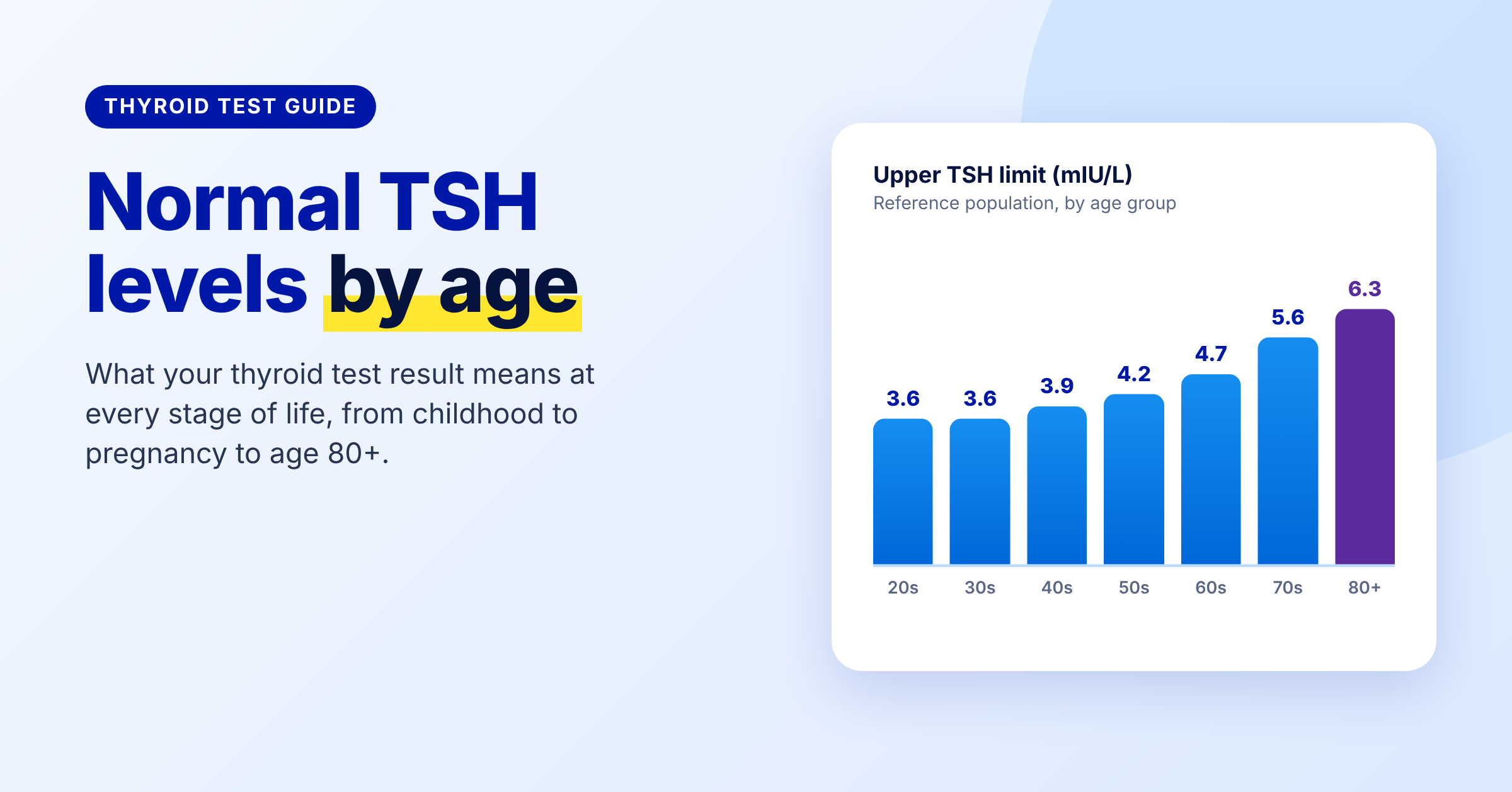
Here’s the short answer. Most labs call 0.4 to 4.0 mIU/L normal for adults, but normal TSH levels by age aren’t one flat line. The upper limit creeps up as you get older, from about 3.6 mIU/L in your 20s to roughly 6.3 after 80, based on large US survey data. Pregnancy and childhood have their own rules too.
That’s why a TSH of 5.2 can mean “let’s look closer” for a 30-year-old and may sit inside the expected range for a 75-year-old. Below you’ll find the chart, what high and low TSH levels say about your thyroid, and what to do next.
What is a normal TSH level?
Thyroid-stimulating hormone (TSH) is made by your pituitary gland, a small gland at the base of your brain. Think of it as a thermostat signal. When thyroid hormone in your blood runs low, the pituitary gland sends out more TSH to tell your thyroid gland to work harder. When thyroid hormone runs high, it sends out less. MedlinePlus describes the same push and pull.
Your thyroid gland makes thyroid hormone in two main forms, T4 and T3. Together they set how fast your cells burn fuel, which touches heart rate, body temperature, digestion and mood. TSH keeps that supply of thyroid hormone steady, so it’s usually the first number a clinician checks when they look at thyroid function.
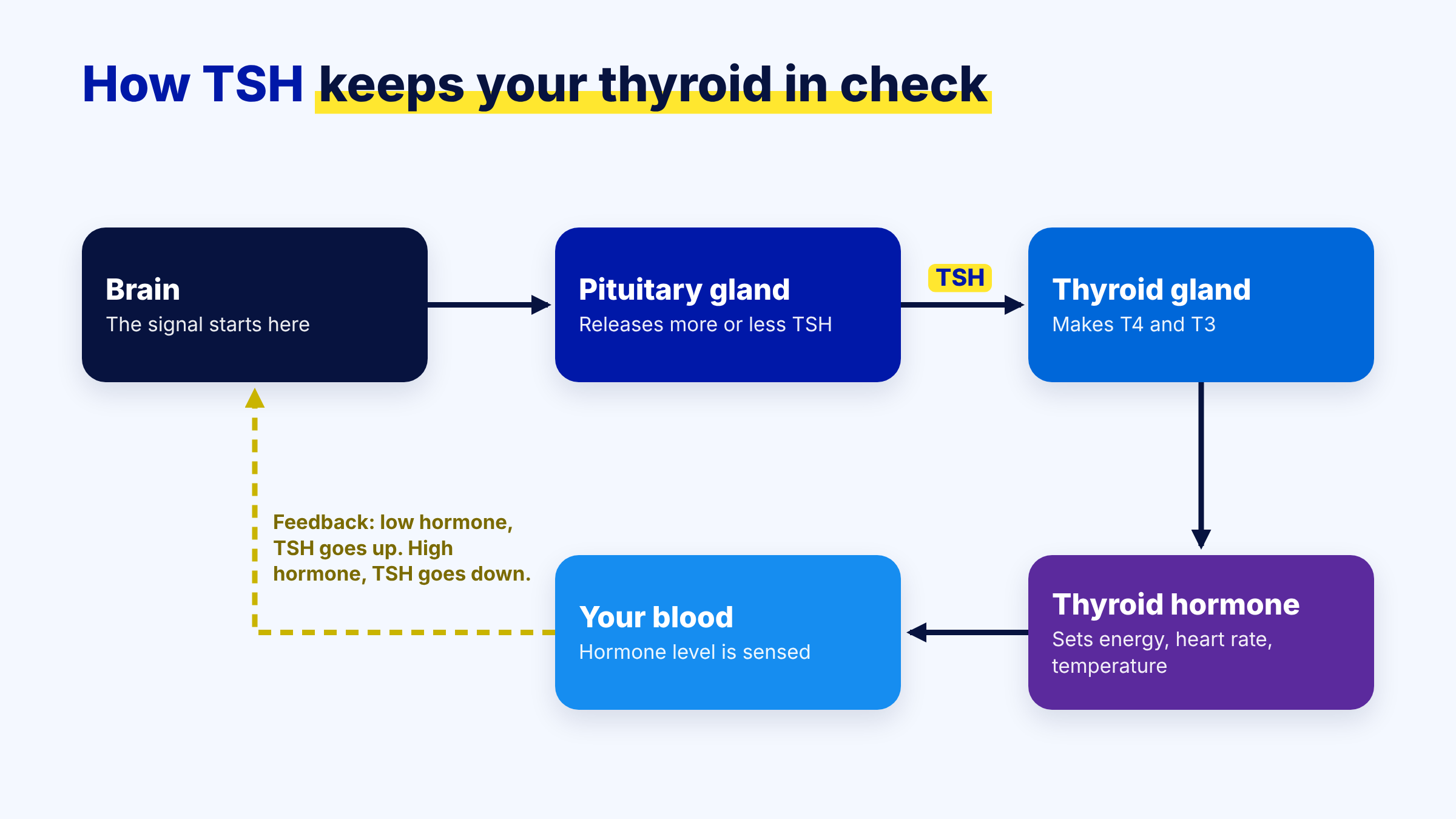
The backwards logic trips people up. High TSH levels usually point to an underactive thyroid, called hypothyroidism. Low TSH levels usually point to an overactive one, called hyperthyroidism.
Why start with TSH instead of T4 or T3? Because the pituitary gland reacts to small shifts in thyroid hormone, TSH levels make a sensitive first check for both hypothyroidism and hyperthyroidism. It’s why most thyroid function testing begins with this one number.
The number most people quote as the normal range for adults is 0.4 to 4.0 mIU/L, short for milli-international units per liter. Some labs stretch the top to 4.5. Every lab sets its own reference range for TSH levels, and it’s printed right beside your thyroid result. Start there, because assays differ from lab to lab.
Here’s the catch. A single printed reference range is built from a mixed crowd of people. It doesn’t know if you’re 25, 55 or 85, and your thyroid doesn’t behave the same at every age.
Normal TSH levels by age: the chart
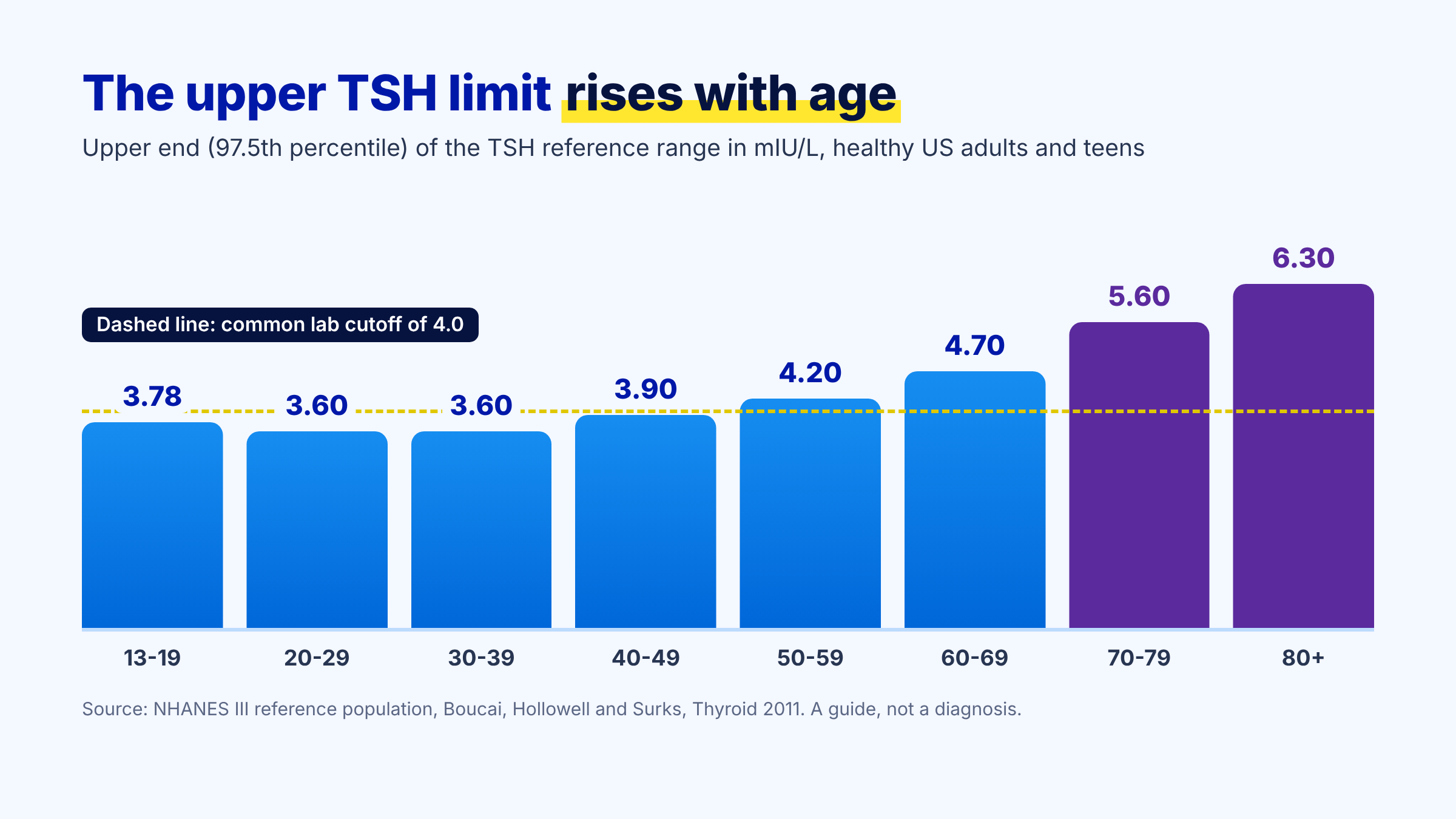
The best US data we have comes from NHANES III, a national health survey. In 2011, researchers Boucai, Hollowell and Surks split the thyroid-disease-free reference population into age groups and published the 2.5th to 97.5th percentile TSH values for each. Those are the numbers in this table.
| Age group | TSH reference range (mIU/L) |
|---|---|
| 13 to 19 | 0.41 to 3.78 |
| 20 to 29 | 0.40 to 3.60 |
| 30 to 39 | 0.38 to 3.60 |
| 40 to 49 | 0.44 to 3.90 |
| 50 to 59 | 0.49 to 4.20 |
| 60 to 69 | 0.46 to 4.70 |
| 70 to 79 | 0.47 to 5.60 |
| 80 and older | 0.44 to 6.30 |
Read it as a guide, not a diagnosis. These values describe where 95 out of 100 healthy people landed. The bottom of the reference range barely moves. The top climbs, by about 0.3 mIU/L per decade according to the authors. Your own lab’s assay and your own health history still decide what your TSH number means.
Children and teens
Kids don’t follow the adult rulebook. TSH levels run highest in newborns and settles toward adult levels as the brain-to-thyroid system matures.
One Croatian study of 397 healthy children, using Abbott assays, found a reference interval of 0.50 to 6.54 mIU/L for babies from 2 days to under 2 months. For 2 months to under 14 years it was 0.80 to 4.61, and for teens 14 to under 19 it was 0.58 to 3.60 (Biochemia Medica, 2021). The authors stress that pediatric ranges depend on the assay. Children’s TSH levels should be read against the lab that ran the test, ideally by a pediatrician.
Adults in their 20s to 40s
This is the tightest window for TSH. Upper limits sit between 3.6 and 3.9 mIU/L. A result of 4.2 in your 30s is only a little over the line, but it’s worth a follow-up, especially if you’re tired, gaining weight or trying to conceive.
Adults in their 50s and 60s
The upper limit drifts to 4.2 in your 50s and 4.7 in your 60s. This is also the decade of menopause for many women, and the fatigue, weight gain, sleep trouble and mood swings of menopause look a lot like thyroid symptoms. A thyroid test sorts out which is which.
Adults 70 and older
Here the age-adjusted picture matters most. The reference upper limit is 5.6 in the 70s and 6.3 after 80. MedlinePlus also notes that TSH may run higher in people over 80 who have no thyroid problem at all.
Some clinicians use a rule of thumb from the French Endocrine Society: divide age by 10, so an 80-year-old’s upper limit would be 8.
A 2025 review in the Cleveland Clinic Journal of Medicine adds that about 14% of people older than 85 had TSH above 4.5 mIU/L (Xu et al.). For older adults, a slightly high number is often just age. That’s why thyroid results in older adults deserve a second look before anyone starts a daily pill.
Normal TSH levels during pregnancy
Pregnancy rewrites the numbers, and normal TSH levels by age stop applying the usual way for your thyroid. In the first trimester, TSH is often a little low, as MedlinePlus notes. Pregnancy changes how your thyroid behaves, and the adult range stops fitting.
The 2017 American Thyroid Association guideline says labs should use trimester-specific ranges built from their own pregnant population. When a lab doesn’t have one, the guideline suggests an upper limit of 4.0 mIU/L for pregnancy, roughly 0.5 lower than the non-pregnant cutoff (Maraka et al., 2018 review). The earlier 2011 ATA ranges were 0.1 to 2.5 mIU/L in the first trimester, 0.2 to 3.0 in the second trimester and 0.3 to 3.0 in the third trimester.
What if a pregnancy result runs high? The guideline recommends testing for TPO antibodies when TSH tops 2.5. Levothyroxine is recommended for women who are TPO antibody positive with a TSH above 4.0. It may be considered at lower levels, or for antibody-negative women between 4.0 and 10.0, as a shared decision.
If you’re pregnant or planning a pregnancy, don’t wait for a routine visit. Tell your clinician about any thyroid history now, and ask which trimester range your lab uses.
What a high or low TSH means
A TSH outside your range tells you the pituitary gland is reacting to something. It doesn’t say what, and hypothyroidism and hyperthyroidism can both feel vague at first. That’s why your clinician usually adds a free T4, and sometimes a free T3, to see how much thyroid hormone your thyroid is putting out. Together, those thyroid function results tell a fuller story than TSH levels alone.
High TSH
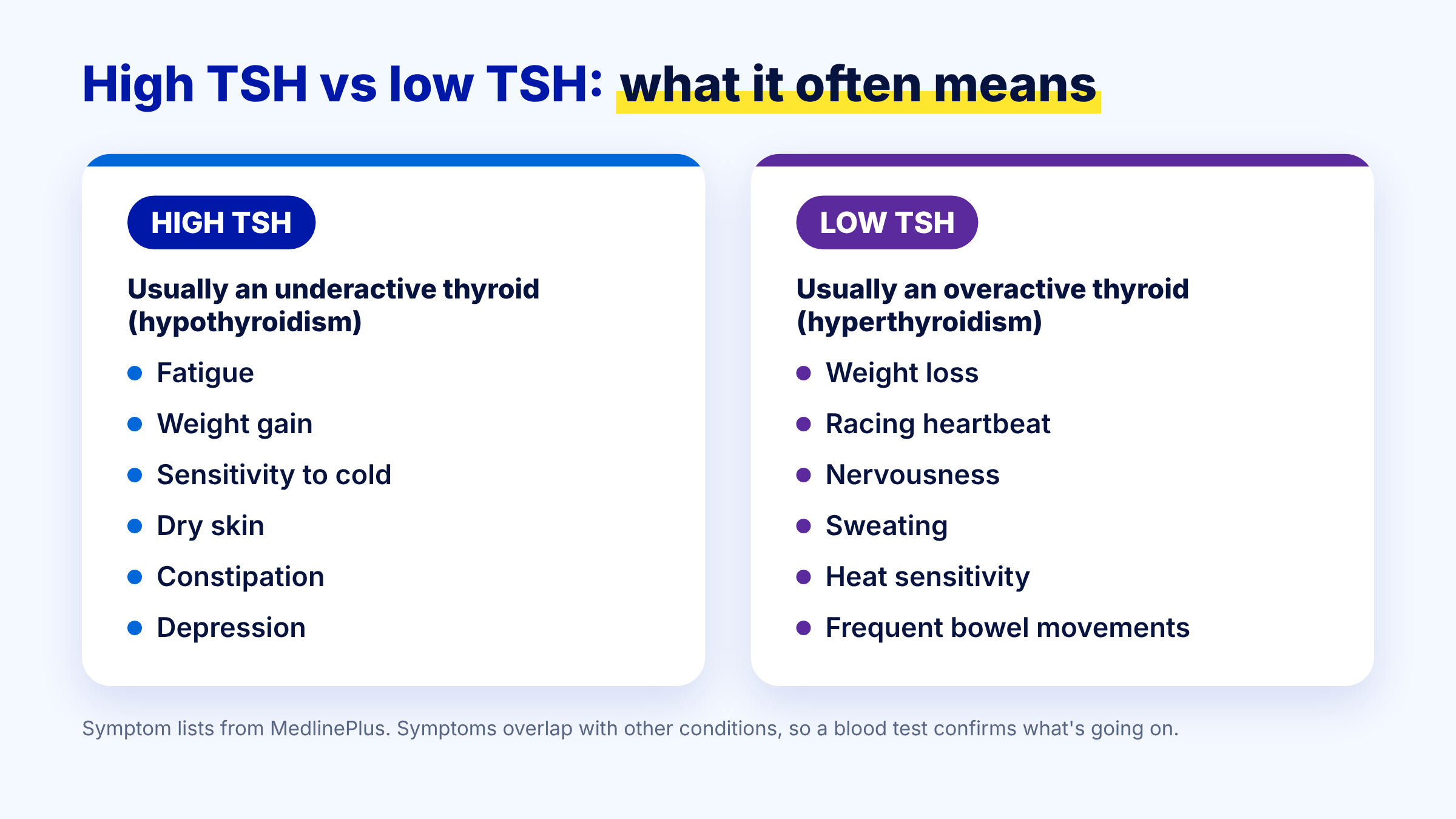
A high TSH usually means hypothyroidism, because the pituitary gland is calling for more thyroid hormone. The symptoms MedlinePlus lists include fatigue, weight gain, sensitivity to cold, dry skin, constipation and depression. Hashimoto’s thyroiditis, an autoimmune condition, is a common cause. Treatment for hypothyroidism, when it’s needed, is usually levothyroxine, a daily thyroid hormone replacement.
Symptoms creep in slowly. Plenty of people blame stress or aging for months, and fatigue is the one most often brushed off. If several of those symptoms ring true, a thyroid blood test is a simple next step, and hypothyroidism is far easier to manage once it’s caught.
Low TSH
A low TSH usually means hyperthyroidism. Think weight loss, a racing heartbeat, nervousness, sweating and heat sensitivity. Graves’ disease, another autoimmune condition, is a well-known cause of hyperthyroidism, and treatment depends on what’s driving it. Fatigue can show up here too, which surprises people. A low result isn’t always thyroid trouble, though. MedlinePlus notes that some serious non-thyroid illnesses can lower TSH levels briefly, which is one reason clinicians repeat the thyroid test before treating anything.
When TSH is only slightly off
This is the gray zone, and it’s where most confusion lives. Subclinical hypothyroidism means TSH sits above the reference range while free T4 is still normal. The 2025 Cleveland Clinic Journal of Medicine review grades it as mild at 4.0 to 10.0 mIU/L and more severe above 10.
Mild cases usually don’t need a rush to treatment. The same review recommends remeasuring TSH two to three months after the first result and checking TPO antibodies, since a one-off high number can fade on its own.
It also argues that most older adults with subclinical hypothyroidism don’t need levothyroxine. The TRUST trial followed 737 adults aged 65 and older with mildly raised TSH and found no difference in symptoms or tiredness after a year on levothyroxine versus placebo.
Why does that matter? Too much medication carries its own risks, including a TSH pushed too low. For a 30-year-old trying to get pregnant, the same mild elevation gets handled differently. Age changes the plan, not just the number, which is the whole point of reading normal TSH levels by age instead of against one flat range.
What can throw off your TSH result
A single TSH reading is a snapshot of your thyroid, and plenty of things blur it. Acute illness can lower TSH levels for a while. Pregnancy shifts them. Some medication changes them, and supplements can interfere with how a lab measures thyroid hormone and TSH. Biotin, found in many hair and nail products, is the one patients forget to mention, so say it out loud when you get your blood drawn.
Labs differ too. Each thyroid lab uses its own assay, and the pediatric studies above stress that a reference range doesn’t transfer cleanly between methods. If you’re tracking a trend, use the same lab each time.
Tell your clinician about everything you take, thyroid medication included. MedlinePlus says you may need to stop certain medicines before a thyroid blood test, but it’s clear on one point: don’t stop anything unless your provider tells you to.
How to prepare for a TSH test and when to retest
A TSH test is a simple blood draw. MedlinePlus says nothing special is required for a TSH test alone, though you may need to fast for several hours if other tests are on the same draw. Bring a list of your medication and supplements, biotin included. If you can, get repeat tests drawn at a similar time of day.
When should you retest? For a mildly abnormal thyroid result in an otherwise healthy adult, the two-to-three-month window from the review above is a sensible default. If you’re pregnant, on thyroid medication or having symptoms, your clinician will set a faster schedule for checking thyroid function.
When to talk to a clinician
Don’t self-diagnose from a chart. Book a conversation if your TSH is flagged and you have thyroid symptoms, if it’s far outside the range for your age, or if the result surprised you. The same goes if you’re pregnant, planning a pregnancy, or already taking thyroid medication.
Seek urgent care for chest pain, a very fast or irregular heartbeat, or severe confusion rather than waiting on a thyroid follow-up.
At Swell, you can tell a licensed clinician what’s going on, and they’ll help you work out what can be handled online and what needs in-person testing. Bring your thyroid result, your age and your symptom list, and ask what treatment, if any, makes sense for you. You’ll leave with clear next steps instead of a number to worry about.
Questions people ask about normal TSH levels
What is a normal TSH level for a 60 year old?
For ages 60 to 69, the NHANES III reference range runs from 0.46 to 4.70 mIU/L. Many labs still print 0.4 to 4.0 or 4.5. A thyroid result a little above your lab’s printed limit isn’t automatically a problem at this age. Repeat the TSH test and look at free T4 before drawing conclusions.
Is a TSH of 5 normal for a 75 year old?
It can be. The reference range for ages 70 to 79 tops out at 5.6 mIU/L. A TSH of 5 with a normal free T4 and few symptoms often just gets monitored. Your clinician will weigh your thyroid symptoms, medicines and other health conditions.
What TSH level is normal during pregnancy?
It depends on your trimester and your lab. The 2017 ATA guidance suggests an upper limit of about 4.0 mIU/L when no local pregnancy range exists, and TSH levels are often lower in the first trimester. Ask your clinician which range they’re using for your thyroid.
What is a bad TSH result?
There’s no single “bad” number. TSH levels far outside your range, especially with symptoms, deserve prompt attention. In adults, a TSH above 10 mIU/L with normal free T4 is graded as more severe subclinical hypothyroidism, and treatment is more likely.
What is the best time to test TSH?
MedlinePlus doesn’t require a special time or fasting for a TSH test alone. Fasting may be needed if other thyroid tests are drawn with it. For repeat checks, keep conditions similar so you’re comparing TSH levels like with like.
Can TSH level become normal?
Often, yes. Mild elevations can settle on retesting, illness-related shifts fade as you recover, and people treated for hypothyroidism usually see TSH levels return to range as the thyroid dose is adjusted. That’s why a second blood test comes before most big decisions.
Trusted references
Public-health, research, and medical-society resources related to this guide.