Seven pills left. A flight in five days. And the pharmacy just told you it’s “too soon” to refill.
Here’s the quick answer on how to get a prescription refill early: ask your prescriber to confirm the reason, then have your pharmacy request an override from your insurance. For most non-controlled medication, that works when the reason is real, like travel, a lost bottle or a dose change. Controlled medications are tougher, and a few can’t be refilled early at all.
The rest of this guide shows you which rules apply to your medication, how many days early you can usually go, and what to do when the answer is no.
Can you get a prescription refill early?
Often, yes. But the pharmacy isn’t the one deciding.
Three things set the answer: the type of medication, your insurance plan, and your state’s law. The pharmacy works inside all three, and so does your insurance. If your plan won’t pay, the pharmacist can’t just wave the refill through, and that’s usually where people get stuck.
An early refill request is really a request for an exception, so treat it like one: bring a reason, your dates and your last fill date. Most early refill requests come down to one of two outcomes. Either the claim goes through with an override code, or it gets rejected and you’re asked to pay out of pocket or wait. The goal is to land in the first group, and that takes a little preparation.
Why your pharmacy says “refill too soon”
Your insurance plan tracks how fast you use your medication. When you ask for a refill, the plan checks the date of your last fill and the number of days it covered. If you ask too early, the claim bounces with a “refill too soon” message.
It’s built to stop waste and misuse. It also catches honest situations by accident.
Every insurer does this a little differently. One insurance plan may allow a refill at day 21, another at day 25, and a mail-order insurer may count shipping time. That’s why a friend’s early refill doesn’t predict yours. Ask for your insurance plan’s window and write it down for next time.
Plans set their own thresholds, and many wait until you’ve used roughly 75 to 80 percent of your supply. One example from a KFF analysis of Medicare Part D described a plan that wouldn’t allow a 30-day refill until three weeks after the last fill. Your plan’s number may differ, and your pharmacist can look it up in seconds.
Seeing “refill too soon” doesn’t mean the refill is forbidden. It means your insurance plan wants a reason. Give a clear one and the refill often goes through on the second try.
Insurance isn’t the only gatekeeper. Pharmacies have their own policies, and state boards of pharmacy add rules on top.
Refill rules by medication type
The medication matters more than anything else. Here’s how the rules shake out.
| Medication type | Federal refill limit | What it means for an early refill |
|---|---|---|
| Non-controlled (blood pressure, thyroid, antibiotics, most maintenance medication) | None on timing | Plan and pharmacy rules decide; overrides are common |
| Schedule III and IV controlled substance | Up to five refills within six months | Possible with prescriber approval; pharmacies are cautious |
| Schedule II controlled substance | No refills allowed | Needs a new prescription every time |
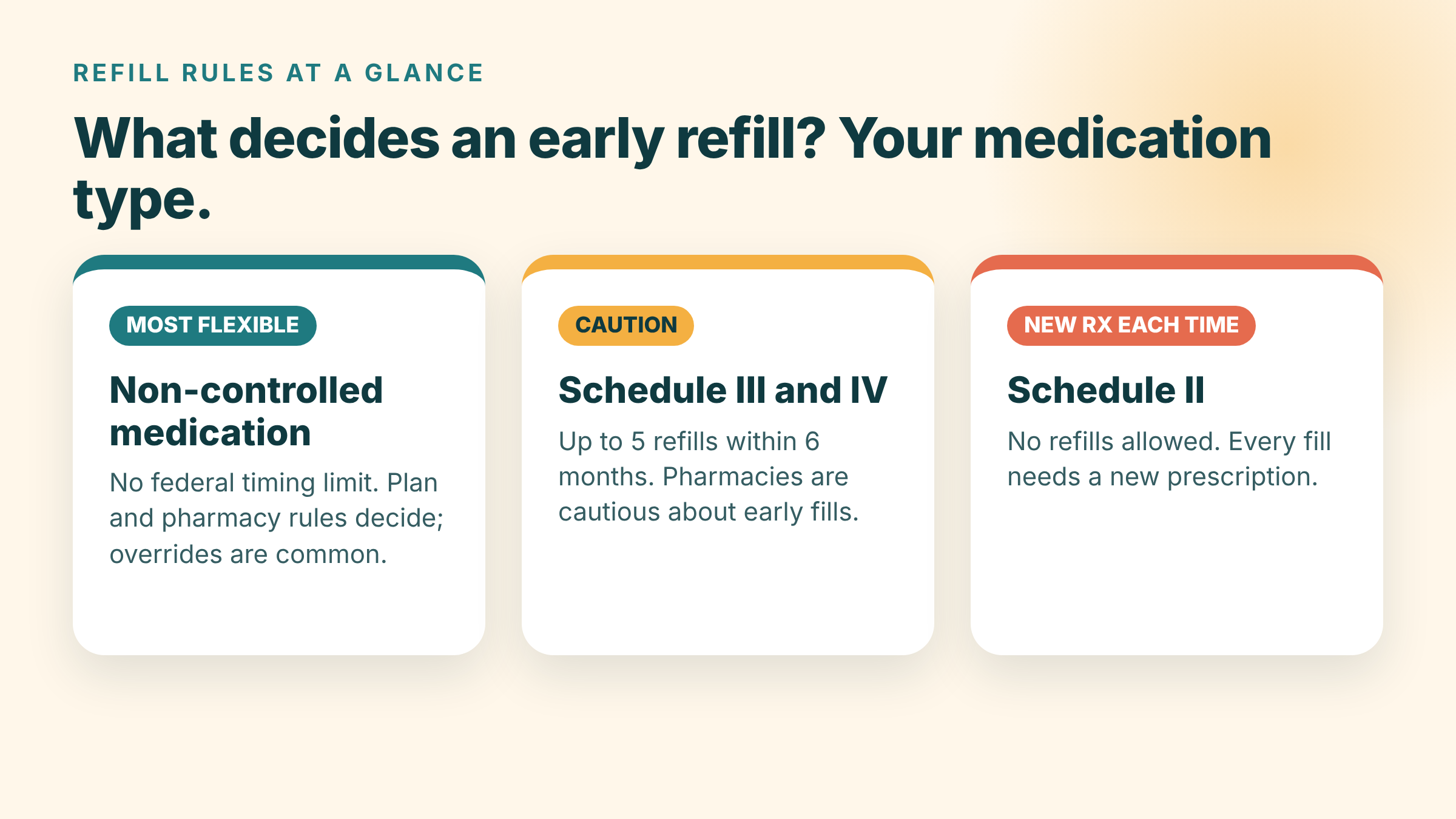
Non-controlled drugs are the easy category. Federal law doesn’t set a timing rule for them, so the limits come from your plan and your pharmacy.
For Schedule III and IV drugs, federal rules say a prescription can be refilled up to five times and only within six months of the date it was written, as laid out in 21 CFR 1306.22. Schedule II prescriptions can’t be refilled at all, per Pharmacy Times. Each fill needs a fresh prescription. Many states add their own limits, and state law can be stricter than federal law, never looser.
So if you take an ADHD stimulant or an opioid, plan on a new prescription rather than an early refill.
Schedule II rules are federal, and no override changes them. A pharmacist who fills a Schedule II drug without a fresh prescription risks their license, so a refusal isn’t personal. The same goes for any controlled substance a state restricts further. Know which schedule your medication sits in before you call.
How early can you refill a prescription?
There’s no single national number. People often hear about a “28-day rule,” but it’s a habit of pharmacies and plans, not a federal law.
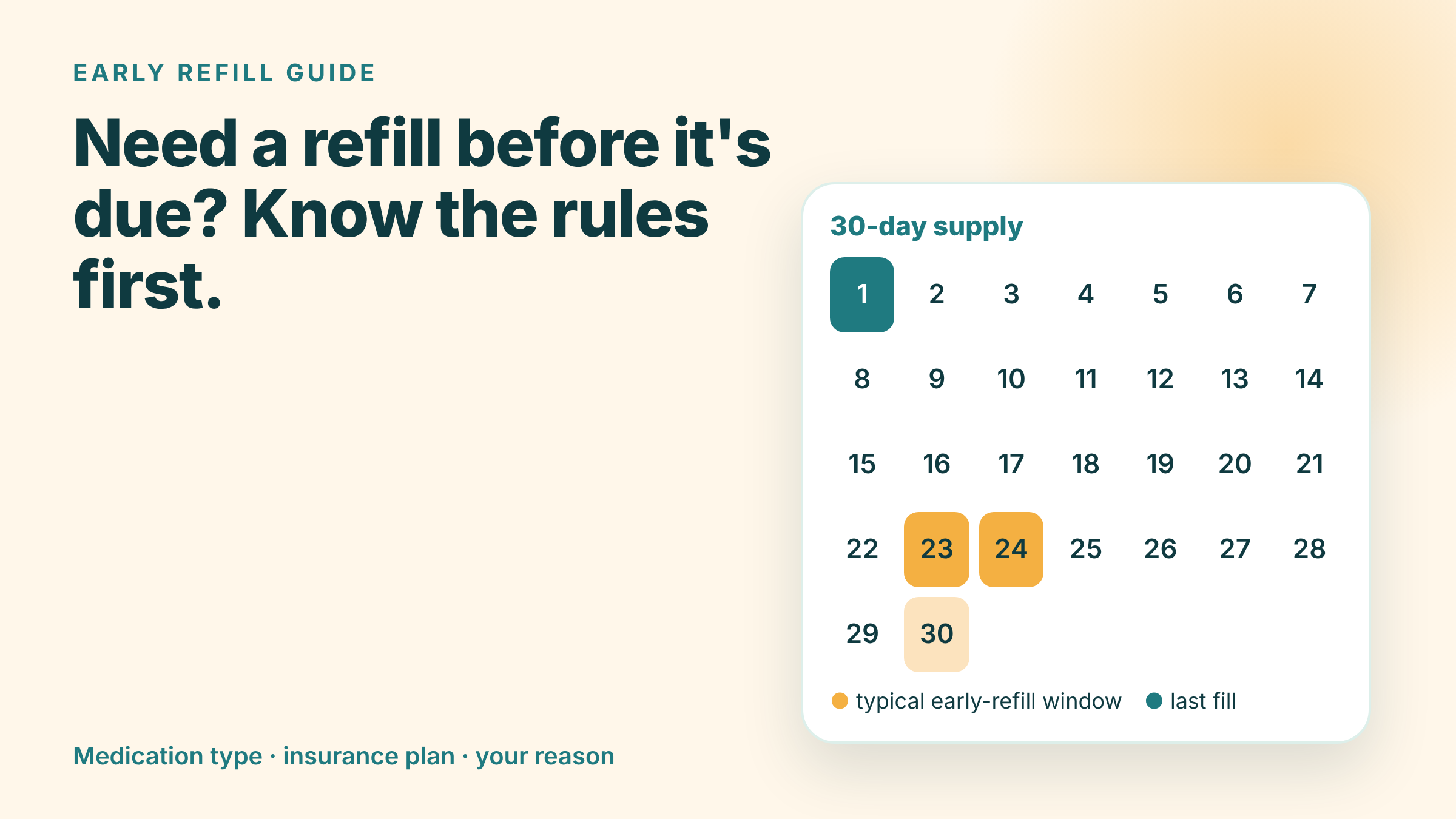
Here’s what’s typical for a 30-day supply of non-controlled medication: the refill can often be filled around day 23 to day 27, depending on the plan. A 30-day supply of a blood pressure pill, for example, may be ready by day 24.
A 90-day supply gives you a longer runway, since the plan’s percentage works out to more days of cushion. If you can, switching to a 90-day supply of a stable medication means fewer refill dates to manage, and a 90-day supply is often cheaper per pill too. Ask your doctor whether your medication qualifies for a 90-day supply, a switch that suits most stable medication, and whether your pharmacy can sync all your prescriptions to one date.
Controlled substances run tighter. A pharmacist may refuse anything earlier than the day your supply ends, even when your insurance would approve it.
Good reasons for an early refill
Pharmacists and plans approve early refills when the reason is clear and documented. Your medication, your plan and your reason all have to line up for the refill to be approved. These are the situations that come up most.
Travel and the vacation override
A vacation override is the most common path for travel. Travel plans shift, so give the exact travel dates, not just the departure day. You tell the pharmacy your travel dates, the pharmacy asks your plan for a one-time exception, and the plan typically approves enough extra days to cover the trip. Call at least a week before you leave. International travel and longer stays can take extra paperwork, and some countries restrict certain medication, so check the rules for your destination before you pack.
Lost, stolen or damaged medication
If your medication was lost or stolen, a police report can help for controlled drugs. Some plans will approve a “lost medication” override once. Expect a second request to get more scrutiny.
Dose changes
If your prescriber raises your dose, your old refill date no longer makes sense. You’re using more per day, so the supply runs out sooner. Ask for an updated prescription that shows the new directions. That’s usually enough for an override. Without it, the pharmacy sees a refill request that’s simply early, and the insurer rejects it as refill too soon.
Storms and emergencies
When disaster hits, rules loosen. The Centers for Medicare & Medicaid Services has told Part D plans to suspend refill-too-soon checks once an evacuation is ordered in a declared emergency area. States act too. During a hurricane, for instance, Florida allowed early refills for people in affected counties, with Schedule II drugs excluded.
How to get a prescription refilled early, step by step
If you’re wondering how to get a prescription refill early without a fight, follow these in order. Skipping straight to the pharmacy counter is the usual mistake, and it can burn the one request your insurer will allow.
- Check your refill date. Look at the label for the last fill date and days’ supply, then count forward. Know how many days early you’re asking.
- Know your reason and your dates. “Leaving March 3, back March 20” beats “I’m going on a trip.”
- Call your pharmacy first. Ask the pharmacist whether your plan allows an early refill override and what it needs. They handle these daily.
- Contact your prescriber if there are refills left on file or the dose changed. If your prescription has run out of refills, you’ll need a new one regardless.
- Ask the pharmacy to submit the override. If you’re leaving town, the phrase to use is “vacation override.” For a bottle that went missing, ask for a “lost medication override,” which the plan treats as a separate code.
- Call your insurer if the pharmacy can’t resolve it. The number’s on your ID card. Ask what documentation your insurance plan wants, and whether a prescriber’s note would speed things up.
- Pick up the refill and check the quantity. Some plans approve a partial fill. Count your medication against what you asked for.
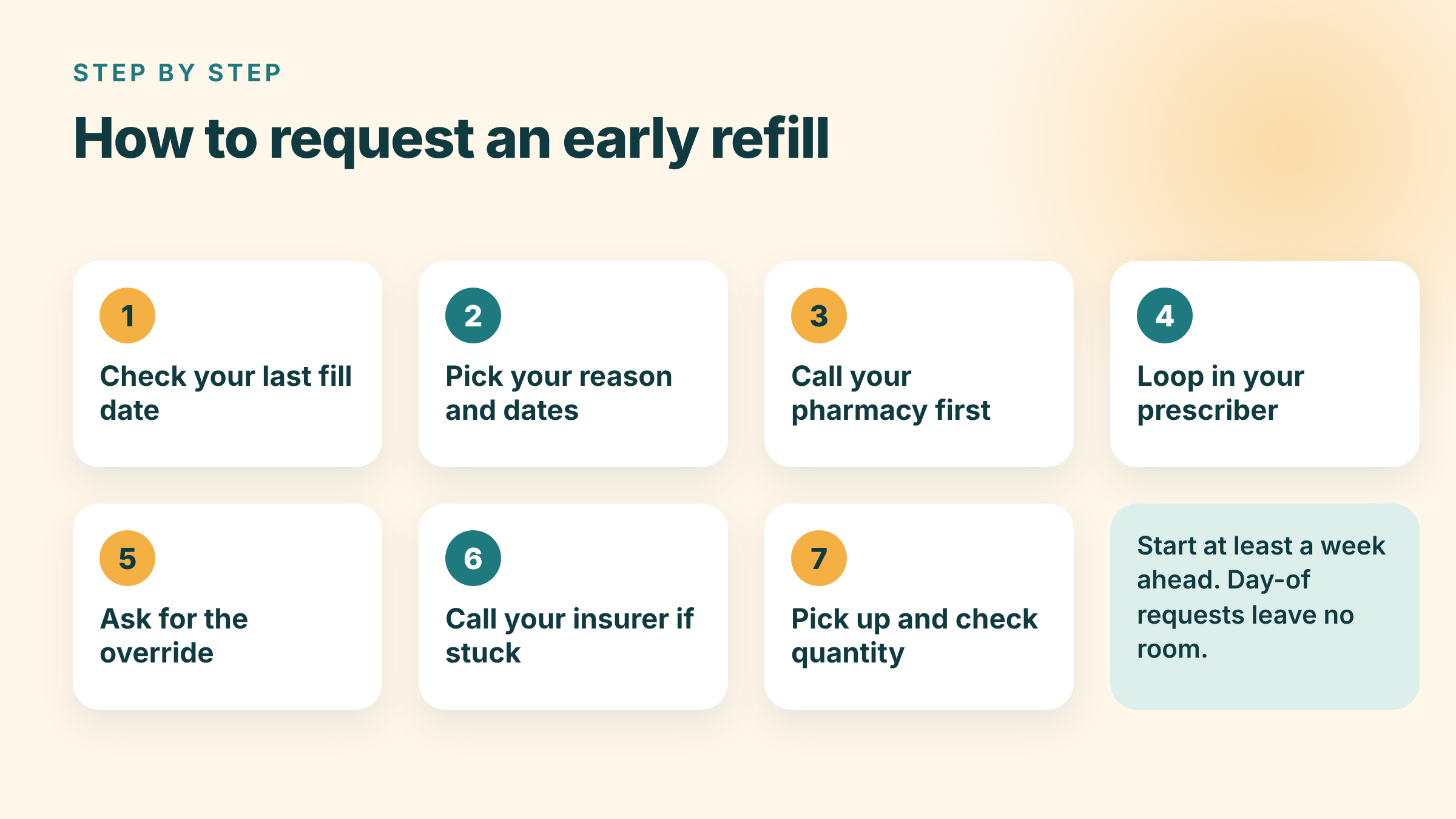
Start early. A request made on the day you run out leaves no room to work. Check what your insurance covers in an emergency before you need it.
What to do if insurance says no
A denial isn’t the end of the road.
First, ask what the denial code says. A “refill too soon” rejection is different from a quantity limit or a prior authorization requirement, and each has its own fix. They can read the code and tell you which one you’ve got.
Second, ask your prescriber to contact the plan directly. Plans take a prescriber’s note more seriously than a patient’s request. Many allow a formal exception when there’s a medical reason, and an insurer’s appeal desk can move fast on those.
Third, consider paying out of pocket for the extra days. An out-of-pocket fill for a handful of tablets is often cheaper than people expect. For many generic drugs, a discount card price is lower than a copay, so a short cash fill of a few days can bridge the gap. Stores set their own policy on cash fills for controlled drugs, and many won’t do it.
If none of that works, ask your pharmacist about an emergency supply. In many states, a pharmacist can dispense an emergency supply of a maintenance medication when they can’t reach your prescriber. An emergency supply is usually just a few days, enough to reach the next appointment. The length varies, and it’s up to the pharmacist and the state.
When you can’t reach your prescriber
Sometimes the hard part isn’t the insurance. It’s that your prescriber’s office is closed, booked for weeks or hours away from where you are. That’s when a clinician-led telehealth visit can save the day.
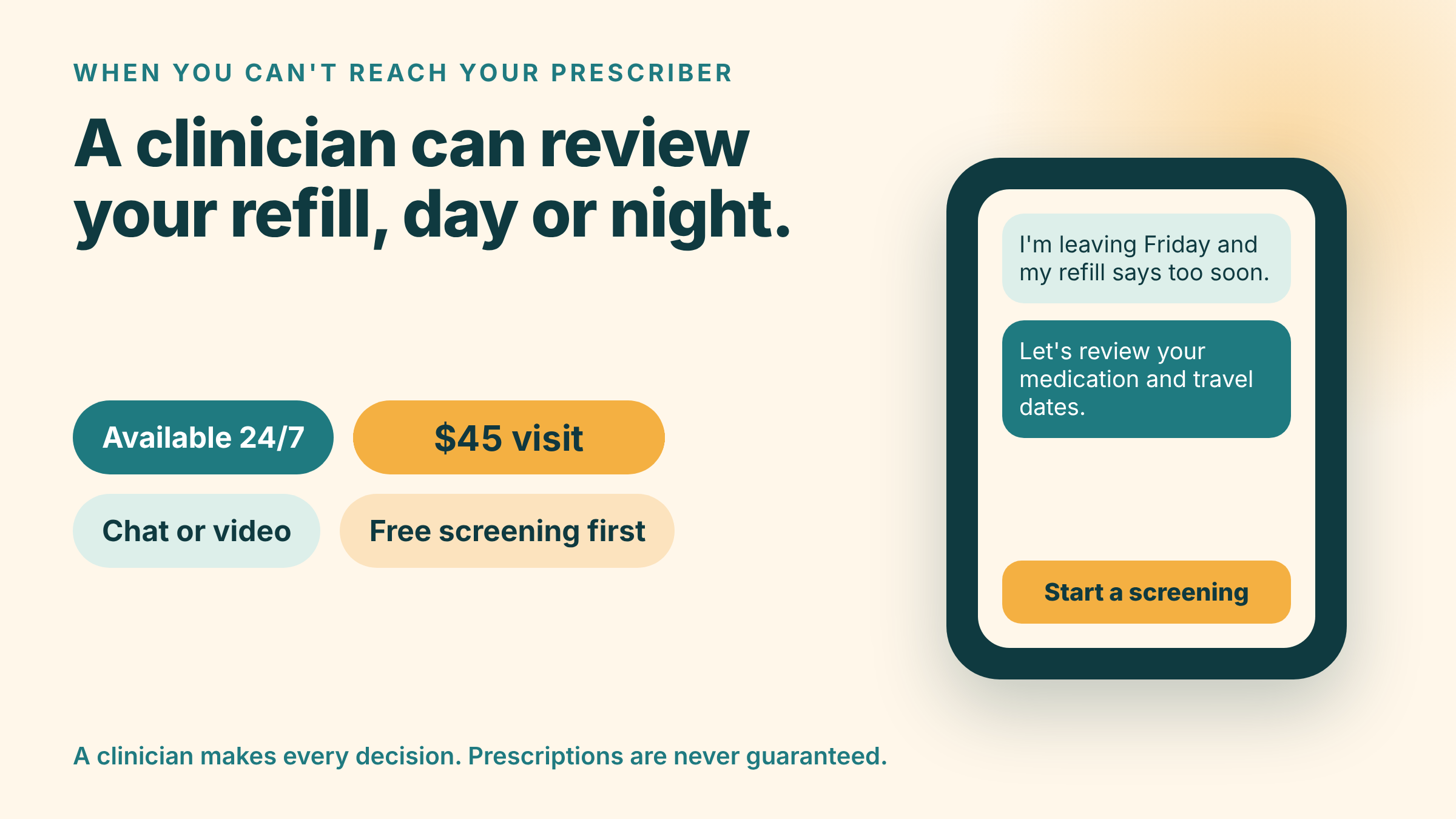
At Swell, licensed clinicians are available 24/7 by secure chat or video. The site offers a medication refill review for many stable, non-controlled medications. It starts with a free screening, followed by a $45 consultation, and medication and lab costs are separate. There’s no membership.
Be clear on the limits. A clinician makes every decision, and a prescription is never guaranteed. A clinician has to evaluate your history and your reason first. Knowing how to get a prescription refill early is easier when someone with a license is on your side. For controlled medications, the rules are tighter. The DEA has extended its telemedicine flexibilities for prescribing controlled substances through December 31, 2026, so check with your clinician about what’s allowed right now.
Have these ready before your visit: the medication name and dose, the name and location of your drugstore, your last fill date, and the reason you need the refill early. That small list saves minutes and often gets you a clearer answer.
If you’re about to run out, don’t wait for the last pill. Start a Swell screening today and get a clinician’s view on your next step.
When to see a doctor
Don’t stretch your medication to make it last. Skipping doses or cutting pills can be risky for heart medication, seizure medication, insulin, antidepressants and thyroid treatment. If you’ve run out and feel unwell, call your prescriber or urgent care now. For chest pain, trouble breathing or any emergency, call 911.
Questions people ask about early refills
How early can I refill a 30-day prescription?
It depends on your plan. Many plans allow a refill after about 75 to 80 percent of the supply is gone, which is around day 23 to 24 of a 30-day supply. A 90-day supply works on the same percentage, so the refill window opens around day 68 to 72. Controlled substances are usually stricter. Your pharmacist can see the exact date your plan will accept.
Can I pay cash to refill early?
Often yes for non-controlled medication, since the pharmacy can sell it outside your insurance. The out-of-pocket price for a generic medication can be low with a discount card. Prices vary, and a discount card can help. Many won’t do this for a controlled substance, and your prescriber’s remaining refills still apply.
Can controlled substances be refilled early?
Rarely, and never for Schedule II. A Schedule II prescription can’t be refilled at all. A Schedule III or IV prescription can be refilled up to five times in six months, but pharmacists tend to refuse anything well ahead of schedule. A new prescription from your prescriber is the usual route.
Does a dose change reset my refill date?
Yes, in practice. When your prescriber changes your directions, the old days’ supply no longer matches how you take the drug. Ask for an updated prescription so the pharmacy can submit a dose change override.
Trusted references
Public-health, research, and medical-society resources related to this guide.
- Florida Health: Early refills during emergencies
- Becker’s Hospital Review: DEA extends telemedicine prescribing flexibilities through 2026
- CMS: Emergency refill Q&A for Part D
- KFF: Medicare Part D policies for extended supplies of medication
- Cornell LII: 21 CFR 1306.22, refilling of prescriptions
- Pharmacy Times: 4 controlled substance laws and regulations you should know