You open your lab portal, scroll down the list, and one line is flagged. RDW, 15.8%, marked high. Your hemoglobin looks fine. Nothing else is red. So what does high RDW mean on a blood test, and should you be worried?
Here’s the short answer. It’s rarely an emergency. A high RDW means your red blood cells vary more in size than they should, and that’s a clue to follow up, not a diagnosis. Most of the time the trail leads somewhere fixable, like low iron or low vitamin B12.
Below, you’ll see how to read the number, what usually sits behind it, and what to do next.
What does high RDW mean? The short answer
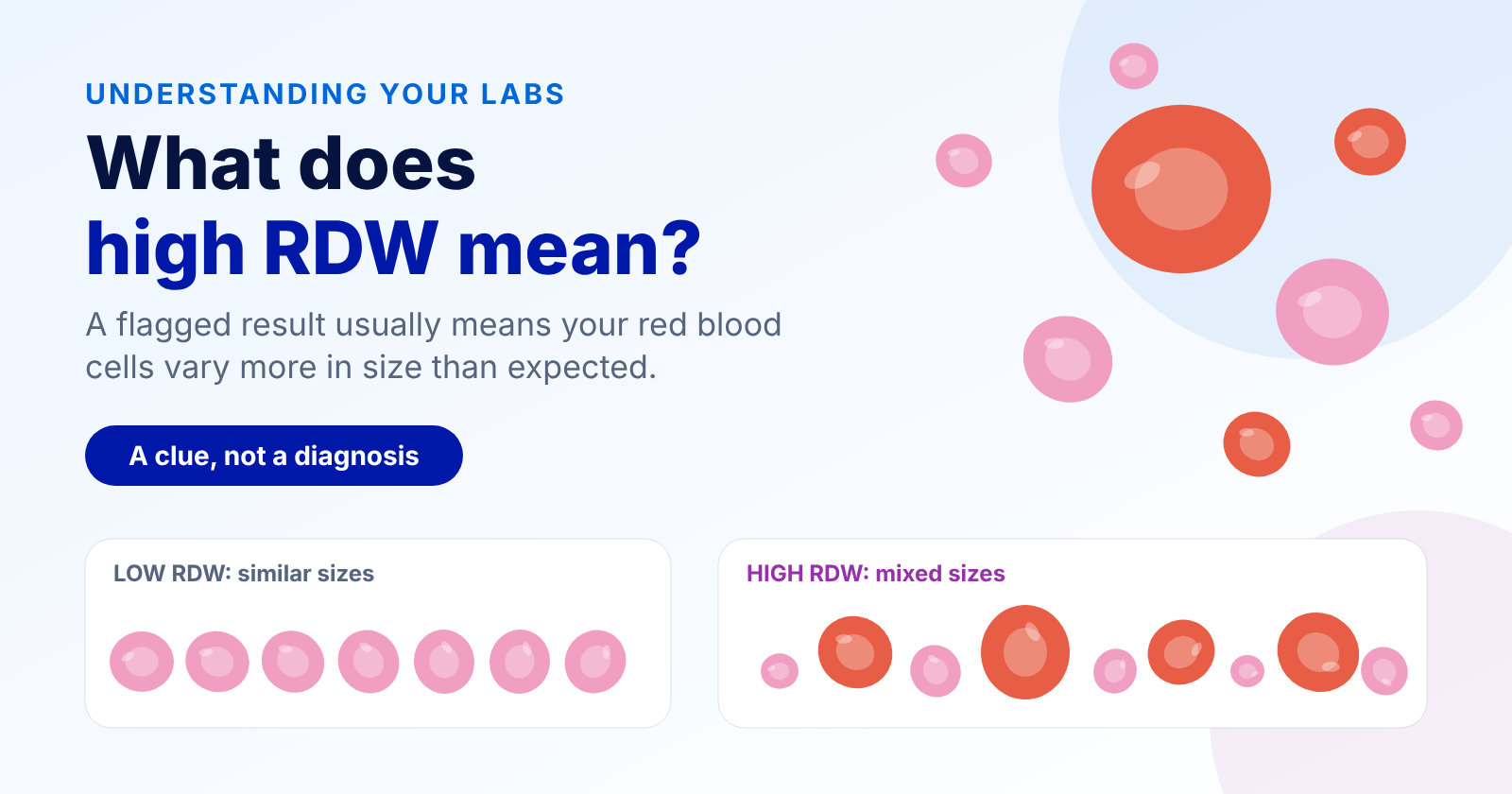
RDW stands for red cell distribution width. It’s one number on your complete blood count that shows how much your red blood cells differ in size. When most cells are about the same size, RDW stays low. When small, medium and large cells are all in the mix, it climbs.
That’s all a high result says by itself. The sizes are uneven. Doctors call this anisocytosis.
Why they’re uneven is the real question, and your other lab values usually answer it. Both MedlinePlus and Cleveland Clinic are clear on one point: RDW isn’t used to diagnose a condition alone. Your healthcare provider reads it next to other results.
What RDW measures and what counts as high
RDW, or red blood cell distribution width, is reported as a percentage. It comes with the blood test most people get at a checkup, an anemia workup or before surgery, a complete blood count (often shortened to CBC). The analyzer sorts your red blood cells by size and draws a histogram. A narrow peak means uniform cells. A wide, spread-out one means a high RDW.
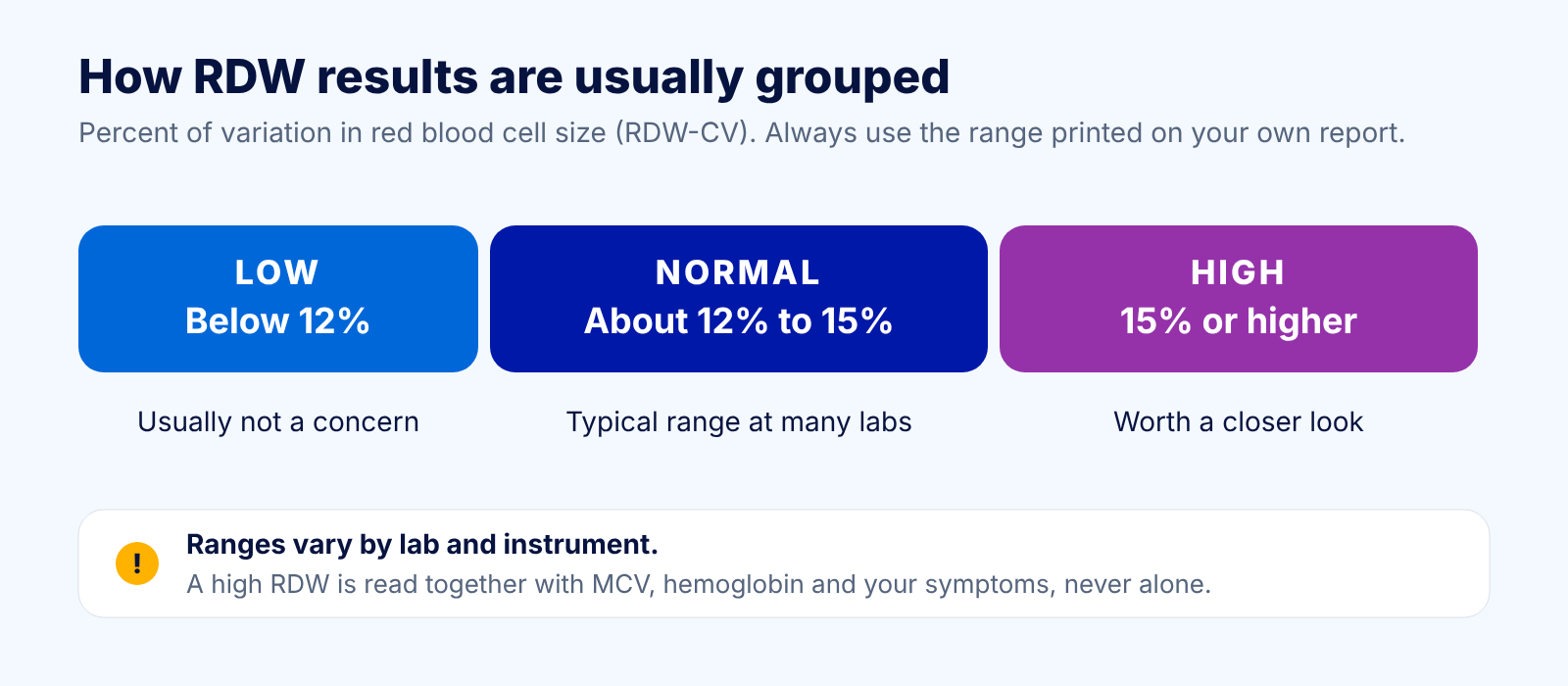
So where’s the line? Reference ranges differ from lab to lab, so use the one printed on your report. As a rough guide, Cleveland Clinic describes about 12% to 15% as normal and 15% or higher as high. A 2019 review in the Annals of Translational Medicine cites a similar 12% to 15% reference range and stresses that each lab should set its own. A low RDW isn’t a worry.
RDW-CV vs RDW-SD
Your report may show one of these or both. RDW-CV is a percentage calculated from the spread of cell sizes relative to the average size, and it’s what most labs print. RDW-SD is a direct width measurement that doesn’t depend on average cell size.
The practical difference? RDW-CV can look high when cells are small. If only RDW-SD or RDW-CV is flagged, ask your healthcare provider which one they’re using before you read anything into it.
Common causes of a high RDW
Think of it as a mixed crowd. Anything that makes your bone marrow turn out a second group of red blood cells, bigger or smaller than the first, widens the spread. Nutritional gaps and chronic disease account for most flagged results.
Iron deficiency
Iron deficiency is the classic cause. When your stores run low, your bone marrow starts building smaller red blood cells, while older, normal-sized ones are still circulating. Small plus normal means a wide spread. RDW often rises before anemia shows up, which is why a high RDW can be the first hint.
Heavy periods, pregnancy, slow bleeding in the gut, a low-iron diet and absorption problems are common reasons. A ferritin test shows how much you have stored. Treatment is simple once you know the cause.
Low vitamin B12 or folate
Low vitamin B12 or folate pushes the other way. Without enough of either, the bone marrow releases oversized, immature red blood cells that mix with normal ones. The spread widens again. Left alone, a deficiency like this can lead to anemia.
Vegan and vegetarian diets without supplements, pernicious anemia, some stomach and bowel conditions, heavy alcohol use and a few medications can all lower these vitamins. The Blood Project notes that when both iron and B12 run low together, a small-cell group and a large-cell group appear at once, and the RDW rises even higher.
Inflammation, liver, kidney and other chronic conditions
Not every high RDW starts in the marrow. Ongoing inflammation, chronic liver disease, kidney disease, diabetes and some cancers (MedlinePlus specifically names colorectal cancer) have all been linked to a higher RDW. In these cases the number often reflects what the condition is doing to the production of red blood cells, not a separate blood problem. Doctors group these under chronic disease, and the RDW in chronic disease tends to run only mildly high.
That’s why one flagged result needs context. Your history, medications and other labs matter more than the RDW itself.
Blood loss, transfusion, thalassemia and other blood conditions
A recent blood loss or transfusion leaves young and old red blood cells side by side, and RDW rises. Hemolytic anemia, where cells break down early, can do the same. Inherited conditions such as thalassemia show up in the combined pattern of your red cell tests, and problems in the bone marrow can too. If the pattern points that way, a hematologist may get involved.
High RDW with normal hemoglobin or normal MCV
This is where most people land, and it’s the part many articles skip. You can have a raised RDW with normal hemoglobin. Early iron deficiency does exactly that. The anemia hasn’t developed yet, but the cell sizes already start to drift. Hematocrit, the share of your blood made up of red cells, often looks normal too.
It can also happen with a normal MCV. If you have both low iron and low B12, small cells and large cells can average out to a normal size, while the RDW still sits high. The average hides the spread. That’s the reason providers look at the width, just the average.
The reverse matters too. A normal RDW doesn’t rule out anemia or another condition, a point Cleveland Clinic makes directly.
How doctors read RDW alongside MCV
MCV, or mean corpuscular volume, is the average size of your red blood cells. RDW tells how much the sizes vary. Together they narrow down the type of anemia fast.
| RDW | MCV | Pattern that often comes to mind |
|---|---|---|
| High | Low | Iron deficiency |
| High | High | Low B12 or folate |
| High | Normal | Early or mixed deficiency, or recent bleeding |
| Normal | Low | Other causes of small cells; inherited traits get considered |
| Normal | Normal | Not a flag on its own, though symptoms still count and deserve a conversation |
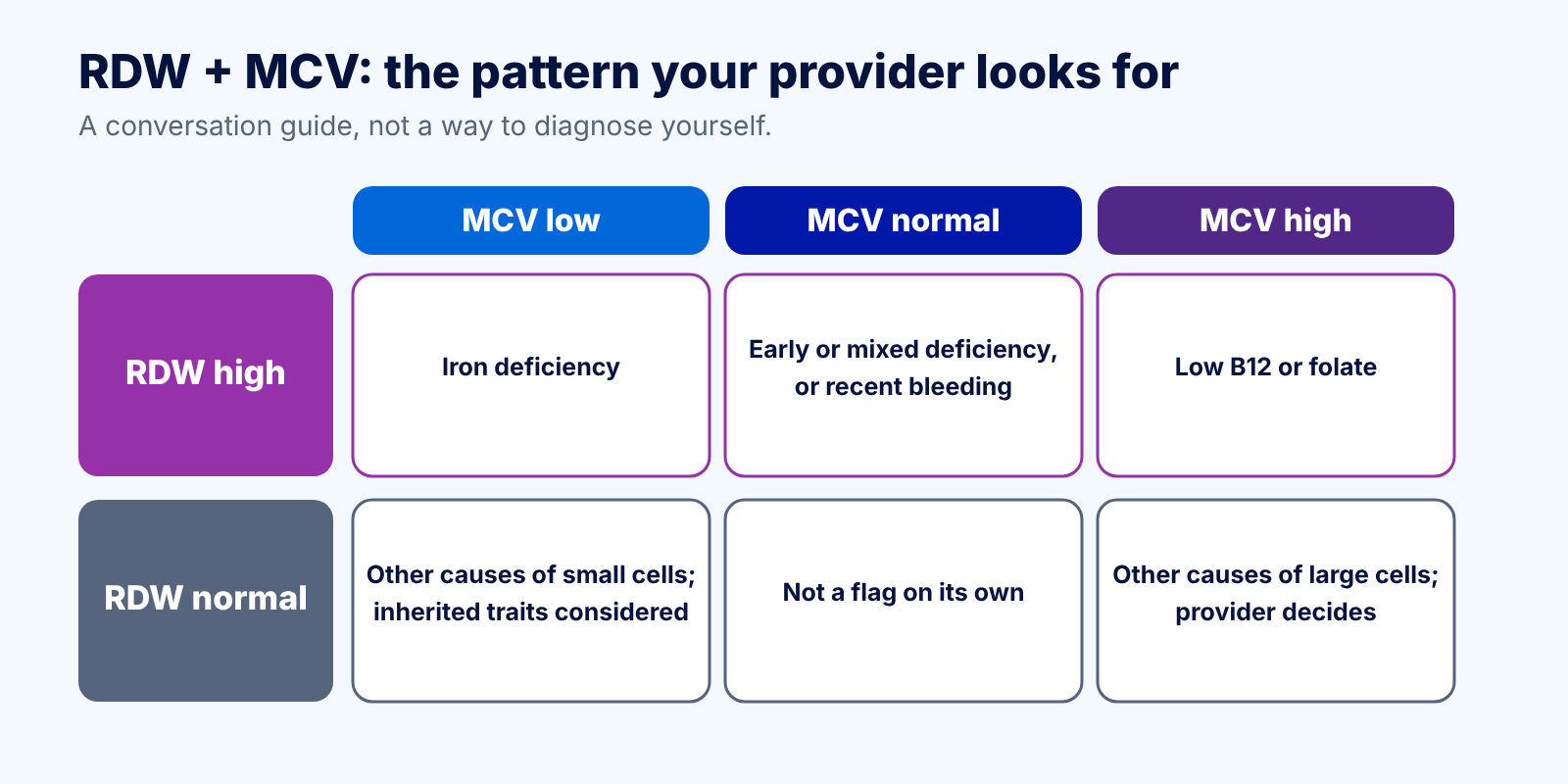
Treat that table as a conversation guide, not a way to diagnose yourself. Your provider may add a blood smear and a reticulocyte count, which shows how fast your marrow is making new cells, to sort out unclear cases.
Symptoms that can go along with a high RDW
RDW itself doesn’t cause symptoms. The condition behind it might. If anemia is involved, you may notice fatigue, pale skin, shortness of breath, dizziness, weakness or an irregular heartbeat. Cleveland Clinic lists those as reasons to call your doctor if they worsen.
Fatigue alone is vague, so don’t read too much into it. Plenty of people feel nothing at all. The flag turns up on a routine panel. That doesn’t make it unimportant, but it does mean you have time to work it out calmly.
Is a high RDW dangerous?
There’s no single dangerous RDW number. A result just over the line, with normal hemoglobin and otherwise healthy labs, usually points toward checking nutrition and watching the trend. A much higher result alongside symptoms of anemia deserves faster evaluation and treatment if needed.
You may also have read that high RDW predicts heart disease. There’s real research behind that. Large studies summarized in the Annals review link higher RDW with heart disease, heart failure, stroke and death, and some pooled analyses report roughly 10% to 20% higher risk per one-point rise. But the authors describe RDW as a marker of overall fragility and inflammation, not a cause, and they call it weak as a stand-alone test. One flagged number doesn’t tell you your future.
Get urgent help for chest pain, fainting, severe shortness of breath, black or bloody stools, or heavy bleeding. Call 911 or go to the nearest emergency room.
What to do if your RDW is high
Start by not guessing. Taking iron or vitamin B12 on a hunch can mask the real cause, and too much iron isn’t harmless. A short, orderly path works better.
- Look at the rest of your complete blood count, including hematocrit and mean corpuscular volume.
- Ask whether ferritin, vitamin B12, folate or a reticulocyte count make sense.
- Share the details that matter: fatigue, heavy periods, any chronic disease, diet, stomach or bowel symptoms, alcohol, medications.
- Start treatment for the cause that turns up, then recheck on the timeline your healthcare provider sets.
Treatment depends entirely on what’s found. Replacing a deficiency often brings RDW back toward normal over time, though it can briefly rise as new cells enter the mix.
Here are four questions worth bringing to your appointment:
- Which RDW is this, CV or SD, and what’s my lab’s reference range?
- What does the rest of my CBC say?
- Which follow-up tests do you recommend, and why?
- When should we recheck?
Get your results reviewed by a clinician
Waiting weeks for an appointment over one flagged line is stressful. Swell’s clinicians can help you make sense of lab results like a flagged red cell distribution width and decide which follow-up testing fits your situation. See how labs and follow-up work at Swell, or learn how Swell works.
Swell isn’t emergency care. If you have severe symptoms, call 911.
Questions people ask about high RDW
Is a high RDW something to worry about?
Usually it’s something to look into, not something to fear. A high RDW points to uneven red blood cell sizes, and the most common causes, like low iron or low B12, are treatable. Worry more if it comes with symptoms, worsening anemia or a steady upward trend across several tests.
What is the most common cause of a high RDW?
Nutritional deficiencies top the list, especially iron deficiency and low vitamin B12 or folate. Both change the size of your red blood cells in different directions. Chronic disease comes next: inflammation, liver disease, kidney disease and diabetes. Your other results help your provider tell which one is most likely in your case.
What RDW level is considered dangerous?
No official cutoff separates safe from dangerous. Many labs flag 15% or higher, and each lab sets its own reference range. How concerning a result is depends on your hemoglobin, MCV, symptoms and health history, not the number alone. Emergency symptoms matter more than any percentage.
Can a high RDW be normal or temporary?
Yes. RDW can rise after a transfusion or blood loss, and while red blood cells recover from a deficiency. Research also shows it tends to be higher with older age and in people with kidney issues or low physical activity. A repeat test often tells whether it’s a one-off.
Can you lower RDW naturally?
You can’t aim at the number directly. Fixing the cause is what moves it. If a deficiency or anemia is found, treatment means replacing iron, B12 or folate under your provider’s guidance, and it usually helps. Calming inflammation or managing a chronic condition helps too. Eating a varied diet supports healthy red blood cells, but don’t start high-dose supplements before testing.
Does a normal RDW rule out a problem?
No. A normal RDW doesn’t exclude anemia or other conditions, because several causes don’t widen the size spread. If you have symptoms, tell your provider even when your RDW looks fine. They’ll look at your full set of results and your history.
Trusted references
Public-health, research, and medical-society resources related to this guide.