It usually starts as a dull ache low on one side of your back, the kind you blame on a bad mattress. Then it sharpens. Within the hour you can’t sit still. So what are the first signs of kidney stones? Pain in your side or back that comes in waves, pink or brown urine, a burning feeling when you pee, and nausea. You won’t always get all four. Some people notice one, and a few feel nothing until the stone moves.
About 11% of men and 6% of women in the U.S. will have a kidney stone at some point, according to the National Institute of Diabetes and Digestive and Kidney Diseases. Catching the early signs of a kidney stone can shorten the misery. In a few cases it protects your kidney.
The first signs of kidney stones, in the order you usually feel them
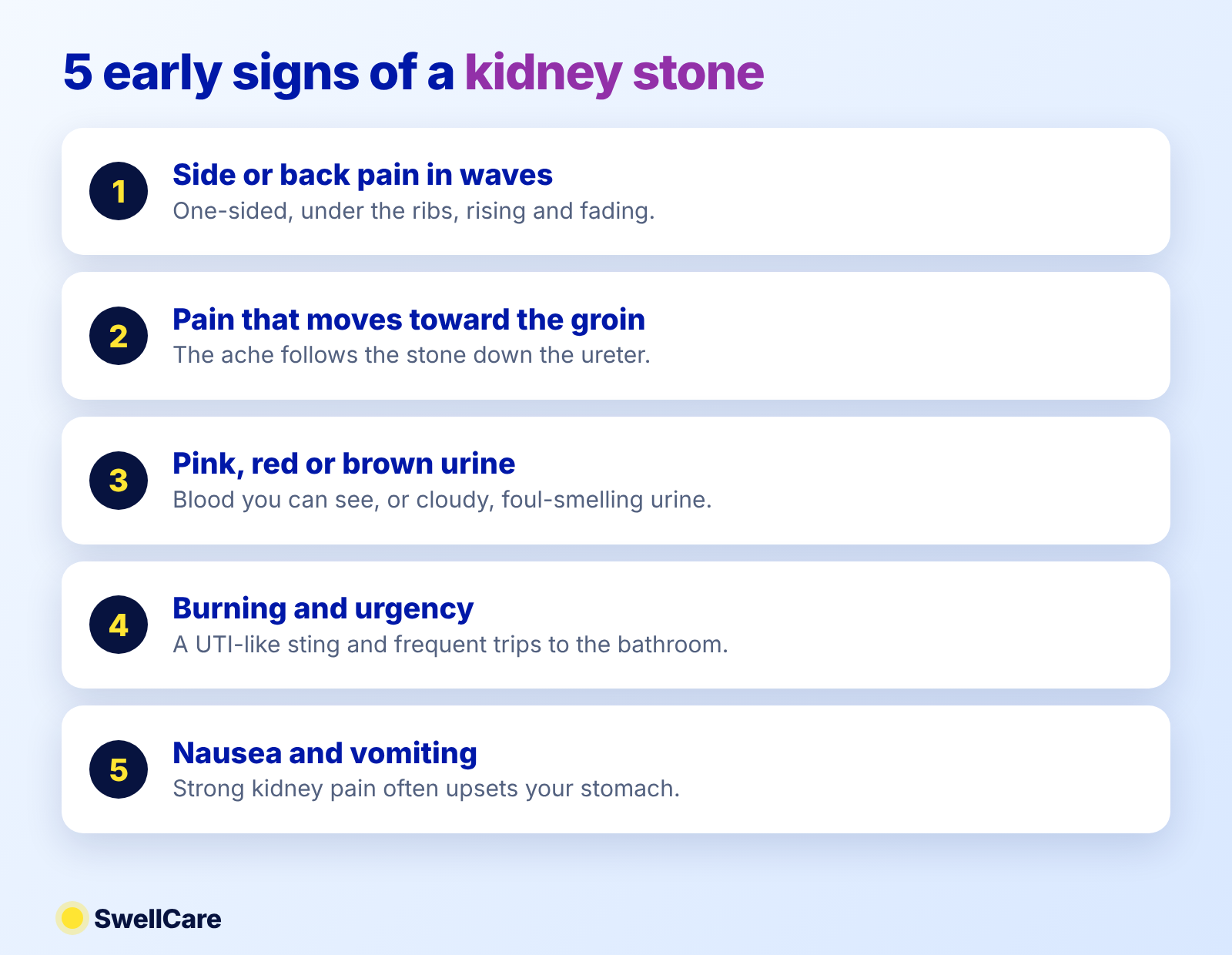
Kidney stone symptoms rarely show up all at once. Here’s the order most people describe, and what each sign tells you.
Side or back pain that comes in waves
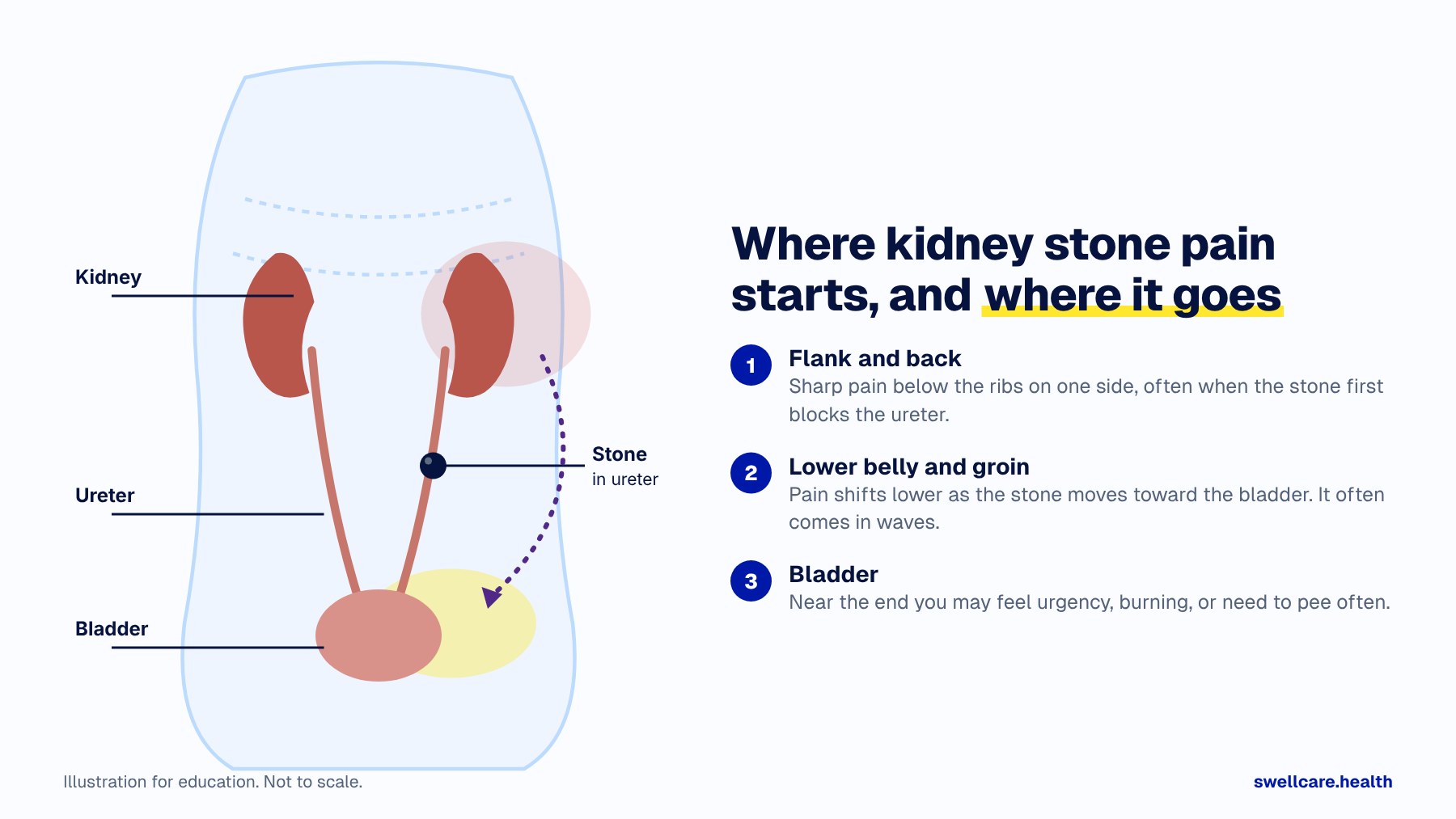
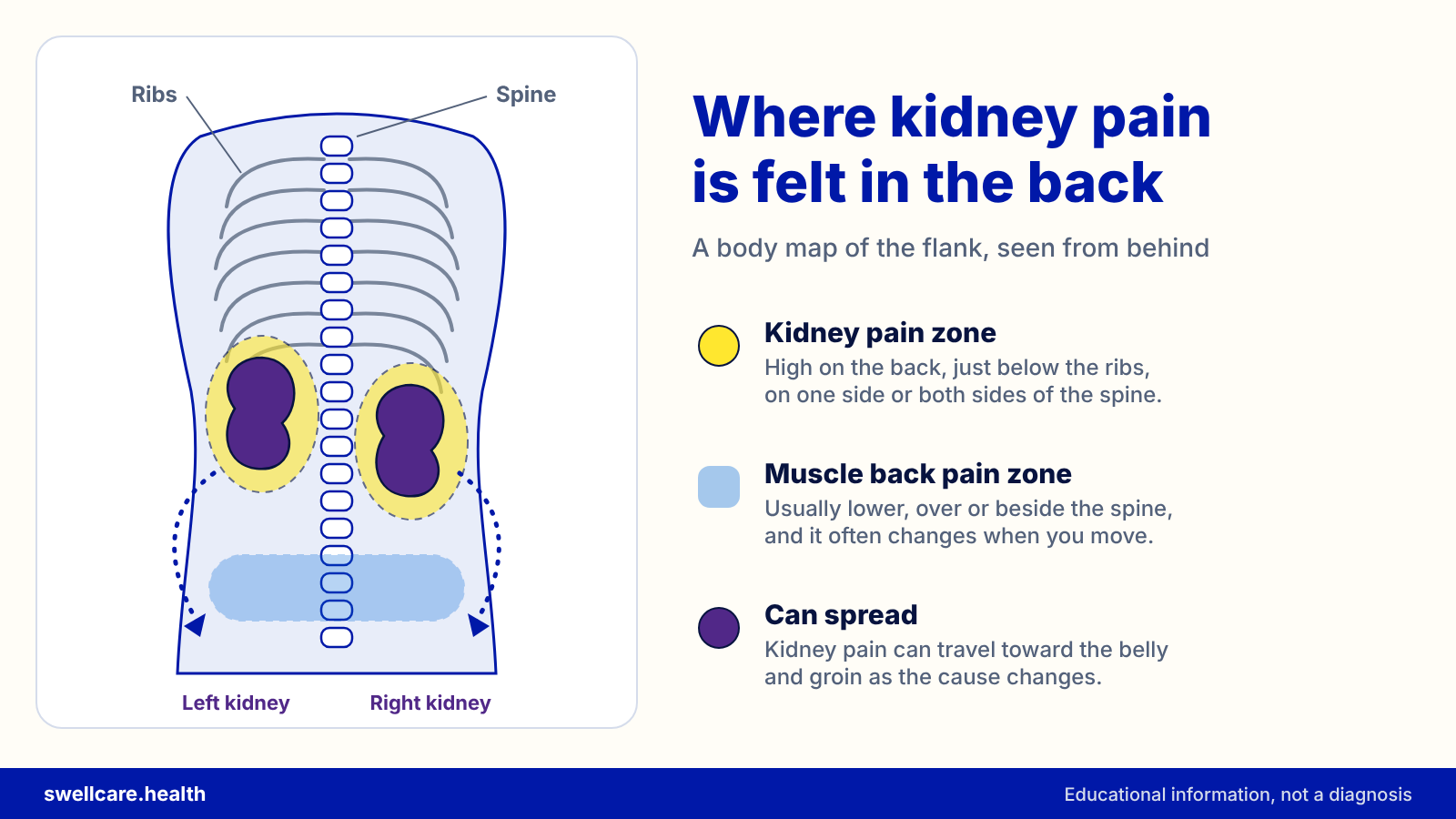
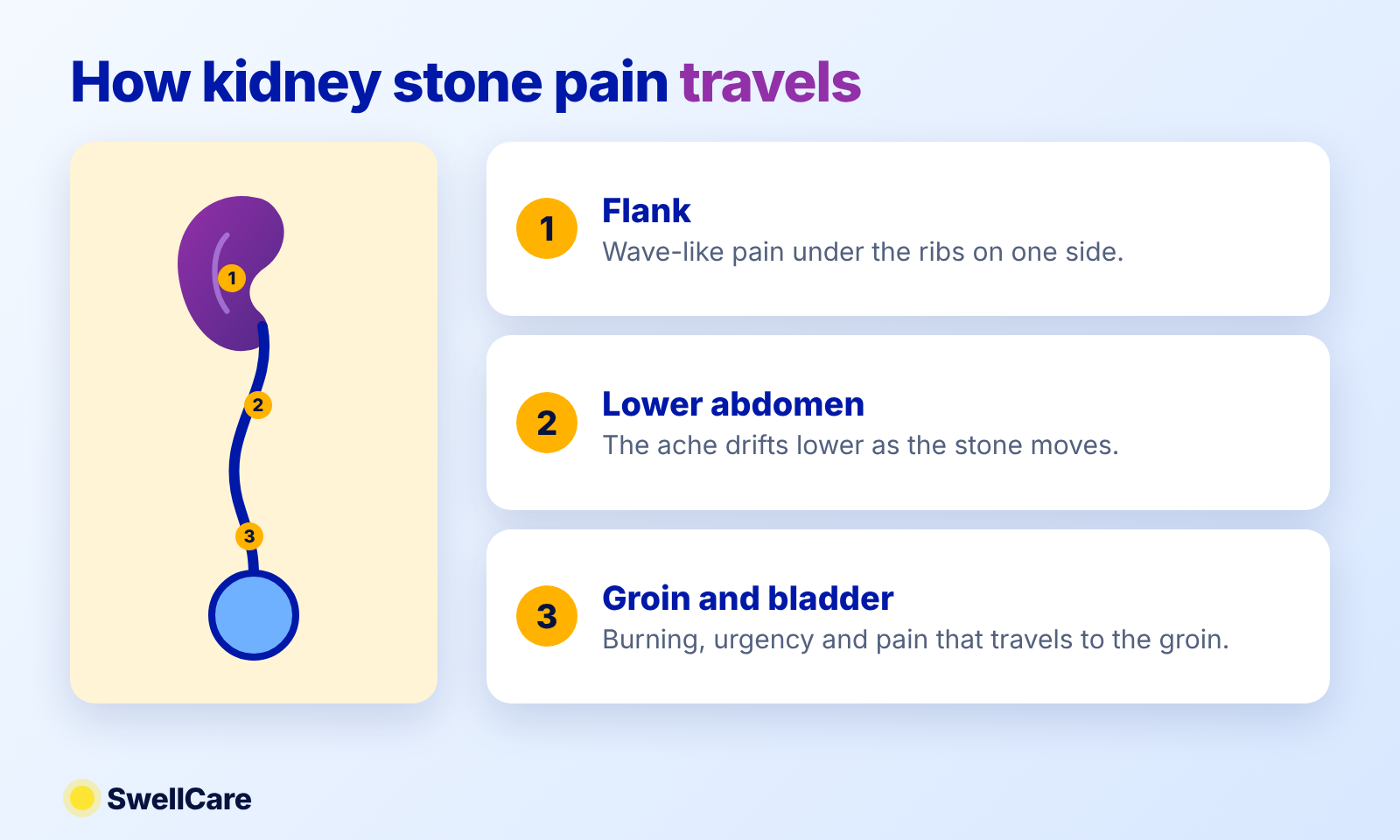
This is the signature. It sits under your ribs on one side, in the flank, and it comes in waves instead of holding steady. It can climb from a nag to a 9 out of 10 in minutes, ease off, then return. That rhythm happens because the ureter, the thin tube that drains your kidney, clamps down around the stone and then relaxes. A steady ache that changes when you twist or bend is more often a pulled muscle.
Pain that travels toward your groin
As the stone slides down the ureter, the ache follows it. You may feel it in your lower abdomen first, then in your groin, and in men the testicles, or in women the labia. If the ache has crept lower since you first noticed it, the stone is probably on the move. Once it reaches the bladder, it can pass out in your urine.
Changes in your urine
Look before you flush. Pink, red or brown urine means blood, and the medical word is hematuria. Sometimes it’s only visible under a microscope. Cloudy or foul-smelling urine can point to an infection. Dark urine in small amounts is a hint that you’re not drinking enough, and low fluid intake is the biggest risk factor for stones.
Burning, urgency and extra bathroom trips
When a stone reaches the lower end of the ureter, near the bladder, it irritates the lining of the bladder and urinary tract much like an infection does. You get a burning sensation during urination, a sudden urge to go, and only a few drops. That’s why so many people assume they have a UTI first.
Nausea and vomiting
The nerves that serve your kidneys and your gut are close neighbors. A stone moving through the ureter often turns your stomach, and plenty of people throw up. Nausea with one-sided pain deserves medical attention, especially if chills join it.
What are the first signs of kidney stones in women versus men?
The core symptoms match. The difference is mostly where the pain spreads: toward the testicles or the tip of the penis in men, toward the labia in women. In women, lower belly pain has many causes, so a stone can be mistaken for period cramps, an ovarian cyst or a UTI. A urine test sorts that out quickly.
Why a small stone can hurt so much
Stones form in the urinary tract when your urine carries high levels of minerals such as calcium, oxalate and uric acid, and those minerals clump into crystals. They range from a grain of sand to a pea, and rarely a golf ball.
Size isn’t the whole story. A small stone sitting quietly inside the kidney can cause nothing at all. The same stone wedged in the ureter blocks the flow of urine and sets off the pain. Location matters more than size.
You’re more likely to get one if you don’t drink enough, have a family history, have had a stone before, carry extra weight, or live with gout or repeat UTIs. Men get them more often than women. Some long-term medicines raise the odds too, including certain diuretics and calcium-based antacids.
What kidney stones get mistaken for
Kidney stones are good impersonators. So are several other conditions, and the pattern matters more than any single symptom.
| Condition | Where it hurts | Clues that point to it |
|---|---|---|
| Kidney stone | One side, from the back around to the front, in waves | Blood in the urine, can’t find a comfortable position |
| UTI | Lower belly pressure | Burning sensation during urination, constant urges, cloudy urine, no waves |
| Appendicitis | Near the belly button, then lower right | Pain with coughing or movement, loss of appetite |
| Back strain | Steady ache in the lower back | Changes with posture, nothing unusual in the toilet bowl |
A kidney infection, which is a urinary tract infection that has climbed upward, can sit on top of a stone as well. That combination is the one you can’t ignore, and we’ll get to it shortly.
Why you shouldn’t wait it out
Plenty of kidney stones do pass on their own, and smaller ones are likelier to. The Urology Care Foundation says waiting up to six weeks is considered safe if you can tolerate the symptoms, there are no signs of infection, the kidney works well and the stone is small enough to pass. That’s a lot of ifs. Without a diagnosis, you’re guessing which ones apply, and you can’t check most of them at home.
A kidney stone that blocks the ureter can back urine up into the kidney. Add bacteria and you have an infection that can spread. Left too long, a blockage can scar the kidney. MedlinePlus lists those risks, and it adds a warning worth remembering: being pain free doesn’t prove the stone is gone. It has to be caught in a strainer or confirmed on a follow-up X-ray.
Our position is simple. Get checked early, even if things settle down. Early treatment is usually simpler treatment, and a short visit now beats a long crisis later.
When to go to the ER and when a same-day visit is enough
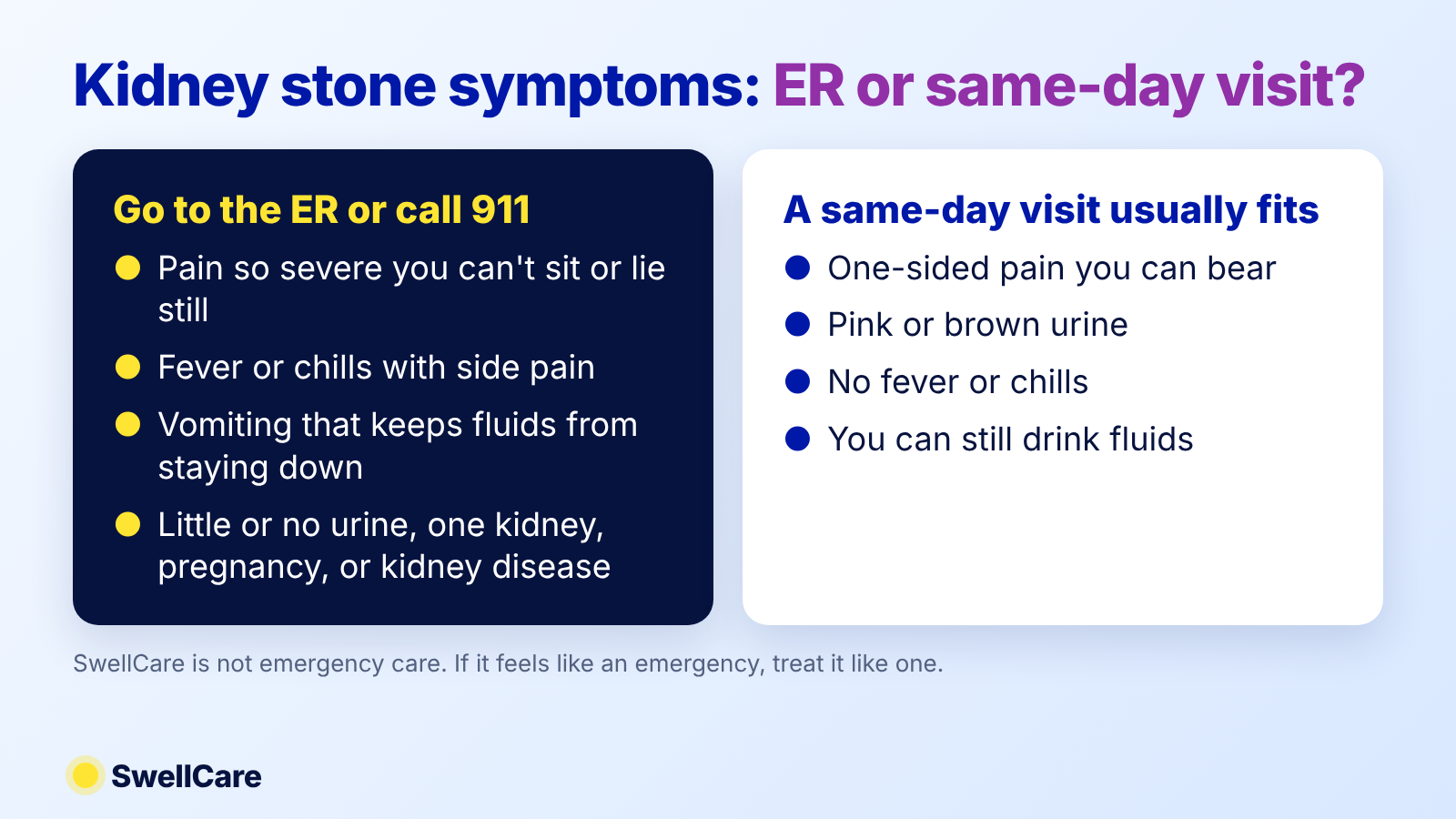
Go to the emergency room or call 911 if you have:
- Pain so severe you can’t sit or lie still
- Fever or chills along with side pain
- Vomiting that keeps you from holding down fluids
- Little or no urine output, or you have one kidney, are pregnant or have kidney disease
Fever and chills with kidney stone symptoms can mean infection behind a blockage, and that needs in-person medical attention. MedlinePlus lists both among the reasons to call a provider, and notes that surgery may be needed when a blockage comes with infection or fever.
A same-day visit usually fits when it’s bearable but one-sided, your urine looks pink or brown, you’re not running a temperature, and you can still drink.
What happens when you get checked
Expect your doctor to ask where it hurts and how the pain behaves. Next comes a urine test for blood, crystals and infection. Blood tests can check kidney function and levels of calcium and uric acid. Imaging confirms the diagnosis: a CT scan or ultrasound shows the stone’s size and location, and a look at your urinary tract with CT is often the choice in the ER.
Kidney stone treatment depends on stone size and symptoms. Small stones often pass with fluids, rest and over-the-counter pain relievers such as ibuprofen or naproxen, unless your doctor has told you to avoid them. A urologist may add a medicine that helps the stone pass. Larger stones, or ones that cause infection or a blockage, may need lithotripsy, which uses shock waves on stones under about half an inch, or ureteroscopy with a laser. Open surgery is rare.
Strain your urine if you can. A caught stone can be analyzed, and that helps your doctor or urologist prevent the next one. Good hydration helps too, and MedlinePlus suggests six to eight glasses of water a day.
Getting help from SwellCare for kidney stone symptoms
SwellCare isn’t emergency care, and it can’t run a CT scan. Here’s what it can do. If you’ve been diagnosed with a stone before and your symptoms feel similar, with no emergency warning signs, a clinician reviews your answers and tells you whether an online visit makes sense or you need testing or treatment in person.
The screening chat is free and a completed consultation costs $45. Medication and lab costs are separate, and a prescription is never guaranteed. You can start with the kidney stone page, or look at urinary tract symptoms that may be a UTI if burning is your main complaint. Need bloodwork afterward? See labs and follow-up.
If this is your first time with these symptoms, or any red flag above shows up, don’t wait for a screen. Seek medical attention in person.
Questions people ask about kidney stones
Can you have kidney stones without pain?
Yes. Many kidney stones cause no symptoms until they start to move. Silent stones are sometimes spotted on an X-ray done for another reason, and small ones inside the kidney may be left alone if they cause no pain or infection. Red or brown urine without pain is still worth a check.
What is commonly mistaken for kidney stones?
UTIs, appendicitis, diverticulitis and back muscle strain are the usual suspects. The giveaway for a stone is one-sided pain that comes in waves and travels toward the groin, often with pink or brown urine. When you can’t tell, a urine test and imaging settle the diagnosis.
What is the average size of a kidney stone?
There’s no single average. Stones run from a grain of sand to a pea, and rarely to a golf ball. Stone size matters because smaller stones are more likely to pass without treatment, and stones under about half an inch are candidates for lithotripsy.
How long does it take to pass a kidney stone?
It depends on stone size and where it sits. Doctors consider waiting up to six weeks reasonable only when symptoms are manageable, there’s no infection and the kidney is working well. If any of those change, the plan changes with them.
Can drinking water help prevent kidney stones?
Yes. Not drinking enough is the biggest risk factor, so hydration is the simplest way to prevent stones. Aim for six to eight glasses a day, and more in hot weather. People who form stones are often told to make about 2.5 liters of urine daily. Your doctor may also adjust sodium, animal protein or oxalate depending on your stone type.
Trusted references
Public-health, research, and medical-society resources related to this guide.