It's 2 a.m. and a pain you've never felt before has you pacing the hallway, unable to sit still. It started in your back, under the ribs, and now it's creeping toward your groin. You're wondering if this is a kidney stone, and whether it's bad enough for the hospital.
So, when should you go to the ER for kidney stones? Go now if the pain comes with a fever or chills, if you can't urinate, if you're vomiting too much to keep fluids down, or if medicine won't touch it. Those symptoms can mean a blocked, infected kidney, and that's a true emergency. Without them, many stones can be handled by your doctor, an urgent care clinic or a urologist.
About 11% of men and 6% of women in the US get a kidney stone at some point, and stone disease led to roughly 1.3 million emergency room visits in 2009 alone.
When should you go to the ER for kidney stones?
Any one of these red flags is enough to go to the emergency room, day or night:
- Fever of 100.4°F (38°C) or higher, or shaking chills. This points to infection behind a stuck stone.
- You can't urinate, or only a few drops come out.
- Vomiting that won't stop, so you can't keep water or pills down.
- Severe pain that medications don't touch.
- You have one working kidney, a kidney transplant or chronic kidney disease. A single blockage can threaten your kidney function.
- You're pregnant, or you feel faint, confused or very weak.
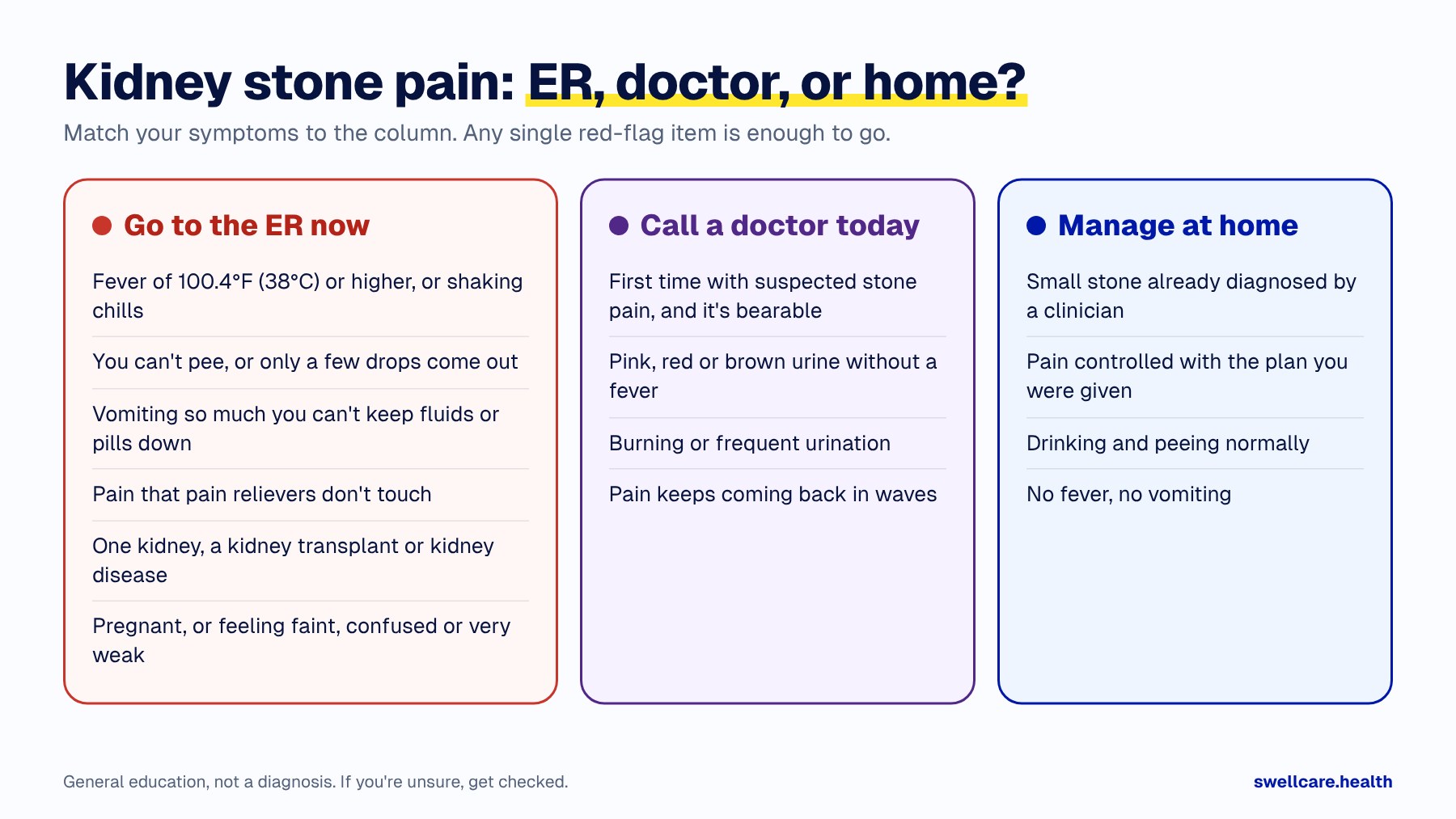
If none of these symptoms apply, call your doctor today. That's the middle ground most guides skip: a kidney stone can feel like an emergency without being one.
What kidney stone pain feels like
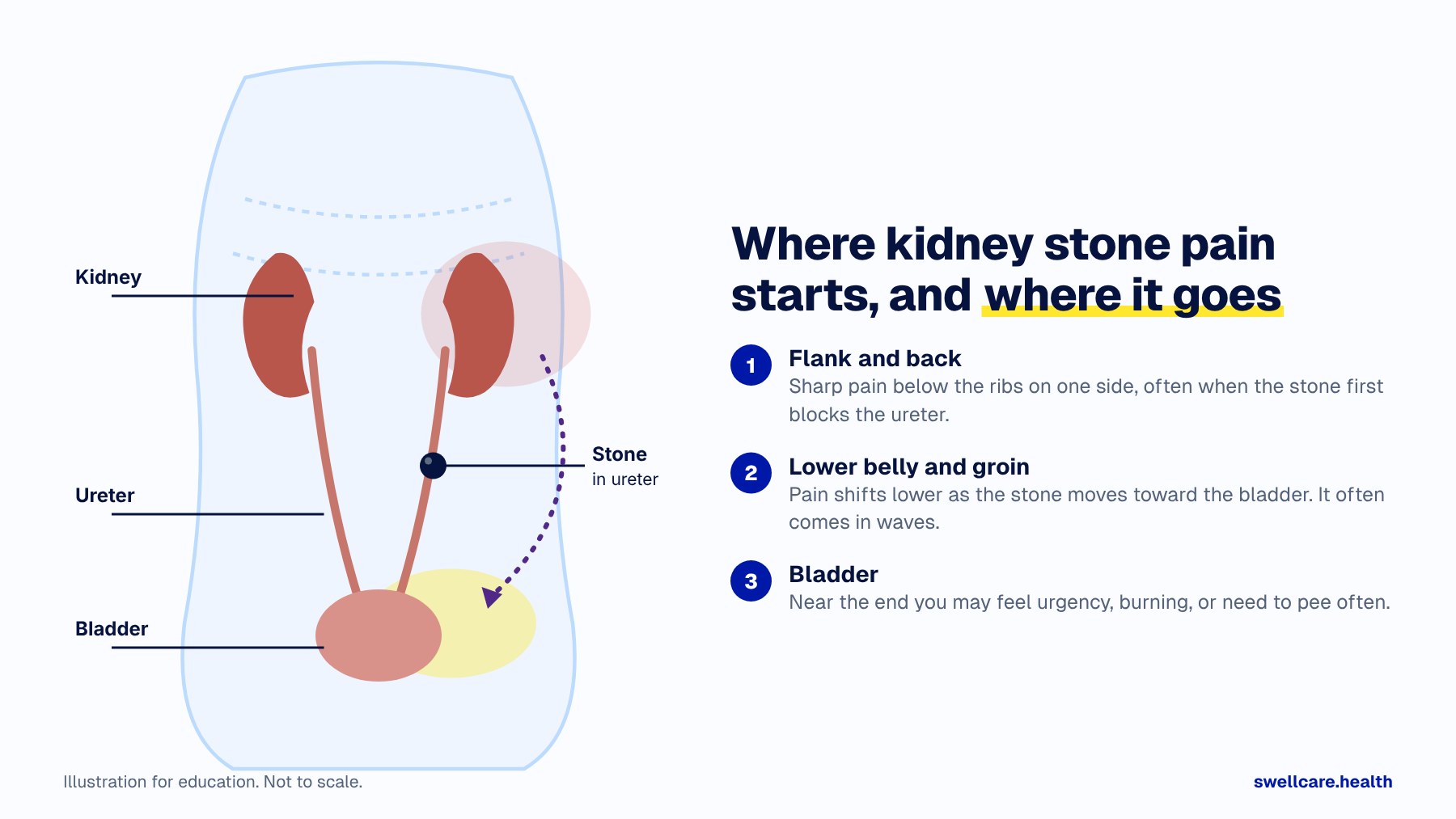
The classic kidney stone symptom is renal colic. It's sharp and cramping. It comes in waves.
It usually starts in your side or back, just below the ribs, then moves into your lower belly and groin as the stone travels down the ureter (the narrow part of the urinary tract that drains into the bladder).
Other common symptoms, according to the NIDDK, include:
- pink, red or brown blood in the urine
- a constant urge to urinate, or pain when you do
- cloudy or bad-smelling urine
- nausea and vomiting
Blood in urine is a strong clue, showing up in 60% to 90% of stone attacks (Endotext). Its absence doesn't rule a stone out.
Why fever with a kidney stone is an emergency
The stone itself rarely does lasting harm. The trouble starts when it blocks urine flow and that trapped urine gets infected.
A blocked, infected kidney can turn into sepsis, a body-wide reaction to infection that can turn life-threatening quickly. Antibiotics alone can't fix it, because the urine can't drain. A urologist has to relieve the blockage, usually with a small tube called a stent or a drain placed through the back. Clinical guidance calls for this urgently, regardless of stone size.
So if you have stone symptoms plus a fever, get emergency care now. Don't wait to see if it settles.
ER, urgent care or urologist: where to go
Urgent care can be a good first stop for a mild first episode, but many centers can't do a CT scan or give IV medicine.
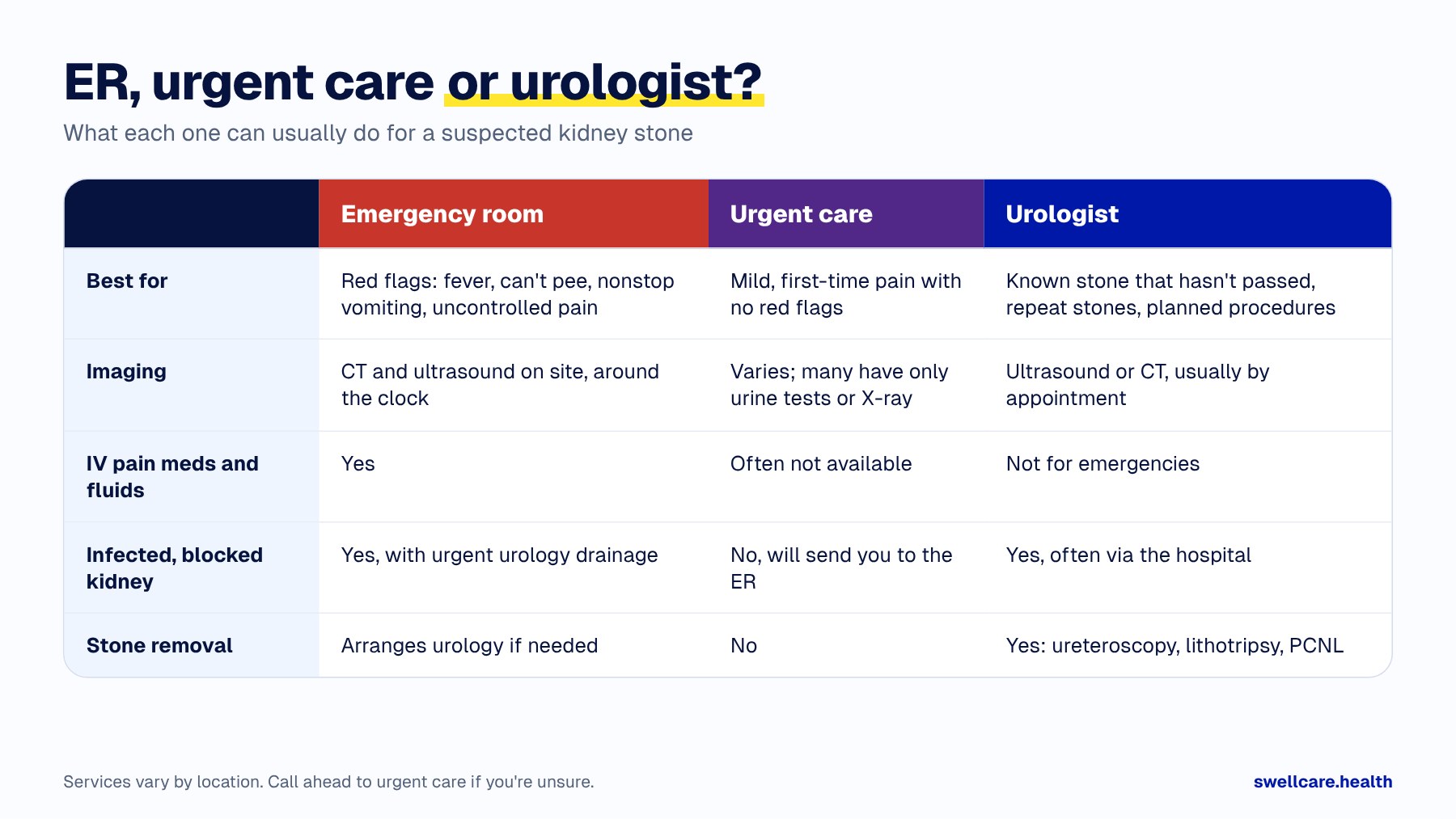
| Your situation | Best place |
|---|---|
| Any red flag above | ER |
| First suspected stone, symptoms manageable, no warning signs | Urgent care or your doctor, same day |
| Known stone that hasn't passed in about 4 weeks | Urology clinic |
| Repeat stones, or a stone over 10 mm | Urology clinic |
What the ER will do for a kidney stone
The first goal is pain control.
Pain relief. NSAIDs such as ketorolac are first-line for renal colic, with opioids held back as a second option. You may also get IV fluids for hydration and anti-nausea medicine.
Lab work. Expect a urinalysis to look for blood and bacteria, and blood tests to check kidney function.
Imaging. A non-contrast CT scan is the most accurate test for a stone. Ultrasound avoids radiation, and in the STONE trial of 2,759 ER patients, starting with it led to no more serious complications than starting with CT. If you're pregnant, ultrasound comes first.
A treatment plan. About 80% of ER visits for stones end with a trip home (AHRQ), often with a prescription, sometimes tamsulosin, and a urology follow-up. The rest are admitted, usually for a blockage or pain that won't settle.
Will your kidney stone pass on its own?
Usually, if it's small. Stone size is the biggest factor.
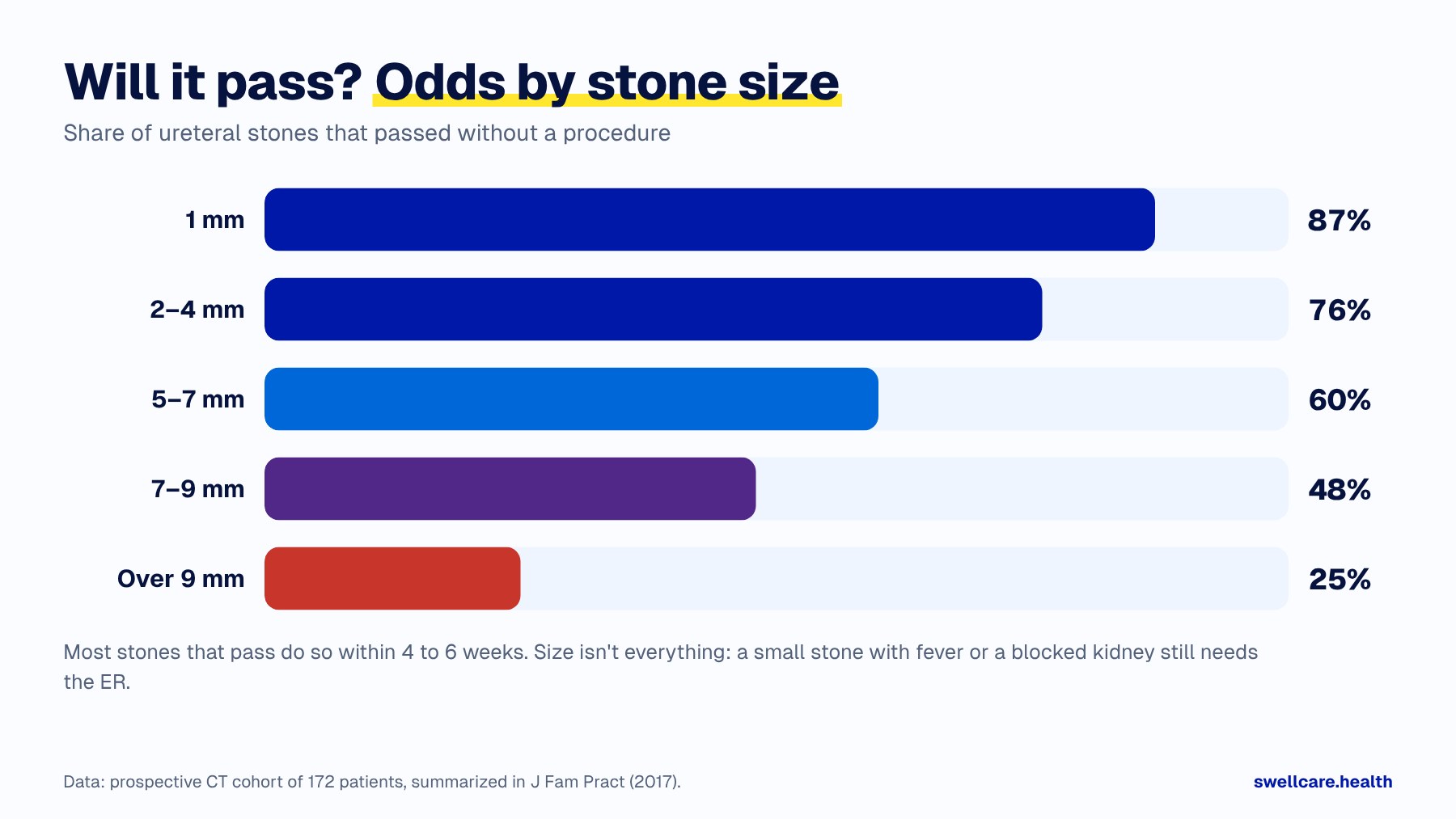
Pooled guideline data show about 68% of stones under 5 mm pass on their own, compared with 47% of stones 5 to 10 mm. Most that pass do so within 4 to 6 weeks.
For stones 5 to 10 mm in the lower ureter, tamsulosin raised passage rates by about 22 percentage points in a meta-analysis summarized in Clinician Reviews. It didn't help smaller stones.
When a stone won't pass, a urologist has treatment options: shock wave lithotripsy, ureteroscopy with a laser, or percutaneous nephrolithotomy (PCNL) for large stones, as NIDDK explains.
Managing a kidney stone at home while it passes
If your doctor has confirmed a small stone and you have no red flags, home care is reasonable. Our approach is simple:
- Keep up your hydration. Drink enough water that your urine stays pale.
- Take pain medicine on schedule, as directed. Ask before using over-the-counter NSAIDs if you have kidney disease or ulcers.
- Catch the stone. Urinate through a strainer so a lab can test it. Knowing whether it's calcium, uric acid or another type shapes how you prevent the next one.
- Know your trigger to go back. Any red flag from the checklist means the ER, even mid-plan.
Pain that looks like a kidney stone but isn't
Not every bout of flank pain is a stone. Appendicitis, a gallbladder attack, a urinary tract or kidney infection and, in women, an ectopic pregnancy or twisted ovary can all feel similar. In older adults, doctors also rule out an abdominal aortic aneurysm, which can mimic a stone (WikEM).
That's why a first episode deserves a proper exam, not a guess.
Your next step
If you're reading this with pain and any red flag, go to the nearest emergency room or call 911. If your symptoms are milder, book a same-day visit and ask for a urinalysis and imaging.
Once treatment is done, ask how to prevent the next one. After a first stone, 30% to 50% of people get another within 10 years. Calcium stones are the most common type, and here's what many people get wrong: NIDDK advises cutting salt, not calcium, because enough dietary calcium helps block stone formation. Uric acid stones need a different diet plan, which is why the lab test matters.
Questions people ask about kidney stones and the ER
Will the ER do anything for a kidney stone?
Yes. The ER can give IV pain relief, treat nausea and dehydration, and confirm the diagnosis with a CT scan or ultrasound. If a stone is blocking an infected kidney, the team calls a urologist to drain it urgently. Most people go home the same day with a plan.
How do I know if my kidney stone is severe?
A stone is severe when it causes a fever, means you can't urinate, triggers vomiting you can't control, or causes pain that medicine doesn't relieve. Those signs suggest a blockage or infection. Stones over 10 mm are also less likely to pass. With only one kidney, any blocking stone is serious.
How long is an ER visit for kidney stones?
It depends on how busy the hospital is. Triage, IV medicine, lab work and a CT scan often take a few hours. A urology consult can add time. If you're admitted, expect at least one night.
Should I go to urgent care or the ER for a kidney stone?
Choose urgent care for mild, first-time symptoms with none of the red flags, and call ahead to check they can scan you. Choose the ER for any red flag, a transplant or single kidney, or pregnancy. When you can't tell, the ER is the safer bet.
When should you go to the ER for kidney stones if you've already been diagnosed?
Go back as soon as any red flag from the checklist appears, even mid-plan. Stones move. One that was safe to pass yesterday can fully block the kidney today. Chills, no urine or pain your prescribed medicine no longer controls all mean a return trip.
Can I go to the ER just for kidney stone pain?
Yes. Severe pain that home medicine can't control is a valid reason to go. Stone attacks rank among the most common reasons adults seek emergency care. Don't wait for more symptoms. Relief and a diagnosis are reason enough.
Trusted references
Public-health, research, and medical-society resources related to this guide.