If you're reading this at 2 a.m. between bathroom trips, here's the number you came for. Once you start antibiotics, a plain bladder infection usually stops burning within a day or two, and most people have swallowed the last pill inside a week. So, how long does UTI last? With treatment, not long.
Skip the antibiotics and a UTI becomes a coin toss, and a lopsided one. In placebo trials, more than half of women still had symptoms on day 9, and a small number crept up toward the kidneys. Below: each version, plus the signs that mean "stop reading, call someone."
How long does UTI last with antibiotics?
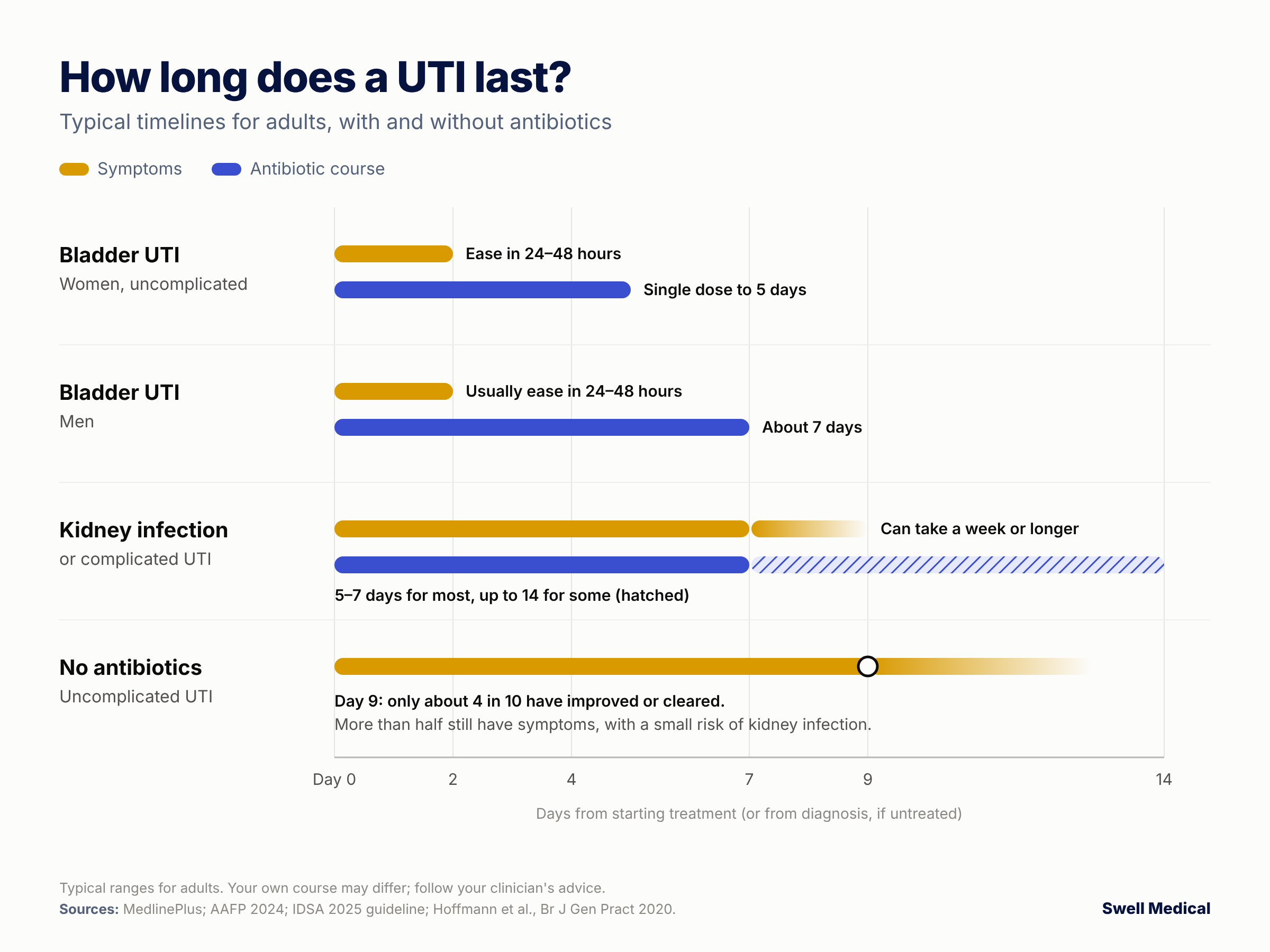
Fast. MedlinePlus puts it at 24 to 48 hours for bladder infection symptoms to clear once treatment begins. That early relief is a trap, though. Feeling fine on day two and being cured on day two aren't the same thing, so keep going until the bottle's empty.
| Type of infection | Typical antibiotic course | When symptoms usually ease |
|---|---|---|
| Bladder UTI, women | Single dose to 5 days | 24 to 48 hours |
| Bladder UTI, men | About 7 days | Usually 24 to 48 hours |
| Kidney infection or complicated UTI | 5 to 7 days, sometimes 14 | Can take a week or longer |
| No antibiotics | None | About 4 in 10 better by day 9 |
Bladder infections (uncomplicated UTIs)
Most UTIs begin with gut bacteria wandering up the urethra and setting up camp in the bladder. For healthy women who aren't pregnant, the American Academy of Family Physicians lists some refreshingly short options: one dose of fosfomycin, 5 days of nitrofurantoin, or 3 days of trimethoprim-sulfamethoxazole. Men get closer to 7 days, with a urine culture first so the drug matches the bug.
Kidney infections and complicated UTIs
"Complicated" doesn't mean scary. It means the infection has moved past the bladder (a kidney infection, or pyelonephritis), or it's happening in a body that makes things harder: a catheter, a blockage, pregnancy, diabetes that isn't well controlled. Under the 2025 IDSA guideline, people who are improving typically get 5 to 7 days of a fluoroquinolone or 7 days of something else.
How long does a UTI last without treatment?
There's real data on this.
A 2020 systematic review pooled women with uncomplicated UTIs who got only a dummy pill in trials. In the two bigger studies, 28% to 37% were symptom-free after 7 days. By day 9, roughly 42% had improved or cleared. Flip that around: more than half still had symptoms nine days in.
Then there's a German urinary tract infection trial in The BMJ. Of 494 women, half took only ibuprofen and half took a single antibiotic dose. Two-thirds of the ibuprofen group did recover without antibiotics. Sounds great. Then you read the rest: they felt worse, for longer, and five ended up with a kidney infection versus one in the antibiotic group.
Our take? Waiting it out is possible. It's rarely worth it when a three-day course usually fixes the problem by Thursday.
What happens if a UTI goes untreated
Left alone, an untreated UTI can climb the urinary tract and reach the kidneys. Your symptoms tell you when that happens: fever, chills, an ache in your back or side, maybe vomiting. In rare cases the infection spills into the blood and becomes sepsis, which is an emergency. Babies, the very old and anyone immunocompromised are most at risk.
Signs your UTI is healing, or getting worse
Don't judge it hour by hour. Look at how your symptoms move across two or three days of treatment.
Signs it's getting better
The burning usually goes first. Then the urgency fades, and you urinate on a normal schedule instead of every 10 minutes. Murky or pinkish urine turns clear. Most people feel like themselves by day 3.
Signs it's getting worse
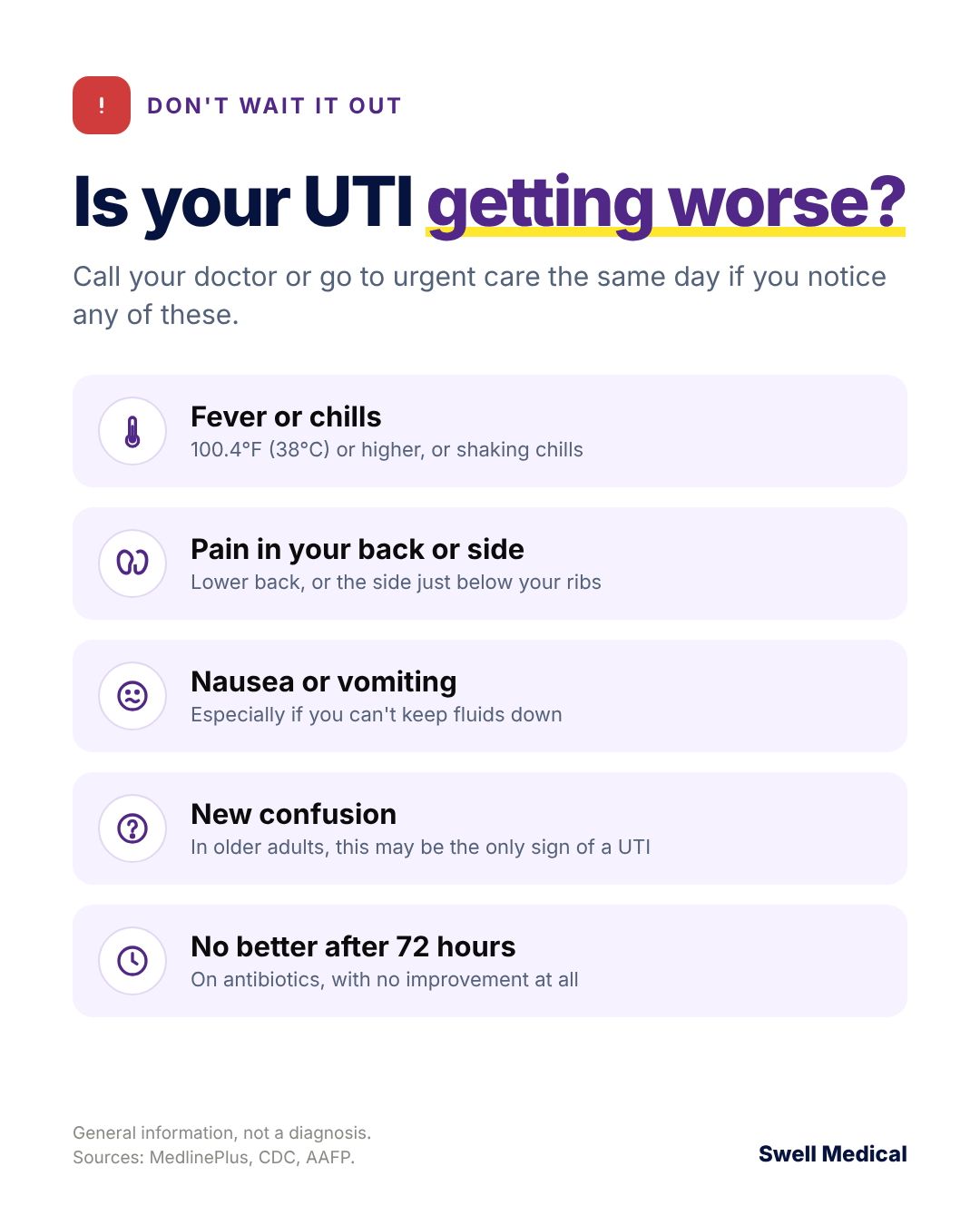
- Fever (100.4°F or higher) or chills that make your teeth chatter
- Pain in your back or side
- Nausea, or you can't keep food down
- Grandma is suddenly confused or unusually sleepy. In older adults that can be the only clue there's a UTI at all
- You're 72 hours into antibiotics and nothing has budged
Any one of these symptoms means the infection may be heading upward, or the drug isn't the right match. Call your doctor or get to urgent care that day, not next week.
Why some UTIs last longer
Usually it's one of three things.
- The bug shrugs off the antibiotic. Antibiotic resistance means your symptoms won't improve until you switch antibiotics. A urine culture confirms the diagnosis and shows which antibiotics will actually work.
- Another health issue is in the way. Diabetes, pregnancy, a urinary blockage or a weakened immune system can all slow recovery.
- Hormones changed. In postmenopausal women, estrogen drops and repeat infections get more common.
How to feel better while the antibiotics work
Stay hydrated, more than you think you need. The AAFP suggests at least 1.5 liters of fluids a day. More fluids, more flushing, and it hurts less to urinate. Ibuprofen or acetaminophen can help with the pain while antibiotics do the real work.
Phenazopyridine, the over-the-counter bladder numbing pill, is a painkiller, not a cure. Drugs.com says not to use it longer than 2 days unless your doctor tells you to. It dyes your urine a startling orange. Harmless, but it ruins underwear.
And cranberry juice? It won't clear an infection you already have. Keep it in the "help prevent the next one" column.
Stopping the next one
Two or three UTIs a year is enough to justify a plan with your doctor to prevent them. Cranberry products made the cut in a 2023 Cochrane review, which found they lowered the risk of repeat infections in women with recurrent UTIs. The Urology Care Foundation adds vaginal estrogen for postmenopausal women and methenamine hippurate, a non-antibiotic option.
Pee after sex to rinse the urethra. Wipe front to back. Gut bacteria should stay well away from the urethra. And when you need to urinate, go, rather than holding it through a three-hour meeting.
When to see a doctor, and how to get relief today
Here's the trade, side by side. Treated, most bladder UTIs stop burning within 24 to 48 hours. Untreated, more than half still have symptoms at day 9, with a small but real risk of a kidney infection. One short visit usually decides which version you get.
The CDC says to see a healthcare provider for any urinary tract infection symptoms. Go same-day, with your doctor or at urgent care, if you've got fever, back pain or vomiting, or if you're pregnant. If symptoms come back after you finish the antibiotics, call again. Bring a list of antibiotics you've taken this past year so your clinician can pick one that works the first time.
Questions people ask about how long a UTI lasts
How do you know when a UTI is healing?
Burning is usually the first thing to fade, often within a day of starting antibiotics, and then you stop planning your day around bathrooms. If your symptoms ease a bit more each day with no fever or back pain, you're on track. Finish every dose anyway.
What can flush out a UTI fast?
Antibiotics, boringly. Nothing in your kitchen clears a UTI as reliably. Water does help your bladder push bacteria out and takes some of the sting away. Cranberry has decent evidence for preventing repeat infections, while D-mannose didn't prevent recurrences in a 2024 trial. Neither one treats an infection that's already started.
Can a UTI last for months?
One properly treated infection shouldn't. When symptoms drag on for weeks or keep returning, something else is usually going on: resistant bacteria, a bladder that doesn't empty fully, or a look-alike such as interstitial cystitis. Ask for a urine culture to pin down the diagnosis, and if you're dealing with recurrent infections, a urologist referral.
Trusted references
Public-health, research, and medical-society resources related to this guide.