It's 9 p.m., it burns when you pee, and your doctor's office is closed until Monday. You type "order antibiotics online" and get a wall of results. Some look like clinics. A few promise pills with no questions asked.
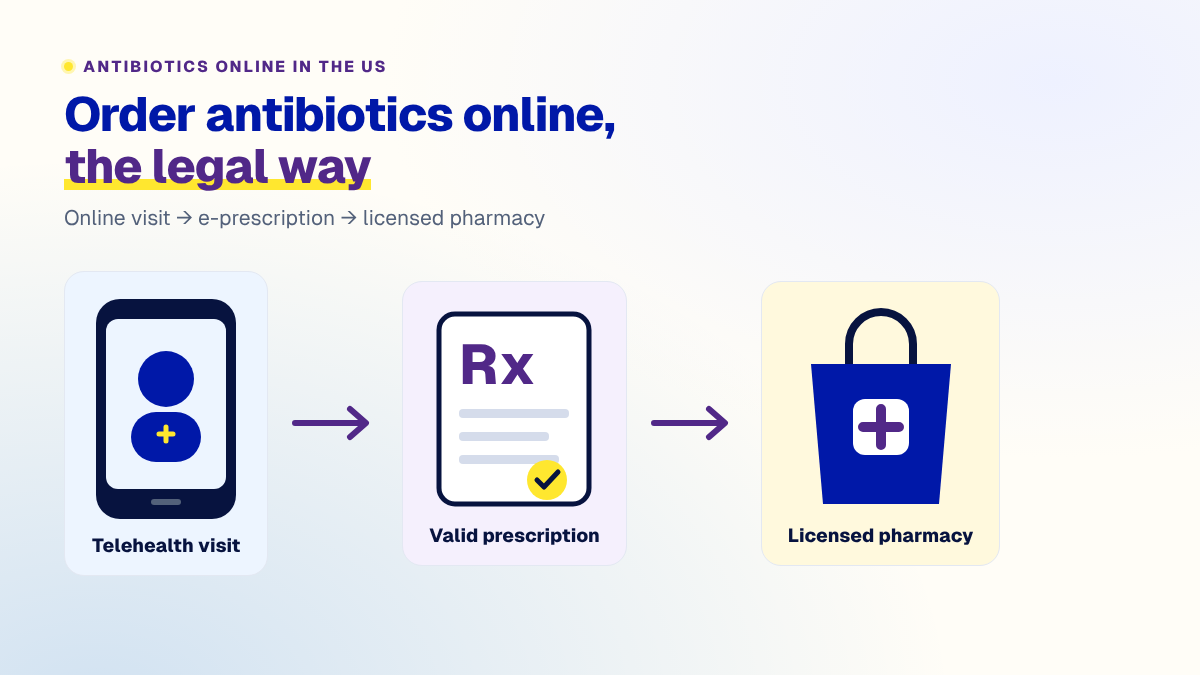
Yes, you can order antibiotics online in the United States, and it can be quick and fully legal. But only one way works: a licensed clinician reviews what's going on, writes a valid prescription, and a licensed pharmacy fills it. Anything that skips the prescription is illegal, and it's often unsafe.
The short answer: yes, with a prescription
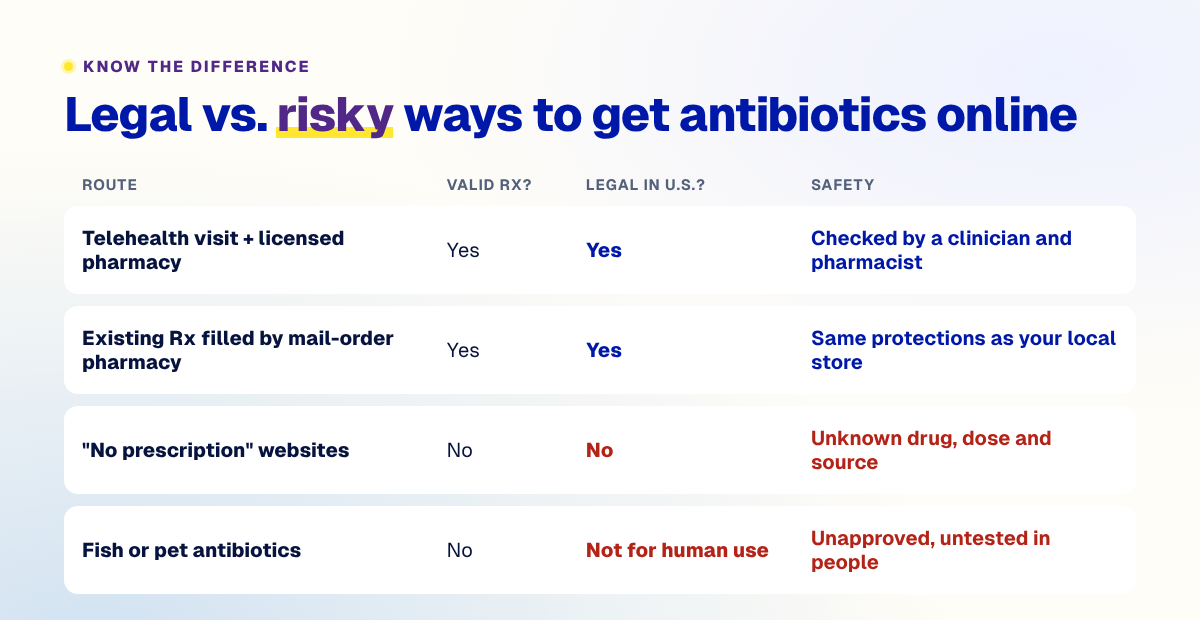
In the US, oral antibiotics are prescription-only drugs. That rule doesn't change because the store is a website. So the real question is whether you can get the prescription online too. You can.
There are three legal routes:
- Telehealth consultation, then pharmacy. You see a doctor, nurse practitioner or physician assistant by video, phone or secure chat. If antibiotics make sense, they send an e-prescription.
- Existing prescription, filled by mail. You already have a valid prescription or refill and use a licensed mail-order service.
- Your own doctor's patient portal. Many practices will handle a simple infection through a portal message or a quick virtual visit.
The illegal route is the one many ads push: "no prescription needed."
Why you can't buy antibiotics online without a prescription
Under federal law, pharmacies can only dispense these drugs on a licensed clinician's order. The FDA's advice is blunt: a safe online pharmacy will always require a doctor's prescription.
The rule isn't red tape. Antibiotics only work on bacteria. They do nothing for viruses like colds or flu, and the wrong medication, dose or length of treatment can leave a bacterial infection half-treated. Every unnecessary course also gives bacteria a chance to adapt.
That adaptation is antibiotic resistance, and it's already here. The CDC estimates that more than 2.8 million antimicrobial-resistant infections happen in the US each year, and more than 35,000 people die from them. Even inside regular clinics, at least 28% of outpatient antibiotics are unnecessary. Cut the clinician out, and antibiotic resistance gets worse, not better.
The "no prescription" websites are real, too. When researchers searched for antibiotic sellers, 36.2% of 138 vendors sold antibiotics without any prescription. Their test order of azithromycin arrived 28 days later from Mexico, with no instructions. That's four weeks of an untreated bacterial infection.
What about over-the-counter antibiotics?
A few antibiotics are sold over the counter, but only as creams and ointments for small cuts and scrapes, such as bacitracin or triple-antibiotic ointment. Antibiotic pills and liquids for a urinary tract infection, sinus infection or strep throat aren't sold over the counter in the US.
Fish antibiotics and overseas websites
Some people try aquarium antibiotics because the label says "amoxicillin." Don't. In December 2023 the FDA sent warning letters to companies selling unapproved antimicrobials for fish and pet birds, noting it can't confirm these products are safe, effective or even contain what the label says.
Ordering from a foreign website isn't a loophole either. The FDA says that in most circumstances it's illegal for individuals to import drugs for personal use.
How to order antibiotics online legally, step by step
Most people are done in under an hour, and many telehealth services can treat common bacterial infections the same day.
Federal law has no in-person exam requirement for non-controlled medications like antibiotics. The clinician still owes you the same standard of care as an office visit and must be licensed in your state.
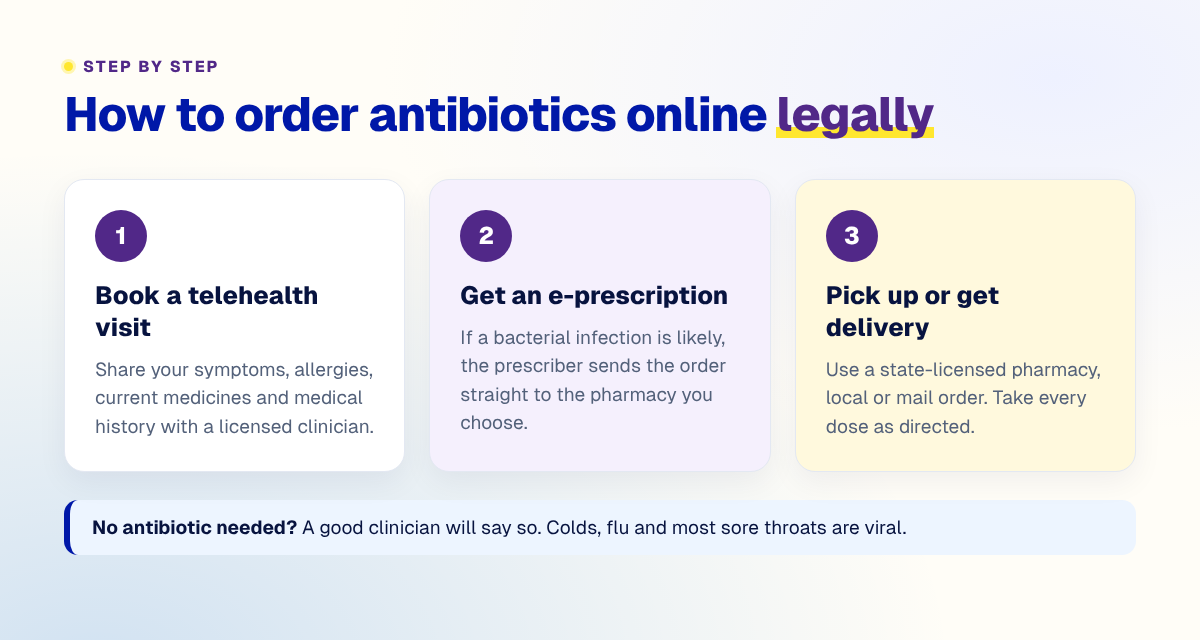
Step 1: Book a telehealth visit
Pick a service with board-certified doctors or licensed nurse practitioners that tells you who'll see you. During the consultation, expect questions about what you're feeling, how long it's lasted, your medical history, allergies, pregnancy, and any medication you already take, including birth control. Keep your medication list handy.
Be specific. "Burning when I pee for two days, no fever, no back pain" beats "I think I have a UTI."
Step 2: Get your e-prescription
If the clinician thinks bacteria are behind it, they'll send an e-prescription straight to the store you name. Sometimes they'll order a test first, such as a urine culture or rapid strep swab.
Sometimes the answer is no. A doctor who won't prescribe antibiotics for a cold is doing their job.
Step 3: Pick up or get delivery
Choose a local pharmacy for same-day pickup, or licensed mail order if you can wait a day or two. Need a refill later? Ask whether the prescription includes one. Most short antibiotic courses don't, and a refill usually needs a new consultation.
Infections an online doctor can treat with antibiotics
Telehealth works best for common, uncomplicated bacterial infections with clear symptoms:
- Urinary tract infection (UTI): an uncomplicated urinary tract infection in an otherwise healthy woman is one of the most common reasons people order antibiotics online.
- Strep throat: often needs a rapid test first, because most sore throats are viral, not caused by bacteria.
- Sinus infection: antibiotics are usually held back unless symptoms last more than about 10 days or get worse after improving.
- Skin infections: mild cellulitis, infected cuts and some acne caused by bacteria.
- Some sexually transmitted infections: bacterial infections like chlamydia, usually with a lab test ordered alongside.
What doesn't belong online? Suspected pneumonia, a fever with a stiff neck, or a UTI with back pain and vomiting. Bacterial infections like these need an exam, and sometimes imaging or IV antibiotics.
Common antibiotics prescribed online
You don't pick the antibiotic. Your clinician does, based on the likely bacteria, your allergies and local resistance patterns. Still, these are the names you're most likely to see on the label.
| Antibiotic class | Common examples | Often used for |
|---|---|---|
| Penicillins | Amoxicillin, amoxicillin-clavulanate | Strep throat, sinus and ear infections |
| Cephalosporins | Cephalexin | Skin infections, some UTIs |
| Macrolides | Azithromycin | Certain respiratory infections, some STIs |
| Tetracyclines | Doxycycline, minocycline | Acne, some skin and tick-borne infections |
| Others | Nitrofurantoin, trimethoprim-sulfamethoxazole | Uncomplicated UTIs |
If you've ever had an allergic reaction to penicillins like amoxicillin, say so clearly. Macrolides such as azithromycin are a common alternative, though resistant bacteria limit where they work well. Tetracyclines like doxycycline are a long-standing acne option.
How to tell if an online pharmacy is legit
Most of the risk sits here. The National Association of Boards of Pharmacy (NABP) says nearly 95% of websites selling prescription drugs operate illegally. Many look polished. Some copy real brands.
Check four things before you hand over a card number, straight from the FDA's BeSafeRx guidance:
- It requires a valid prescription. No exceptions.
- It's licensed by your state board of pharmacy, which you can confirm through the state license lookups BeSafeRx links to (if it isn't listed, don't use it).
- It lists a US street address and phone number.
- A licensed pharmacist is there to answer questions about your medication.
A quick shortcut: web addresses ending in .pharmacy have been vetted by NABP, and its Safe Site search tool will tell you if a site is on the "Not Recommended" list.
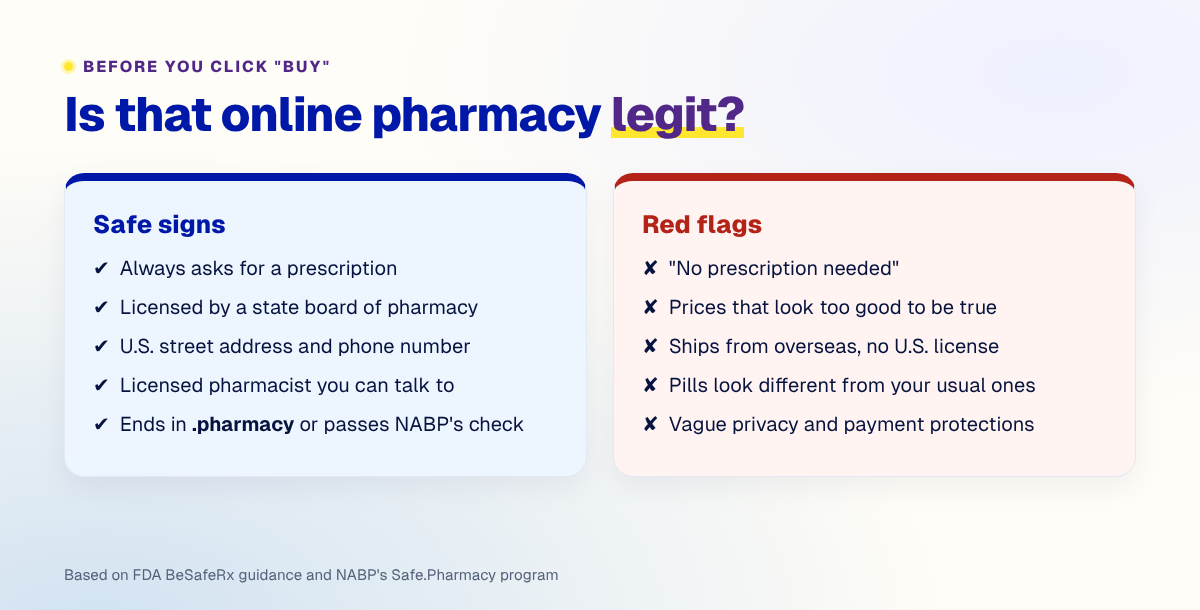
Red flags matter too. Deep discounts, no prescription, pills that look different from your usual ones or packaging in another language all mean walk away.
What ordering antibiotics online costs
You'll usually pay for two things: the consultation and the medication.
With insurance, many plans cover telehealth much like an office visit, so you may only owe a copay. Some insurance plans steer you to their own virtual care partner, so check your card or app first. Medicare and Medicaid rules vary by plan and state. Without insurance, telehealth companies usually charge a flat fee, and prices vary widely.
Most common antibiotics are generic and fairly inexpensive. Paying cash? Discount cards can cut the price, and sometimes the cash price beats your insurance copay, so ask. Medication that costs more online than at your local store isn't a deal.
Taking antibiotics safely
Getting the prescription is half the job. Take every dose at the times listed, and follow your prescriber's instructions on how long to continue. Don't save leftover antibiotics or share them. Common side effects include an upset stomach, diarrhea and yeast infections. Taking some antibiotics with food helps.
Call a doctor or pharmacist right away if you notice side effects such as a rash, hives, swelling of the lips or face, or trouble breathing. These can signal an allergic reaction. Severe or watery diarrhea during or after treatment also needs a call.
Ask about interactions with other antibiotics and drugs. Rifampin, for example, makes some hormonal birth control less effective. Your pharmacist can check your full medication list in minutes.
When to skip telehealth and see a doctor in person
Go to urgent care or the ER instead if you have:
- trouble breathing, chest pain, or signs of pneumonia such as fever with a productive cough and shortness of breath
- a fever over 103°F, confusion, or a stiff neck
- back or side pain, vomiting, or fever with UTI symptoms
- redness that's spreading fast, or a wound that's hot, swollen and draining
- symptoms in a baby, during pregnancy, or with a weak immune system or complex medical history
If you're unsure, start the virtual visit anyway. A good clinician will tell you to go in.
Your next step
If it looks like a simple infection, book a telehealth visit with a licensed clinician, have the e-prescription sent to a state-licensed pharmacy, and skip any site that sells antibiotics without one. That's the whole safe way to order antibiotics online.
Questions people ask about ordering antibiotics online
Can I order antibiotics without seeing a doctor?
Not legally. You don't have to see a doctor in person, but a licensed clinician has to assess you and write a prescription. A video, phone or chat visit counts. Sites selling antibiotics with "no doctor needed" are breaking US law, and you can't know what's in the package or whether it suits your infection.
Can you purchase antibiotics online?
Yes. Once you have a valid prescription, you can buy antibiotics online from a state-licensed pharmacy that ships to your home, or send it to a local store for pickup and use your insurance as usual. Check the license through the FDA's BeSafeRx tool before you pay.
Is it legal to buy antibiotics from Canada or Mexico online?
Generally, no. The FDA says it's illegal in most cases for individuals to import prescription medication for personal use. Foreign sites also aren't licensed by your state. The FDA's narrow exceptions don't fit a routine antibiotic you can get legally at home.
How fast can I get antibiotics online?
Often the same day. Many telehealth visits take 15 to 30 minutes, and an e-prescription can reach a local store within an hour or two. Mail delivery usually takes one to three days. Getting worse quickly? Local pickup or in-person urgent care is faster.
Can an online doctor refuse to prescribe antibiotics?
Yes, and sometimes they should. If it sounds like a virus, antibiotics won't help and can cause side effects. The clinician may suggest symptom relief, a lab test or an in-person exam instead. That's the call a careful doctor would make in an office.
Will antibiotics help a cold or the flu?
No. Colds, flu and most sore throats are caused by viruses, and antibiotics only work on bacteria. Taking them anyway won't speed recovery, and it feeds antibiotic resistance. Flu has its own antiviral treatment, which a telehealth clinician can prescribe if you're seen early enough.
Trusted references
Public-health, research, and medical-society resources related to this guide.