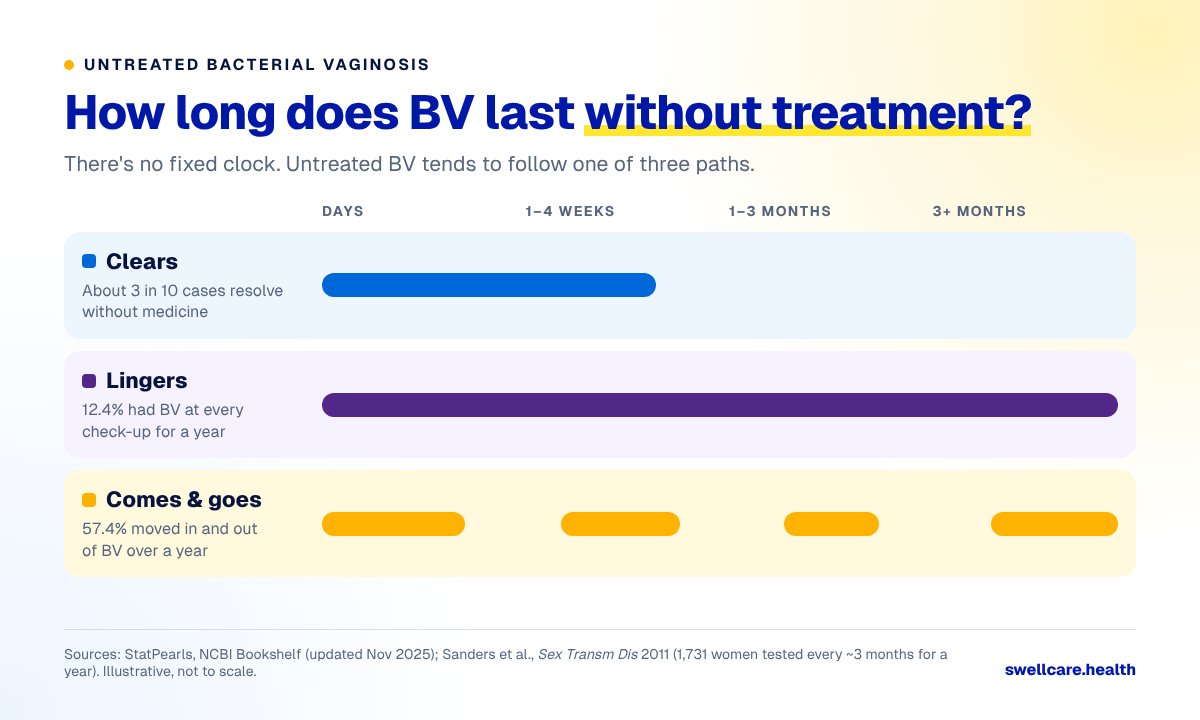
How long does BV last without treatment? It depends on which of these three paths yours takes: it clears, it lingers in the background, or it seems to go and then keeps coming back.
That fishy smell has hung around for a week. Maybe the vaginal discharge looks a little thinner and grayer than usual. You're hoping it'll just stop.
Sometimes it does. So how long does BV last without treatment? There's no fixed clock. Roughly 3 in 10 cases of bacterial vaginosis clear without any medicine, sometimes within a few weeks. The rest can drag on for months, fade and flare, or vanish and then come straight back.
Waiting isn't always wrong. But it's a gamble with real downsides, and a short course of antibiotics clears most cases within a week. Below you'll find what the research says, what to watch for, and the point where waiting stops making sense.
How long does BV last without treatment?
Bacterial vaginosis isn't a classic infection where one germ invades. It's an imbalance in the vaginal microbiome. A healthy vagina usually runs on lactobacilli, the "good" bacteria that keep the environment acidic. With bacterial vaginosis, other bacteria (Gardnerella and a mix of anaerobic bacteria) take over, the vaginal pH rises, and the familiar symptoms show up.
Because it's a shift in balance rather than an invader, your body can sometimes shift it back. The CDC says plainly that "at times, BV will go away without treatment." What no one can tell you is whether yours will, or how fast.
Here's the realistic picture:
| Timeframe | What tends to happen with untreated BV |
|---|---|
| A few days | Symptoms may come and go, often around your period or after sex |
| 1 to 4 weeks | Some cases settle as lactobacilli recover |
| 1 to 3 months | Many cases are still present, often with no symptoms at all |
| 3+ months | BV may persist, or clear and return in cycles |
When BV clears up on its own
Spontaneous clearing happens when Lactobacillus species regain ground, crowd out the BV bacteria and bring vaginal pH back toward normal. Avoiding triggers helps: no douching, no scented washes, and condoms for a while. The CDC notes that some people have only "transient" changes in their vaginal bacteria while others have them for much longer.
When it lingers for months or keeps coming back
The other side is less comforting. In a large Alabama study that tested 1,731 women every three months for a year, 12.4% had BV at every single visit, and 57.4% moved in and out of it. So for many people, untreated BV doesn't end so much as idle in the background. That's the real answer to whether bacterial vaginosis will go away on its own: it might, but you can't count on it.
What decides whether BV goes away by itself
You can't control everything, but certain habits push bacterial vaginosis one way or the other.
Douching is the big one. In that same study, women who douched were more likely to stay BV-positive across the whole year. It washes out the protective bacteria along with everything else.
Sexual activity plays a part. Semen is alkaline, so frequent unprotected sex can nudge vaginal pH up and give BV bacteria the upper hand. A new sex partner, or several, raises the odds of bacterial vaginosis too, and so does sex between women when vaginal fluid is shared.
Your period matters. Blood is also alkaline, which is why some people notice the smell creeping back every month. Smoking, a copper IUD and a recent course of antibiotics for something else have all been linked to BV in some studies.
Want to give your body a fair chance? Use condoms for now, skip anything scented near the vulva and let it be for a week or two. If things aren't clearly better by then, get checked.
Can you have BV and not know it?
Yes, and it's common. About 29% of US women aged 14 to 49 have BV at any given time, and 84% of them report no symptoms, according to national survey data.
That matters for timing. "My symptoms went away" and "my BV went away" aren't the same thing. Asymptomatic bacterial vaginosis still changes the vaginal environment and still raises your odds of STIs, which is why a negative test is the only real proof it's gone.
It also means some people have had BV for months before they ever notice it. Sometimes it only turns up during a routine pelvic exam or Pap test.
Signs BV is clearing up, or getting worse
Signs it may be settling:
- The fishy odor fades, including after sex or your period
- Discharge goes back to clear or white and your usual amount
- No itching or burning when you pee
Signs it isn't:
- A strong fishy smell that keeps returning
- Thin gray or off-white vaginal discharge that won't let up
- New vaginal itching, burning, soreness or pelvic pain
Odor is usually the last thing people notice going and the first they notice coming back. Had it on and off for more than two weeks? Assume it isn't resolving.
Itching is worth a second look. Bacterial vaginosis usually causes odor more than itch, so heavy itching points toward a yeast infection or another vaginal infection instead.
What happens if BV is left untreated
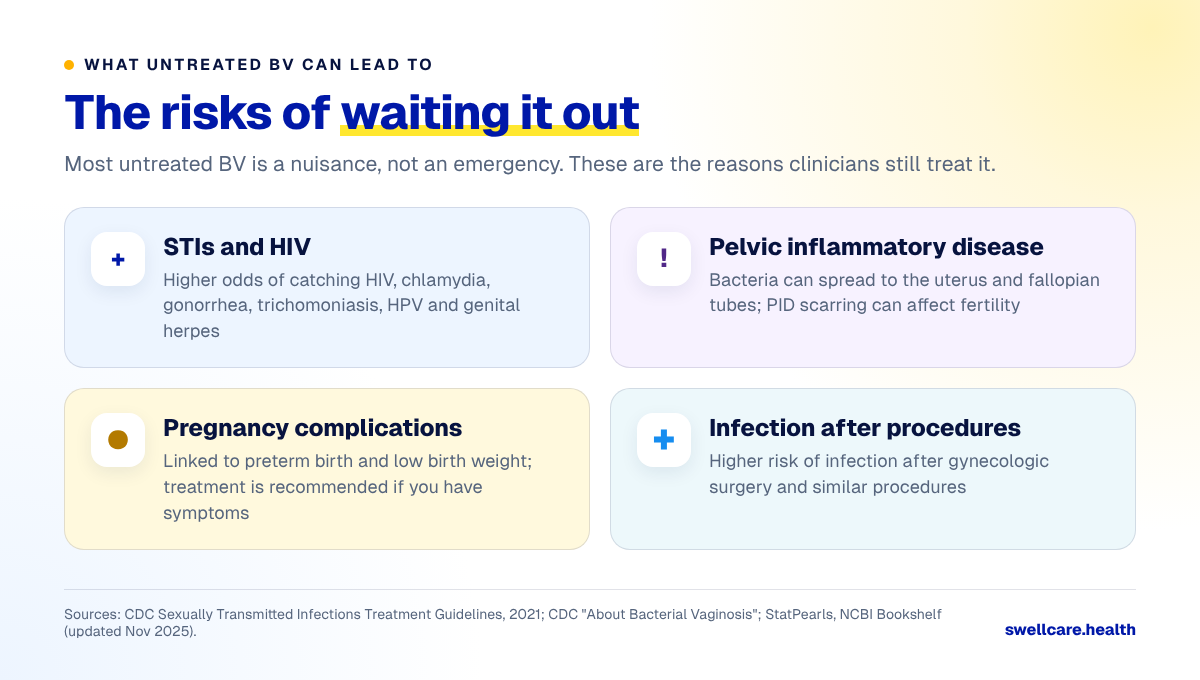
Most of the time, untreated BV is a nuisance, not an emergency. The complications below are why doctors still recommend treating bacterial vaginosis when you have symptoms.
Higher odds of STIs and HIV
Healthy vaginal bacteria are part of your natural defense against STIs. With BV, that protection drops. The CDC's treatment guidelines link BV to a higher risk of picking up HIV, gonorrhea, chlamydia, trichomoniasis, HPV and genital herpes. In plain terms, the STIs on that list are easier to catch while BV is active, because the vagina has lost its usual protective bacteria.
The CDC's patient page names chlamydia and gonorrhea specifically as STDs that untreated BV makes more likely. Having sex with someone new? Don't sit on symptoms.
Pelvic inflammatory disease and infections after procedures
BV bacteria can travel upward from the vagina into the uterus and tubes. Leaving it alone has been linked to pelvic inflammatory disease (PID) and a higher risk of infection after gynecologic surgery. PID can scar the fallopian tubes, and that scarring is a known cause of infertility. If you have a procedure coming up, such as an IUD insertion or a hysteroscopy, tell your gynecologist about any symptoms first.
BV during pregnancy
This is where waiting carries the most weight. If you have BV during pregnancy, your baby is more likely to arrive early or at a low birth weight. The CDC's clinical guidelines also tie it to waters breaking early and infection of the uterus after delivery. The NHS lists premature birth and miscarriage among the possible pregnancy complications.
The CDC recommends treating everyone with symptoms during pregnancy. Some antibiotics, including tinidazole, are avoided while you're expecting, so tell your healthcare provider about the pregnancy before you get a prescription.
How fast BV goes away with treatment
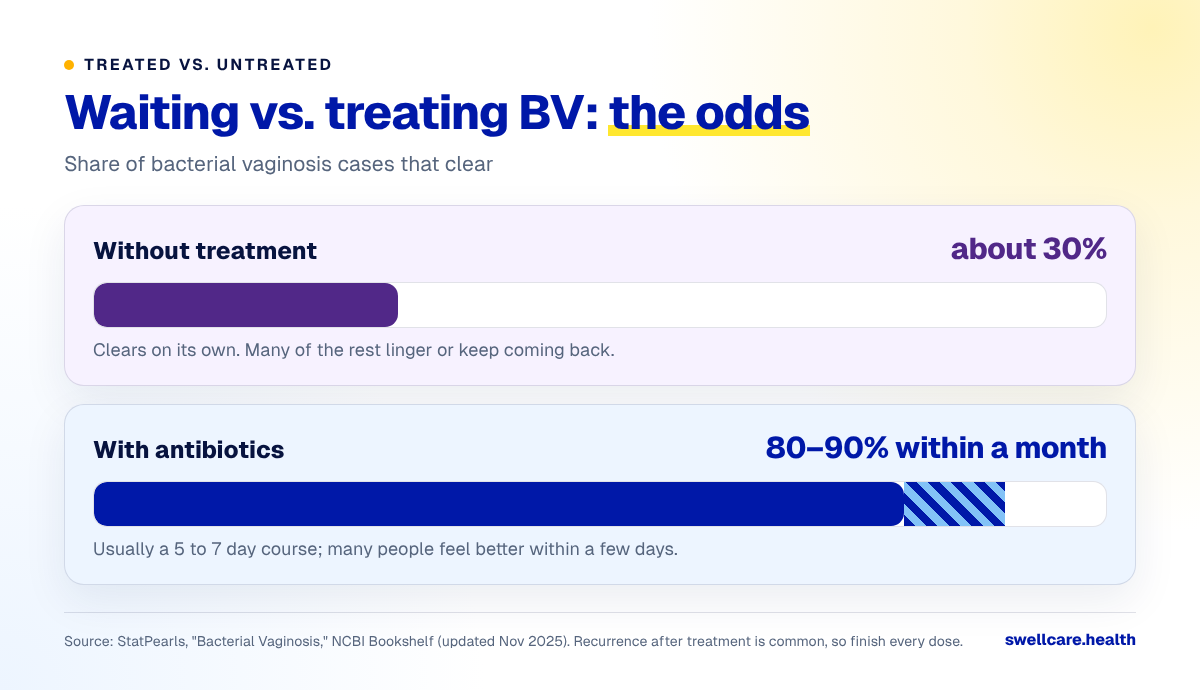
Here's the contrast that matters. Without treatment, about 30% of cases clear. With antibiotics, cure rates within a month typically run 80% to 90%. The antibiotics knock back the overgrown bacteria so lactobacilli can move back in, and many people feel noticeably better within a few days of starting.
Prescription options that work
These are the CDC's recommended first-line options:
| Medicine | How you take it | How long |
|---|---|---|
| Metronidazole tablets | 500 mg by mouth, twice a day | 7 days |
| Metronidazole gel 0.75% | One applicator in the vagina, once a day | 5 days |
| Clindamycin cream 2% | One applicator in the vagina at bedtime | 7 days |
Alternatives include tinidazole, secnidazole (a single dose) and clindamycin pills or ovules, which are small vaginal suppositories. Your healthcare provider will pick based on pregnancy, allergies and what you'll actually finish.
Finish the full course even if you feel fine by day three. Stopping early raises the chance BV comes back, and about 10% to 15% of people need a second round anyway.
What about home remedies?
Probiotics, yogurt and boric acid are popular, and some people swear by them. The evidence is thin. A probiotic won't hurt, but it isn't a replacement for treatment when you have symptoms. Boric acid is sometimes used under medical guidance for recurrent cases, never by mouth, and never during pregnancy.
One more catch. Bacterial vaginosis is easy to confuse with a yeast infection, trichomoniasis or even a UTI, since all of them can cause burning or unusual discharge. Treating the wrong vaginal infection at home can mean weeks of symptoms for nothing.
Why BV comes back and how to lower the odds
BV is stubborn. Recurrence can reach up to 80% within nine months of treatment, so getting it again doesn't mean you did anything wrong. If yours keeps coming back, a gynecologist can help you build a longer-term plan.
The biggest recent change involves men. A 2025 trial in the New England Journal of Medicine gave male partners oral metronidazole plus a clindamycin cream for a week. Over 12 weeks, BV came back in 35% of women whose partner was treated versus 63% of those whose partner wasn't. In October 2025, ACOG adopted guidance supporting this approach for long-term monogamous couples.
That's a big shift. For years the advice was that men didn't need anything, which suggests the bacteria behind BV can pass back and forth during sex more than we thought.
Other steps that help: condoms, no douching, gentle unscented soap on the vulva only (never inside the vagina), and finishing every dose. Some people with frequent recurrence use a longer suppressive course of a vaginal gel, which your healthcare provider can set up.
When to see a doctor about BV
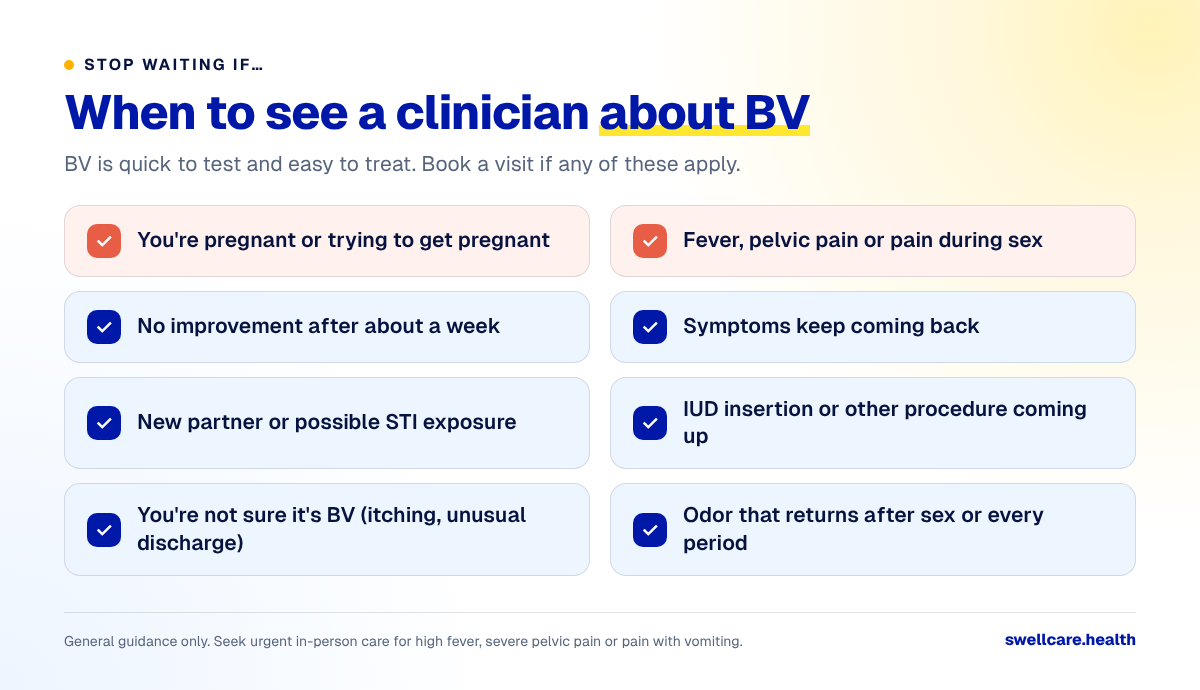
Bacterial vaginosis is easy to test for and easy to treat, so the bar for booking a visit should be low. See a healthcare provider if any of these apply:
- You're pregnant or trying to get pregnant
- Symptoms haven't improved after about a week, or keep coming back
- You have a fever, pelvic pain or pain during sex
- You have a new partner or might have been exposed to a sexually transmitted infection
- You have a procedure coming up, like an IUD insertion
- You're not sure it's BV
A visit is quick. Your healthcare provider checks the discharge, tests the pH and looks at a sample under a microscope, or sends a swab to a lab. It's a good moment to ask for testing for other STIs as well, since the vaginal symptoms can overlap. Most people leave with a prescription the same day, and telehealth visits can often handle a clear-cut repeat episode.
Questions people ask about untreated BV
Does BV clear up naturally?
Sometimes. Bacterial vaginosis can go away on its own in about 30% of cases as the healthy vaginal bacteria recover, sometimes within a few weeks. Many others persist quietly or return. If you have symptoms that last more than a week, or you're pregnant, it's safer to get tested and treated than to wait it out.
What happens if you don't treat BV for a month?
For many people, nothing dramatic happens. The odor and discharge simply continue or come and go. But for that month your risk of STIs, including HIV, chlamydia and gonorrhea, is higher, especially if you're sleeping with someone new. During pregnancy the risk of premature birth rises. A month of untreated BV is also a month of symptoms that a week of antibiotics could have cleared.
How long does it take for BV to fully go away?
With antibiotics, most people feel better within a few days and are cured once they finish the 5 to 7 day course. Without treatment there's no set timeline. It might clear in a couple of weeks or linger for months. A follow-up test is only needed if symptoms come back.
Why did I get BV out of nowhere?
It can feel random, but there's usually a trigger that knocks back your good bacteria. Common ones are sex with someone new, sex without a condom, your period, douching, scented products or a recent round of antibiotics. Sometimes there's no clear cause at all. Bacterial vaginosis is extremely common, and it isn't a sign of poor hygiene.
Is BV a sexually transmitted infection?
Not officially, though sex clearly plays a role. You can get BV without ever having sex, but new or multiple partners raise the risk. Recent research showing that treating men lowers recurrence also suggests some sexual transmission. And having BV makes it easier to catch a true sexually transmitted infection, so regular STI testing is smart if you're sexually active with new partners.
Does my partner need treatment too?
If you have a male partner and your BV keeps coming back, ask about it. ACOG now supports treating men in long-term monogamous relationships, based on a 2025 trial that nearly halved recurrence. Female partners aren't routinely treated, but they should get checked if they have symptoms.
Trusted references
Public-health, research, and medical-society resources related to this guide.