You peel off your socks after a long day and the crease beside your little toe is white, soggy and so itchy you can't leave it alone. So, what is athlete's foot? It's a common fungal skin infection of the feet, and most cases clear in one to two weeks with a cheap cream from the pharmacy aisle.
The catch? People stop treatment too early or use the wrong product, and it comes back. Here's how to spot it and get relief that lasts.
What is athlete's foot?
Athlete's foot is the everyday name for tinea pedis, an infection of the outer layer of skin on the feet. It's caused by dermatophytes, a group of fungi that feed on keratin, the tough protein in hair, nails and calluses. The usual culprits are Trichophyton rubrum and T. interdigitale, according to a 2023 review in Drugs in Context.
You don't have to be an athlete. Anyone whose feet spend hours in warm, damp shoes can get it. Cleveland Clinic estimates that 3% to 15% of people have it at any given time, and it's more common in men and adults over 60.
The same fungi cause ringworm on the body and jock itch in the groin, so doctors sometimes call it ringworm of the feet. Left alone, the infection can spread elsewhere.
Signs of athlete's foot to look for
The most common symptoms of athlete's foot are:
- Itching, stinging or burning, often worst right after you take off your shoes and socks
- Peeling, cracked or scaling patches between the toes
- Skin that looks red, purple, gray or white, depending on your skin tone
- Dry, thick soles that don't improve with lotion
- Small blisters or, rarely, open sores
Symptoms can show up on one foot or both feet. Doctors group the infection into four types, and many people have more than one at once.
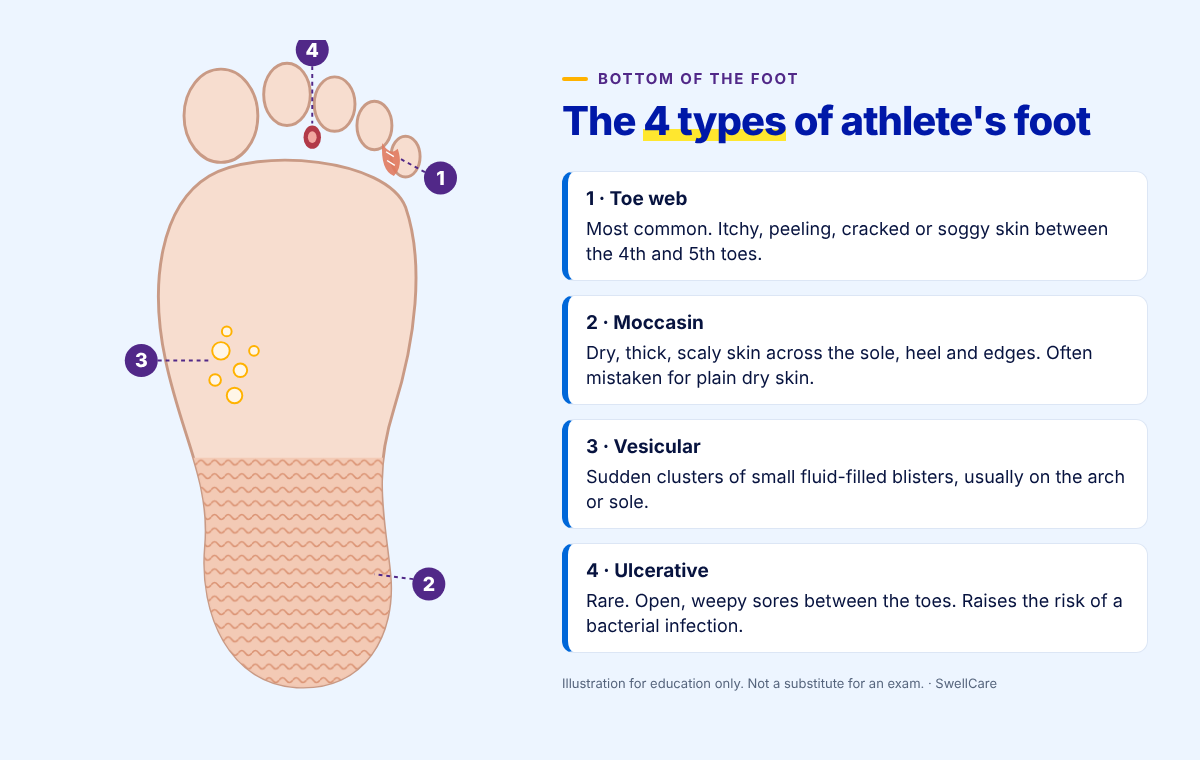
Toe web (interdigital) athlete's foot
This is the type most people get. The gap between the fourth and fifth toes usually goes first: it turns soft, white and itchy, then cracks and peels. Moisture trapped there feeds the fungus.
Moccasin-type athlete's foot
The fungus spreads across the sole, heel and sides of the foot like a slipper. The sole gets dry, thick, scaly and only mildly itchy. It's easy to mistake for plain dry skin, and the infection sometimes moves into the toenails.
Vesicular athlete's foot
Small fluid-filled blisters pop up in clusters, usually on the arch. These symptoms can flare suddenly and itch intensely.
Ulcerative athlete's foot
The rarest type. Open, weepy sores form in the toe webs or on the sole, and broken skin lets bacteria in.
What causes athlete's foot (and who gets it)
Dermatophytes love warm, dark places with plenty of moisture. A foot sealed inside shoes for ten hours, soaking in its own sweat, is ideal. The fungi also live on damp floors in locker rooms and gym showers or around a swimming pool, which is why shower sandals belong in your gym bag.
Is athlete's foot contagious? Yes. The infection spreads through direct contact and through flakes of skin left on floors, towels, bedding, socks or shoes. It's contagious enough to pass between family members, and the CDC notes that athletes face extra risk from sweat and shared gear.
Your risk goes up if you:
- Wear closed, tight shoes most of the day or sweat heavily
- Walk barefoot in gym showers, locker rooms or at the swimming pool
- Share towels or footwear with someone who has it
- Have diabetes, obesity or a weakened immune system
- Already have nail fungus
Is it athlete's foot or something else?
Several conditions cause similar symptoms, and antifungal treatment won't fix any of them. The American Academy of Family Physicians lists these common lookalikes:
| Condition | How it usually differs |
|---|---|
| Contact dermatitis | Rash follows the shape of a shoe or strap; usually spares the toe webs |
| Dyshidrotic eczema | Tiny "tapioca" blisters on the sides of toes, often on the hands too |
| Foot eczema | Often a history of atopic skin; usually spares the toe webs |
| Psoriasis | Silvery scale, patches elsewhere on the body, pitted nails |
Getting it right matters, since steroid creams that calm eczema can make a fungal infection worse. A doctor can confirm tinea pedis in minutes with a KOH (potassium hydroxide) test on a few scraped flakes.
Fast relief: how to treat athlete's foot at home
Most mild cases respond to over-the-counter treatment. Here's the plan we suggest:
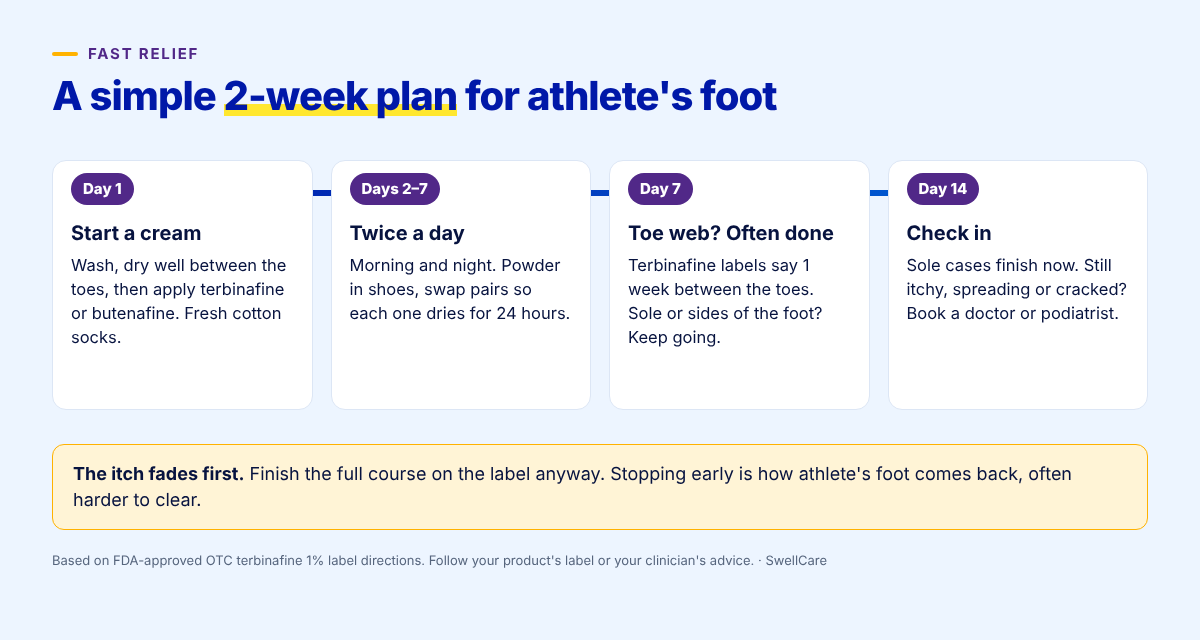
- Wash and dry. Wash your feet in the shower with soap and water, then dry thoroughly, especially between the toes. Use a hair dryer on the cool setting if any moisture is left.
- Pick the right topical cream. Terbinafine (Lamisil AT) or butenafine (Lotrimin Ultra) tend to work faster than older options, and the AAFP rates them above clotrimazole or miconazole at a similar price.
- Apply it past the edges. Spread a thin layer over the rash and about an inch of healthy skin around it.
- Follow the label to the end. The FDA-approved Lamisil AT label says twice a day for 1 week between the toes, or 2 weeks on the bottom or sides of the foot.
- Treat your shoes and socks to prevent reinfection. Dust powder in your shoes and wear clean socks daily.
| Cream | Common brand | Label course |
|---|---|---|
| Terbinafine 1% | Lamisil AT | 1 week (toe webs) to 2 weeks (sole) |
| Butenafine 1% | Lotrimin Ultra | 1 to 4 weeks, per label |
| Clotrimazole 1%, miconazole 2% or tolnaftate 1% | Lotrimin AF cream, Micatin, Desenex, Tinactin | 4 weeks |
One thing to skip: creams that pair an antifungal with a steroid such as betamethasone. The 2025 AAFP review advises against them. The steroid can calm the itch while the fungus keeps growing.
How long does athlete's foot take to go away?
With the right treatment, symptoms often ease within days, and most cases clear within one to eight weeks, says Cleveland Clinic. Moccasin-type infections need longer treatment because the skin is thick.
Does it go away on its own? Rarely. Untreated, it tends to linger, spread to the nails or hands, and come back every summer. The itch usually fades in a few days, which is exactly when people stop. Don't. The American Academy of Dermatology warns that stopping your medication early may leave the infection in place.
Why cracked toes matter more if your legs swell
Cracked, soggy toe webs are an open door for a bacterial infection. In a well-known case-control study in the BMJ, people with toe web intertrigo (broken skin between the toes, often caused by athlete's foot) had about 14 times the odds of leg cellulitis. People with lymphedema had about 71 times the odds.
So if you live with leg swelling, lymphedema, venous disease or diabetes, athlete's foot isn't just an itch. Check your feet every day, including between the toes. Treat any peeling early to prevent cracks, and dry carefully before putting on compression stockings.
When to see a doctor about athlete's foot
Call a doctor, podiatrist or dermatologist if:
- Your symptoms aren't better after 2 weeks of an over-the-counter antifungal
- You have diabetes, poor circulation, lymphedema or a weakened immune system
- You see signs of a bacterial infection: spreading redness, warmth, swelling, pus or red streaks, or you have a fever
- Your toenails are thick, yellow or crumbling
- It keeps coming back after treatment
A clinician may prescribe a stronger topical treatment or prescription oral medication, which is usually saved for severe infections, nail involvement or cases creams can't clear. Suspected cellulitis needs antibiotics, fast.
How to keep athlete's foot from coming back
Once your feet are clear, a few habits help prevent a repeat:
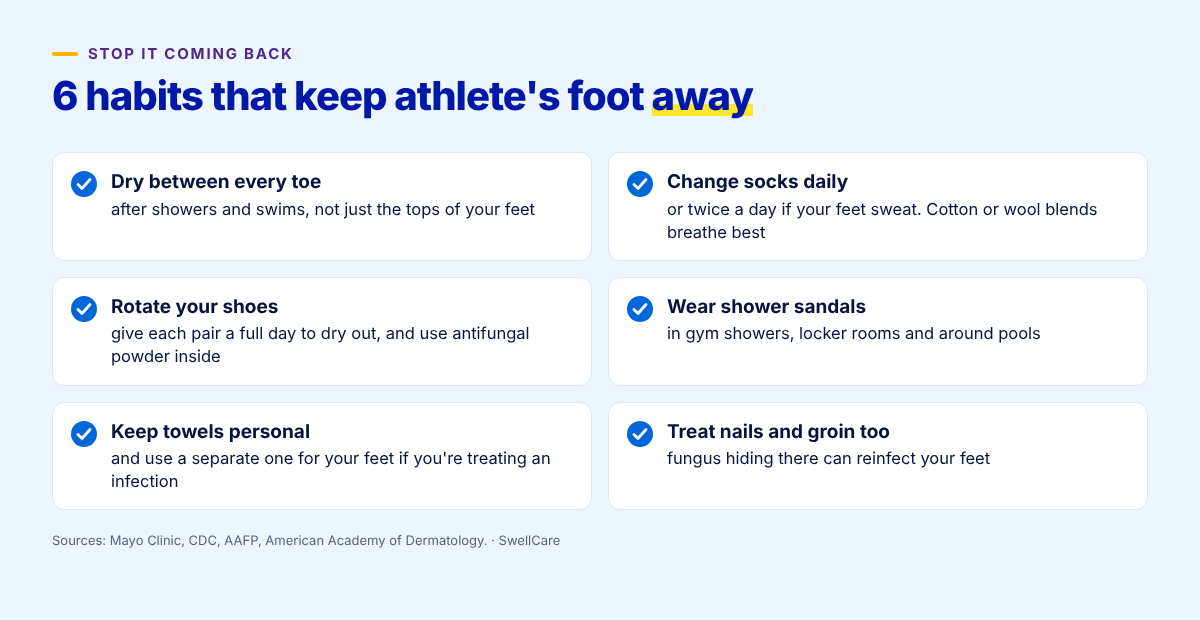
Dry between every toe after a shower or swim, since leftover moisture is all the fungus needs. Change socks daily, more often if your feet sweat. Rotate two pairs of shoes so each dries for a full day (no need to throw them out), and dust the insides with antifungal powder. Wear sandals in gym showers. Don't share towels or unwashed bedding. And treat any nail fungus or jock itch at the same time, so it can't reseed your feet.
Questions people ask about athlete's foot
What is the main cause of athlete's foot?
Fungi called dermatophytes cause athlete's foot. They thrive in warm, moist conditions, so sweaty feet inside closed shoes give them the perfect place to grow. You pick them up by walking barefoot on damp shower floors or by sharing towels, socks or shoes with someone who has the infection.
Does athlete's foot go away by itself?
Usually not. Mild symptoms may calm down for a while, but the fungus tends to stay in the skin and flare again in hot weather. An over-the-counter antifungal used for the full time on the label is the fastest, cheapest fix. See a doctor if the infection isn't clearly better after two weeks.
What is the best cure for athlete's foot?
For most people, a cream like Lamisil AT or Lotrimin Ultra applied twice a day works best and fastest, often within one to two weeks. Keep your feet dry and treat your shoes too. Severe, recurring or nail-related cases may need prescription treatment, such as an oral medication.
Can athlete's foot spread to other parts of your body?
Yes, it can spread. Scratching can carry the fungus to your hands, and drying your groin with the same towel you used on your feet can cause jock itch. It can also move into the toenails, which are much harder to treat.
Your next step: If the itch started this week, pick up a cream like Lamisil AT and use it to the last day on the label. If you have diabetes or leg swelling, or the skin is cracked and red, book a SwellCare foot and skin check before a small fungal problem becomes a bigger one.
Trusted references
Public-health, research, and medical-society resources related to this guide.