Your back seized up yesterday. Getting out of the car took two tries. Should you walk it off, or stay on the couch?
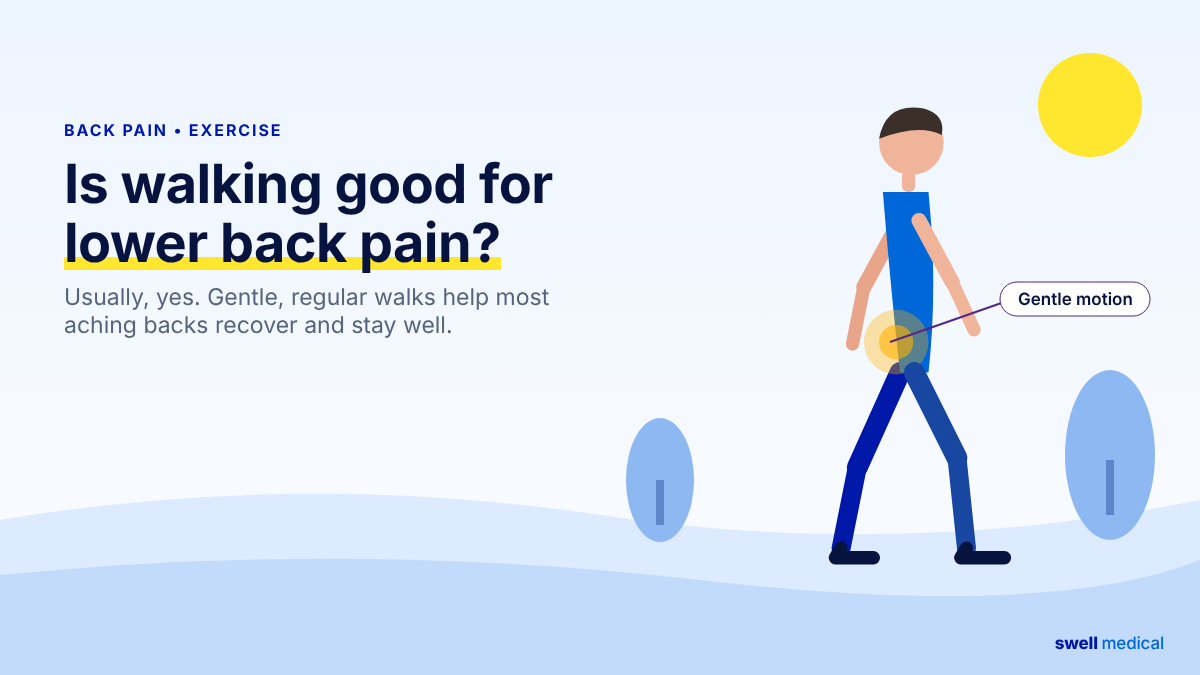
So, is walking good for lower back pain? For most people, yes. Gentle walking is one of the safest, cheapest things you can do for a sore back. A large 2024 trial found a simple walking program nearly doubled the time people stayed free of a new flare-up. Rest feels safer. It usually isn't.
About 39% of US adults had back pain in a three-month window in 2019, and the figure climbs past 44% after age 45.
Why walking helps a sore lower back
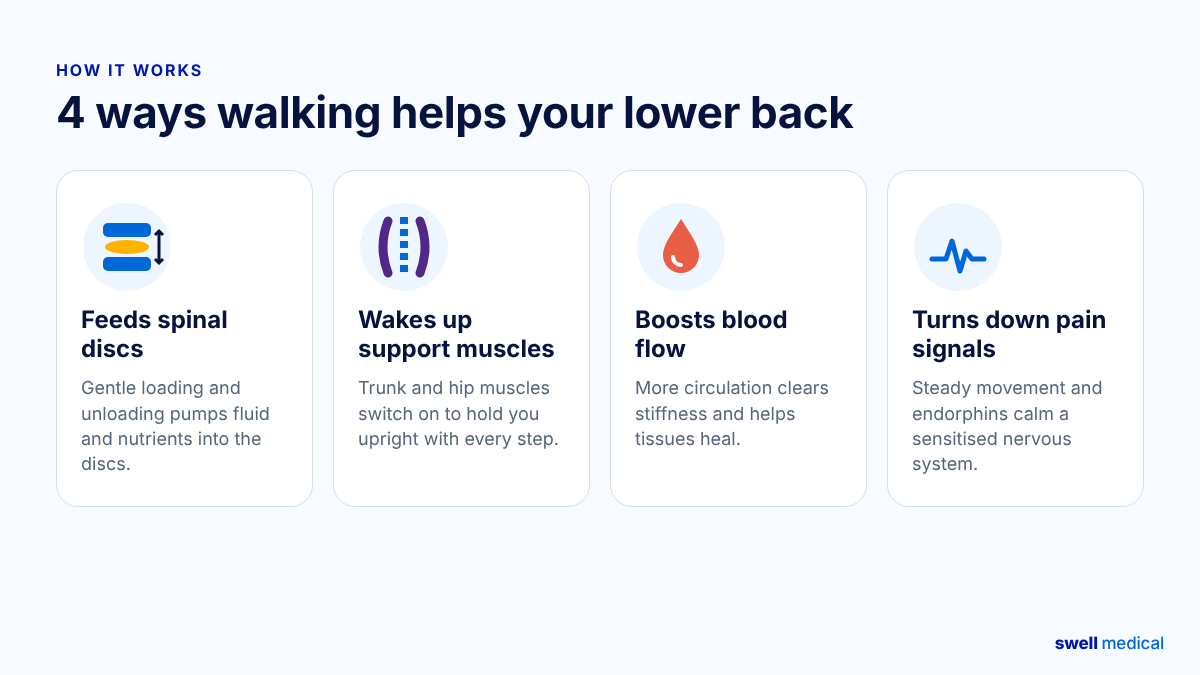
Your spine's built to move, and walking's smooth rhythm does several jobs at once.
It feeds your discs. The discs between your vertebrae have very little blood supply of their own. They're fed by movement, which draws in fluid and nutrients, like a sponge being squeezed and released. Sitting for hours can't do that.
It wakes up the muscles that hold you upright. Each step asks your deep trunk and hip muscles to steady your pelvis and hold an upright posture. Over weeks, that builds endurance in the core muscles that protect your lower back, without the strain of crunches.
It improves circulation. Better circulation carries oxygen to irritated tissue, helps settle inflammation and clears the stiffness that builds when you sit still. Most people feel looser ten minutes in.
It turns down the volume on pain. Walking releases endorphins and lifts your mood. Back pain is partly a nervous-system alarm, and lower stress means it goes off less often. Better sleep, healthy weight and lower blood pressure tend to follow.
It's also low-impact, so you regain flexibility without the jarring forces of running.
Walking or rest: which is better for low back pain?
Walk, in most cases.
For decades, people with a bad back were told to lie flat for a week. Then a review of trials comparing bed rest with staying active found that people who kept moving had a faster recovery and missed less work.
MedlinePlus says providers no longer recommend bed rest. Ease off normal physical activity for the first few days if you need to, then add light aerobic exercise such as walking or swimming. Heavy lifting can wait about six weeks. The American College of Physicians guideline agrees, putting exercise and other non-drug care ahead of medication for chronic low back pain.
A day or two of taking it easy after a fresh strain is fine. A week on the sofa isn't. Muscles weaken, stiffness and stress build, and recovery slows.
What the newest studies found
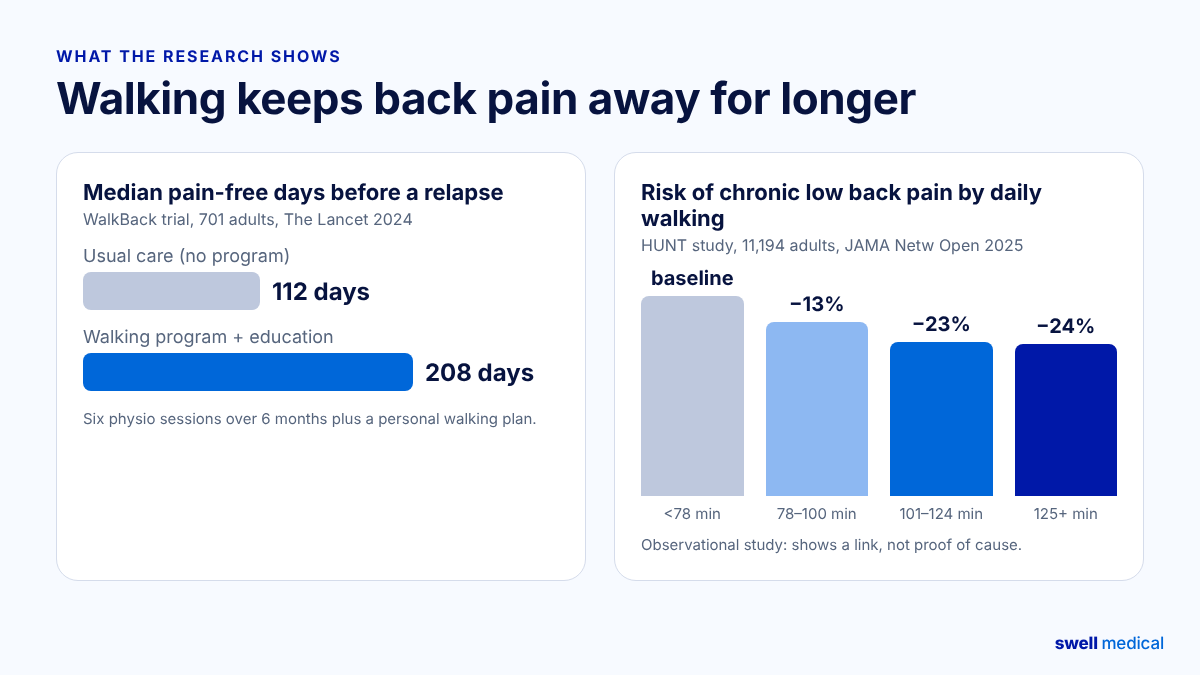
Two recent studies moved walking from "probably helpful" to well supported.
In the WalkBack trial (The Lancet, 2024), researchers enrolled 701 Australian adults just recovered from back pain. Half got a personalized, progressive walking program plus six physiotherapy sessions over six months. The rest got nothing extra. The walking group went a median of 208 days before a recurrence, versus 112 days. That's about a 28% lower risk of recurrence. One caveat: walkers reported more minor leg and foot complaints, so build up gradually.
The second study, from Norway's HUNT cohort, tracked 11,194 adults with week-long motion sensors (JAMA Network Open, 2025). People who walked more than 100 minutes a day had roughly a 23% lower risk of chronic low back pain than those under 78 minutes. Total time on your feet mattered more than speed. It's observational, so it shows a link rather than proof, but together the message is clear: a regular walking routine helps your back now and makes the next flare-up less likely.
A 6-week walking plan for lower back pain
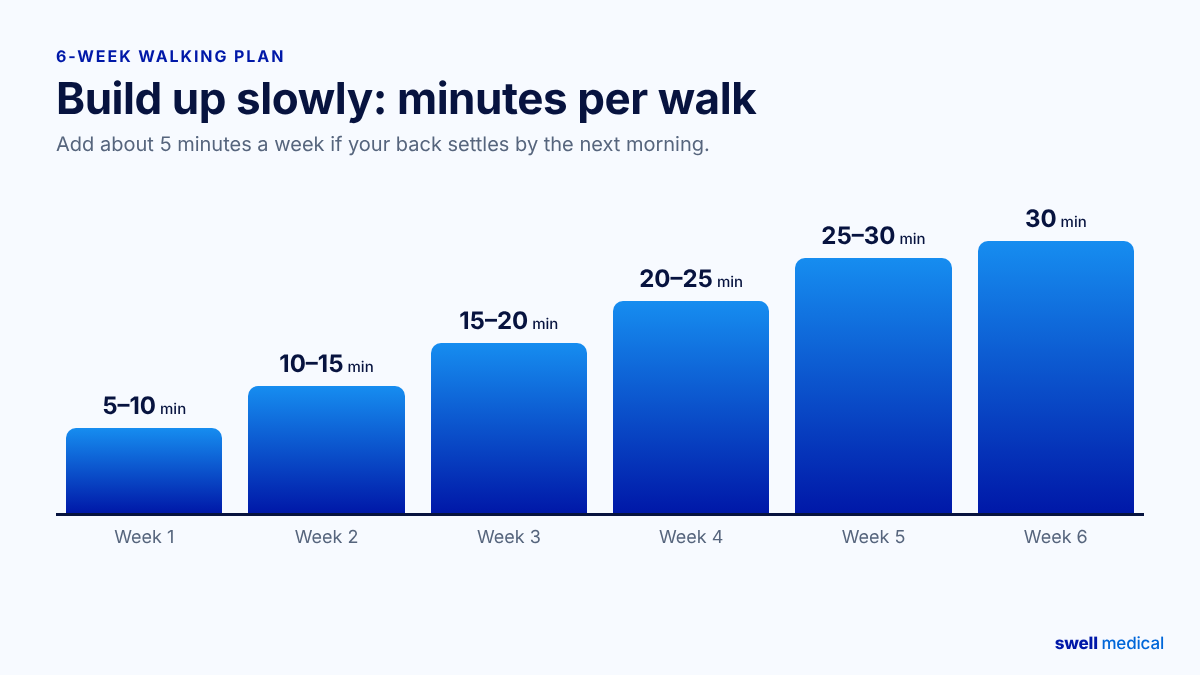
Aim for steady progress, not a heroic first day. This plan suits most adults with non-specific lower back pain (no serious underlying cause). Walk at a pace where you can still talk in full sentences.
| Week | Minutes per walk | How often | Focus |
|---|---|---|---|
| 1 | 5–10 | 1–2 times a day | Flat, easy route |
| 2 | 10–15 | Once or twice a day | Relaxed arm swing |
| 3 | 15–20 | Most days | Conversational pace |
| 4 | 20–25 | Most days | Add a few minutes of brisker walking |
| 5 | 25–30 | 5 days a week | Gentle hills if your back allows |
| 6 | 30 | 5 days a week | About 150 minutes a week |
That week-6 target matches the federal Physical Activity Guidelines for Americans, which call for at least 150 minutes of moderate activity each week.
Use a simple rule many physical therapists teach. Mild soreness that's gone by the next morning is fine. If pain spikes sharply, spreads down a leg, or feels worse the next day, drop back to the previous week's time.
A pedometer or phone app helps. Log your normal daily steps for a few days, then add 500 to 1,000 steps a week rather than chasing 10,000 on day one. A walking group or regular partner helps too. Consistency is what drove the WalkBack results.
How to walk without aggravating your back
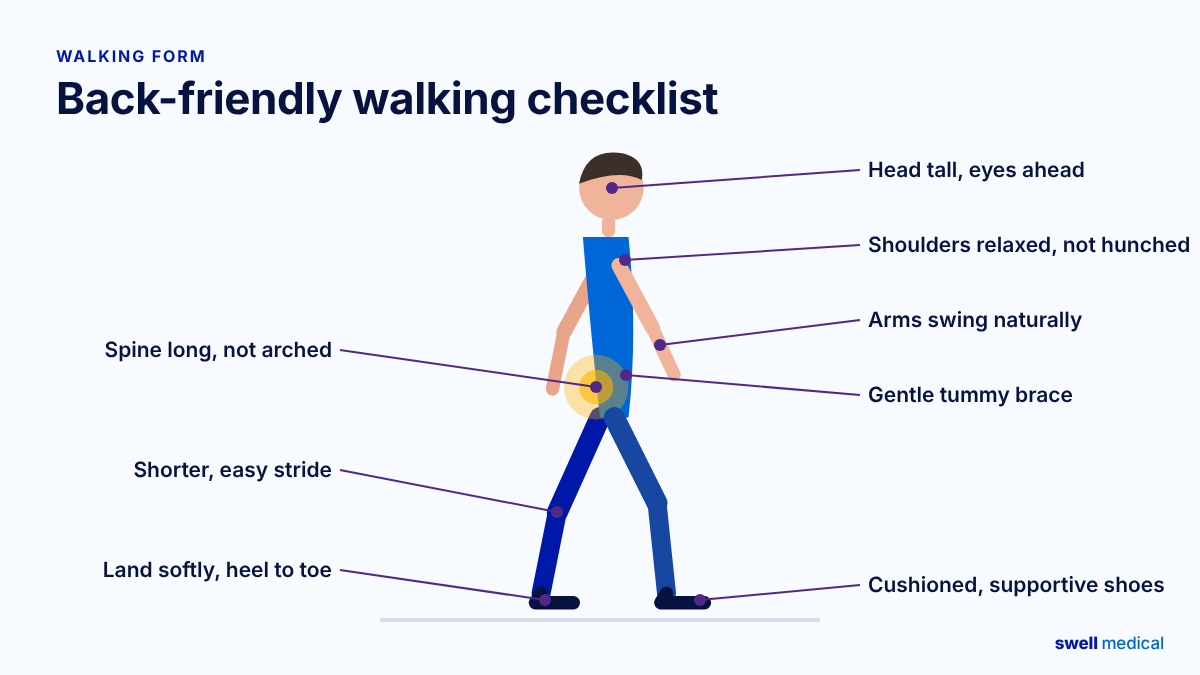
Good posture takes pressure off sore tissue. Run through this checklist in the first few minutes of every walk:
- Stand tall, head over your shoulders, eyes ahead rather than down at your phone.
- Let your shoulders drop and your arms swing naturally.
- Gently brace your tummy, as if expecting a light poke. Don't suck it in hard.
- Take a slightly shorter stride. Overstriding makes your lower back arch with each step.
- Land softly and roll from heel to toe.
Shoes matter. Choose cushioned walking shoes with good arch support, and replace them once the soles wear flat. Worn-out footwear changes how force travels up to your spine.
Pick easy terrain at first. A smooth path is kinder to a sore back than rocky terrain, and you'll find your stride sooner. Downhill stretches tend to arch the spine, so save hills for later. On a treadmill, hold the rails lightly for stability until your confidence returns.
After you walk, try a few minutes of gentle stretching like knee-to-chest or a slow cat-cow. Warm muscles make stretching easier. Once walking feels routine, add strengthening for your core muscles two days a week, as the federal guidelines recommend muscle-strengthening work alongside aerobic activity.
When walking makes back pain worse
Walking helps most backs. It won't suit every back on every day.
Spinal stenosis. When a narrowed spinal canal presses on nerves, walking can bring on leg heaviness or cramping that eases when you sit or bend forward. You can usually still walk, just differently. Spine-health suggests shorter sessions, a slight treadmill incline, trekking poles, or leaning on a shopping cart so your spine flexes forward a little.
Sciatica or a herniated disc. Walking is often well tolerated. But if pain travels further down your leg the longer you go, shorten the walk and see a physician or physical therapy team.
A fresh injury. After a fall or car accident, get checked before you start any walking routine.
Red flags: when to see a doctor right away
Go to an emergency department, or call 911, if back pain comes with any of these cauda equina warning signs:
- Numbness in the groin, genitals, buttocks or inner thighs
- New trouble starting to urinate, controlling your bladder or bowels, or any leakage
- Numbness, tingling or weakness in both legs
- Sudden changes in sexual function or sensation
See a doctor soon if you also have a fever, unexplained weight loss, a history of cancer, or pain that wakes you at night. No better after a few weeks of gentle activity? A clinician can find the cause.
Take your first walk today
Skip the gear shopping and the perfect plan.
Put on supportive shoes and go for five to ten minutes at an easy pace. Notice how your back, and your mood, feel tonight and tomorrow morning. Then do it again.
If you came here asking "is walking good for lower back pain?", the answer for most people is yes, and a daily walking routine is the first step.
If your pain keeps returning, or you want a plan built around your body and your day, talk to a Swell Medical clinician, online, day or night. We'll look at what's driving your pain and help you build a routine you can keep.
Questions people ask about walking and lower back pain
How long should I walk with lower back pain?
Start with 5 to 10 minutes once or twice a day, and add about 5 minutes a week if your back settles by the next morning. Most people reach 30 minutes on most days within six weeks. The HUNT study linked more than 100 minutes of total daily walking, errands included, with a lower risk of chronic back pain.
Does walking loosen up the lower back?
Often, yes. It builds flexibility by moving your lower spine through a gentle, repeated range of motion, and it warms up stiff muscles. Many people feel looser after 10 to 15 minutes. If stiffness gets worse afterward, or pain spreads into a leg, shorten your walks and talk to a clinician.
What is the single best exercise for lower back pain?
There's no single best exercise for everyone. The American College of Physicians lists exercise, yoga and tai chi among the first options for chronic back pain. Walking stands out because it's free and easy to keep doing, so it's a sensible first choice for most people with a sore back.
What exercises should I avoid with lower back pain?
During a flare, hold off on heavy lifting, sit-ups, lying leg raises, and high-impact sports like running. MedlinePlus advises waiting on these until your provider says it's safe. Gentle walking, swimming and stretching are usually fine meanwhile, as long as pain stays mild.
Can walking make a herniated disc worse?
Rarely. It's more likely that gentle walking helps a herniated disc by keeping you moving and improving blood flow to the area. Stop and get checked if walking sends pain farther down your leg, causes new numbness or weakness, or changes bladder or bowel control.
Trusted references
Public-health, research, and medical-society resources related to this guide.