You twisted your ankle, iced it and waited. A week later it still hurts to climb stairs, and the soreness sits a few inches higher than you'd expect. That pattern is the classic clue.
So, what is a high ankle sprain? It's an injury to the ligaments that hold your two shin bones together just above the ankle joint, a band of tissue called the syndesmosis. It's less common than a rolled ankle, slower to heal and easy to mistake for a "normal" sprain early on.
What is a high ankle sprain?
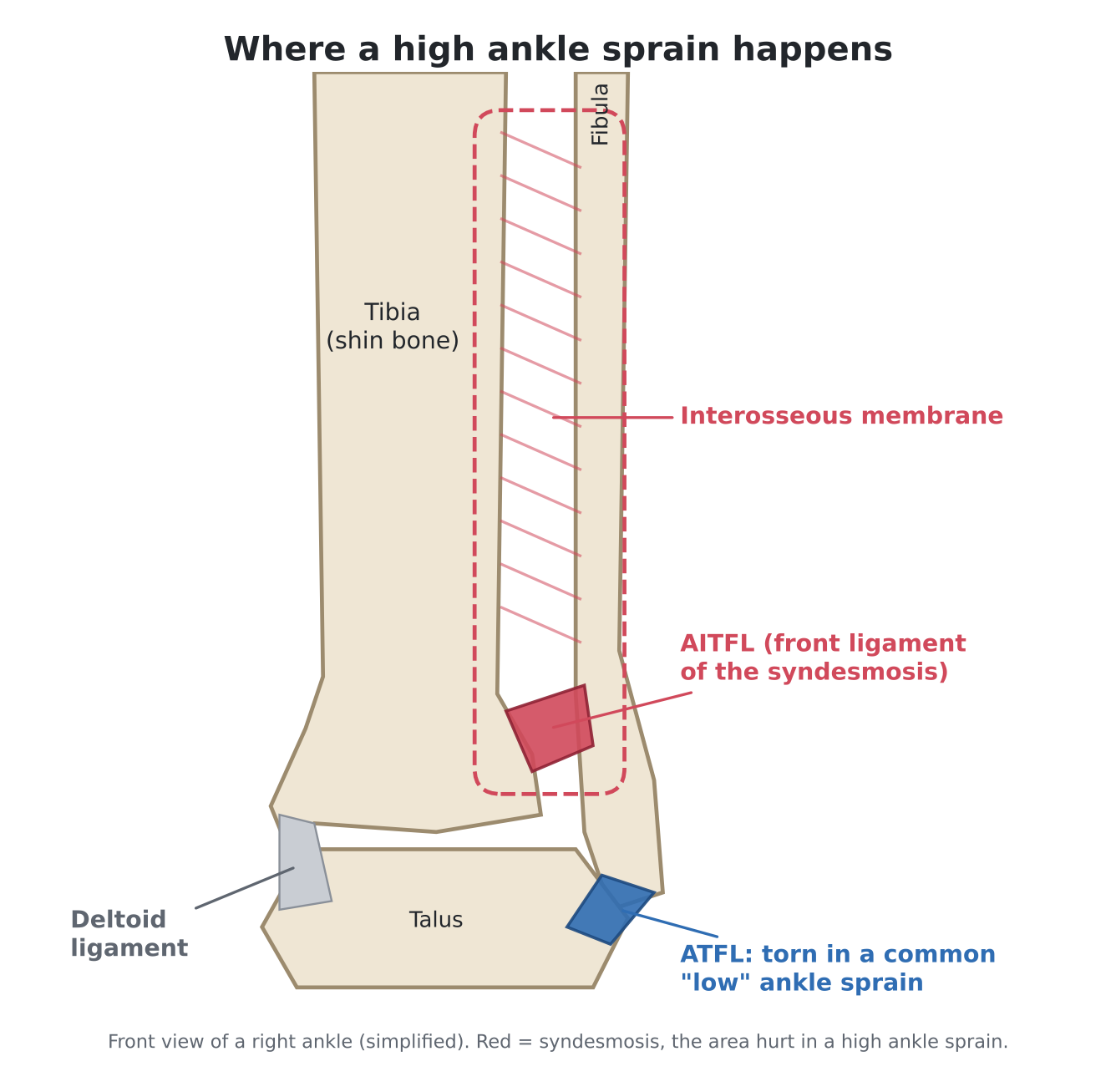
Your lower leg has two bones: the thick tibia (shin bone) and the thin fibula on the outside. Near the ankle joint, a set of tough ligaments keeps them locked together so the joint stays stable when you push off, cut or land.
Doctors call this connection the syndesmosis. In a high ankle sprain, those ligaments stretch or tear, and the top of the ankle joint loses some of its stability.
The ligaments involved
The American Orthopaedic Foot & Ankle Society's FootCareMD guide lists three main parts:
- AITFL (anterior inferior tibiofibular ligament) at the front
- PITFL (posterior inferior tibiofibular ligament) at the back
- Interosseous membrane, a sheet of tissue running between the two bones
Below the shin bones sits the talus, the bone that forms the bottom of the ankle joint. The deltoid ligament on the inner ankle can tear too, and a torn deltoid usually means a more serious injury.
High ankle sprain vs. low ankle sprain
Most sprains are the "low" kind, where the foot rolls inward. A high ankle sprain happens higher up, from a different motion.
| Low ankle sprain | High ankle sprain | |
|---|---|---|
| Where it hurts | Outside of the ankle, below the bone bump | Front of the ankle and a few inches above it |
| Usual motion | Foot rolls inward | Foot twists outward |
| Ligaments hurt | ATFL and other outer ligaments | Syndesmosis: AITFL, PITFL, interosseous membrane |
| Typical recovery | Usually faster | Often at least twice as long |
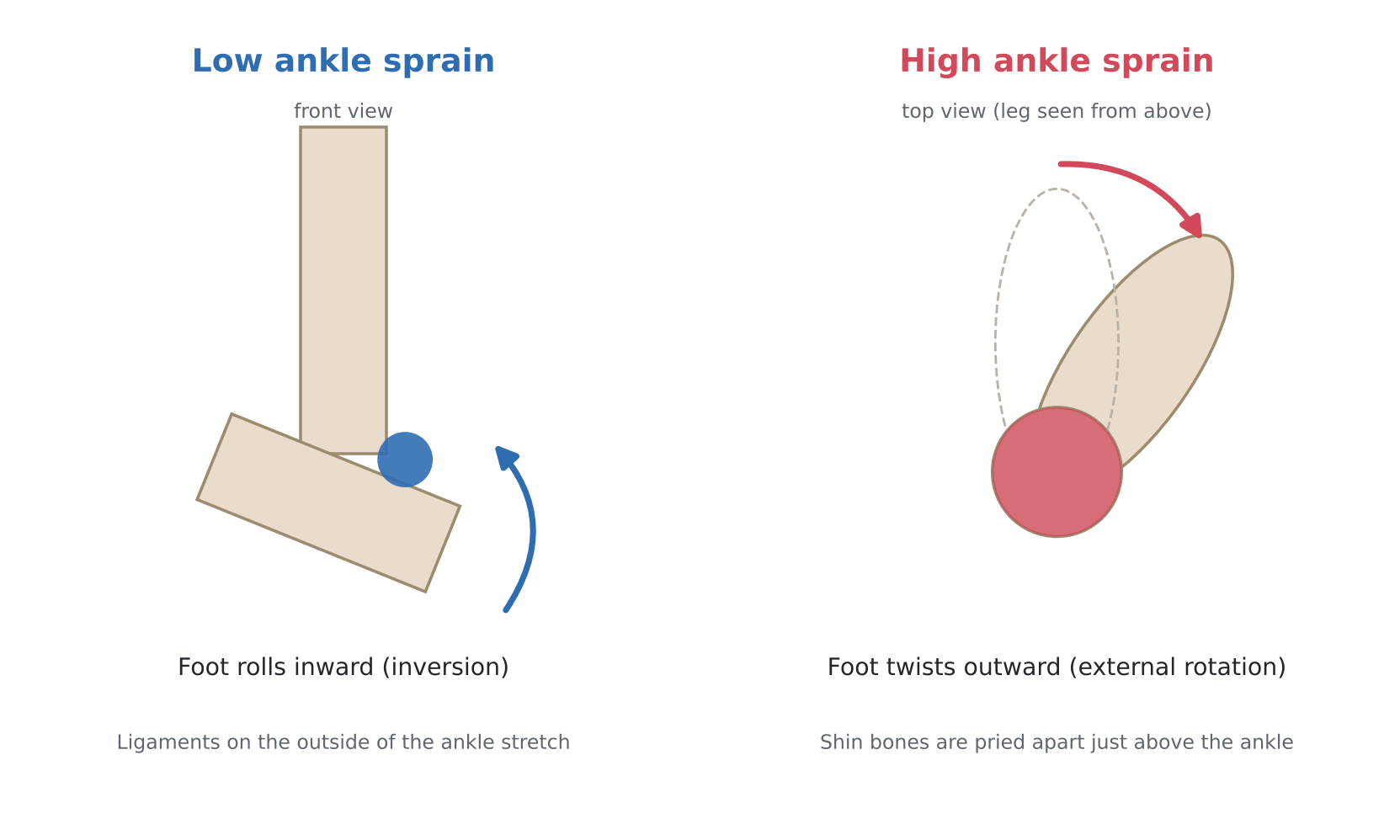
How a high ankle sprain happens
The usual cause is external rotation: the foot is planted and turns outward, and the talus wedges the shin bones apart. Picture a lineman getting rolled onto from the side, or a skier whose boot twists as they fall.
Cleveland Clinic notes these injuries almost always involve some kind of collision. Athletes in contact sports carry the most risk: football, basketball, wrestling, ice hockey, skiing and soccer. In a national study of US high school sports, about 11.5% of ankle ligament injuries involved the syndesmosis, and football had the highest rate.
NFL fans hear about it every season, and NFL teams often list players out for weeks. Yet a bad step off a curb or a fall on ice can do it too.
Symptoms of a high ankle sprain
High ankle sprain symptoms can be subtle at first. Watch for:
- Pain above the ankle, at the front of the lower leg
- Soreness that gets worse when you flex the foot upward, such as on stairs
- Trouble standing on your toes or pushing off
- Swelling that may be milder than you'd expect
- Bruising that shows up days later, sometimes higher on the leg
That last point fools people. The common rolled ankle often balloons right away. With a high one, swelling and bruising can look modest while the ache stays stubborn.
Can you walk on a high ankle sprain?
Sometimes. With a mild one, many people can limp along. Walking doesn't mean it's minor. If you can't put weight on the foot at all, assume there may be a fracture and get it checked the same day.
How doctors diagnose it
Diagnosis starts with how you got hurt and a careful press along the ankle joint and shin. Two hands-on tests do a lot of the work:
- Squeeze test. The doctor squeezes the tibia and fibula together partway up the calf. Pain down at the ankle during the squeeze test points to the syndesmosis.
- External rotation test. With your knee bent and ankle at 90 degrees, they turn the foot outward. Discomfort above the ankle is a red flag.
X-rays rule out a fracture and show whether the gap between the bones has widened, called diastasis. Views of the whole leg matter, because the force can break the fibula near the knee (a Maisonneuve fracture). An MRI shows which ligaments are torn, and a CT scan gives a closer look at the bones. A missed diagnosis is common, so an ankle that isn't improving deserves a second look.
High ankle sprain grades
Doctors grade the damage to guide treatment:
| Grade | What it means | Usual approach |
|---|---|---|
| Grade 1 | Ligaments stretched, joint stable | Rest, protection, rehab exercises |
| Grade 2 | Partial tear, some instability possible | Boot or brace, therapy; surgery in some cases |
| Grade 3 | Complete tear, unstable joint | Surgery is often recommended |
Your grade, more than the label, decides how long you're out.
Treatment and recovery time
Most people recover without an operation. Treatment has two jobs: protect the joint while the tissue mends, then rebuild strength, motion and balance.
The first few days
Start with RICE: rest, ice, compression and elevation. FootCareMD suggests icing about 20 minutes every 2 to 3 hours with an ice pack wrapped in a thin towel. Ibuprofen or another over-the-counter reliever can help if it's safe for you. Use crutches if putting weight on the ankle hurts.
Boot, crutches and physical therapy
A removable walking boot often protects the ankle for the first weeks. Once the pain settles, rehab takes over. Expect range of motion work, calf and peroneal strengthening exercises, balance drills and, later, drills for your sports. Those same exercises are your best prevention against a repeat ankle injury, along with an ankle brace or tape when you return.
When surgery is needed
An operation is usually saved for grade 3 tears, a widened joint (diastasis) or a fracture. A surgeon holds the tibia and fibula in place with screws or a suture-button device while the ligaments heal. If the injury is left unstable, the long-term risk of stiffness and arthritis goes up.
How long does a high ankle sprain take to heal?
Plan on weeks, not days:
- Mild injury: about 2 to 4 weeks, per the AOFAS
- Typical case: about 6 to 8 weeks back to normal activity, longer for athletes
- Ligament healing: roughly 3 months
- Severe or surgical cases: 6 weeks to 4 months or more
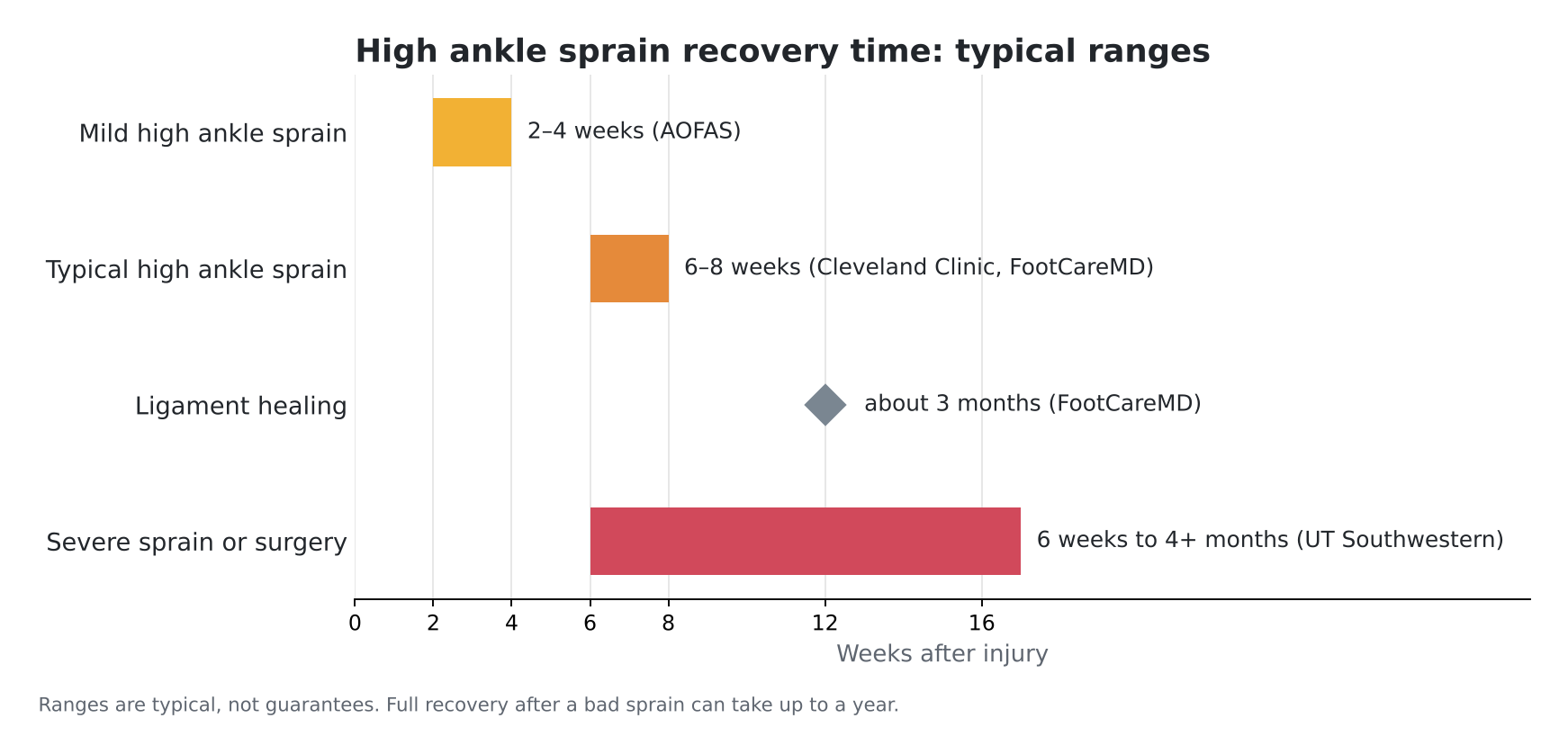
Elite athletes do well. A recent review summarized by Physio Network found 96% got back to their sports, at around eight weeks on average. FootCareMD's readiness check: you should be able to hop on the injured foot 15 times without pain. Rushing back to sports before you pass that test raises the odds of a repeat injury.
When to see a doctor
Get checked promptly if:
- You can't put any weight on the foot
- The tenderness sits above the ankle rather than below the outer bone
- Pain runs up the leg toward the knee
- Your symptoms aren't clearly better after a week or two of home treatment
- Swelling or instability is still there at 6 weeks
FootCareMD advises seeing a foot and ankle orthopaedic surgeon if your ankle hasn't improved by 6 weeks.
Swelling still hanging around after an ankle injury? Book a SwellCare assessment and we'll find what's holding your recovery back.
Questions people ask about high ankle sprains
How long does it take for a high ankle sprain to heal?
Most people get back to normal activity in about 6 to 8 weeks. Mild sprains can settle in 2 to 4 weeks, while the torn tissue needs about 3 months to mend. Severe tears or sprains that need surgery can take 4 months or longer.
How do you tell if it's a high ankle sprain?
Look at where it hurts and how it happened. The telltale symptoms are pain above the ankle after the foot twisted outward, plus more pain on stairs or when you push off. A doctor can confirm the diagnosis with a squeeze test, an external rotation test and X-rays, plus an MRI when needed.
Which is worse, a high or low ankle sprain?
A high ankle sprain is usually worse. It damages the ligaments that hold the shin bones together, so it typically keeps you out at least twice as long. It's also more likely to cause stiffness later.
Do high ankle sprains need surgery?
Most don't. Grade 1 and many grade 2 injuries get better with rest, a boot or brace and physical therapy. A surgeon usually considers an operation for a complete tear, an unstable or widened joint, or a fracture.
Trusted references
Public-health, research, and medical-society resources related to this guide.