It’s 11 p.m. Your jaw is pounding, and the dental office won’t open for ten more hours. You want toothache relief, and you want it now.
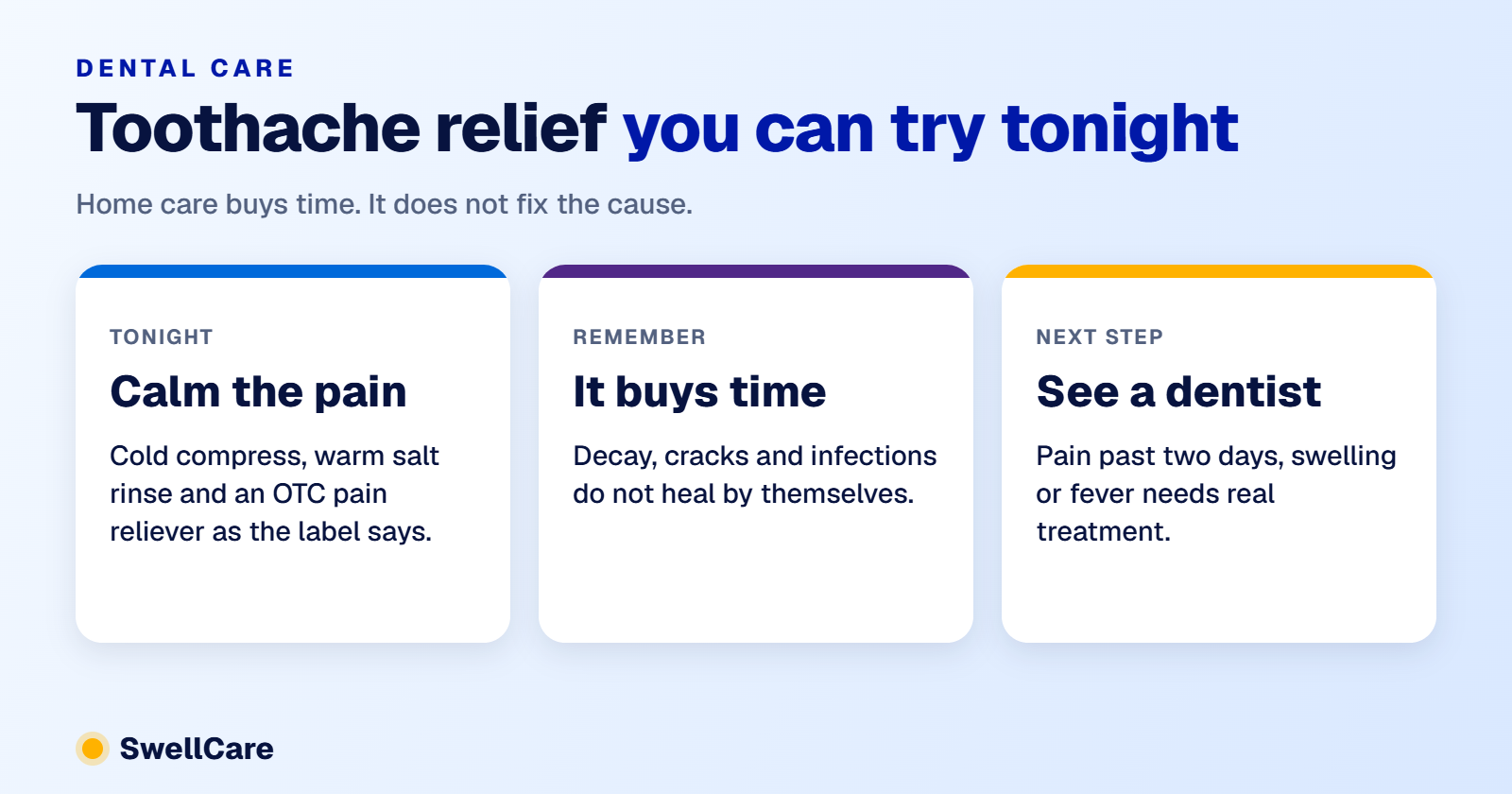
Here’s the short version. A cold compress, a warm saltwater rinse and an over-the-counter pain reliever taken the way the label says can take the edge off tonight. None of them fixes the cause. A toothache usually points to decay, a crack or an infection, and those don’t heal by themselves. Use home care to get through the night, then use this page to decide how fast your toothache needs dental care.
Why does your tooth hurt like this?
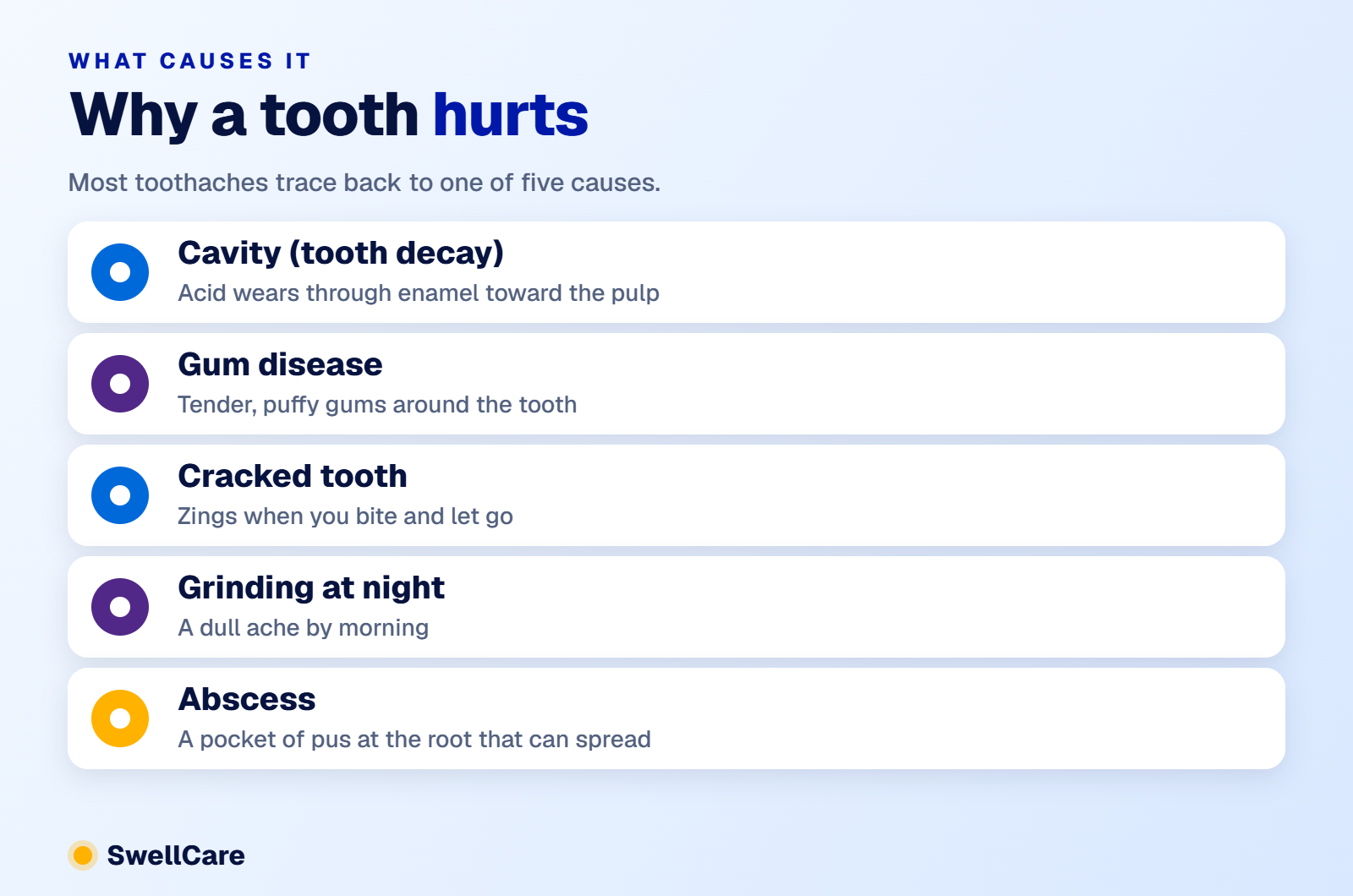
Every tooth has a core of pulp, a bundle of nerves and blood vessels. Tooth pain starts when something irritates it. Bacteria in your mouth turn sugar and starch into acid, and that acid wears through the enamel into softer layers underneath, according to the National Institute of Dental and Craniofacial Research. The result is a cavity, the most common source of tooth pain. Dentists call the process tooth decay. Once decay reaches the pulp, the throbbing begins.
Cavities aren’t the only cause of toothache. Gum disease leaves the gum tender and puffy, and a cracked tooth zings when you bite and let go. Grinding at night? That’s a dull ache by morning. And a tooth infection, also called an abscess, is a pocket of pus, packed with bacteria, at the root that can spread if nobody drains it. A loose or lost filling can expose the tooth in much the same way.
Toothache relief you can try at home tonight
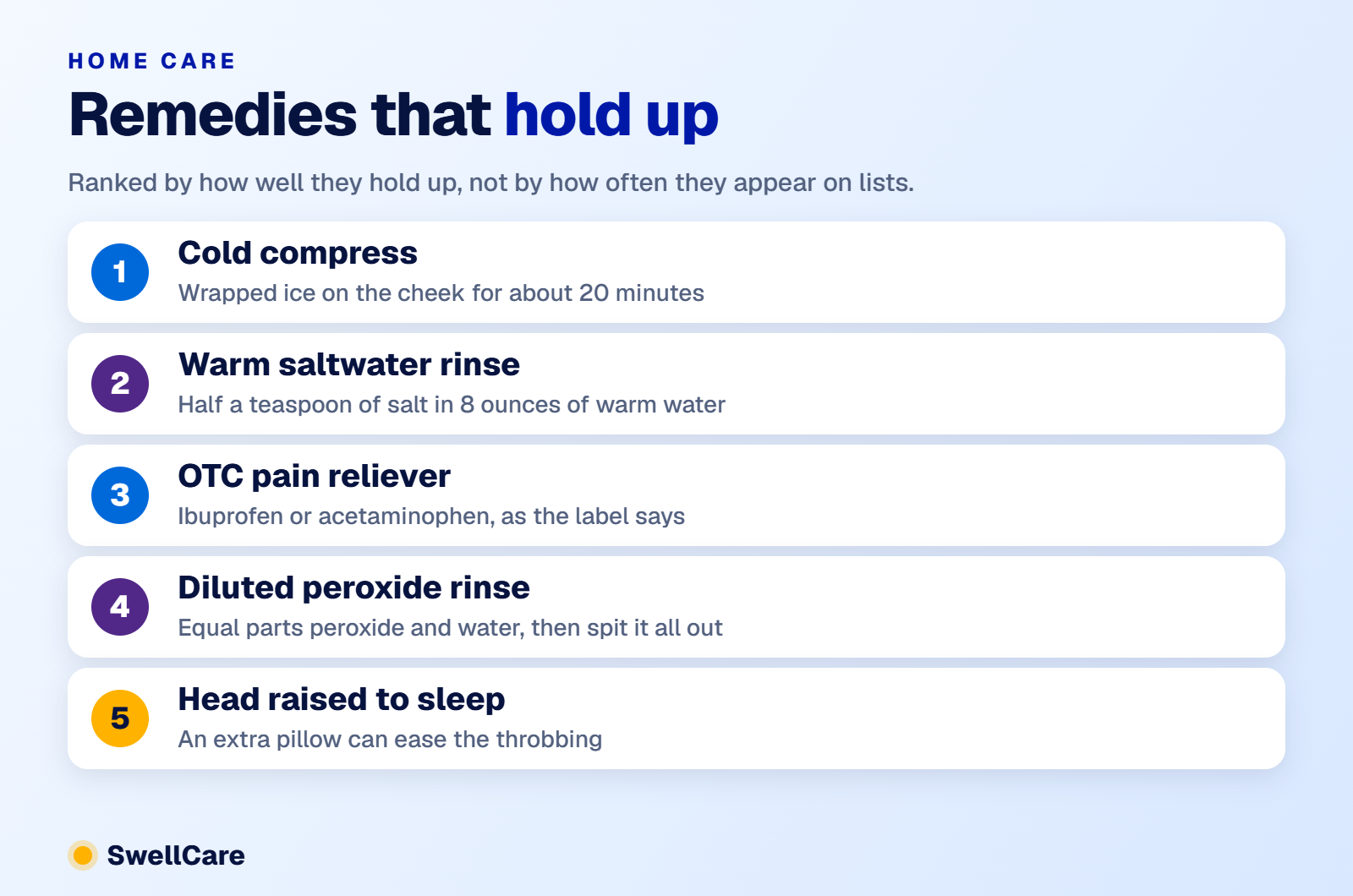
These home remedies are ranked by how well they hold up, not by how often they show up on internet lists. Most of these remedies calm a toothache for an hour or two and nothing more. Home remedies buy time; dental treatment fixes the problem.
Cold compress
Wrap ice or a cold pack in a thin towel and hold it against your cheek, outside the sore tooth, for about 20 minutes. Cleveland Clinic suggests repeating it several times a day. Cold narrows blood vessels, which calms swelling and inflammation. Keep the ice off the gum itself. Mayo Clinic suggests a cold compress especially when the pain followed an injury to the face.
Warm saltwater rinse
Stir half a teaspoon of salt into 8 ounces of warm water, swish for 30 seconds and spit. Think of it as a gentle homemade mouthwash. It loosens food and bacteria trapped around the tooth and soothes irritated gum. It won’t cure the underlying problem, but it costs almost nothing and it’s hard to get wrong.
Over-the-counter (OTC) pain relievers
Ibuprofen and acetaminophen do most of the heavy lifting. Ibuprofen is also an anti-inflammatory, so it helps when inflammation is part of the picture. Read the label for the dose, and ask a pharmacist if you have kidney trouble, stomach ulcers or take a blood thinner. Don’t press aspirin against your gum, because Mayo Clinic warns it can burn the tissue.
Diluted hydrogen peroxide rinse
Mix equal parts hydrogen peroxide and water, swish briefly and spit it all out. Cleveland Clinic’s rule is blunt: never rinse with it full strength, and don’t swallow it. Treat it as an occasional rinse, not a daily habit. An antibacterial mouthwash from the drugstore won’t treat the tooth, but it can freshen things up.
Kitchen remedies: clove, peppermint and garlic
Every list of remedies has them, so here’s our honest verdict. Clove oil is a traditional numbing agent, and some people use a drop mixed into a carrier oil on a cotton swab for short-lived relief. Never dab clove oil or any essential oil undiluted on the gum, because it can irritate the tissue. A cooled peppermint tea bag held on the gum is gentle and harmless, but it won’t fix anything. Garlic is a popular folk remedy, but there is no good evidence that it treats a real tooth problem. These remedies are fine for comfort at most. They shouldn’t talk you out of a dentist visit.
What to skip when your tooth hurts
Benzocaine gels are the big one. The FDA says over-the-counter benzocaine products for the mouth carry a serious risk of methemoglobinemia and provide little to no benefit, and they should not be used for infants and children younger than 2. That’s a blood condition that limits how much oxygen your blood can carry. Check with a clinician before you try a numbing gel.
Plenty of popular remedies aren’t worth the risk. Skip aspirin on the gum, undiluted peroxide and any plan that amounts to waiting a week. If the tooth pain continues after a day or two, the home remedies have done all they can.
If it’s only sensitivity to cold or sweets, a toothpaste made for sensitive teeth is a better bet than anything above. Brief sensitivity that fades in seconds is common.
When a toothache needs a dentist or urgent care
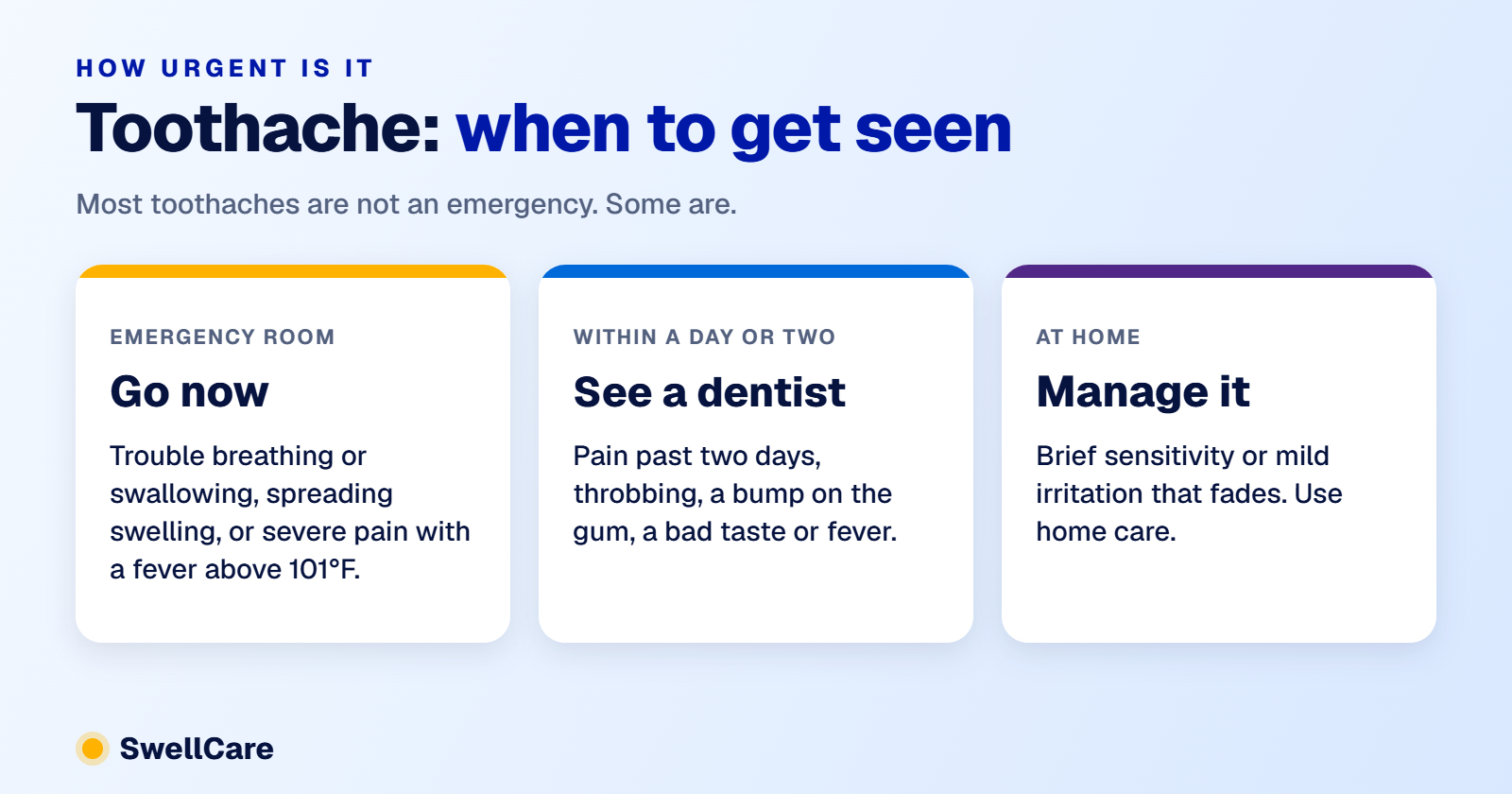
Most toothaches aren’t an emergency. Some are, and they need emergency care. Here’s how to tell them apart.
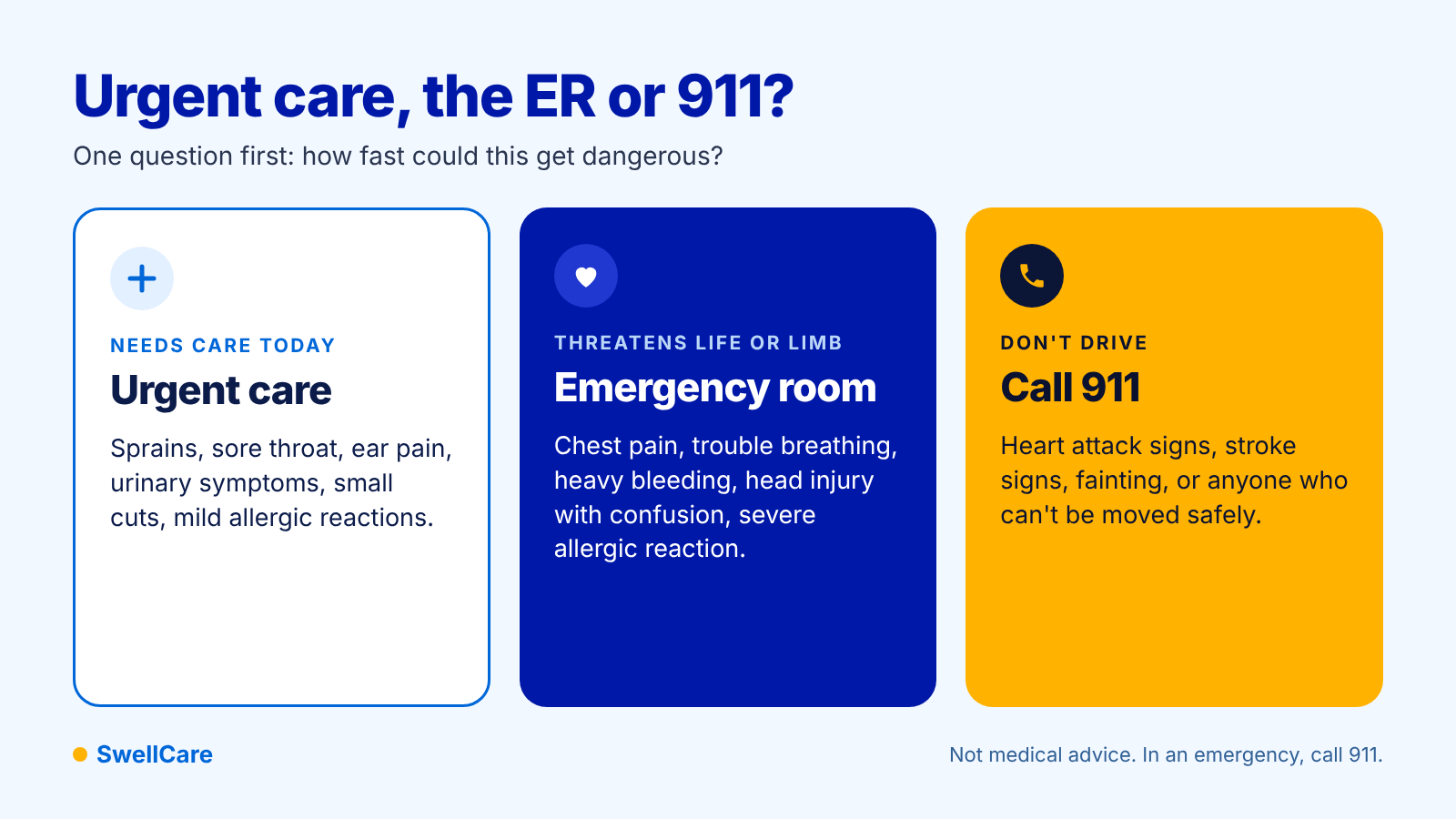
Go to the emergency room now if
You have trouble breathing or swallowing, swelling that spreads to your face, jaw or neck, or swelling near the eye. Bleeding that won’t stop with pressure counts too. So does severe tooth pain with a fever above 101°F, which Cleveland Clinic lists as a reason to go to the ER. A swollen jaw from a tooth infection is flagged as a very serious symptom by MedlinePlus, because an untreated infection can worsen and become life-threatening.
See a dentist within a day or two if
The pain lasts more than two days. It throbs, it’s worse when you bite, or the gum is red and puffy with a bump on it. You notice a bad taste, or you have a fever. Any of these suggests a tooth infection that needs real treatment, not another rinse.
What a dentist will actually do about it
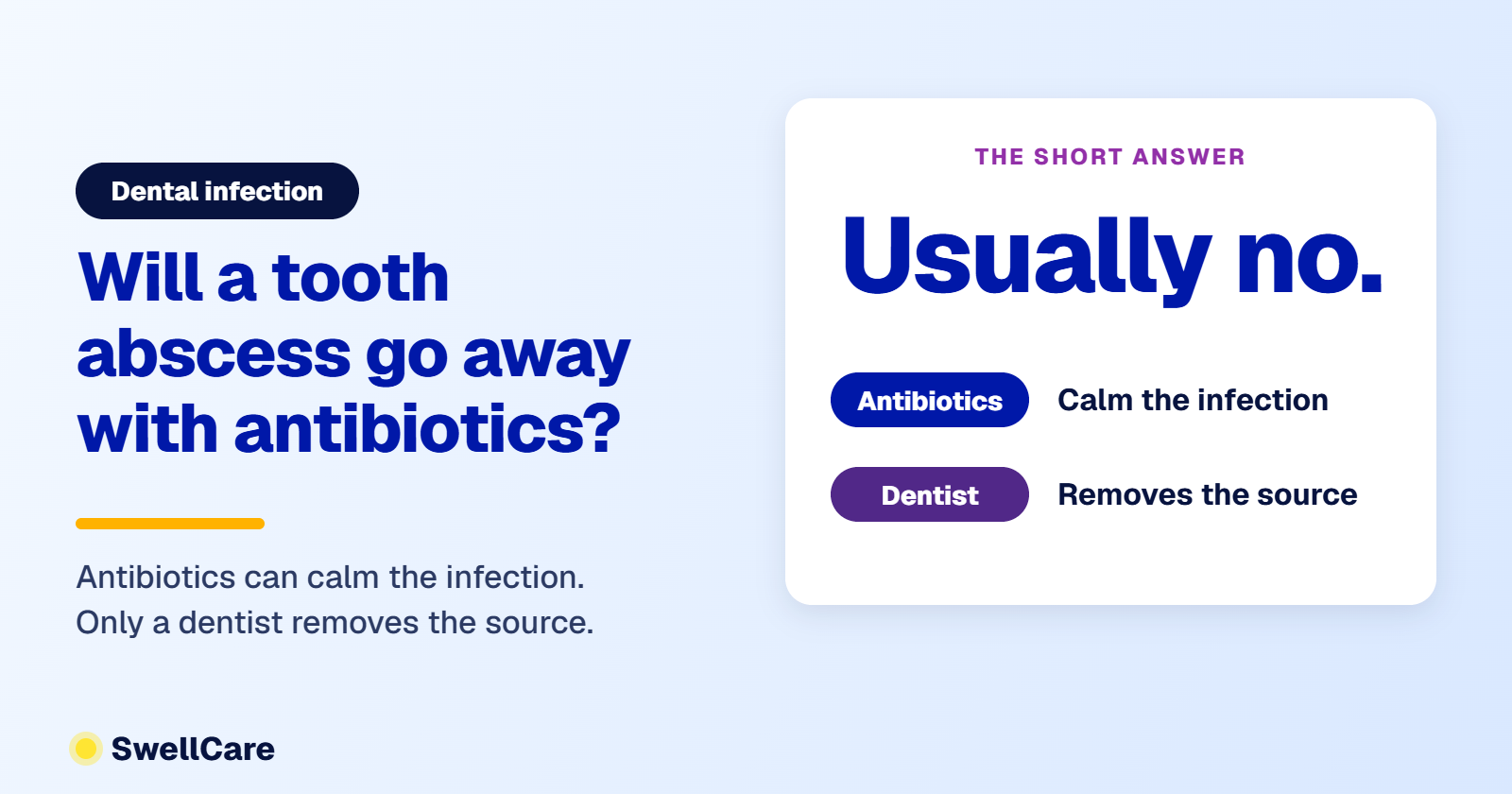
Treatment depends on the cause. A cavity gets a filling, and a small filling is a quick job. If decay has reached the pulp, you may need a root canal. A tooth that can’t be saved comes out in a tooth extraction, which is the last resort. Dentists sometimes prescribe antibiotics for a spreading infection, but antibiotics only ease symptoms unless the source is treated too.
If cost is why you’re putting off dental care, say so when you call. Ask what the least expensive safe treatment is. A cheap filling now beats an expensive root canal later.
Not sure how urgent it is? Talk to a clinician tonight
That 11 p.m. question, “can this toothache wait until morning?”, is exactly what a licensed clinician can help with. SwellCare offers clinician-led, non-emergency urgent care around the clock by video or chat. You tell us what’s going on, a clinician reviews it, and you find out what can be handled online and what needs in-person dental treatment. Here’s how a visit works.
We’ll be straight about the limits. A video visit can’t fill a cavity, and no prescription or outcome is guaranteed. What it can do is point you to the right level of care so you don’t sit up all night guessing. For an emergency, call 911 or go to the ER.
Questions people ask about toothache relief
How long does a toothache last?
It depends on the cause. Irritated gum from trapped food may settle within a day or two. A cavity or abscess won’t fully go away without treatment from a dental professional, though the pain can come and go. If it lasts longer than two days, book a dentist.
Can a toothache go away on its own?
Sometimes, when the cause is minor gum irritation. A deep cavity or infection won’t. If pain suddenly stops, don’t assume you’re in the clear, because the problem may still be there. Get it checked anyway.
How do you sleep with a toothache?
Prop your head on an extra pillow. Hold a bag of ice, wrapped in a towel, to your cheek for 20 minutes before bed, and take an over-the-counter pain reliever according to its label. Rinse with salt water or a plain mouthwash first, and avoid sugary or very hot and cold drinks late at night. If tooth pain keeps you awake, treat that as a sign to call a dentist.
Does a throbbing tooth mean infection?
Not always, but throbbing means the pulp is irritated. Add swelling, fever, a bad taste or a bump on the gum, and an abscess becomes likely. Don’t wait it out. See a dentist soon, or get emergency care if it spreads.
What helps nerve pain in a tooth?
Nerve pain usually means decay has reached the pulp, and no home remedy gets there. Cold packs and pain relievers buy time. The real answer is dental treatment, such as a root canal or tooth extraction.
Trusted references
Public-health, research, and medical-society resources related to this guide.