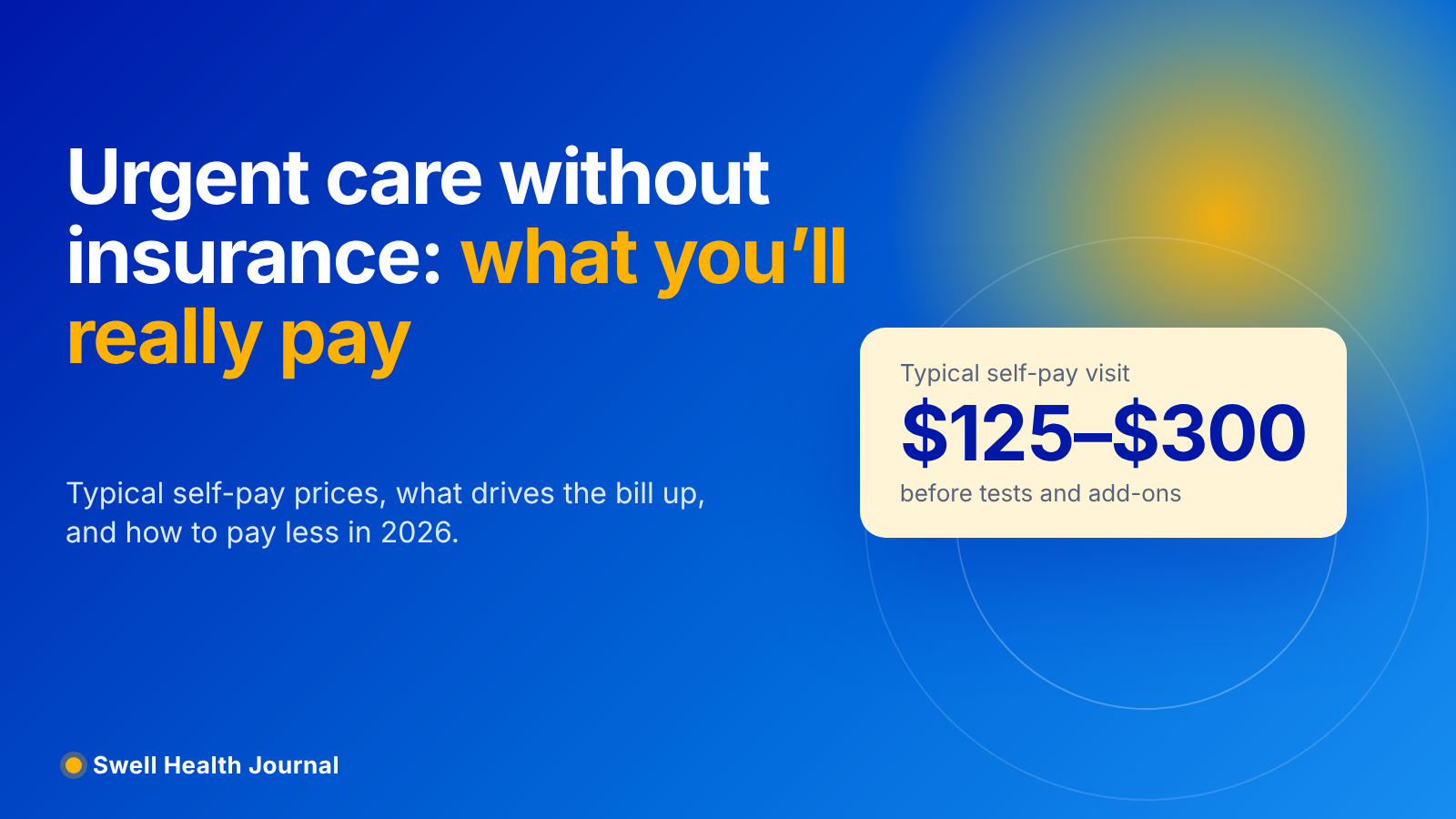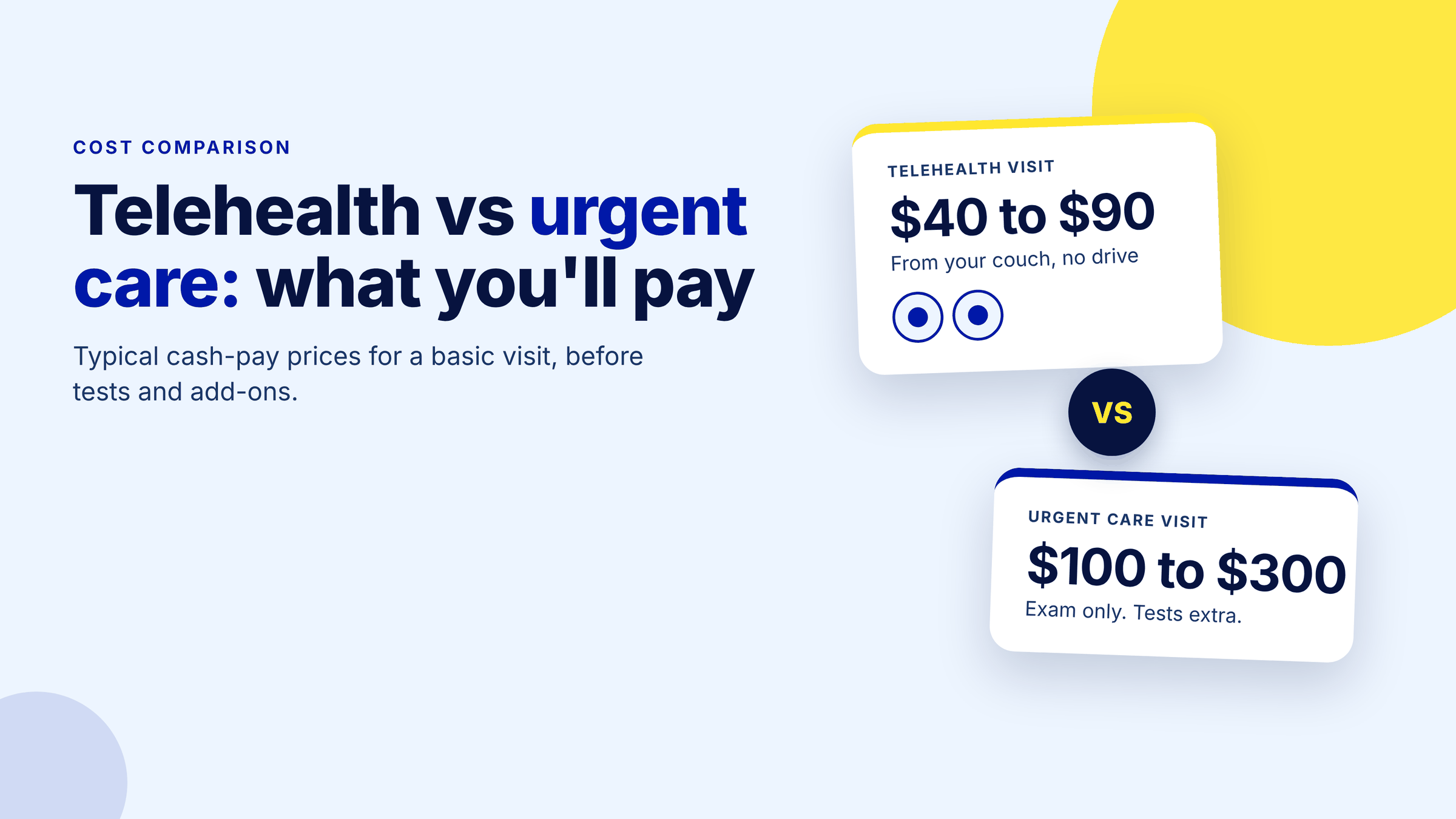
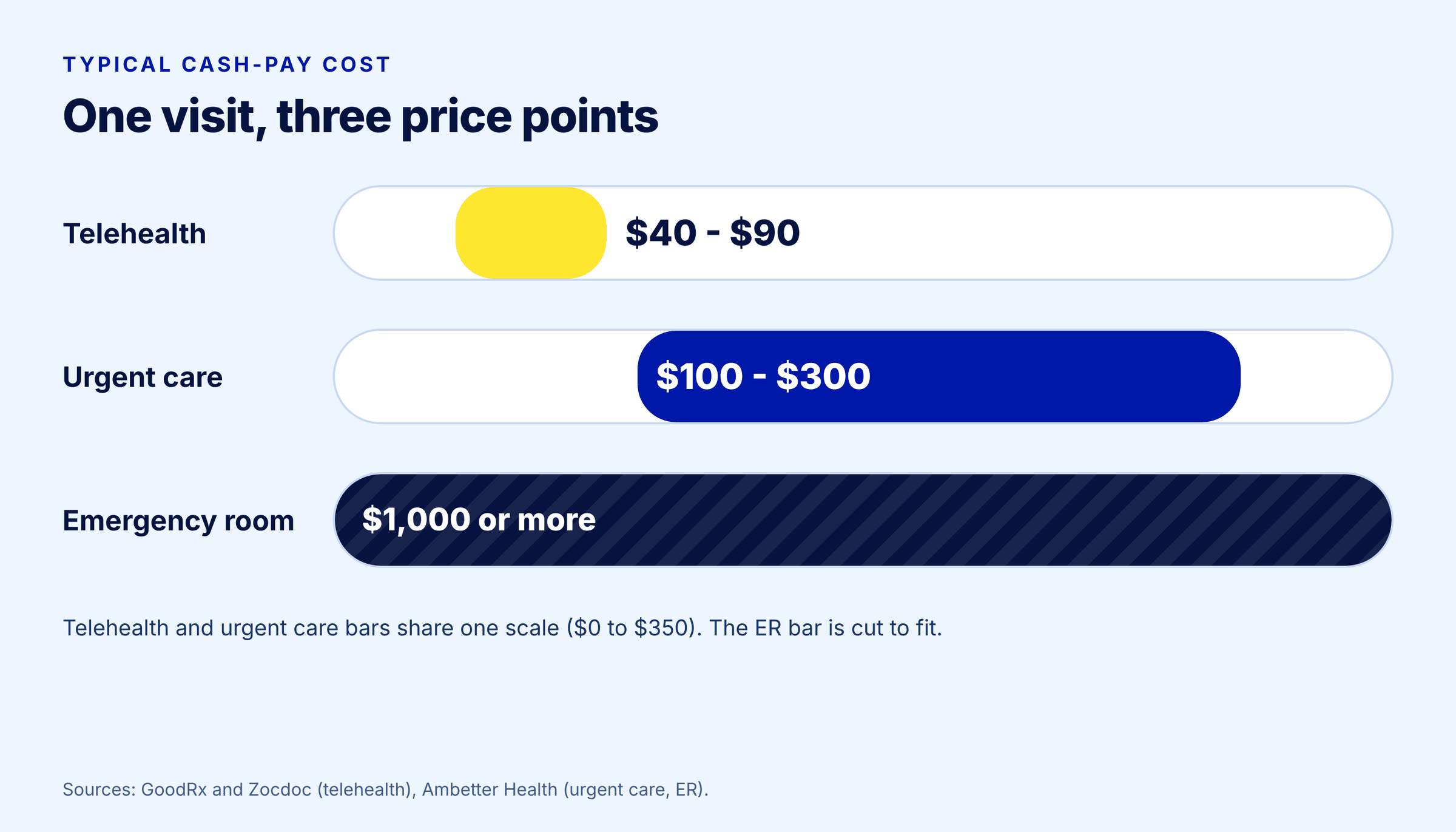
It’s 9 p.m. Your throat feels like sandpaper, your kid has a fever, and the urgent care down the road closes in an hour. So, is telehealth cheaper than urgent care? For most minor illnesses, yes. A cash-pay telehealth visit usually runs $40 to $90. An urgent care visit starts around $100 and climbs fast once anyone orders a test.
Cheaper per visit isn’t always cheaper per problem, though. Here’s where the savings are real, where they vanish, and how to tell which one you need tonight.
Is telehealth cheaper than urgent care? The short answer
Per visit, telehealth wins on price almost every time. Per problem, it depends on what’s wrong.
If your symptoms can be sorted out by talking and looking at you on a screen, a video visit does the job for a fraction of the price. Many people wonder if a doctor on a screen can really replace a clinic visit. For minor illness, often yes. If you need an X-ray, stitches or a lab panel, a telehealth visit can turn into an expensive way to hear “come in.”
The best recent evidence leans toward telehealth. A University of Pennsylvania study in JAMA Network Open (February 2026) tracked more than 160,000 insurer-billed visits for ten common conditions. When care began with telemedicine, the average episode was billed at $96. When it began in person, the figure was $509, according to Penn Medicine’s summary of the study. It’s one health system in Philadelphia, so read it as a strong signal, not a guarantee.
What an urgent care visit really costs
Without insurance, a basic urgent care visit typically lands between $100 and $300, and that usually covers only the exam, according to Ambetter Health. A Health Affairs analysis cited by GoodRx put the average near $180 for something minor, like a sprain or small cut. A comparable emergency room visit averaged about $1,720.
The base price is only the start. Add-ons get billed separately:
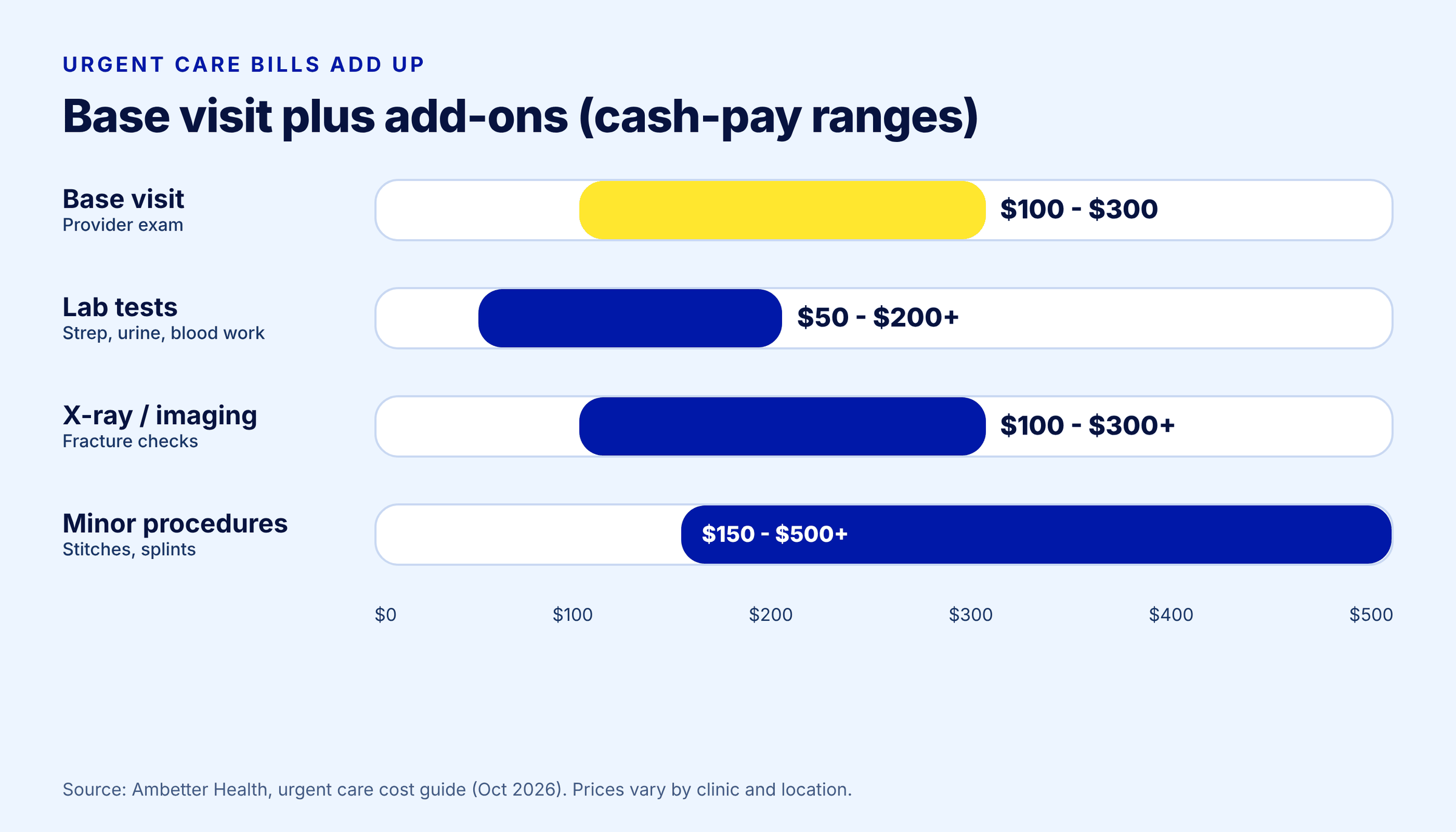
Labs often run $50 to $200 or more. X-rays and other imaging run $100 to $300 or more. Minor procedures like stitches can reach $150 to $500 or more. Ambetter’s own examples show how fast it stacks up: a sore throat with a strep test comes to roughly $225, and an injury with an X-ray and splint to about $450.
Insurance helps, but it doesn’t zero things out. Urgent care copays commonly sit between $30 and $75. Before you’ve met your deductible, you may owe the full price of the visit. And an out-of-network clinic can cost far more than an in-network one. Self-pay patients can ask about a discount or payment plan, too.
What a telehealth visit costs
For a typical virtual visit without insurance, expect $40 to $90, based on figures from GoodRx and Zocdoc. Specialist visits, such as virtual psychiatry or dermatology, can cost more. Common problems like a UTI or a rash usually don’t.
Pricing models differ. Ask your primary care office whether it offers video visits, too. Some platforms charge per visit, others sell memberships. If you only need care now and then, paying per visit is usually the better deal. Cash-pay patients should also ask about a self-pay discount before booking.
With coverage, the answer depends on your plan. Some insurers treat a telehealth visit like an office visit, with the same copay or coinsurance. Medicare covers many virtual services from home through December 31, 2027. Medicaid rules vary by state. The one rule that always applies: confirm the platform is in your network before you book.
Telehealth also fits mental health care well. Therapy and medication management are mostly conversation, so there’s little a screen can’t do. For mental health visits, Penn’s team found episode charges were about the same either way, though telehealth patients needed fewer follow-ups.
Telehealth vs urgent care costs, side by side
| Telehealth visit | Urgent care visit | |
|---|---|---|
| Typical cash-pay price | $40 to $90 | $100 to $300 |
| Copay with insurance | Often matches a clinic copay | Commonly $30 to $75 |
| Labs and imaging | Ordered separately, if needed | Labs $50 to $200+, imaging $100 to $300+ |
| Physical exam | Not possible | Yes |
| Travel and waiting room | None | Drive time and a front desk line |
| Best for | Colds, sinus infection, pink eye, rashes, refills, mental health, UTI symptoms | Possible fracture, stitches, strep swab, anything needing hands |
Where telehealth savings can disappear
Here’s the part most price comparisons skip.
First, follow-ups. A 2017 Health Affairs study of respiratory infections, reported by GoodRx, found a telehealth visit averaged $79 versus $146 in person. But patients who started with telehealth spent about $45 more afterward on follow-up visits, labs and prescriptions. The visit was cheaper. The episode was closer than the sticker price suggested.
Second, paying twice. If a virtual doctor tells you to get an exam or imaging in person, you’ve paid for a visit that didn’t solve anything.
Third, the pharmacy. An antibiotic prescription, a lab fee and the visit itself are three separate charges.
When urgent care or the ER is the smarter call
Skip the video visit if you already know you’ll need hands-on care. Think a possible fracture, a deep cut that needs stitches, or symptoms that need a physical exam or a same-day strep swab. A doctor can’t do a physical exam through a screen. Going once beats paying for two visits.
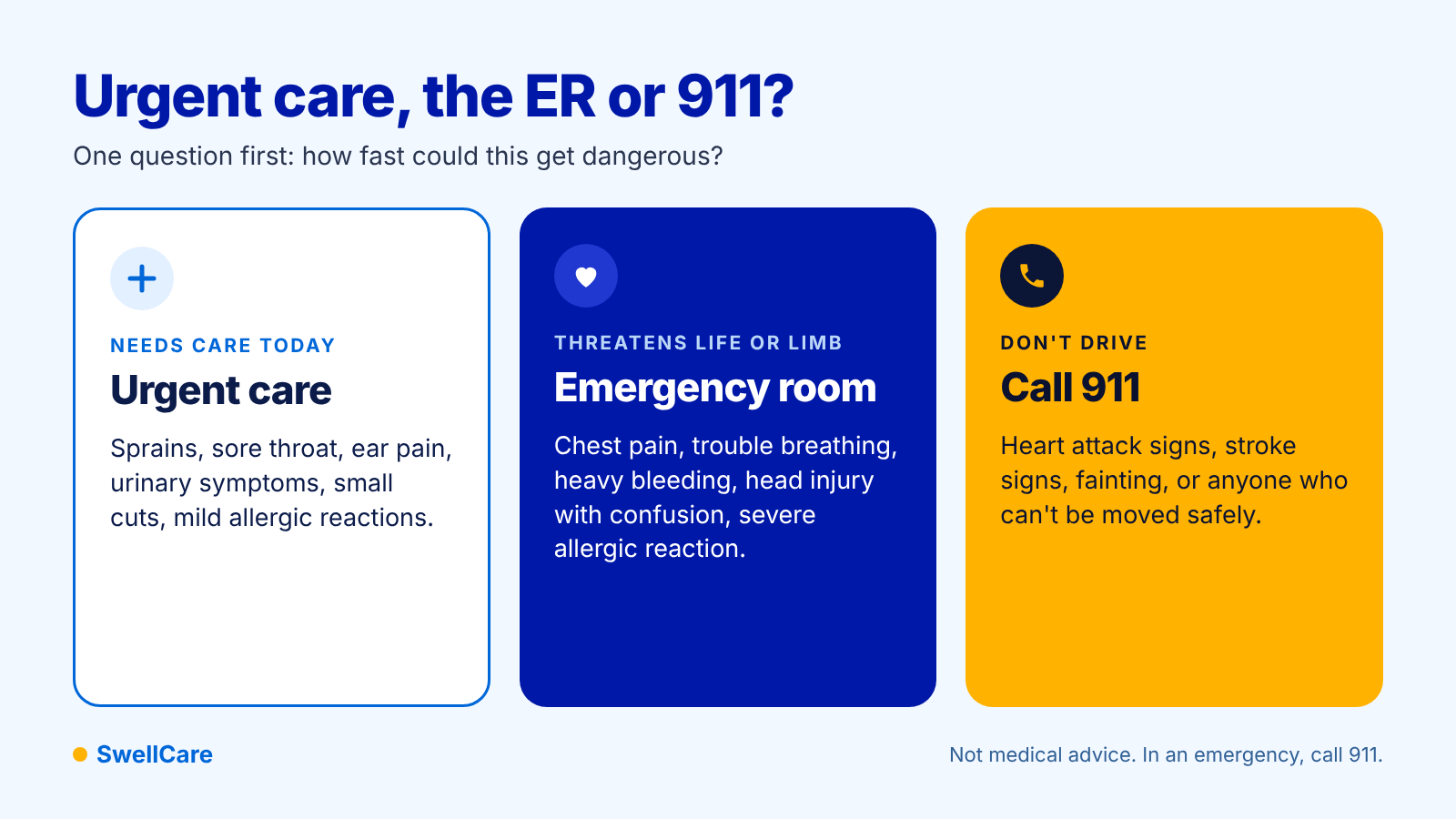
Some things shouldn’t wait for either option. Call 911 or go to the emergency room for chest pain, signs of a stroke, trouble breathing, severe bleeding or a serious injury. The ER is the safest place for those, no matter the bill. Bills there typically start around $1,000.
Not sure what your symptoms point to? If it feels serious, go to the emergency room. Otherwise, a good telehealth clinician will tell you when you need to be seen in person. Your regular primary care doctor can help with routine and follow-up care.
What cheaper care looks like in practice
Take a sinus infection that’s dragged on for a week, a stubborn case of pink eye, or the classic burning of a UTI. All three send people to urgent care. All three can often be handled with a video visit, a quick chat with a doctor, and a prescription for antibiotics sent to your pharmacy if they’re appropriate.
At Swell, a completed consultation is $45 total. Sign-up and the free screening cost nothing. There’s no monthly membership, it’s cash-pay, and medication and lab costs are separate. Virtual care is available 24/7, so there’s no driving and no waiting room.
That $45 isn’t a promise your whole episode will cost $45. If you need labs or medication, those are extra, and if your symptoms need in-person care, we’ll say so.
How to choose in two minutes
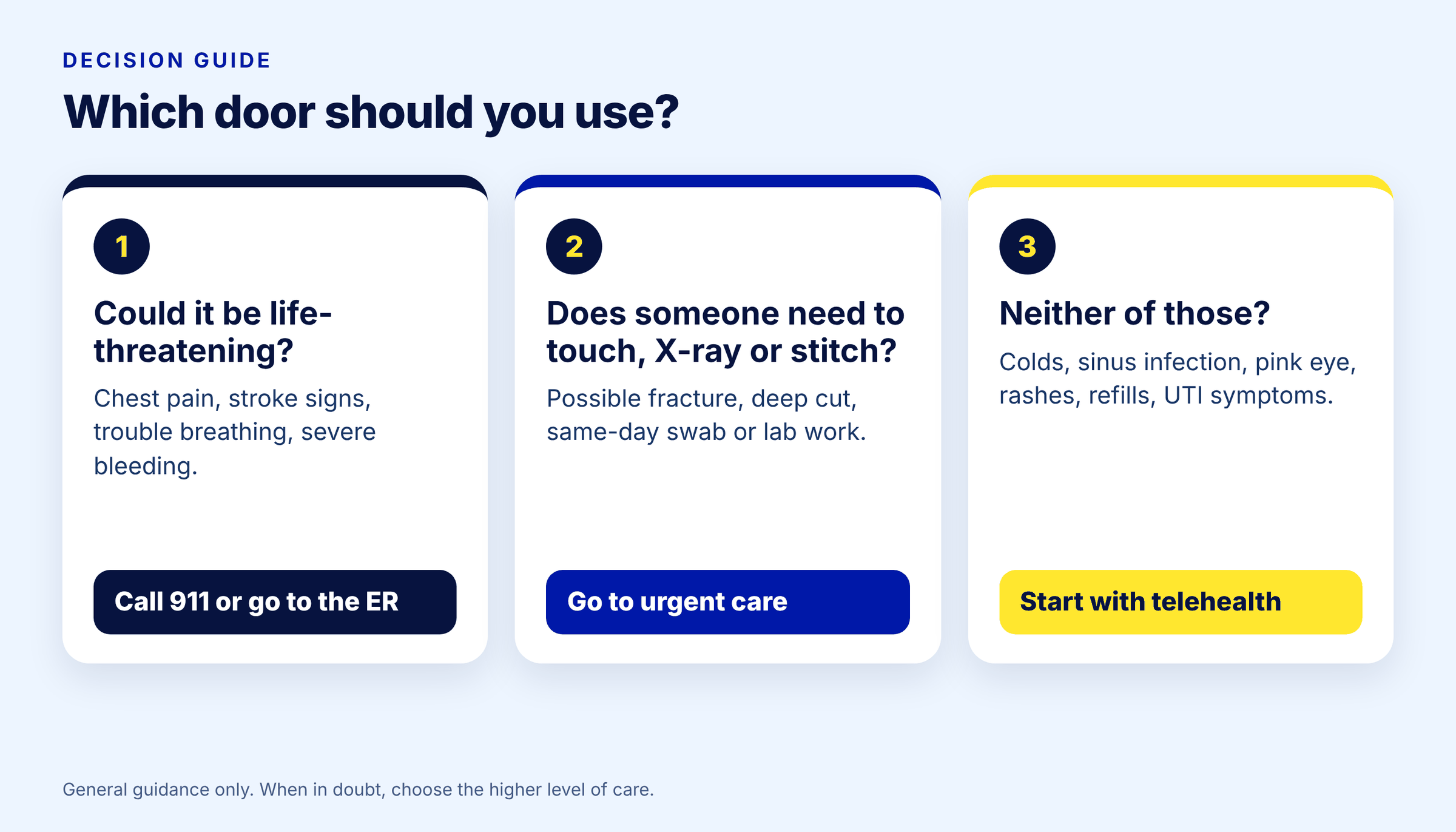
- Ask if it’s life-threatening. If yes, call 911 or head to the ER.
- Ask if someone needs to touch you, X-ray you or stitch you up. If yes, go to urgent care.
- If neither applies, start with a video visit and describe your symptoms. It’s the cheaper first step for most minor illnesses.
Ready to find out what’s going on? Get care now at Swell and talk to a clinician from home.
Questions people ask about telehealth and urgent care costs
How much cheaper is telehealth than urgent care?
For a basic visit, telehealth typically costs $40 to $90 without insurance, versus $100 to $300 at urgent care. Tests, X-rays and procedures can push an urgent care bill well past that. Telehealth savings are largest for minor, talk-and-look problems.
Does insurance cover telehealth the same as urgent care?
Often, but not always. Many plans charge the same copay for a telehealth visit and a clinic visit, while others set their own rates. Check that the platform is in your network, and ask about your deductible before booking.
Can telehealth prescribe antibiotics?
Yes, when a clinician decides antibiotics are appropriate, and the prescription goes to your pharmacy. A video visit can treat common issues like sinus infections and UTI symptoms. But if you need a strep swab or lab test to confirm, you may be sent to a clinic.
Is telehealth available 24/7?
Many services are. Swell’s virtual care runs around the clock, so you can be seen at night or on weekends without a front desk or wait times. Availability and wait times vary by platform.
What if telehealth tells me to go in person?
Then go. A doctor who sends you to urgent care or the ER is doing the job properly. You may still pay for the virtual visit, so choose one with a low, clear price.
Can I use HSA or FSA funds for telehealth?
Many telehealth platforms accept HSA and FSA cards, but rules vary by account and provider. Check with your plan administrator or the platform before you pay.
Trusted references
Public-health, research, and medical-society resources related to this guide.