You woke up with a stripe of burning skin on one side of your chest, and now you’re staring at your calendar. So, can you go to work with shingles? Often, yes, but only if your rash is covered, you feel well enough, and you won’t be near people who are at risk. If the blisters are still open and weeping, or your job puts you around newborns, pregnant coworkers or patients, the answer flips to stay home.
Let’s sort out which side of that line your shingles puts you on.
So, can you go to work with shingles?
The answer depends on three things: what your rash looks like today, what your job involves, and who you’ll be around. Shingles is a reactivation of the chickenpox virus, so the rules for shingles at work come down to whether that virus can reach anyone near you.
A coworker can’t catch shingles from you. What you can pass on is the varicella-zoster virus, the same virus behind chickenpox. Someone who has never had chickenpox or the vaccine could catch chickenpox from you, and that risk comes from the open blisters, never from the pain.
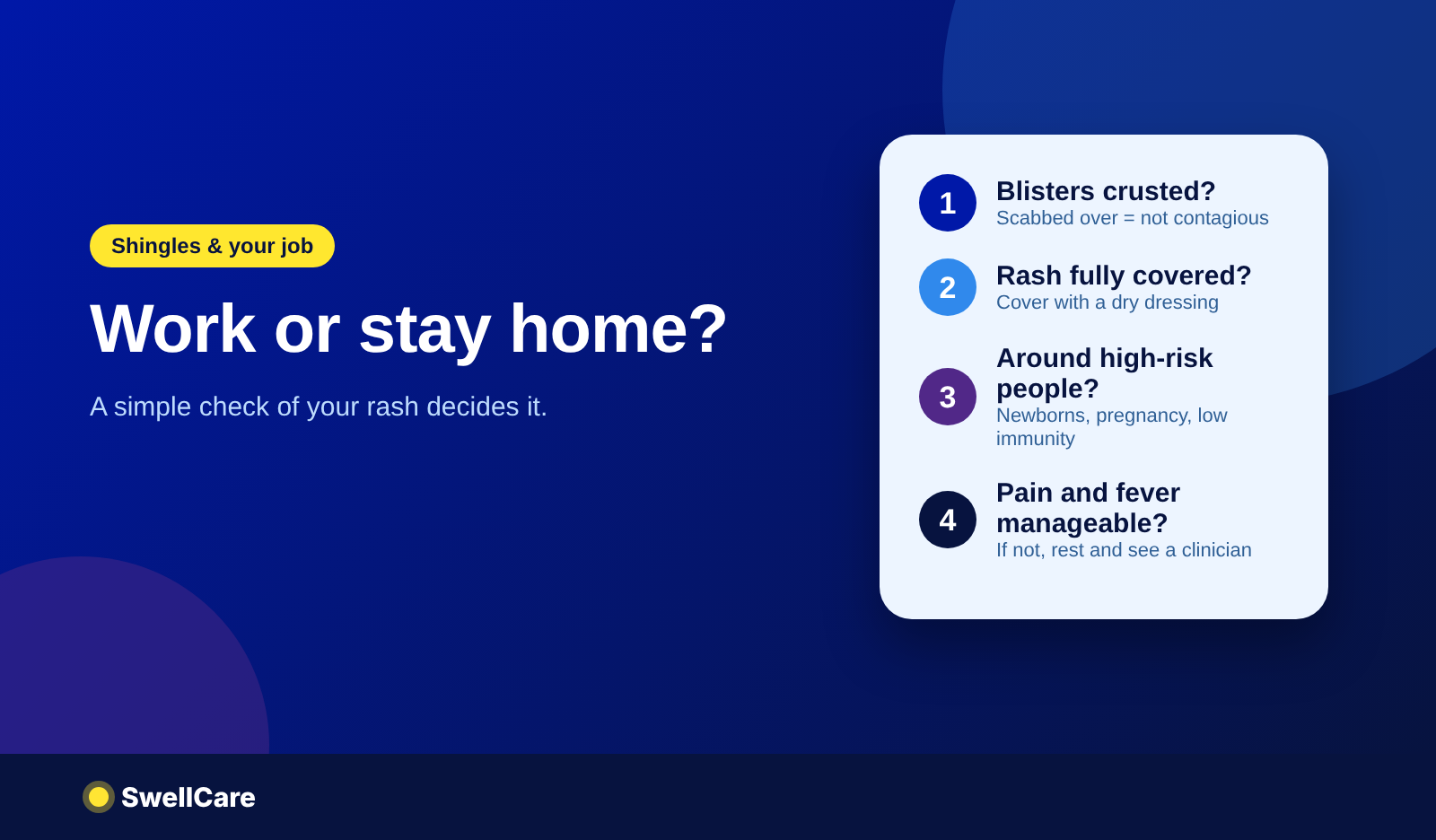
Here’s the rule most clinicians use. If your blisters are fully crusted over, you’re not contagious, and you can work if you feel up to it. Still wet? Keep the rash covered and think hard about your workplace. And if a fever hits, or the pain makes it hard to focus, rest is the better plan, whatever your skin looks like.
How long is shingles contagious?
The contagious period begins when blisters appear and ends when every blister has scabbed over. According to the CDC’s overview of shingles, people can’t spread the virus before the blisters show up or after the rash has crusted. Blisters typically scab over in 7 to 10 days, MedlinePlus notes, and the CDC’s clinical overview says the rash heals in about 2 to 4 weeks. So the contagious period for shingles is usually well under two weeks.
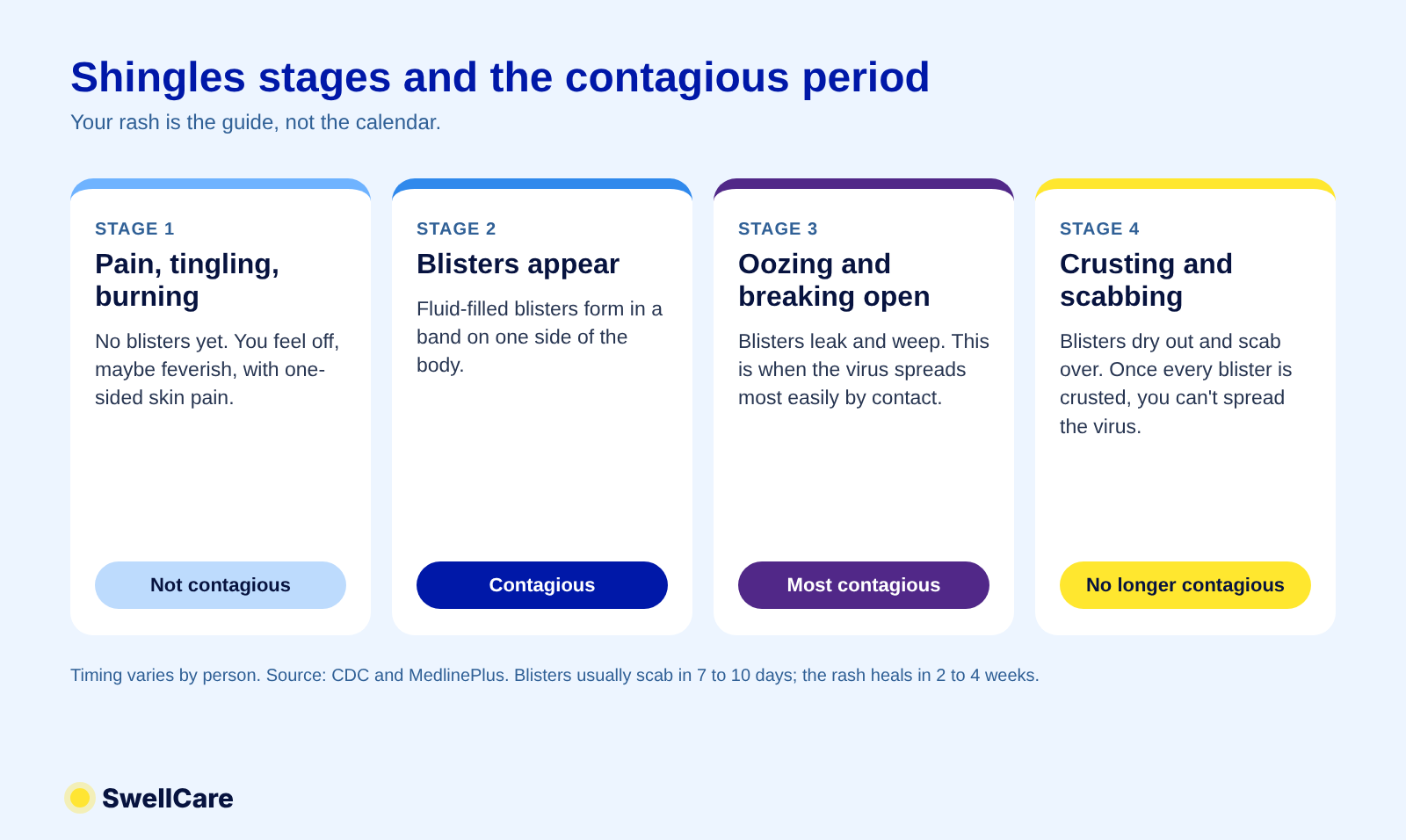
Think of it in four stages:
| Stage | What you see | Contagious? |
|---|---|---|
| 1. Early pain | Tingling, burning, no rash yet | No |
| 2. Blisters appear | Small fluid-filled blisters in a band | Yes |
| 3. Oozing | Blisters leak and break open | Yes, highest risk |
| 4. Crusting | Blisters dry and scab over | No |
The spread happens through direct contact with fluid from the blisters, or by breathing in virus particles from them. That’s why covering the rash matters so much. Covering the shingles blisters with a dry, loose dressing, plus frequent hand washing, cuts the risk a great deal, though neither erases it. Covering the rash also keeps clothing from irritating the skin.
Who you could put at risk at work
Most coworkers are fine, since shingles only spreads as chickenpox. Nearly everyone born in the US before 1980 has had chickenpox, and the CDC puts that figure above 99%. The people to worry about are a smaller group:
- Pregnant women who have never had chickenpox or the vaccine
- Premature or low birth weight babies
- People with a weakened immune system, such as those on chemotherapy, steroids or transplant drugs
A weakened immune system is easy to miss, because nobody wears it on their sleeve. If you can’t be sure who’s in that group on your team (the same goes for contact-spread skin conditions like scabies), assume someone might be. A coworker mentioning she’s expecting, or a colleague who’s in cancer treatment, is reason enough to keep your distance until you’ve scabbed.
There’s a flip side. If you’ve never had the shingles vaccine, this is a good moment to ask about it. The two-dose Shingrix vaccine is recommended for adults 50 and older, and for adults 19 and older with a weakened immune system. Having shingles once doesn’t guarantee you won’t get it again, and the shingles vaccine lowers your odds.
Going back to work with shingles, job by job
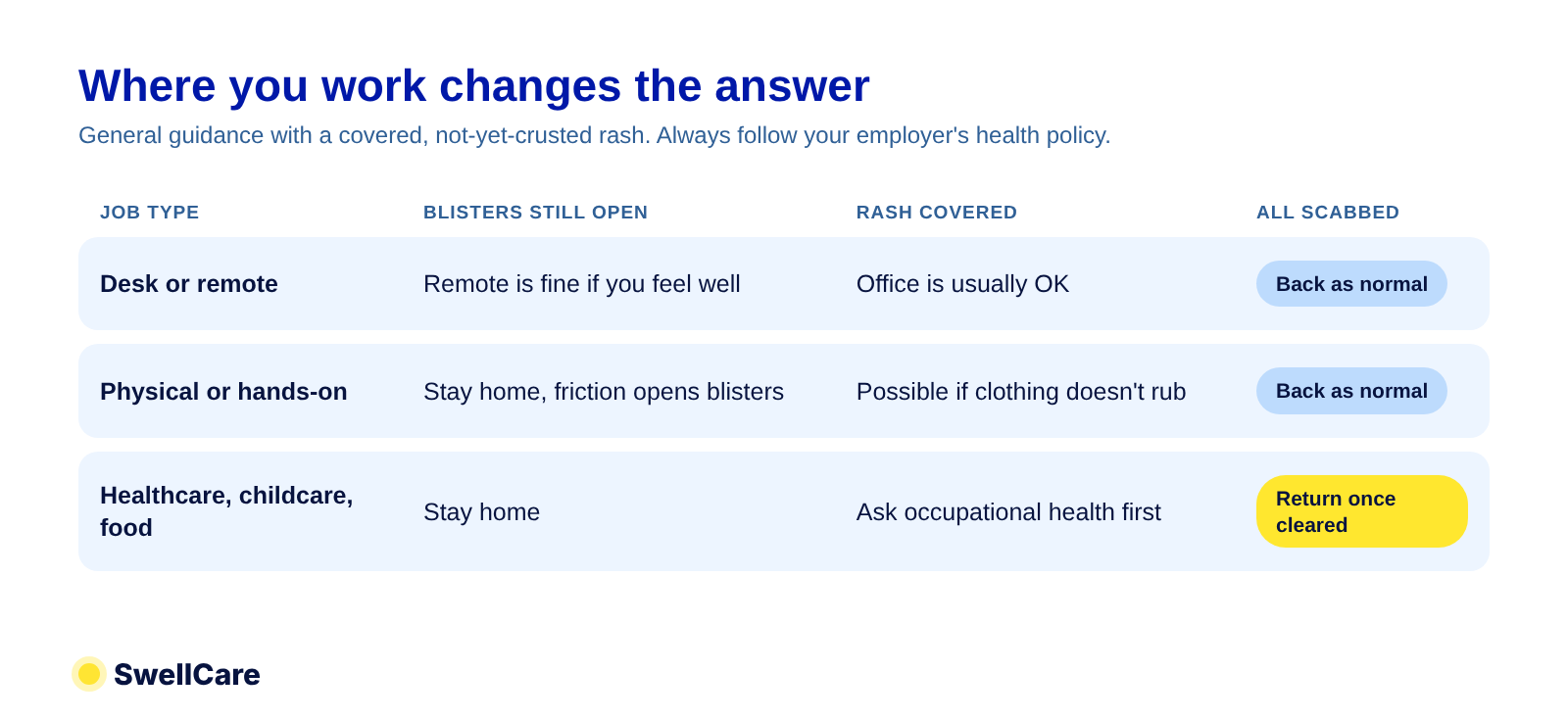
Your job decides how risky a covered rash really is. Here’s how it usually plays out.
Desk jobs and remote work
If you sit at a desk and the rash is under your clothes, you can often work with shingles, and many people do. Working from home is even easier when you’re still in the blister stage. Just be honest about your energy. Shingles pain can be distracting, and a day on the couch with your laptop beats pushing through a full commute.
Healthcare, childcare and food service
This is where the rules get stricter. Around patients, small children or open food, most employers want you off until every blister has crusted. Healthcare workers should check with occupational health, and childcare staff should ask their director. Many facilities have written policies that go beyond general advice, so follow yours.
Physical jobs
Heavy lifting, harnesses, tool belts and sweaty uniforms rub on the rash and can break blisters open. That raises your pain and your chance of passing the virus along. If you work with your body, give yourself time until the blisters have dried.
When to stay home no matter what
Some days, the rash is the smaller problem. Stay home if you have:
- A fever or chills
- Pain you can’t manage, even with over-the-counter relief
- Blisters you can’t cover, such as on your face, hands or neck
- Open, oozing blisters in a job with close contact
- Regular contact with newborns, pregnant women or people with low immunity
Resting isn’t weakness. Rest gives your immune system room to work, and exhaustion tends to make symptoms worse. Even a rash that looks mild can come with deep fatigue.
How long will you be off work?
There’s no single number. Many people with mild shingles are back within a week or so, once the blisters have crusted over, often in 7 to 10 days, and the pain is under control. Others need two weeks or more, especially with a rash on the face or torso, or when the pain is severe.
A rough way to plan your return to work: wait until the blisters are dry, check that you can wear normal clothes comfortably, and ease in with shorter days if you can. If you’re still on day four of oozing, plan on more time. And if the nerve pain, known as postherpetic neuralgia, lingers after the rash fades, tell your doctor, because it can affect how well you sit, type or concentrate.
Telling your employer and your rights
You aren’t required to share your diagnosis, but you may want to tell your employer you have a contagious skin condition so they can protect coworkers. Many workplaces will accept a short note from a clinician.
If you work for a covered employer with 50 or more employees, the Family and Medical Leave Act can give you up to 12 weeks of unpaid, job-protected leave for a serious health condition, though not every case of shingles qualifies. Employers with 15 or more employees must also consider reasonable accommodations under the ADA, such as remote work or adjusted duties. Rules vary by state and employer, so check your handbook and ask HR.
What to do if your rash is near your eye
Shingles that touches the forehead, eyelid or tip of the nose can spread to the eye. That can threaten your vision. If you notice a rash anywhere near an eye, or eye pain, redness or blurry sight, get seen the same day. This one isn’t a wait-and-see situation.
Get a shingles check today
Antivirals work best when you start them early. The CDC says treatment is most effective within 72 hours of symptom onset, and starting an antiviral quickly can ease the worst of the pain. It’s also worth asking about postherpetic neuralgia, the nerve pain that can linger long after the rash is gone. The CDC lists three antiviral options: acyclovir, valacyclovir and famciclovir. Your doctor decides which, if any, fits you.
If you’re not sure whether what you have is shingles, or whether you’re safe to be around coworkers, you don’t need to wait for a clinic slot. Swell offers 24/7 clinician-led virtual care by secure chat or video (see how it works). A completed consultation is $45 total, with no membership. A clinician can look at your rash, rule out other causes, talk through your symptoms and tell you what makes sense for your job and when to see a doctor in person. Swell isn’t emergency care, so call 911 if you have severe symptoms.
Start a visit with a Swell clinician and get a clear next step today.
Questions people ask about shingles and work
Can I go to work with shingles if it is covered?
Often yes, if the rash is fully covered with a dry dressing, you feel well and you won’t be around high-risk people. In healthcare, childcare or food service, wait until every blister has scabbed over.
Should I tell my boss I have shingles?
You don’t have to share details, but telling your employer helps protect coworkers who could be at risk, such as someone who is pregnant. You can say you have a contagious skin condition and share a clinician’s note.
Can I work from home with shingles?
Yes, in most cases. Working from home keeps you away from others while the blisters are open, as long as you feel well enough to work. Rest if you have a fever or heavy symptoms.
How long should I stay home with shingles?
Stay home until the blisters have scabbed over, usually 7 to 10 days. If your job involves vulnerable people, or the pain and fatigue are heavy, you may need more time.
Is shingles contagious through the air?
The virus can spread by contact with blister fluid, and by breathing in virus particles from the blisters. The risk is low when the rash is covered, and it ends once the blisters have crusted.
Trusted references
Public-health, research, and medical-society resources related to this guide.