You’ve been dabbing acne cream on a cluster of red bumps for two weeks. They’re still there. Maybe they itch. Maybe they showed up on your thighs, where you’ve never had a pimple in your life.
Here’s the short version of folliculitis vs acne. Both are inflamed hair follicles, but acne is a clogged pore driven by oil, while folliculitis is a follicle irritated or infected by bacteria, yeast or friction. The bumps look alike. The fixes don’t.
Getting it wrong costs you time, and sometimes it makes things worse. An acne routine can leave an infection untouched, and an antibiotic aimed at the wrong target can feed a yeast problem. This guide shows how each one forms, puts them side by side, gives you four checks to run tonight, explains the fungal lookalike that fools most people, and tells you when a clinician should take a look.
Folliculitis vs acne: the short answer
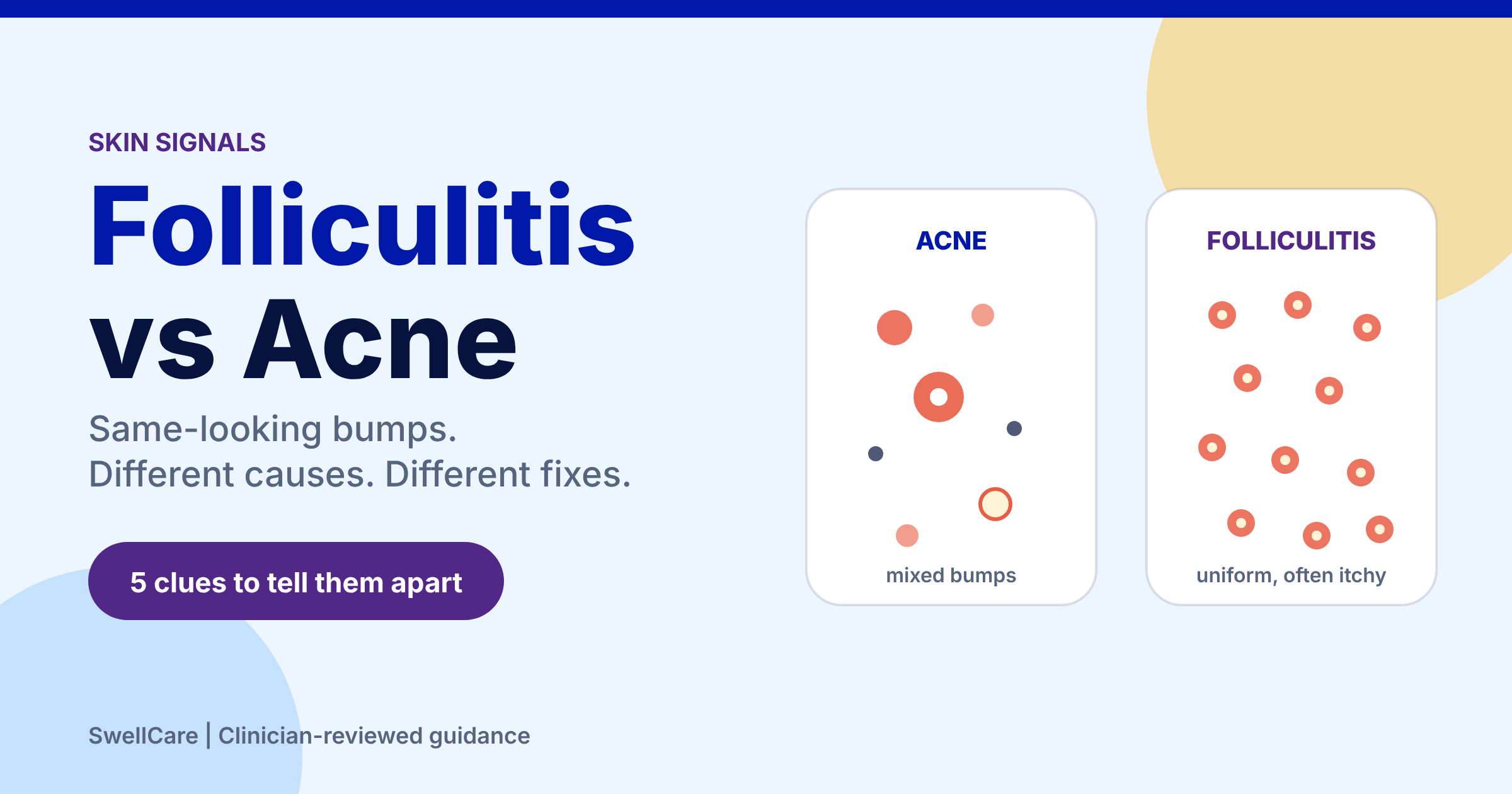
If your bumps are a mixed bag of blackheads, whiteheads and a few deeper, sore lumps, mostly on your face or upper body, think acne. If they’re similar-sized red bumps or pustules, often itchy, that appeared within days of shaving, a sweaty workout or a hot tub, think folliculitis.
That rule works most of the time. It fails often enough that dermatologists treat the two as a real diagnostic puzzle. The American Academy of Dermatology notes that folliculitis can pass for an acne-like breakout, and it recommends seeing a dermatologist to confirm what you have, since some cases need antibiotics and plenty don’t (see the AAD folliculitis guide).
Acne is the far more common of the two skin problems. The AAD estimates that up to 50 million Americans deal with it each year, and roughly 85% of people aged 12 to 24 have at least minor acne (AAD skin conditions by the numbers). Folliculitis is common too, but it flies under the radar because so many people assume every bump on the skin is a pimple.
Why does the label matter? Because treatment for acne and treatment for folliculitis point in different directions, and a correct diagnosis shortens the road to clearer skin. A dermatologist usually reaches a diagnosis by examining the lesions, the pattern across your skin and your recent history. Most people need no tests at all.
What is happening inside the follicle
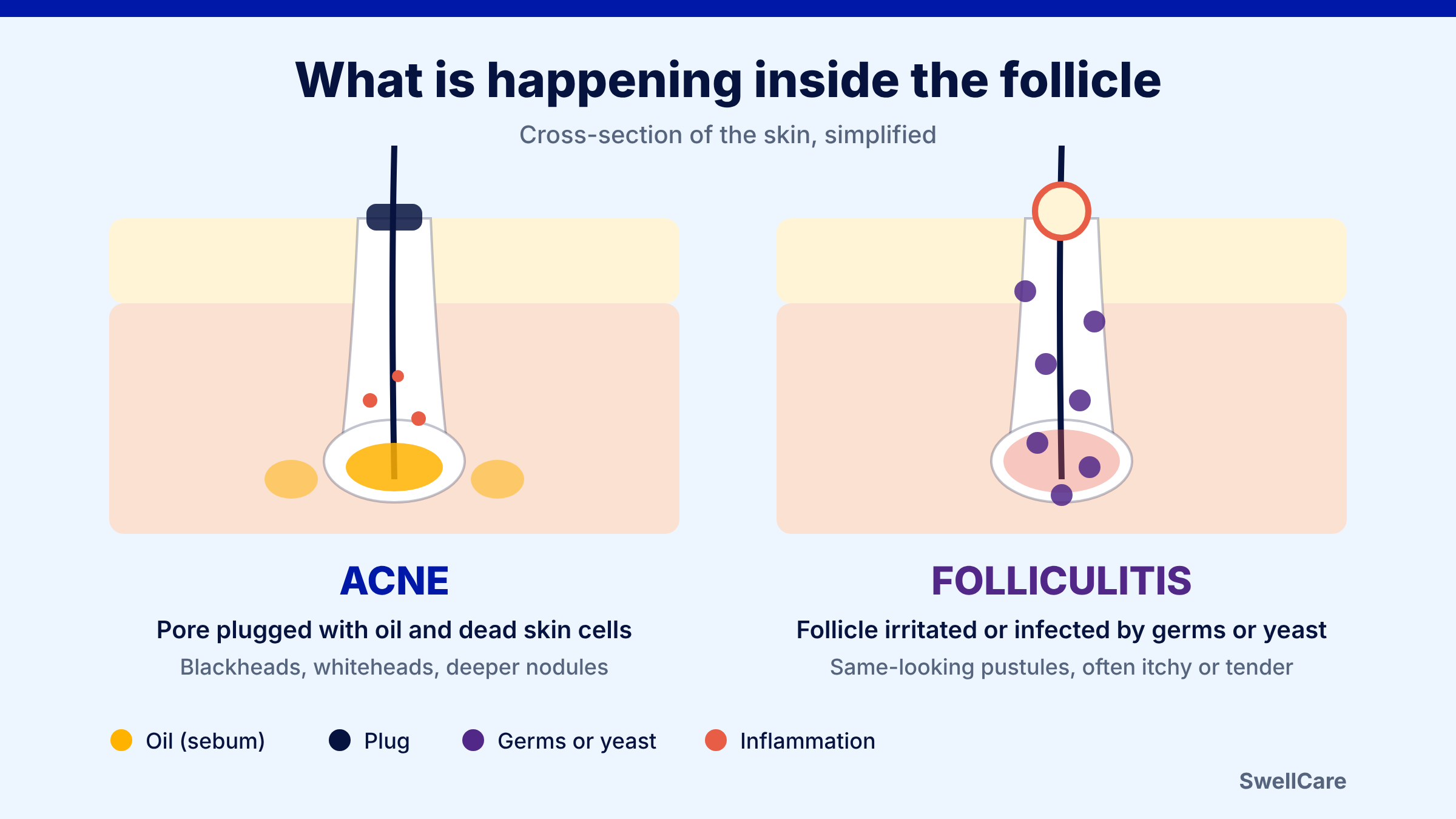
Every hair on your body grows from a tiny pocket in the skin called a hair follicle. Next to each follicle sits an oil gland. Both acne and folliculitis are problems in that pocket, which is exactly why the bumps look so alike from the outside.
Acne starts with a clogged pore
Your sebaceous glands make sebum, a natural oil that normally travels up the follicle and out onto the skin. In acne, dead skin cells and extra sebum bind together and plug the pore. A plug that stays closed under the surface becomes a whitehead. One that’s open to the air darkens into a blackhead. Together, these are called comedones.
Then the pore’s resident bacteria, including Cutibacterium acnes, multiply in the trapped oil. Your immune system reacts. The area turns red and swollen, and it hurts when you press it. That inflammation is what turns a simple clogged pore into a red bump, a pus-filled pustule or a deeper nodule. Doctors call each individual spot a lesion, and acne lesions come in stages: open and closed comedones, small red papules, pustules and, in more severe cases, nodules and cysts. Most people call the whole lot pimples.
Hormones nudge the process along, especially during puberty, around a menstrual cycle or with a condition like PCOS, because they tell the sebaceous glands to make more sebum. Genetics and certain medications add to the load, and so can stress. That’s why acne clusters on the face, chest and upper back. Sebaceous glands are densest there, and pores clog most easily.
Folliculitis starts with an irritated or infected follicle
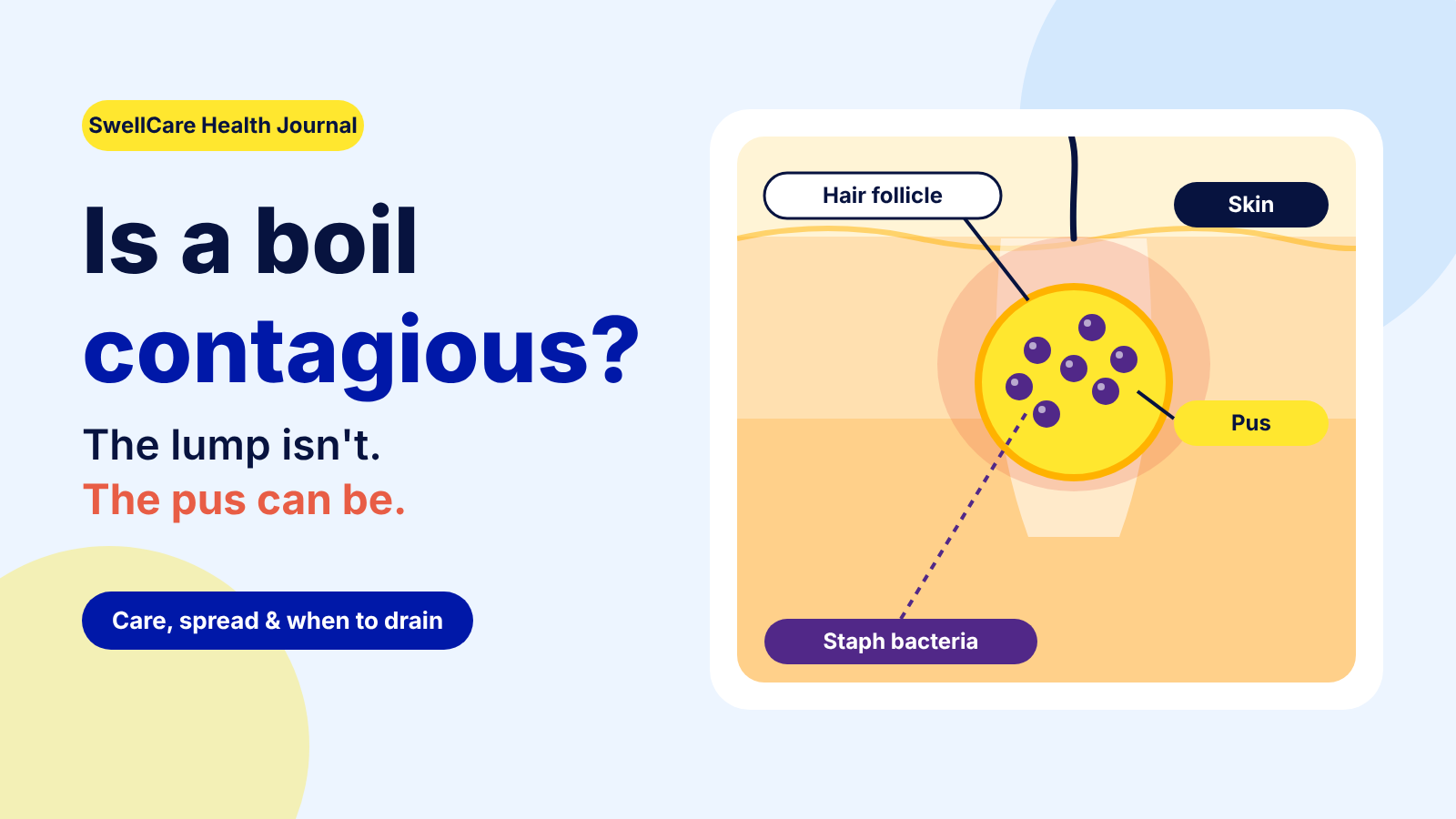
Folliculitis skips the clogging step. The follicle itself is damaged or irritated, germs get in, and the follicle becomes inflamed. Bacteria, most often staph that already lives on your skin, slip through tiny breaks around the follicle opening. Your immune system answers with inflammation, and the follicle fills with pus. That’s the pustule you see. The AAD describes it as an infection of the hair follicles that can show up anywhere on the body except the palms and soles, and a common culprit is the bacterium Staphylococcus aureus.
What damages the follicle? Friction from tight clothing or skin rubbing on skin. Shaving, plucking and waxing. The hair follicles on your legs and beard area take the brunt of it, along with the underarms and buttocks. Hot, damp skin that stays hot and damp. Some topical products and medications. And hot tubs that aren’t kept properly treated, which we’ll get to.
So here’s the difference in one line. Acne grows from the inside out, from oil and a plug. Folliculitis comes from the outside in, from irritation or germs. The bumps may be identical. The cause isn’t.
Folliculitis vs acne side by side
Nothing beats a table when two conditions overlap this much. Use it as a guide, not a verdict, because real skin is messy and many people have more than one thing going on.
| Acne | Folliculitis | |
|---|---|---|
| Typical lesions | A mix: blackheads, whiteheads, red bumps, pustules, sometimes deep nodules | Similar-sized red bumps or pustules, often with a thin red ring |
| Itch | Usually mild or absent | Often itchy; sometimes tender or burning |
| Common spots | Face, chest, upper back | Beard area, thighs, buttocks, legs, armpits, areas under swimwear or tight gear |
| How fast it appears | Builds over days to weeks, then flares and fades | Often shows up within days of a trigger |
| Main cause | Oil, dead skin cells, bacteria, hormones | Friction, shaving, germs, yeast, contaminated water |
| Blackheads and whiteheads? | Yes, typically | No |
| Usual first move | Benzoyl peroxide, a retinoid or both | Remove the trigger, use warm compresses, add an antifungal or antibiotic if needed |
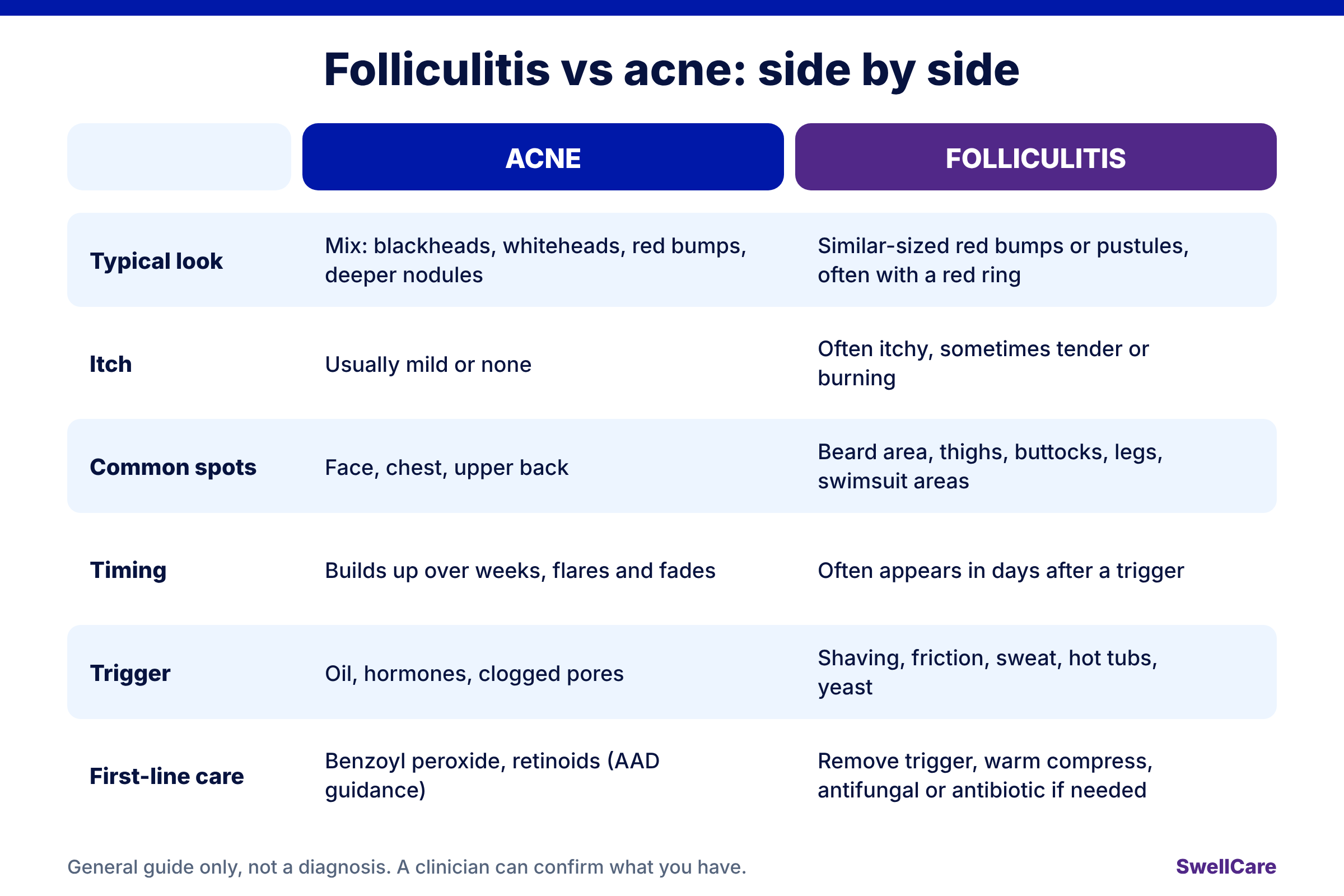
The row that settles more arguments than any other is the blackhead row. Acne is a pore-clogging condition, so it usually leaves comedones behind. A patch of uniform pustules with no blackheads or whiteheads anywhere nearby should make you suspect folliculitis.
Four clues you can check at home tonight
You don’t need a microscope to start sorting folliculitis vs acne. You need a mirror, decent light and about five minutes. Work through these four clues, then add them up.
Look at the mix of bumps
Acne is rarely tidy. Look closely and you’ll usually find several lesion types sitting side by side: a few blackheads, a couple of whiteheads, one angry red bump and maybe a deeper lump.
Folliculitis is more uniform. The bumps tend to be the same size and the same stage, often with a tiny hair running through the center of each one. If every bump looks like a clone of its neighbor, that’s a point for folliculitis.
Notice the itch
Ask yourself honestly: does it itch, sting or burn more than it hurts? Acne bumps usually ache when pressed. Folliculitis often itches, and the itch can be the first thing you notice. Intense, persistent itching in a patch of uniform bumps on the chest or back is also the calling card of the fungal type we’ll cover shortly.
Check where they are
Location is a clue, not a rule. Acne favors the face and the upper body. Folliculitis follows friction and moisture. Think of the beard area, thighs, buttocks and underarms, plus anywhere your swimsuit or gym gear sat against damp skin.
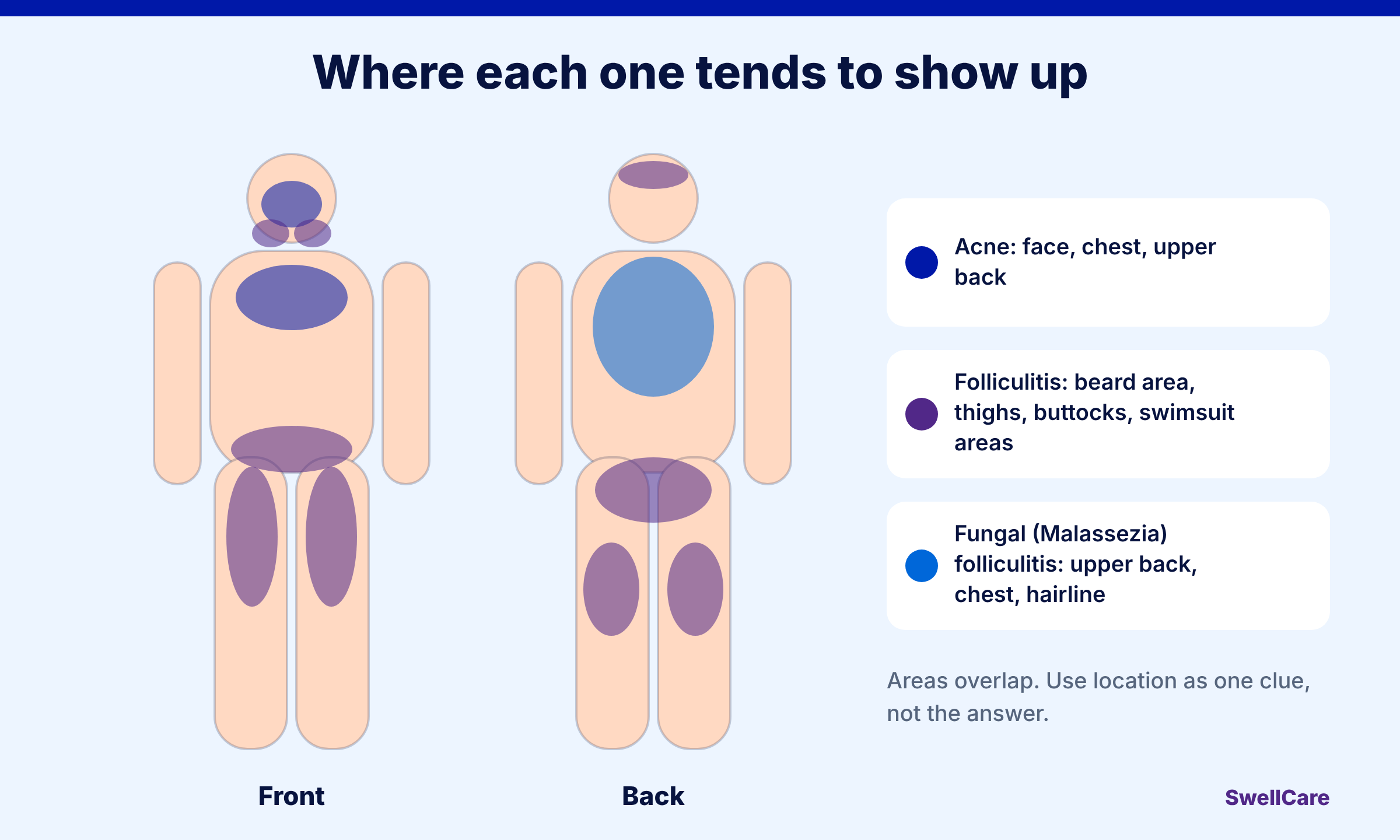
Bumps on the buttocks and outer thighs, a place where oil glands are modest and friction is constant, point strongly toward folliculitis.
Think back over the last 48 hours
Timing is where folliculitis gives itself away. Did you shave, wax or pluck? Did you wear tight leggings through a sweaty workout and sit around in them afterward? Did you soak in a heated pool or spa?
The AAD says most people with this type of folliculitis see the breakout about 12 to 48 hours after the soak, usually on the skin a swimsuit covered. MedlinePlus puts the window at several hours to five days. Acne, on the other hand, has no clear trigger event. It just builds.
If you can name a trigger inside the last couple of days, folliculitis moves to the top of the list. A rash on swimsuit skin the day after a soak is classic hot tub folliculitis. Pay attention to razor bumps too. Razor bumps are real, and curly hair that curls back into the skin after shaving causes a related problem called pseudofolliculitis barbae, which looks like folliculitis but is mostly an ingrown-hair reaction.
Fungal acne: the lookalike that fools most people
There’s a third player, and it causes a lot of misdiagnosis. “Fungal acne” isn’t acne at all. It’s Malassezia folliculitis, also called pityrosporum folliculitis, and it’s caused by an overgrowth of Malassezia, a yeast that lives on almost everyone’s skin without causing trouble.
When the conditions are right (heat, humidity, heavy sweating, occlusive products or a recent course of antibiotics), the yeast overgrows inside the follicle. The result is a crop of small, itchy red bumps and pustules.
Malassezia feeds on the oils in your sebum, so it thrives where oil glands are busy. That’s the reason pityrosporum folliculitis loves the chest and upper back, the same real estate acne likes. It’s also why the two get confused so often, even by people who’ve had acne for years. The yeast is not a sign of poor hygiene. Plenty of clean, active people get Malassezia folliculitis because they sweat in synthetic clothing and don’t change right away.
DermNet, a clinician-written reference, describes the pattern clearly. The bumps are uniform in size and look alike. They’re typically itchy. They cluster on the upper back and chest. They can also appear on the forehead, hairline, chin and neck, and on the outer upper arms. And there are no blackheads or whiteheads, which is the single biggest difference from true acne (DermNet on Malassezia folliculitis).
Here’s why it matters. A person sees itchy bumps on their chest, assumes it’s acne and starts an acne routine. Maybe a dermatologist or a telehealth visit prescribes an antibiotic. The bumps don’t clear, or they get worse, because antibiotics don’t touch yeast and can even tip the balance in its favor. The usual treatment is antifungal: topical options such as selenium sulfide shampoo, ketoconazole or econazole, or an oral antifungal for stubborn cases.
Fungal folliculitis also tends to come back. Treating the triggers matters as much as the medication: heat, sweat, tight synthetic clothing and heavy, oily products.
Confirming it is simple for a clinician. They may scrape a few cells and look for budding yeast under the microscope. Often the pattern alone is enough to try an antifungal and see if the itch settles.
Why the right label changes treatment
The point of sorting folliculitis vs acne isn’t to win a diagnosis contest. It’s to pick treatment that fits the cause. The wrong match wastes weeks, irritates your skin and, in some cases, raises the risk of scarring.
If it is acne
The AAD’s 2024 acne guidelines cover adults, adolescents and children over 9. They give strong backing to a short list: topical benzoyl peroxide to cut acne-causing bacteria, topical retinoids (adapalene, tretinoin, tazarotene and trifarotene) to unclog pores and calm inflammation, and combinations of the two. Oral and topical antibiotics are also on the list.
The guidelines add a firm caution: limit oral antibiotics where possible, and pair them with benzoyl peroxide to reduce resistance. Salicylic acid and azelaic acid earn conditional support. Isotretinoin is reserved for severe acne or cases that haven’t responded to standard care (AAD acne guidelines).
Why these? Benzoyl peroxide works on bacteria, retinoids work on the clogging itself, and salicylic acid helps loosen the dead skin that blocks a pore. Each treatment attacks a different step in the same chain.
Most over-the-counter acne products boil down to those same ingredients. Benzoyl peroxide and salicylic acid come in washes, gels and pads. Adapalene is the retinoid you can now buy without a prescription. Salicylic acid is gentler on sensitive skin. It also works well on comedones, the blackheads and whiteheads that cap clogged pores. Retinoids keep new comedones from forming and calm inflammation. They also fade lesions that are already there. Expect some dryness and peeling in the first few weeks. A routine that fights oil and sebum buildup works slowly, so give it time before you swap it for something new.
In practice, a consistent treatment routine matters more than a stack of products. A benzoyl peroxide wash or gel, plus a retinoid at night, used for about two months, beats switching products every week. Hormonal options, such as combined oral contraceptives or spironolactone, can help some women, and a clinician can discuss them.
If it is folliculitis
Mild folliculitis often heals once you remove the cause. The AAD recommends warm compresses for 15 to 20 minutes, three to four times a day, to ease discomfort and speed healing. If shaving, plucking or waxing triggered it, stop for about 30 days.
Some cases need medicine. A topical antibiotic can help a localized bacterial patch. An oral antibiotic is reserved for more widespread or stubborn infection. An antifungal is the answer when yeast is the culprit. A clinician decides which, ideally after looking at the pattern. Bacteria and yeast need opposite treatment.
This one is its own subtype. It’s caused by Pseudomonas aeruginosa, a bacterium that thrives in warm, poorly treated water. MedlinePlus says mild cases often clear without treatment, severe ones may need an antibiotic, and the rash usually heals without scarring. It can come back if you jump into the same water before it’s cleaned (MedlinePlus on hot tub folliculitis).
Notice the difference in philosophy. Acne care is about long-term control of oil, pores and inflammation. Folliculitis care starts with the trigger.
Three mistakes show up again and again. People treat fungal bumps with antibiotics, which can’t touch yeast. They scrub bacterial folliculitis with acne products, which only scrapes irritated hair follicles and invites more bacteria. And they wait for razor bumps to clear while the shaving carries on. A dermatologist will tell you the same thing every time: change the trigger, match the treatment to the cause and save antibiotics for the cases that need them. Overuse breeds resistant bacteria and does nothing for pustules caused by yeast.
What to do this week (and what to skip)
While you work out which one you have, a few moves are safe for almost every kind of bump.
- Wash gently, once or twice a day. Use a mild cleanser and lukewarm water. Scrubbing a bumpy patch makes it angrier, not cleaner.
- Use warm compresses on tender, itchy bumps. Press a clean, warm, damp cloth on the area for fifteen to twenty minutes, a few times a day. The AAD backs this for folliculitis, and it costs nothing.
- Change out of sweaty clothes fast. Shower after workouts, wash gym gear after every wear and let swimsuits dry fully before the next use.
- Pause shaving, waxing and plucking on the affected area. Thirty days is the AAD’s suggestion when hair removal set it off. If you have to shave, use a clean, sharp blade and shave in the direction the hair grows.
- Keep the routine boring. Fragrance-free, non-comedogenic moisturizer and sunscreen. Hold off on new actives for a week while the skin settles.
Now the skip list. Don’t pop or squeeze pimples or any other bumps. Squeezing pushes bacteria or yeast deeper, spreads the problem and raises the odds of scarring. Don’t share razors, towels or washcloths. Don’t start a leftover antibiotic from your medicine cabinet, because the wrong drug is worse than none. And don’t layer three new acne products on top of each other at once.
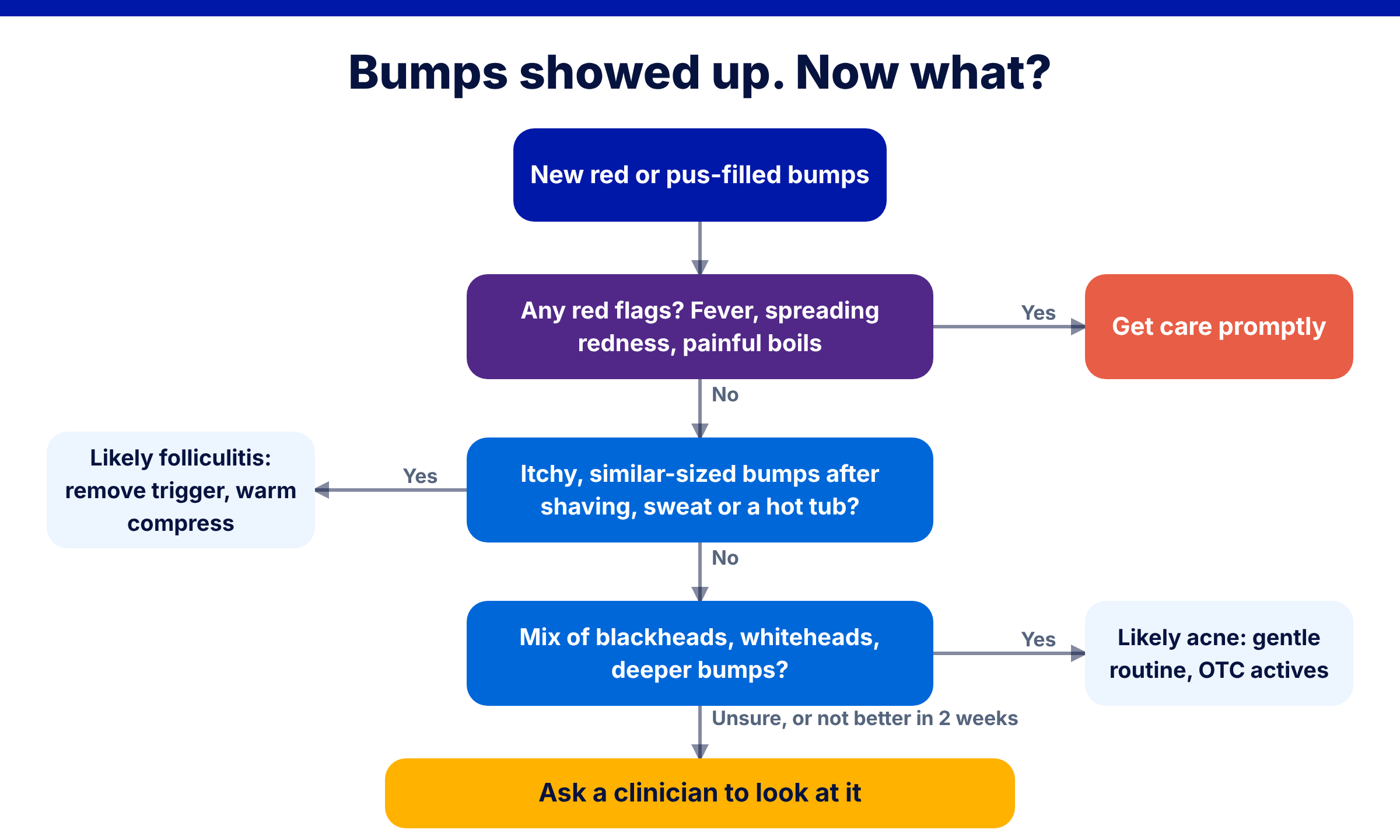
Give a sensible routine about two weeks. If nothing has improved by then, or sooner if anything on the next list shows up, it’s time for a professional opinion.
When to see a doctor
Most bumps are annoying, not dangerous. A few signs mean you shouldn’t wait.
Get care promptly if you have a fever, if the redness is spreading outward, if a bump has turned into a large, hot, painful boil, or if you notice streaking, swollen lymph nodes or you simply feel unwell. These can signal a deeper infection such as an abscess, which sometimes needs drainage and antibiotics.
Book a visit sooner rather than later if:
- the bumps haven’t improved after about two weeks of sensible care;
- they keep coming back in the same place;
- the itch is intense;
- you’re seeing dark marks or early scarring;
- you have diabetes or a weakened immune system, which makes skin infections harder to shake.
When the folliculitis vs acne question stays unclear after a couple of weeks, a dermatologist can often tell the difference by looking, and usually no testing is needed. When the picture isn’t clear, they may swab the area for a culture, scrape skin to look for yeast or, rarely, take a small biopsy. If your symptoms are severe or you have chest pain, trouble breathing or other emergency signs, call 911 or go to an emergency department.
Get a skin check with Swell
Waiting weeks for a dermatology appointment is the part nobody likes. If you’ve worked through the clues above and the folliculitis vs acne question is still unresolved, a clinician can often review a skin concern remotely, which makes telehealth a practical first step.
Swell offers 24/7 online care. Rashes and skin concerns are among the things the team can review by photo or video. You start with a free screening. Then, if a visit is the right next step, the consultation is $45, with no membership. Medication and lab costs are separate.
Here’s what to expect, honestly. A clinician looks at your photos and asks about timing, triggers and medications. They’ll ask what you’ve already tried, then tell you what they think is going on and what to do next. Some patients get a treatment plan. Others are told they need to be seen in person. A prescription is never guaranteed, and Swell isn’t a replacement for emergency care or for an ongoing relationship with a dermatologist.
Start with a free screening at Swell and see what a clinician thinks. You can also browse the conditions Swell covers before you decide.
Questions people ask about folliculitis vs acne
How can I tell folliculitis from acne at home?
Check three things: the mix of bumps, the itch and the timing. Acne usually brings blackheads, whiteheads and bumps of different sizes. Folliculitis tends to be uniform and often itchy, and it appears within days of shaving, sweating or a hot tub soak. No blackheads plus a clear trigger? That points toward folliculitis. Still unsure? Ask a clinician.
Can you have folliculitis and acne at the same time?
Yes. They can overlap on the same patch of skin, especially on the chest and back, and one can irritate the other. Heavy acne products can irritate follicles, and fungal folliculitis often hides inside what looks like stubborn acne. When treatment only half works, a mixed picture is a common reason.
Can I pop a folliculitis pimple?
Please don’t. Squeezing can push bacteria or yeast deeper into the skin, spread the infection to nearby follicles and leave a scar or dark mark. Use a warm compress for 15 to 20 minutes a few times a day instead. If a bump keeps growing or becomes a large, painful boil, get it checked.
How long does folliculitis take to go away?
Mild folliculitis often settles on its own once you remove the cause, which can mean days to a couple of weeks. Hot tub folliculitis tends to heal without scarring. If bumps haven’t improved after about two weeks, keep coming back, or get painful, see a clinician, because you may need an antifungal or antibiotic.
Is fungal acne the same as acne?
No. Fungal acne is Malassezia folliculitis, caused by yeast rather than clogged pores. It’s usually itchy and uniform, and it shows up on the chest, upper back or hairline without blackheads or whiteheads. Standard acne products and antibiotics often don’t help and sometimes make it worse. Antifungal treatment is the usual fix.
Can hot tubs cause bumps that look like acne?
Yes. Poorly maintained hot tubs and pools can carry Pseudomonas bacteria that cause hot tub folliculitis, an itchy, red, pimple-like rash that appears hours to a few days after a soak. It’s usually worst where swimwear held water against your skin. Most mild cases clear on their own, but a clinician can help if yours doesn’t.
Trusted references
Public-health, research, and medical-society resources related to this guide.