You opened your lab portal, saw a small H next to “Monocytes,” and your stomach dropped. Take a breath. A high monocyte result is common, and it usually means your immune system is busy with something ordinary, like a recent viral infection.
Here’s the high monocytes meaning in one line: your blood holds more of one kind of white blood cell than the lab expects. Doctors call that monocytosis. It’s a clue, not a diagnosis. Below, you’ll see what counts as high, what’s usually behind it, and the few situations that deserve a closer look.
What do monocytes do in your body?
Monocytes are a type of white blood cell. Your bone marrow makes them, they travel through the bloodstream, and they work as first responders for your immune system, reacting to inflammation and infection. When tissue is damaged or germs show up, monocytes head to the scene and mature into macrophages that swallow debris and invaders. So a rising count often reflects a normal immune response at work. It isn’t a sign that something has failed.
What counts as a high monocyte count?
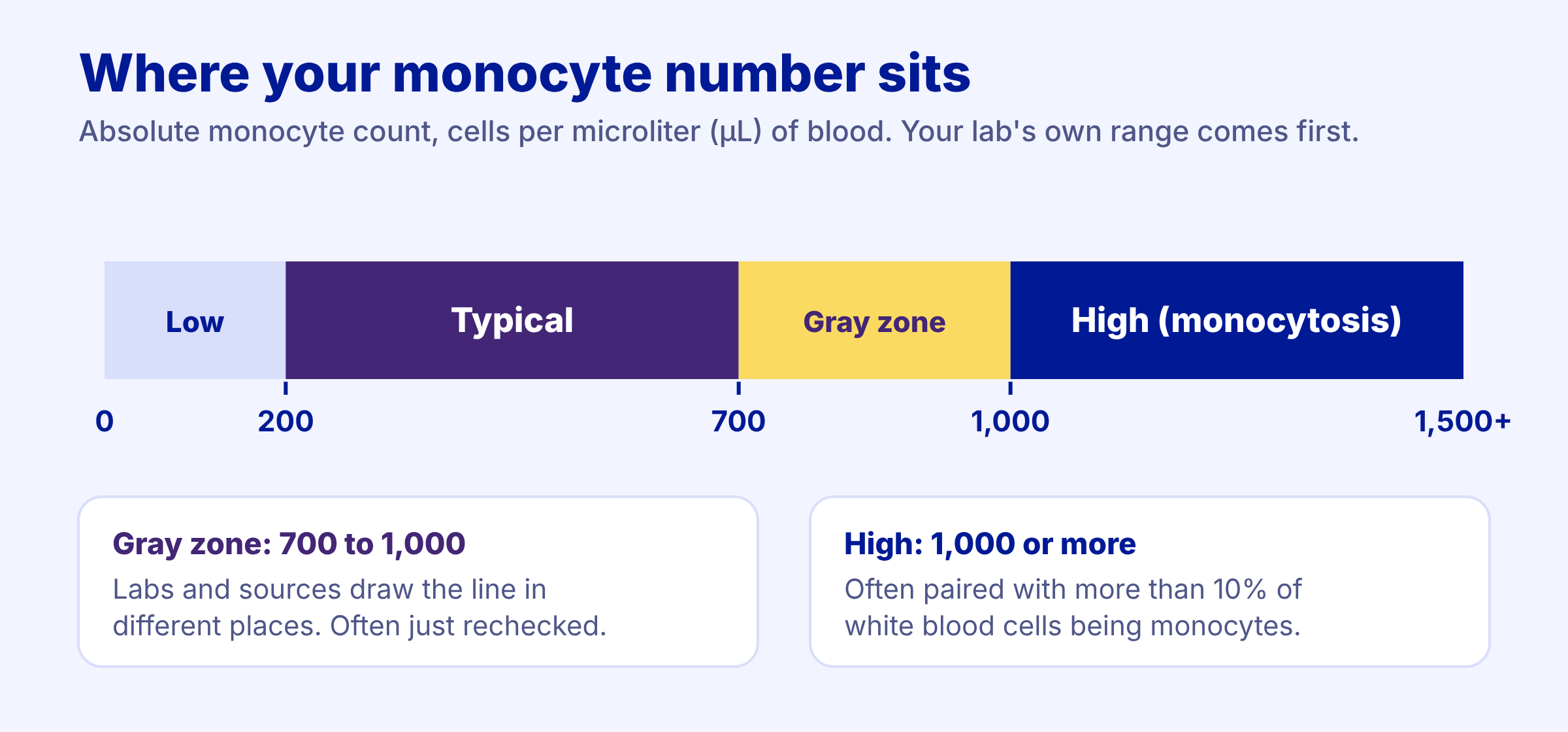
Your report lists two numbers, and they’re easy to mix up. One is the percentage of white blood cells that are monocytes. The other is the absolute monocyte count, the actual number of cells per microliter of blood. Doctors lean on the absolute count, because a percentage can look odd simply because another cell type dropped.
| Measure | Typical adult range | Usually called high |
|---|---|---|
| Monocytes as a share of white blood cells | About 2% to 8% | Above 10% |
| Absolute monocyte count | Roughly 200 to 700 per µL | 1,000 per µL or more |
Sources draw the line a little differently. Cleveland Clinic defines monocytosis as 1,000 monocytes per microliter with more than 10% of white blood cells, while Healthline counts anything above about 800. Your lab’s printed range wins.
High monocytes meaning: the usual causes
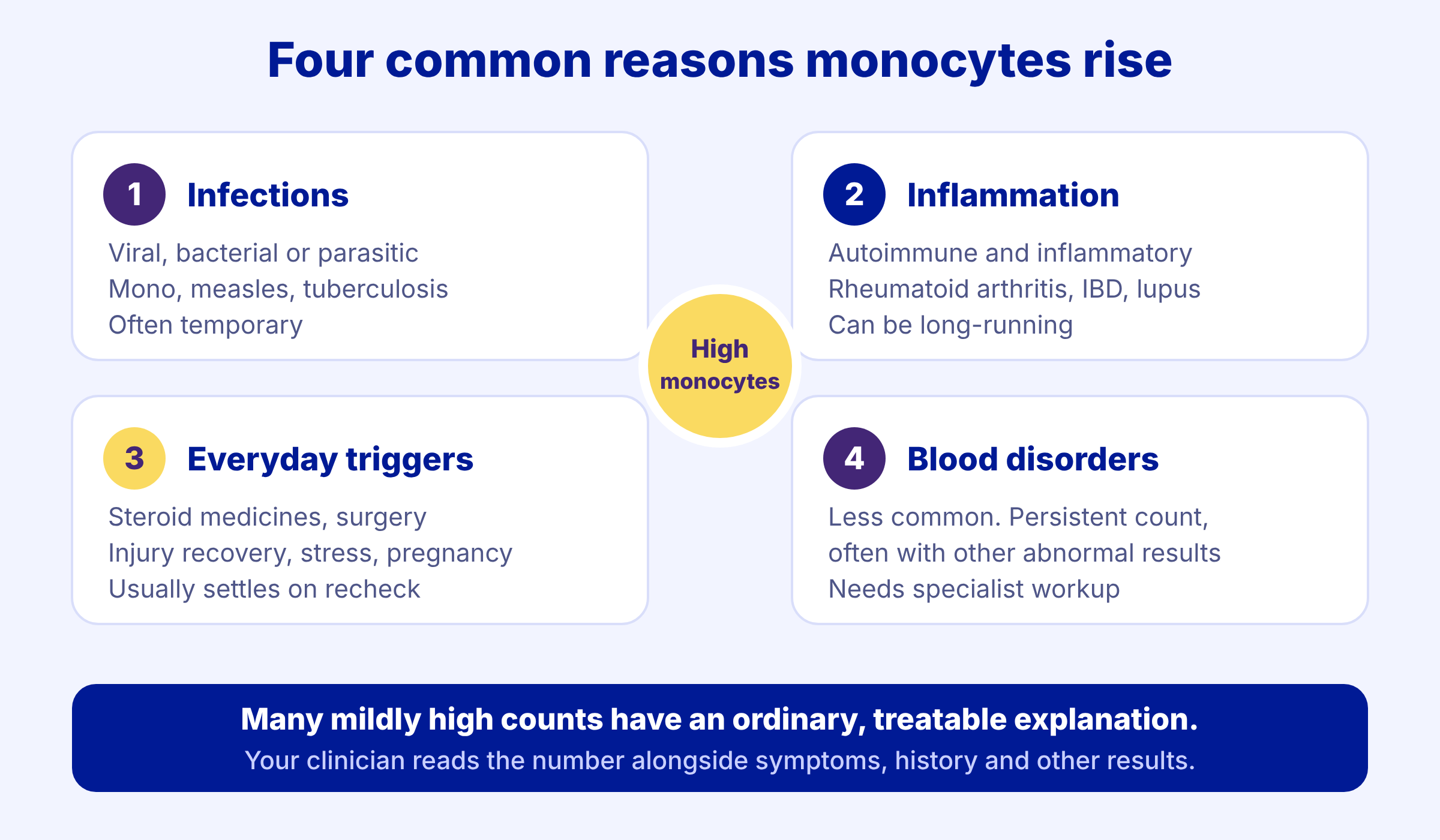
Most of the time, a high monocyte count traces back to something your immune system is already handling, and your monocyte count simply reflects the effort. Here are the main groups.
Infections that raise monocytes
Infection is the classic trigger. A viral infection such as mononucleosis, measles or mumps can do it, and so can bacterial infections like tuberculosis and some parasitic ones, according to Healthline. Your monocyte count often settles once the infection clears, as the immune response winds down.
Inflammation and autoimmune conditions
Chronic inflammation keeps calling monocytes in, and any lasting inflammation can hold the number up. Autoimmune diseases such as rheumatoid arthritis, lupus and inflammatory bowel disease are all linked to higher counts. If you already live with one, a high number may simply track your flares.
Medications, stress and recovery
Steroids can push the number up. So can recovery from surgery or injury, pregnancy, intense exercise, physical stress and having your spleen removed, as WebMD explains. Acute stress is on most lists of triggers. A few other medicines can do it too, including the antipsychotic ziprasidone. Stress and recovery both pass, so the number often follows. Tell your doctor everything you take.
When high monocytes point to a blood disorder
This is the part that sends people searching at midnight, so let’s be plain. Yes, some blood cancers raise monocytes. Chronic myelomonocytic leukemia (CMML) is the best known. It’s uncommon, and the median age at diagnosis is about 72, according to Blood Cancer United. Lymphoma and other leukemia types can also show up with a raised count.
What separates these from an ordinary bump? A persistent monocyte count that stays high on repeat tests, usually next to other abnormal results such as low red cells or platelets, plus symptoms. That’s when a doctor starts looking at the bone marrow. Most people with a raised count don’t have CMML, and one mildly high number with none of that rarely means cancer.
Do high monocytes cause symptoms?
On their own, no. Monocytosis doesn’t cause symptoms. The underlying cause might. Watch for fever, fatigue, night sweats, weight loss you can’t explain, swollen lymph nodes and joint pain, a list the Blood Project shares with patients. Signs that fade as an illness passes fit the ordinary picture. Ones that hang around don’t.
High absolute monocytes vs. a high percentage
The lab works out your absolute monocyte count by multiplying the monocyte percentage by your total white blood cell count. Try it. Ten percent of 6,000 cells is 600, well inside the typical range. Eight percent of 14,000 is 1,120, which is high even though 8% looks fine.
It works the other way too. A high percentage with normal absolute monocytes usually isn’t a worry. So when you ask about your result, ask which number was flagged.
How doctors figure out why your monocytes are high
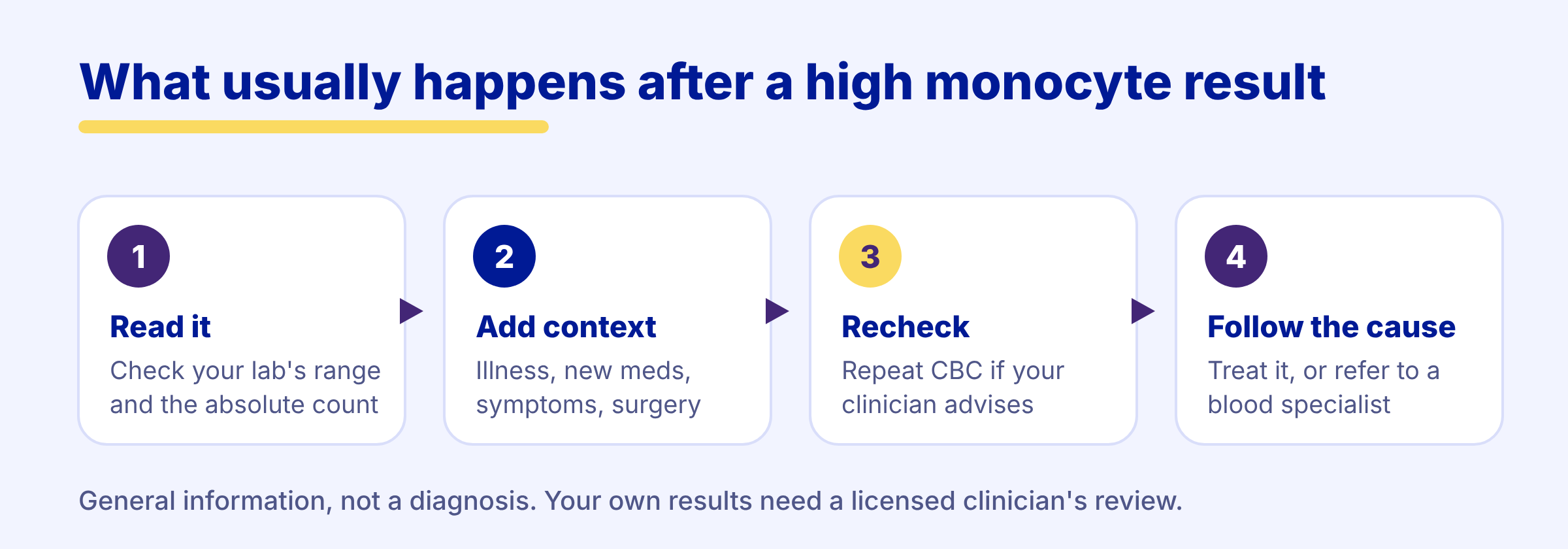
It starts with a blood test called a complete blood count (CBC) with differential. Your absolute monocyte count comes straight from it. Your doctor may add a peripheral blood smear to look at the cells under a microscope, and check for an enlarged spleen, liver or lymph nodes. Then comes the detective work: recent illness, new medications, symptoms, earlier results.
Often the plan is just to repeat the CBC once the infection or stress has passed, and a second blood test settles the question. A persistent count gets more testing for the underlying cause, and treatment waits on what that testing finds. Sometimes that means a referral to a hematologist, a blood specialist. A clear diagnosis comes from the whole picture, never from one number.
Can you lower high monocytes?
Treatment targets the cause, not the number. A viral infection needs rest. Tuberculosis needs antibiotics. A flare of a chronic condition needs its own treatment plan, and every treatment choice belongs to you and your doctor. Regular exercise and an anti-inflammatory eating pattern, like the Mediterranean diet, may support blood health, but Healthline says they belong alongside your doctor’s plan, never in place of it. Don’t chase a lab value with supplements.
When to see a doctor about high monocytes
Book a visit if your monocyte count stays high on a repeat test, if you have fever, night sweats, weight loss or fatigue that won’t lift, or any persistent change you can’t explain, or if your complete blood count shows other abnormal values. Head to the emergency room if things are severe or getting worse. Nothing on this page replaces a clinician who knows your history.
Your next step: get your results read by a clinician
A flagged number feels scary mostly because nobody has explained it. Swell’s licensed clinicians review lab results, tell you what’s flagged and what isn’t, order follow-up labs when it makes sense, and say whether you should see a specialist. Visits are online, day or night.
Have a result you don’t understand? Start with a Swell clinician today. It isn’t emergency care, so call 911 for severe symptoms.
Questions people ask about high monocytes
Is 1.4 absolute monocytes high?
Yes, if your lab reports it in thousands per microliter. A value of 1.4 means 1,400 cells per µL, above the usual 1,000 cutoff for monocytosis. It’s still only a clue. Your doctor will check for a recent infection or other trigger and likely repeat the test before drawing any conclusion.
What virus causes high monocytes?
Several can. Infectious mononucleosis is the best known, and measles and mumps can do it too. Many other viral illnesses may raise the number briefly while your body fights them. The monocyte count usually drifts back toward normal after you recover, which is why doctors often just recheck.
What medications cause high monocytes?
Steroids are the most common culprit. Some other drugs can raise white blood cells, including the antipsychotic ziprasidone and medicines that boost white cell production. Radiation therapy can do it as well. Never stop a prescribed treatment on your own because of a lab value. Ask your doctor first.
What autoimmune disease has high monocytes?
Inflammatory arthritis, lupus and inflammatory bowel disease are the usual examples, and celiac disease is sometimes listed too. The ongoing inflammation keeps drawing monocytes into the bloodstream. If you have one of these conditions, bring your monocyte result to your next appointment.
Do high monocytes mean cancer?
Usually not. Infections, inflammation and ordinary triggers are far more common explanations. Cancer becomes a question when the count stays high on repeat tests and comes with other abnormal blood results or signs such as weight loss. Your doctor can sort that out with follow-up testing.
Trusted references
Public-health, research, and medical-society resources related to this guide.