You took the first pill hours ago, and it still burns every time you pee. So you’re asking the obvious question: how long do UTI antibiotics take to work? Most people notice relief within a day or two. Full recovery takes a bit longer, and a few infections need more than the first round of treatment. Here’s what to expect, and the point where you should pick up the phone.
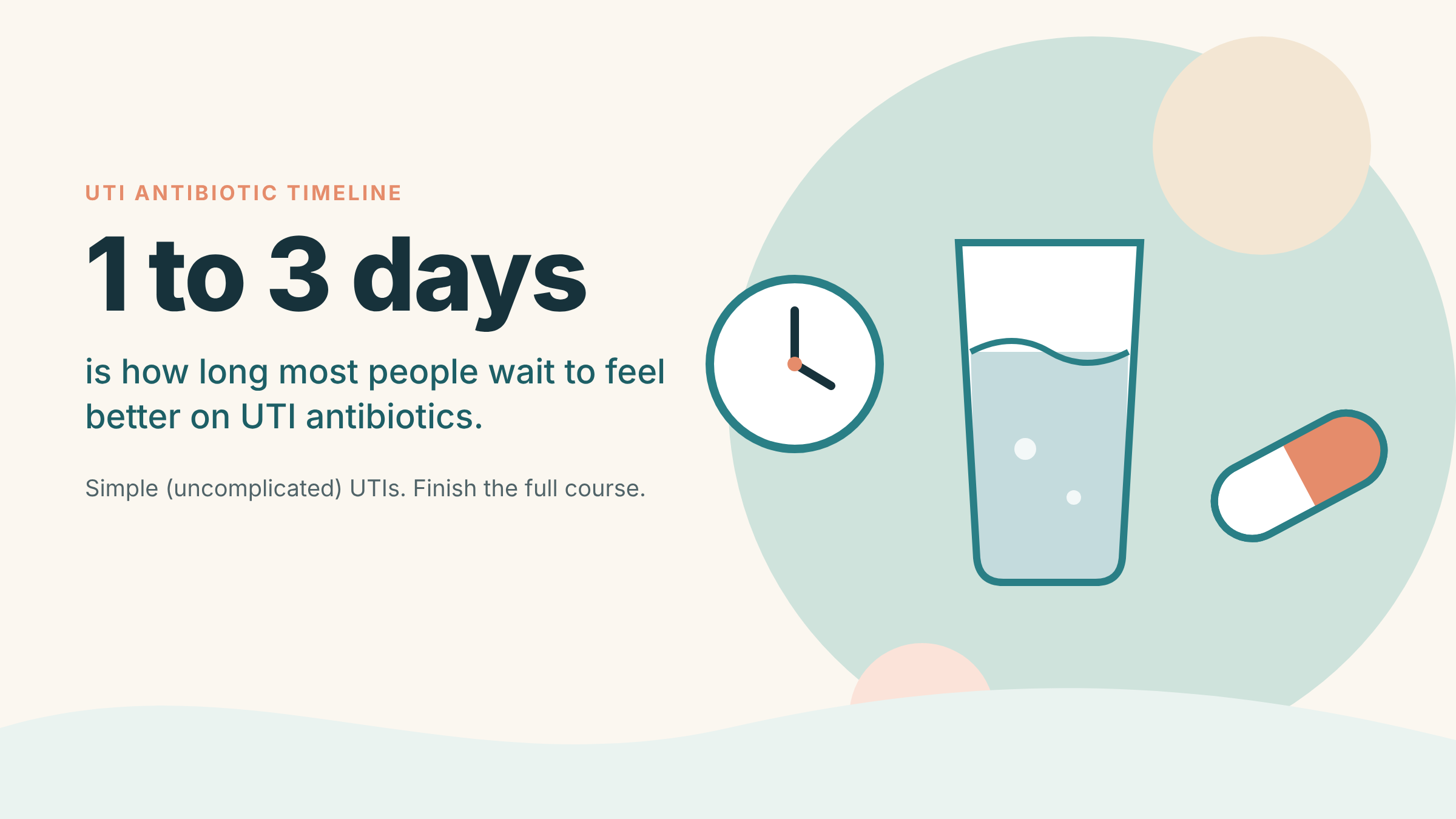
The short answer: most people feel better in one to three days
A UTI is a urinary tract infection, most often a lower one called acute cystitis. Doctors call it uncomplicated when it stays put in an otherwise healthy, non-pregnant adult, and that’s the type these timelines fit best. Antibiotic treatment kills the bacteria behind the infection, and symptoms ease as the urinary tract heals.
So how long do UTI antibiotics take to work in practice? For a simple infection, UTI symptoms usually start easing within a day or two of the first dose. Drugs.com reports that nitrofurantoin begins working in the bladder within hours, with noticeable improvement in 24 to 48 hours and full relief in roughly three to five days. The American Academy of Family Physicians tells women with a urinary tract infection that they will probably feel better within three days of starting antibiotics.
Feeling better isn’t the same as being cured. The bacteria die off faster than irritated tissue can settle.
That gap is why your antibiotics keep going after the pain fades, and why finishing the course matters. Here’s the quick version:
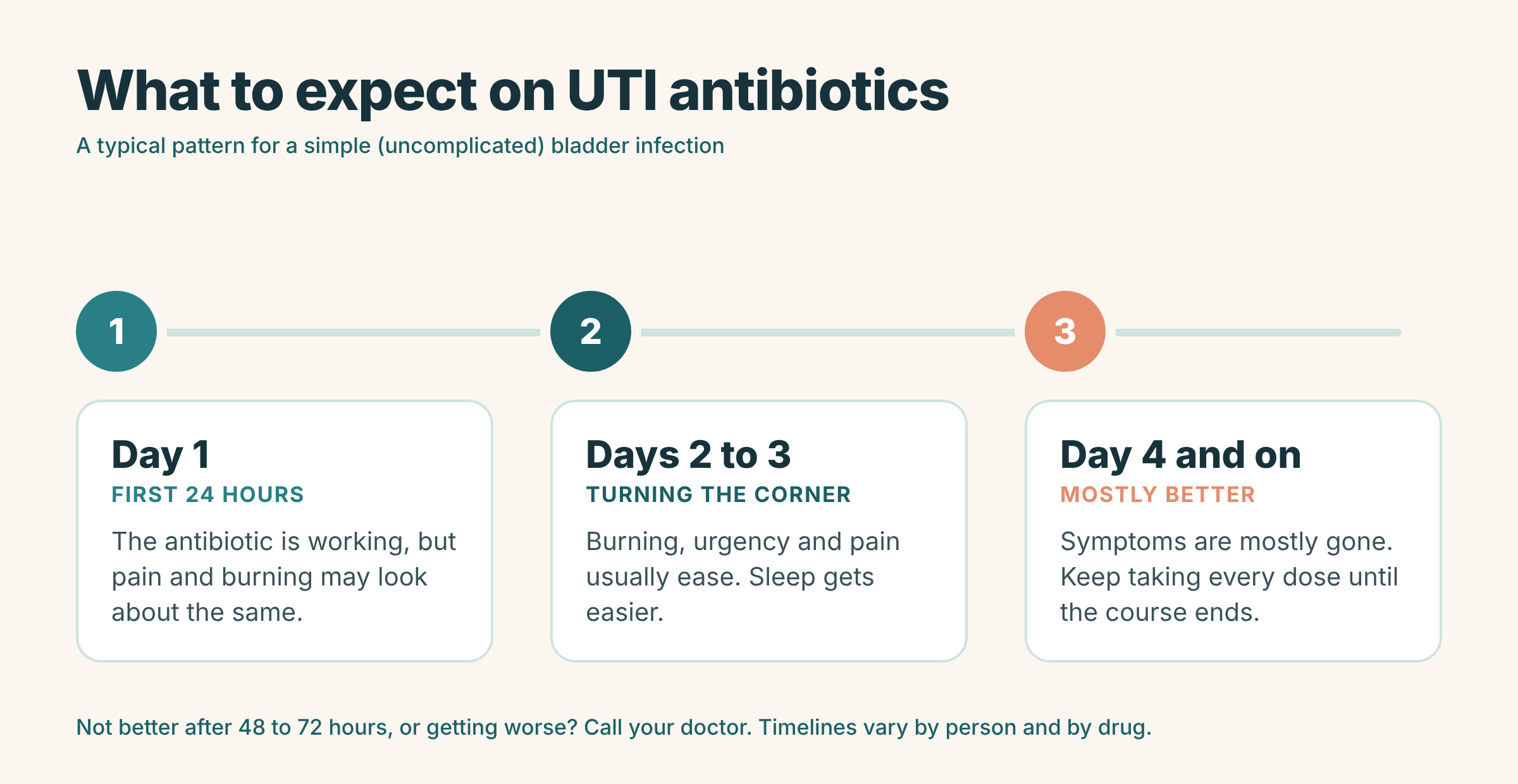
- First 24 hours: the antibiotics are working, but you may not feel it yet.
- Days 2 to 3: pain, burning and urgency usually ease for a simple UTI, and other symptoms follow.
- Day 4 onward: most symptoms are gone, though the course has days left.
How long do UTI antibiotics take to work? A day-by-day timeline
Every infection runs a little differently. Still, a typical uncomplicated UTI follows a pattern, and knowing it keeps you from panicking on night one of treatment. Your symptoms are the best gauge you’ve got, so watch how they change.
The first 24 hours
You’ve taken your first dose or two. The antibiotic is already acting on bacteria in your bladder, but the lining is inflamed, and inflammation takes longer to settle than germs take to die. Expect the discomfort to be about the same, or slightly softer by evening. Symptoms such as burning, urgency and that dull pelvic ache can all stick around. A rough first night doesn’t mean the antibiotics are failing.
Days two and three
This is where most people turn the corner. The sharp burning fades, you’re not racing to the bathroom every twenty minutes, and you sleep through the night again. A temperature, if you had one, should be back to normal. If you took fosfomycin, MedlinePlus says symptoms should begin to improve 2 to 3 days after the single dose.
Day four and beyond
By now a simple UTI should feel mostly gone, with symptoms down to a faint reminder. A little soreness or the odd sudden urge can linger, and that’s normal while the urinary tract recovers. What isn’t normal is pain that holds steady or climbs, or symptoms that return the day you stop. We’ll cover that decision point below.
How long do UTI antibiotics take to work for each drug?
Your clinician picks the drug based on your history, allergies, pregnancy status, kidney function and local resistance patterns. So treat this table as a ballpark for urinary tract infection treatment, not a prescription. The right antibiotic treatment for you may look different.
| Antibiotic | How it’s taken | When you may feel better |
|---|---|---|
| Nitrofurantoin (Macrobid) | Twice daily with food; 5 to 7 day courses are typical | Acts in the bladder within hours; most people improve in 24 to 48 hours |
| Fosfomycin | One packet mixed in cold water, a single dose | Improvement usually begins 2 to 3 days after the dose |
| Other options your clinician may choose (trimethoprim-sulfamethoxazole, cephalexin, ciprofloxacin) | Varies by drug, often 3 to 7 days | Most people feel better within a few days, per Cleveland Clinic |
Course length matters as much as speed, and it varies with each dose schedule. MedlinePlus lists 1 to 5 days of treatment for a simple bladder infection in women and 7 to 14 days for men. Complications such as pregnancy, diabetes or a mild kidney infection usually mean 7 to 14 days of treatment.
Why some UTIs take longer to clear
If you’re still miserable on day three, one of a handful of things is usually going on, and each one changes the plan for your urinary tract infection.
It’s a complicated UTI or a kidney infection
Doctors call a UTI complicated when it comes with fever or flank pain, a blockage such as a kidney stone, or a catheter or stent. A kidney infection (pyelonephritis) falls in this group, and it’s a more serious infection than cystitis. Its symptoms include fever, flank pain and chills, and the kidney can take longer to respond than the bladder. The NIDDK notes that kidney infections may need antibiotics by mouth, through an IV, or both, and a blockage may need a procedure. Newer IDSA guidance on complicated UTI suggests about 7 days for most patients who are improving, rather than the old 10 to 14.
The bacteria don’t respond to that drug
Antibiotic resistance is the second big reason. If the germ shrugs off your antibiotic, the first prescription simply won’t help, and the bacteria keep multiplying. A urine culture shows which bacteria are present and which antibiotic kills them, so your doctor can switch drugs. Antibiotic resistance is also why finishing a course matters.
Your health history changes the clock
Men, pregnant patients and people with diabetes generally need longer courses. Recurrent infections, meaning a third UTI or more in a year, may call for testing before the next prescription, and a recurrent UTI is worth a longer talk with your doctor. In older adults, confusion can be the only sign of infection, so don’t wait for classic symptoms.
What helps while the antibiotic does its job
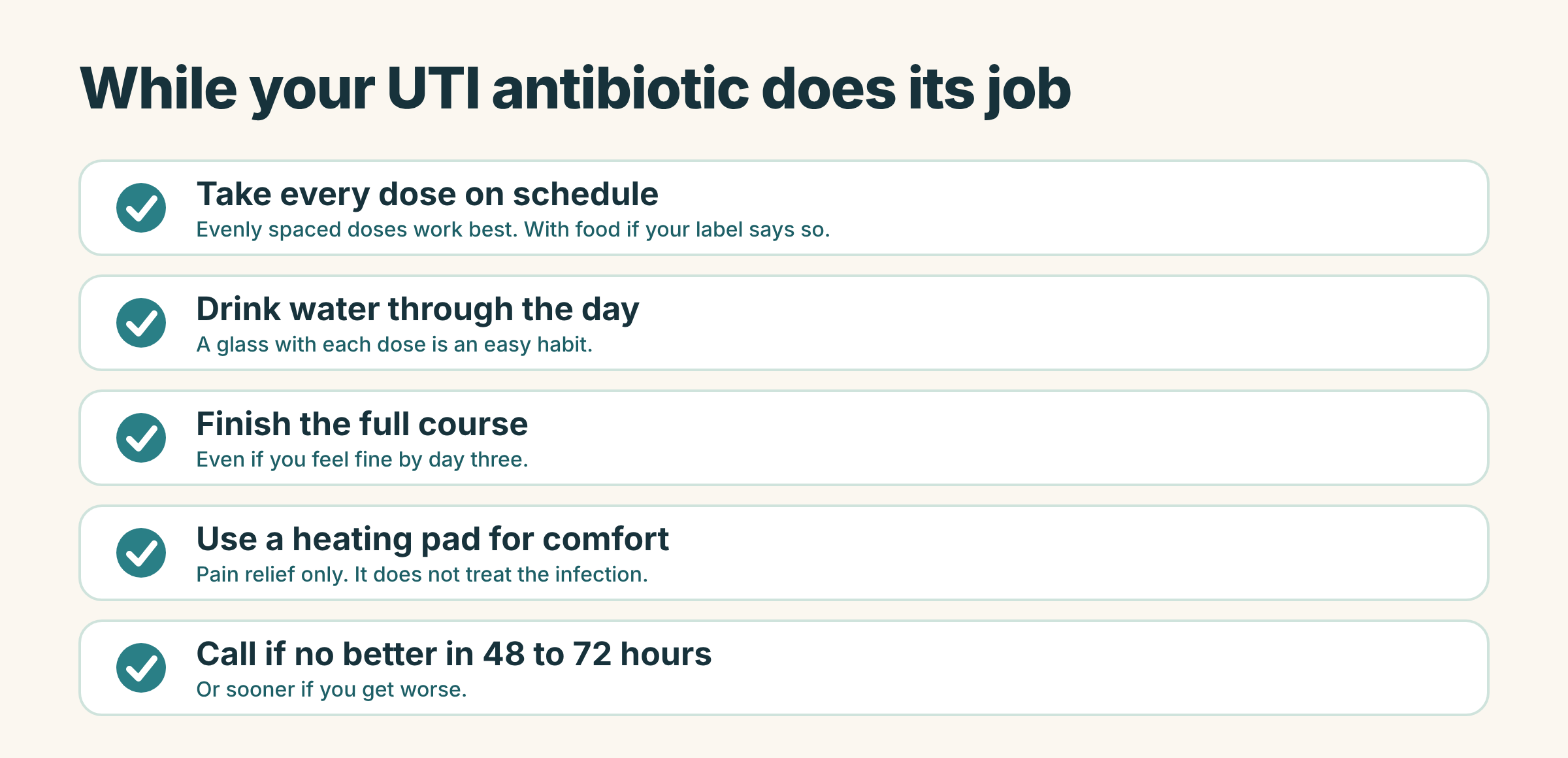
Take every dose at the spacing on the label, since uneven doses weaken treatment. Ask your doctor or pharmacist if you’re unsure. If it’s nitrofurantoin, take it with food, which the label recommends. Keep drinking water, since fluids help flush your system, and your doctor will almost always say so. Aim for a glass of water with each dose, and more water through the day.
Comfort is a separate job. Phenazopyridine can ease the burning, but MedlinePlus is clear that you still need the antibiotic. A warm heating pad on your lower belly takes the edge off, and cutting back on caffeine and alcohol for a few days spares an irritated urinary tract.
Finish the full course, even when you feel fine on day three. Stopping early lets the survivors rebound, and MedlinePlus warns that skipped doses can leave you with an infection that’s harder to treat and bacteria that are antibiotic resistant. A full course of antibiotics is the whole point of treatment.
Still hurting after 48 to 72 hours? Here is what to do
Use this rule. If your symptoms haven’t improved after 48 to 72 hours, or they get worse at any point, call your doctor. Jot down your symptoms once a day (burning, urgency, discomfort, temperature), because a simple log makes that call faster. Don’t wait out the whole course of antibiotics.
Why that window? Fosfomycin’s label says to call if there’s no improvement after 2 to 3 days, and the AAFP expects most women to feel better within three. After a call, your doctor may order a urine culture, change the antibiotic treatment, or look for a cause other than a simple bladder infection.
Two things not to do: don’t double up on doses, and don’t borrow a leftover antibiotic from the last time. Wrong drug, wrong dose, wrong length, and you’ve made the next infection harder to treat.
When to get care right away
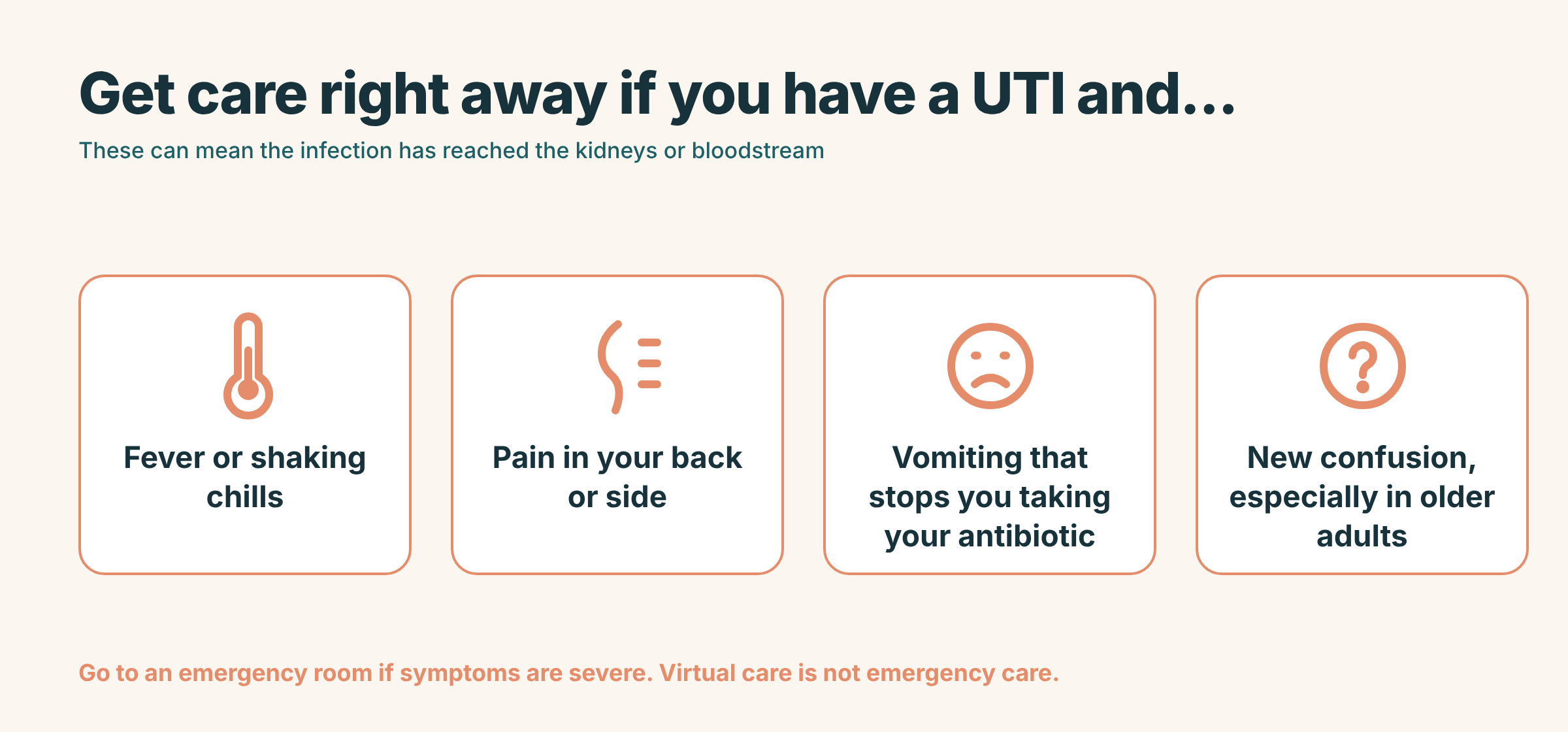
Some symptoms mean the infection may have reached the kidneys or the bloodstream. Treatment can’t wait for these, so don’t book an appointment. Get care the same day, or go to an emergency room:
- A fever or shaking chills
- Pain in your back or side
- Nausea or vomiting that keeps you from taking your antibiotic
- New confusion, especially in an older adult
Untreated, a kidney infection can lead to sepsis, a medical emergency, and sepsis can move fast. If you’re worried, go.
Get UTI care without the wait
UTI symptoms don’t keep office hours. Swell offers clinician-led virtual urgent care around the clock, so a clinician can review your symptoms and decide whether a lab test, treatment or prescription makes sense. A completed consultation is listed at $45, with medication and lab costs separate. Prescriptions aren’t guaranteed, and virtual care isn’t emergency care. If you have any red flag above, go to the ER first.
Already on antibiotics and not improving? That’s exactly the moment to reach out to Swell rather than waiting another day.
Questions people ask about UTI antibiotics
Can UTI antibiotics work in 24 hours?
They start working within hours. Some people feel a little better in 24 hours, but more often, meaningful relief of burning and urgency takes a day or two for a simple, uncomplicated UTI. No change at all after 48 to 72 hours? Call.
How long until the burning stops?
For an uncomplicated UTI, the burning usually fades by day two or three. Lingering soreness for a few more days can happen. If symptoms keep coming back, that’s a recurrent UTI pattern worth raising with your doctor. Pain that’s getting worse, or a new fever, isn’t normal healing and needs a prompt call.
Can I stop antibiotics once I feel better?
No. Symptoms fade before every bacterium is gone. Stopping early can let the infection come back, and it raises the odds of resistant bacteria. Take the full course exactly as prescribed, even if you feel completely normal by day three.
How long do antibiotics take to work for a UTI in men?
Men often feel better in a few days too, but the course is longer. MedlinePlus lists 7 to 14 days for a simple bladder infection in men, and the AAFP says at least seven days. A urinary tract infection in a man deserves a clinician’s evaluation, because it’s sometimes tied to the prostate.
What if antibiotics do not work for my UTI?
The usual causes are antibiotic resistance, the wrong drug for that germ, an infection that has spread to the kidneys (pyelonephritis), or a different problem that mimics a UTI, such as another urinary condition. Testing sorts this out. Call your doctor, and don’t stop your current prescription unless they tell you to.
Trusted references
Public-health, research, and medical-society resources related to this guide.
- American Academy of Family Physicians: Urinary tract infection patient information
- MedlinePlus: Fosfomycin
- MedlinePlus: Urinary tract infection (encyclopedia)
- Cleveland Clinic: Urinary tract infections
- Drugs.com: How long does nitrofurantoin take to work for a UTI?
- emDocs: 2025 IDSA guideline update on complicated UTI
- NIDDK: Kidney infection (pyelonephritis), treatment