It’s 2 a.m. Something burns every time you pee, and you’re already planning a pharmacy run. Stop for a second.
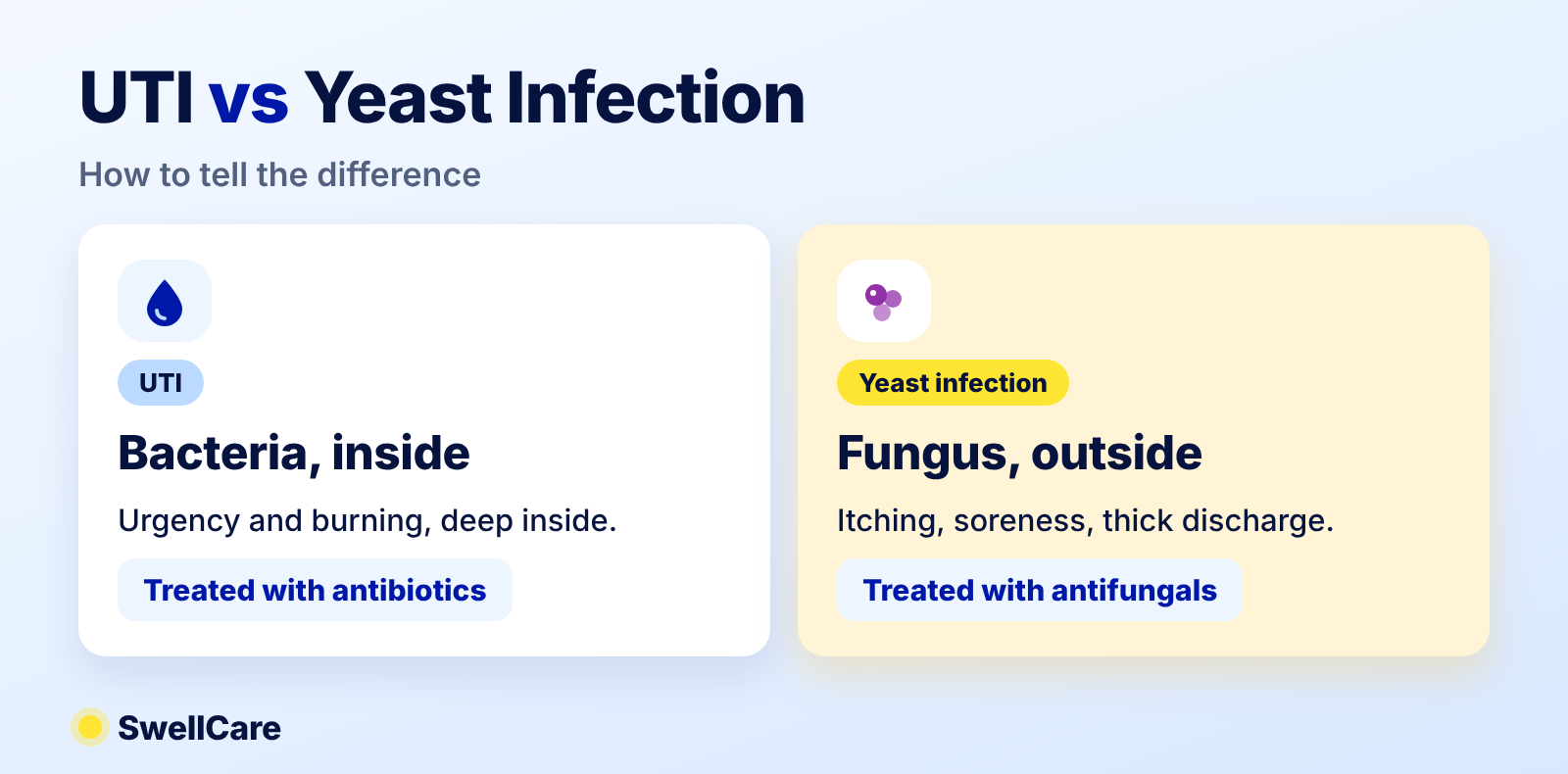
Here’s the short answer on UTI vs yeast infection. A UTI (urinary tract infection) usually brings urgency, constant bathroom trips and pain low in your belly. A yeast infection usually brings itching, soreness and thick discharge on the outside. Burning when you urinate can come with either one, which is why so many people guess wrong.
That guess matters. Antibiotics clear bacteria, but they do nothing for a fungus, and they can even set a yeast infection off. Below, you’ll see how the two compare, why telling them apart is harder than it sounds, and when a short call with a clinician beats another night of wondering.
UTI vs yeast infection at a glance
Start with the big picture. This table shows how the symptoms usually line up, though real bodies are messier than any chart.
| Feature | UTI | Yeast infection |
|---|---|---|
| Where it hurts | Inside: lower belly, bladder, urethra | Outside: the vulva and vaginal opening |
| Burning | Sharp, starts inside during urination | Stings where urine touches irritated skin |
| Itching | Rare | The hallmark symptom |
| Discharge | Usually none | Thick, white, often odor-free |
| Urgency and frequent urination | Hallmark symptoms | Uncommon |
| Urine | Cloudy, strong-smelling or pink | Usually looks normal |
| Fever or back pain | Possible if it reaches the kidneys | Not typical |
Two rows of the chart don’t fit neatly in a symptom list, so here they are on their own:
| Feature | UTI | Yeast infection |
|---|---|---|
| What it is | Bacterial infection of the urinary tract | Overgrowth of Candida, a fungus, in the vaginal area |
| Usual treatment | Antibiotics | Antifungal medicine |
Both are common. MedlinePlus calls UTIs the second most common type of infection in the body, and women get them about four times as often as men. The CDC says roughly 75% of women will have at least one yeast infection in their lifetime, and 40% to 45% will have two or more.
What a UTI feels like
UTIs start when bacteria slip into the urethra and travel toward the bladder. Your urinary tract also includes the ureters and kidneys, and an infection can settle in any part of it. Most of the symptoms cluster around the bladder. You may notice:
- Burning or pain during urination, often the first of the symptoms
- Strong, frequent urges to go, even when little comes out
- Pressure, cramping or dull pain in your lower belly
- Cloudy, bloody or strong-smelling urine
The CDC notes that the shorter urethra in women, and its closeness to the rectum, makes UTIs more common in females. Menopause can raise the risk too. Lower estrogen changes the vaginal bacteria, which makes it easier for germs to move in. Some clinicians prescribe vaginal estrogen to cut down on repeat infections, since estrogen helps keep the tissue healthy. Ask about it if your UTIs keep coming back after menopause.
Watch for the warning signs that an infection has climbed. A bladder infection can spread to the kidneys, and a kidney infection often shows up as fever, chills, nausea or pain in your back or side. That’s not a wait-and-see situation, because your kidneys do too much work to be left with an untreated infection.
Compare that with a yeast infection, which rarely sends you running to the bathroom. If urgency is your main complaint and there’s no itching or discharge, a UTI is the likelier culprit. Doctors still confirm it with a test, because other conditions can mimic the pain and the urination changes.
What a yeast infection feels like
Vaginal yeast infections happen when Candida, a fungus that normally lives in the body in small amounts, overgrows. Candida albicans causes most cases. The symptoms show up on the outside and inside the vaginal area rather than in the bladder or the rest of the urinary tract:
- Intense vaginal and vulvar itching and irritation
- Soreness, swelling and redness
- Thick, white, clumpy vaginal discharge that usually doesn’t smell
- Pain during sex
- Burning during urination, when urine touches the irritated skin
A vaginal yeast infection can build over a few days. It often shows up after a round of antibiotics, during pregnancy, or when blood sugar runs high in people with diabetes. If you’ve had a yeast infection before, the itch will feel familiar, but treat a repeat as a fresh question rather than an assumption. The fungal overgrowth looks and feels the same whether it’s your first or your fifth.
Picture a rash that stings when it gets wet. That’s closer to yeast than a UTI, where the discomfort lives deeper inside. The CDC also points out that none of these symptoms is unique to yeast, which is exactly why a quick guess so often misses.
Why burning when you pee fools almost everyone
Burning is the symptom that makes the UTI vs yeast infection question so hard. Both can sting, and both can make you dread the bathroom.
The difference is where the sting starts. With a UTI, the burning is internal: it happens as urine travels through an inflamed urethra, and it often arrives with urgency, belly pain and cloudy urine. With a vaginal yeast infection, the burning is external: it happens when urine splashes across swollen, irritated skin, and it usually comes with itching or discharge.
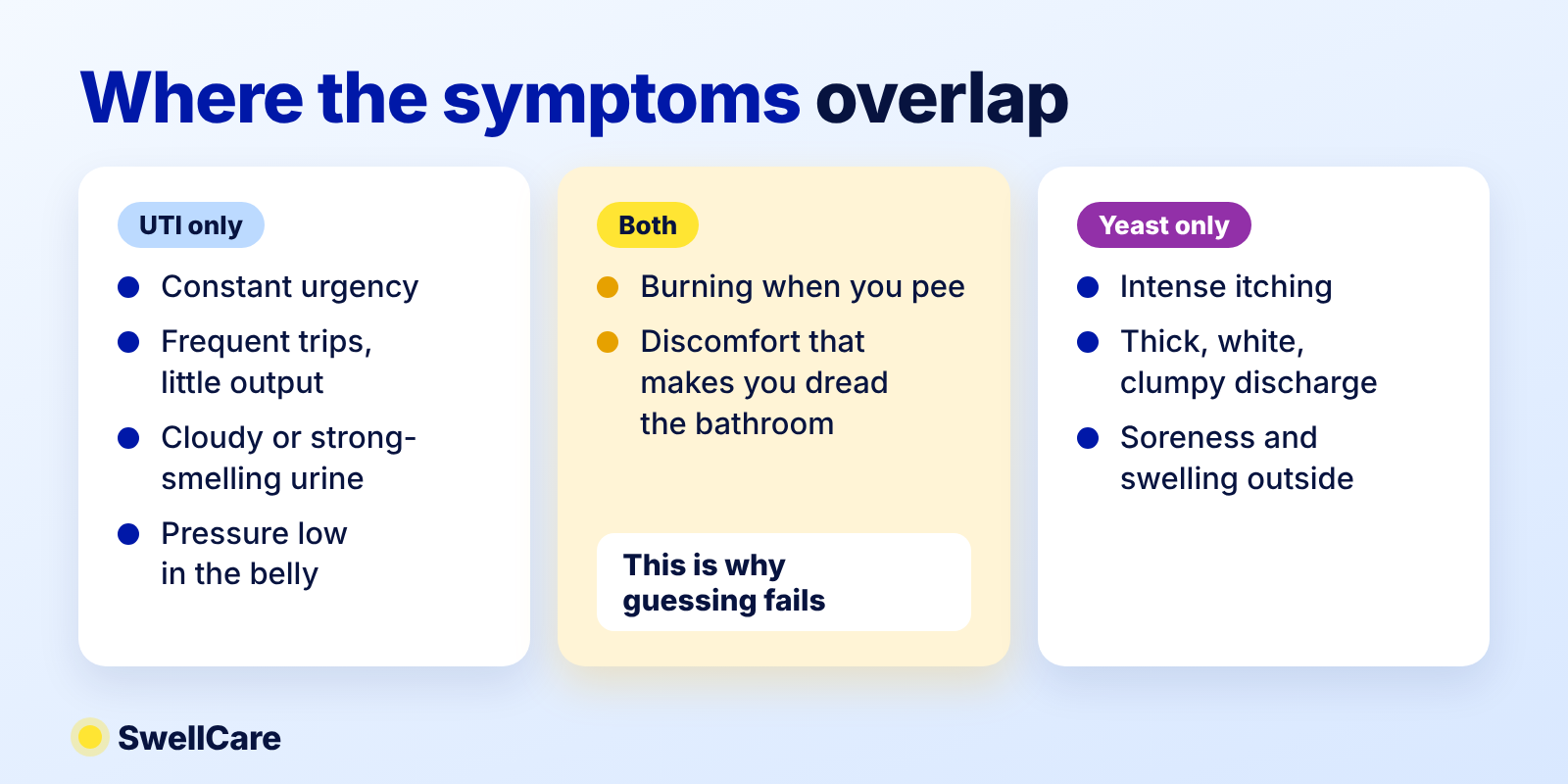
Here’s a rough test some clinicians suggest. If the burn feels like it’s coming from deep inside, think UTI. If it stings on the surface and itches, think yeast infection. It’s a hint, not a diagnosis, and the two can sit side by side.
Why self-diagnosis gets it wrong so often
Most of us trust our own read. The research says we shouldn’t.
One 2002 study led by Dr. Daron Ferris, reported by HealthDay, followed 95 women who bought over-the-counter yeast treatments. After clinic testing and lab cultures, only 33.7% had a yeast infection and nothing else. Only about a third of the women who were sure they had a yeast infection were right, and the treatment they chose couldn’t help the rest. About 19% had bacterial vaginosis, and nearly 14% had no vaginal infection at all. Past yeast infections didn’t make women more accurate, and neither did reading the package label.
Bacterial vaginosis and some sexually transmitted infections can look just like yeast. The CDC also warns that UTI symptoms can resemble an STI, so a clinician may suggest testing. A confident guess is still a guess, and a urine culture or a vaginal exam gives you facts instead.
What causes each one
The root cause is the biggest difference between UTIs and a yeast infection. One is a bacteria problem and the other is a fungus problem.
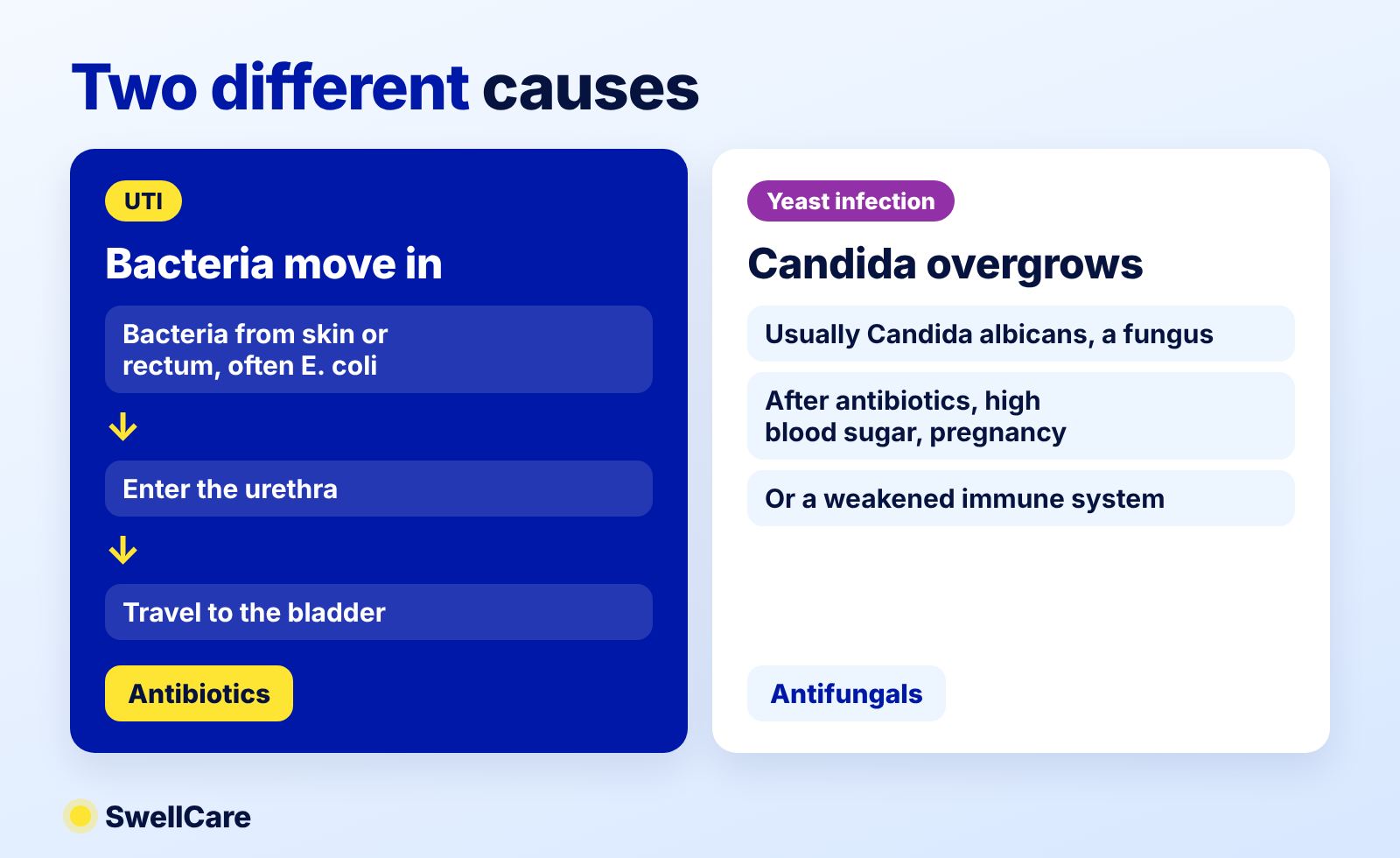
UTIs are almost always caused by bacteria. NIDDK says fungi rarely cause them. Most often it’s bacteria from the skin or rectum, including E. coli, that enter the urethra. The CDC lists recent sexual activity, pregnancy, menopause, spermicide use, age and a previous UTI as risk factors. UTIs aren’t STIs, but sex can push bacteria toward the urethra.
Vaginal yeast infections come from Candida, usually Candida albicans. Think of it as a fungus problem, not a hygiene problem. The CDC names frequent antibiotic use and diabetes as risk factors, along with a weakened immune system or steroid medicines. Anything that weakens your immune system tilts the balance toward fungal overgrowth. Pregnancy raises the odds too. Interestingly, 10% to 20% of women carry yeast with no symptoms at all, so finding it doesn’t always mean treating it.
Can you have a UTI and a yeast infection at the same time?
Yes. It’s more common than people think, and it can happen in a specific order. You get a UTI, take antibiotics to clear the bacteria, and those same antibiotics also wipe out helpful bacteria that keep Candida in check. A few days later, the itching starts.
That’s one reason doctors ask what medicines you’ve taken recently. If your symptoms change midway through a UTI course, say so. Don’t assume a new yeast infection is a side effect you have to live with. A second yeast infection after antibiotics is common, and it’s treatable.
How each one is treated
The treatments don’t overlap, so picking the wrong treatment wastes days. Yeast cream won’t touch a UTI, and antibiotics won’t fix a yeast infection.
Treating a UTI
UTIs need antibiotics, and antibiotics need a prescription. Treatment usually starts after a urine test, often a urinalysis that checks for white blood cells and blood. A urine culture can identify the bacteria, though NIDDK says results take a few days. The CDC adds that you should take every dose as directed and never save leftovers for later, because antibiotics carry side effects that range from rashes to drug-resistant infections.
One more detail: people who have bacteria but no symptoms usually don’t need antibiotics, with exceptions such as pregnancy. Treatment works best once the diagnosis is right, which is why the urine test comes first.
Treating a yeast infection
Mild vaginal yeast infections usually respond to an antifungal, and a mild yeast infection rarely needs more than one round. According to the CDC, short courses of topical azoles for one to three days, or a single 150 mg dose of fluconazole by mouth, relieve symptoms in 80% to 90% of people who finish treatment. The antifungal comes as a cream, a suppository or a pill. Some creams are sold over-the-counter, while fluconazole needs a prescription. If you can’t tell whether it’s a yeast infection, skip the guesswork, because a prescription is only useful when it matches the cause.
Pregnancy changes the plan. The CDC recommends seven days of a topical azole and advises against the single fluconazole dose. If you’re pregnant, call your clinician first.
Recurrent yeast infections, meaning three or more in a year, need a different approach. Expect culture testing and a longer course of treatment, since the usual quick fix may not hold.
A quick way to sort out your symptoms
Use these steps as a starting point, not a verdict:
- Check where it hurts. Deep, low belly pain or pressure points to a UTI. Outer soreness and itching point to yeast.
- Notice how often you need to go. A sudden urge every few minutes, with little urination to show for it, is a classic UTI pattern.
- Look at the discharge. Thick, white and clumpy suggests yeast, while a UTI doesn’t usually cause any.
- Check what you see in the toilet. Cloudy, pink or strong-smelling output suggests a UTI.
- Scan for red flags. Fever, chills, back pain or vomiting mean you shouldn’t wait.
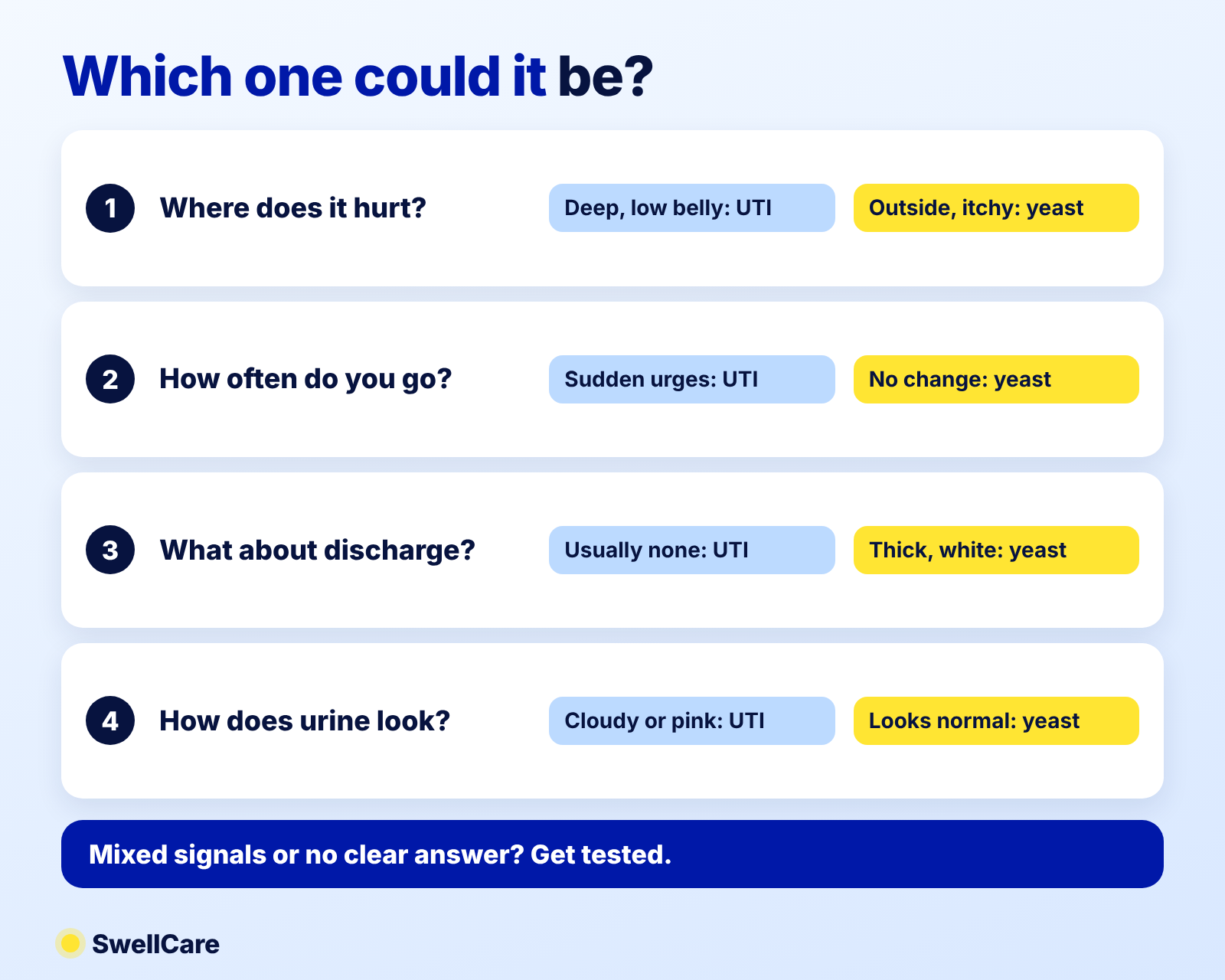
If your answers point both ways, or you can’t tell whether you have a UTI or a yeast infection, that’s your cue to get tested.
When to see a doctor
Some situations skip the guesswork entirely. Get care the same day if you have:
- Fever, chills, nausea or back or side pain
- Blood in your urine
- Symptoms during pregnancy
- Diabetes or a weakened immune system
- Symptoms that don’t improve after a week
- Three or more infections in a year, which means recurrent infection
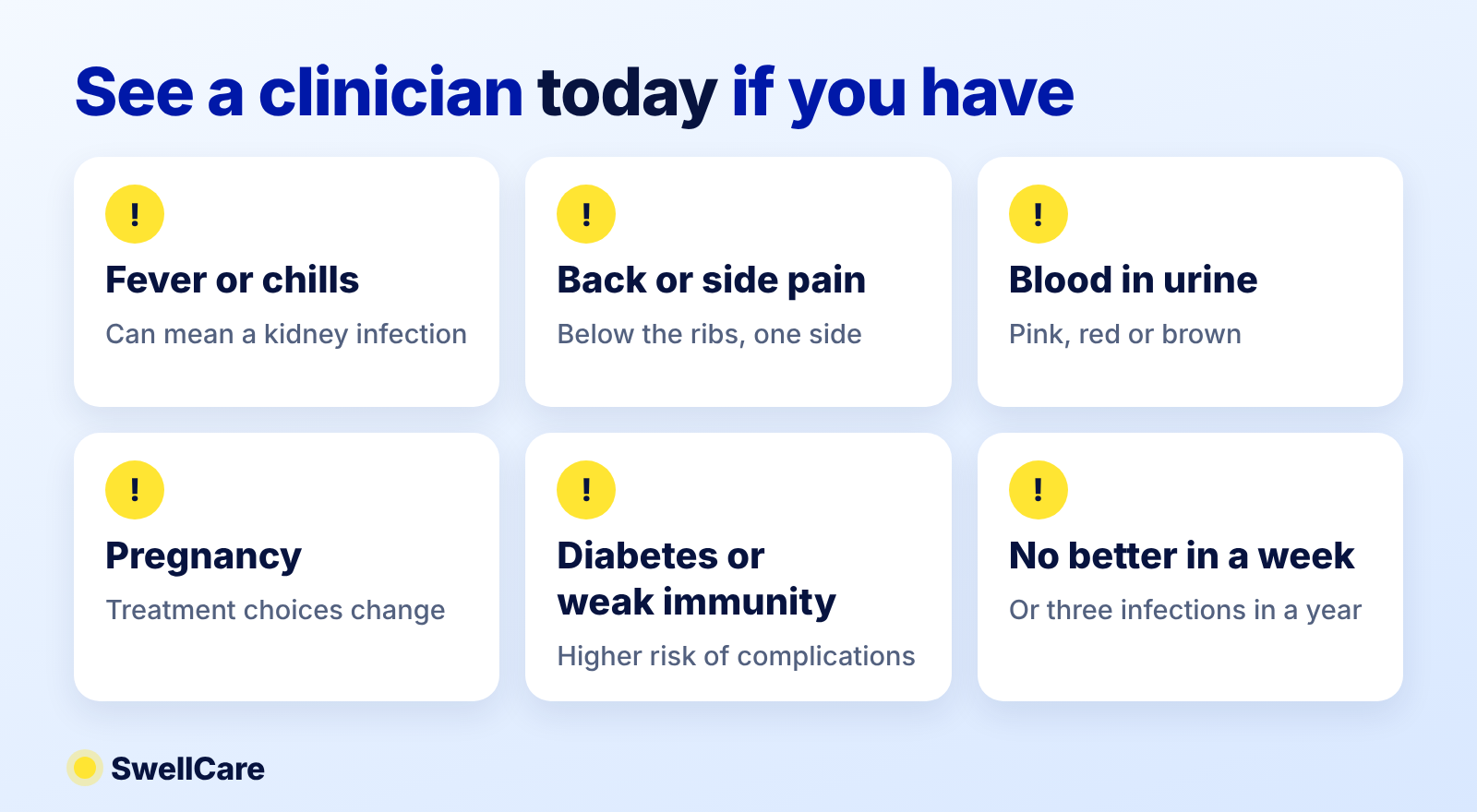
Back or side pain below the ribs can mean the kidneys are involved, so don’t push through it. Either a kidney infection or a wrong guess can turn a three-day problem into a three-week one, and delayed treatment is the usual reason. If this is your first time with these symptoms, get a proper diagnosis rather than guessing.
How to lower your risk of both
You can’t prevent every infection, but a few habits help. Prevention is simple, and the CDC backs several of these habits. The aim is to prevent bacteria from moving in and to prevent yeast from taking over.
- Stay hydrated. Staying hydrated helps flush bacteria from the urinary tract.
- Urinate after sex. It helps prevent bacteria near the urethra from climbing.
- Skip douches and scented sprays. They upset the natural balance that keeps bacteria and yeast in check, and they won’t prevent infection.
- Choose breathable underwear and change out of wet clothes quickly.
Two more points matter for prevention. Keep blood sugar steady if you have diabetes, since high sugar feeds fungal growth. And take antibiotics only when you need them: they’re essential for a UTI, but overuse can invite fungal trouble. Both help prevent a repeat.
None of this is a guarantee. Still, good prevention cuts down how often you’re back in this spot, and it’s far easier than treatment.
Get a clear answer from a SwellCare clinician
You don’t have to sit in a waiting room to settle this. Your SwellCare clinician can talk through your symptoms in a video visit, help you decide whether you need a urine test and, when it’s appropriate, prescribe the right treatment. That means one conversation instead of a guess, a pharmacy detour and a second round of symptoms.
Ready for a real answer on your UTI or yeast infection? Get care now and tell us what you’re feeling. For more plain-language guides, browse the SwellCare Health Journal.
Questions people ask about UTI vs yeast infection
How do I know if I have a UTI or a yeast infection?
Look at where the symptoms show up. A UTI usually means urgency, frequent urination, a burning feeling inside and sometimes cloudy urine. A yeast infection usually means itching, soreness and thick discharge. If you can’t tell, or you have a fever or back pain, get tested and ask about treatment.
Can a yeast infection feel like a UTI?
Yes. A yeast infection can feel like a UTI. Burning when you urinate is common with both, because urine can sting irritated skin during a vaginal yeast infection. The clues that point to yeast are itching and vaginal discharge, while urgency and cloudy urine point to a UTI.
Can you have a UTI and a yeast infection at the same time?
Yes. Antibiotics for a UTI can reduce helpful bacteria and let Candida overgrow, so a yeast infection sometimes follows. You can also have both at once without any medicine involved. Mixed symptoms are a good reason to see a clinician for a urine culture and an exam.
Will a UTI or yeast infection go away on its own?
Don’t count on it. Some mild cases settle, but you can’t know which, and an untreated UTI can reach the kidneys. If symptoms last more than a few days, get worse or come with chills, get treatment.
Does drinking water flush out a yeast infection?
No. Water helps flush bacteria from the urinary tract, which is why hydration is a UTI prevention habit. A yeast infection is a fungal overgrowth, a fungal problem rather than a bacterial one, so it needs an antifungal, sometimes by prescription, not extra fluids.
Can men get yeast infections or UTIs?
Yes, though both are less common than in women. Men can get UTIs and can develop yeast irritation too. Because a UTI in a man is less typical, it’s worth having a clinician look at it.
Trusted references
Public-health, research, and medical-society resources related to this guide.