You spot a red, weepy patch on your daughter’s elbow, and now you’re wondering whether to keep her away from her cousins. Take a breath. Is eczema contagious? No. You can’t catch it by touching, hugging, sharing a towel or sitting next to someone who has it. Eczema is a chronic skin condition linked to the immune system, genes and the environment, not a germ that hops from person to person. The itchy rash is real, though, and so are the questions about its symptoms.
Is eczema contagious? The short answer
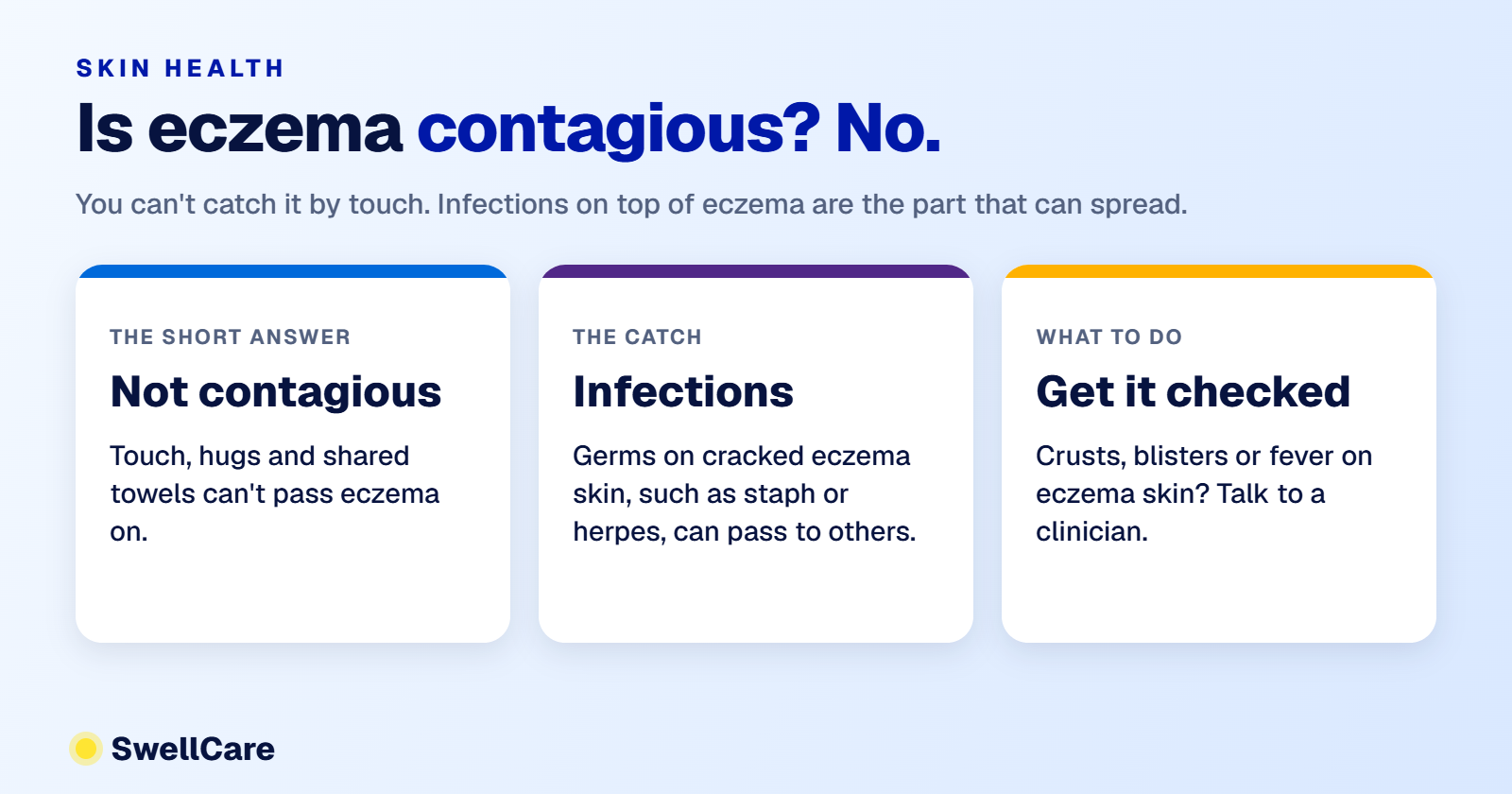
Still no. Atopic dermatitis, the most common type of eczema, is not contagious, according to the National Institute of Arthritis and Musculoskeletal and Skin Diseases. You can’t pass it on, and nobody passed it to you.
That matters, because about 31 million Americans live with some form of it, many of them kids. They go to school. They swim. They get hugged.
Here’s the better way to picture it. Eczema is skin inflammation tied to an overreactive immune response, not an infection. The rash is inflammation, not a visitor.
There’s one catch, and it’s the part most guides skip. Eczema skin cracks, and cracked skin lets germs in. Dry, itchy skin is the usual early sign. Those germs can spread even though the eczema itself can’t. We’ll get to that below.
Why eczema looks like it spreads
If eczema can’t spread, why does it seem to wander? A few reasons trip people up.
First, the rash travels. A patch on the wrist shows up on the neck a week later, and it feels like something moved. Really, the same triggers that set off one area (dry air, a new detergent, stress) set off others. Scratching an itchy spot also irritates the skin around it, so the rash grows. Those flare-ups are inflammation, nothing more.
Second, it runs in families. Parents, kids and siblings often share it because of genetics, not germs. Shared homes also mean shared triggers like dust, pets and harsh soap.
Third, other rashes look just like it, and the symptoms overlap. Ringworm, impetigo and contact dermatitis can all pass for eczema, and a couple of those really do spread. Contact dermatitis, for what it’s worth, is a reaction to an irritant, not a germ. A rash that’s round with a clearer center, or crusty and honey-colored, deserves a closer look from a clinician.
What actually causes eczema
The exact cause isn’t known. Researchers point to a mix of genes and environment, including a leaky skin barrier and an immune system that overreacts. Family history plays a role: eczema often runs in families, and many people with it also have asthma or hay fever.
Healthy skin holds water in and keeps irritants out. In eczema, that skin barrier doesn’t work as well. Skin dries out, itches and gets inflamed. Allergens and irritants slip in more easily, and the immune system can answer with more inflammation. Itchy skin, more scratching, a weaker barrier: it’s a loop.
Allergens such as pollen and dust mites can set off a flare for some people. That link is one reason eczema is treated as an immune-driven condition, not a skin infection. Stress doesn’t cause it, but stress can make flare-ups worse.
Common triggers include:
- Harsh soaps, fragrances and some fabrics such as wool
- Dust mites, pet dander, mold and pollen
- Dry winter air or very hot showers
- Stress and poor sleep
- Certain foods, for some people
Triggers are personal. Yours may not be your sister’s. Tracking your own flare-ups and symptoms for a few weeks often shows a pattern.
When eczema skin gets infected and can pass germs
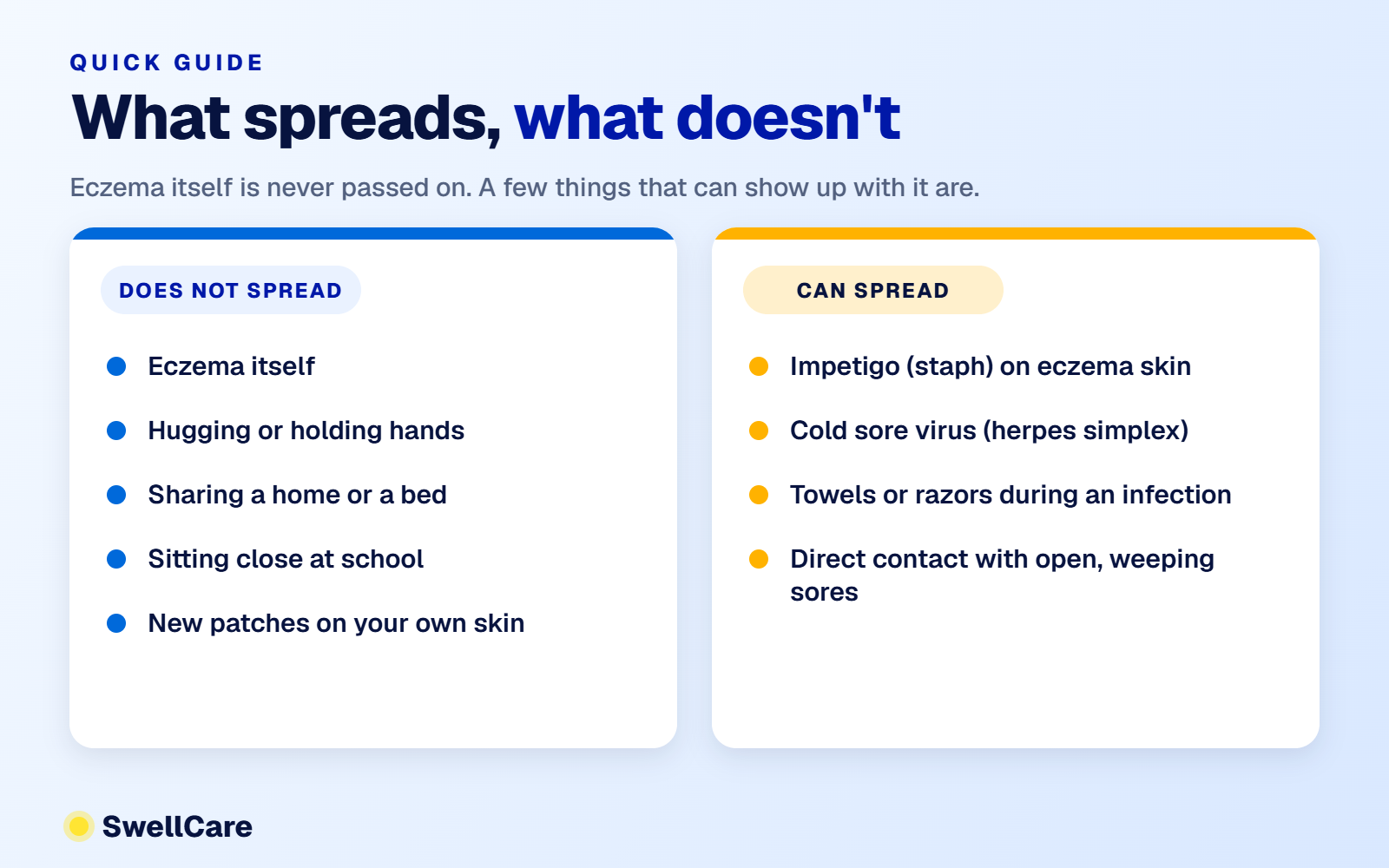
This is the important exception. Eczema doesn’t spread, but an infection sitting on eczema can. Broken skin is an open door, and people with eczema get a skin infection more easily than others. A skin infection can also make eczema symptoms worse.
The American Academy of Dermatology lists the signs to watch for: yellowish-orange crusts, pus-filled blisters, sores that look like cold sores, swollen red bumps, and redness that streaks or spreads. Eczema that suddenly stops responding to its usual treatment is another clue.
Staph and impetigo
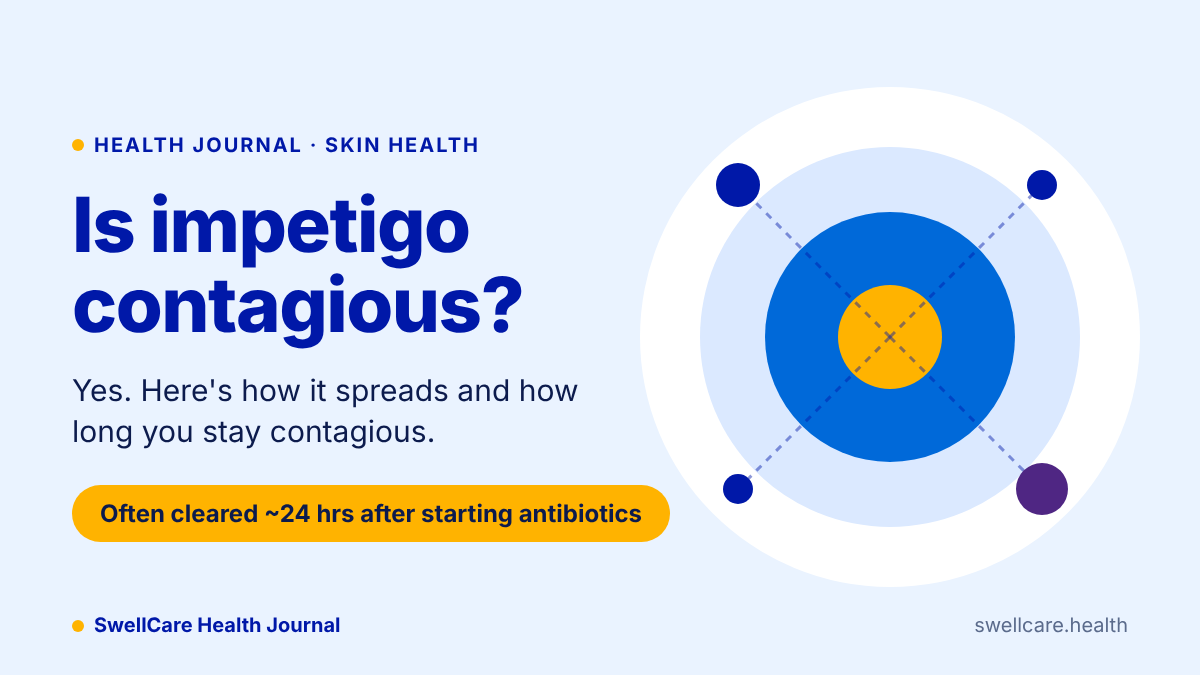
Staph bacteria love broken skin. When they take hold, the result can be impetigo, a crusty, sometimes weepy infection. It spreads through direct contact with the sores and, less often, through shared towels, clothing or bedding. Colorado’s health department notes that a person stops being contagious about 24 hours after starting antibiotics, and that covering the sores helps. Untreated, it stays contagious while the sores drain.
So the eczema didn’t spread. The infection did. Treatment for it is different from eczema treatment, and it usually means antibiotics.
Eczema herpeticum and cold sores
The scariest one is eczema herpeticum. It happens when the herpes simplex virus, the same family of virus behind cold sores, infects eczema skin. Clusters of itchy, painful blisters appear, often on the face and neck, usually with fever and swollen lymph nodes. It’s treated as a medical emergency, and it needs antiviral medicine fast.
If you’ve got a cold sore, skip close face contact with anyone who has active eczema, especially babies. Wash your hands first. If you have eczema and blisters like that appear, get care the same day.
Everyday rules for touching, sharing and living together
You don’t need to isolate anyone. A few common-sense habits cover nearly every situation.
| Situation | What to do |
|---|---|
| Hugging, holding hands, sitting close | Completely fine |
| Sharing a bed, home or dinner table | Fine |
| Swimming or school | Fine, unless there are open, crusted or weeping sores that can’t be covered |
| Towels, razors and clothes during an infection | Don’t share, and wash after use |
| Kissing with an active cold sore | Avoid, especially with babies or anyone with eczema |
| Moisturizer in a tub | Use a clean spoon or pump, not your fingers |
That last tip is simple hygiene. Dipping fingers into a shared jar can plant germs right where the skin is most vulnerable.
How eczema is treated
There’s no cure, but treatment works well. The goal of any eczema treatment is calmer skin, fewer flare-ups and better sleep. Good treatment also protects the skin barrier.
Most plans start with the basics. A thick, fragrance-free moisturizer goes on right after a short, lukewarm bath. Avoiding your personal triggers comes next. These steps are the foundation of treatment, and they matter even when the skin looks fine. From there, a clinician may add prescription creams, usually a topical corticosteroid, or non-steroid ointments for sensitive areas. Light therapy, injectable biologics and newer targeted pills are options when symptoms are moderate to severe. Each treatment has trade-offs, so it helps to talk them through.
Itch at night is its own problem. If scratching is costing you or your child sleep, tell your clinician, and check with them before starting any new medicine.
Because eczema is chronic, expect a long game. Chronic doesn’t mean constant. It tends to come and go, and a chronic condition needs a routine, not a one-off fix. A good plan keeps flare-ups short and rare, and an itchy night becomes the exception.
A dermatologist is worth seeing when the basics aren’t enough, when it’s affecting your sleep or school, or when infections keep returning. Ask the dermatologist about your skin barrier, triggers and next-step treatment, and whether a skin patch test makes sense. For everything else, a primary care visit, including an online one, can often get you started.
When to see a doctor, and how to get care today
Some signs shouldn’t wait for next week’s appointment.
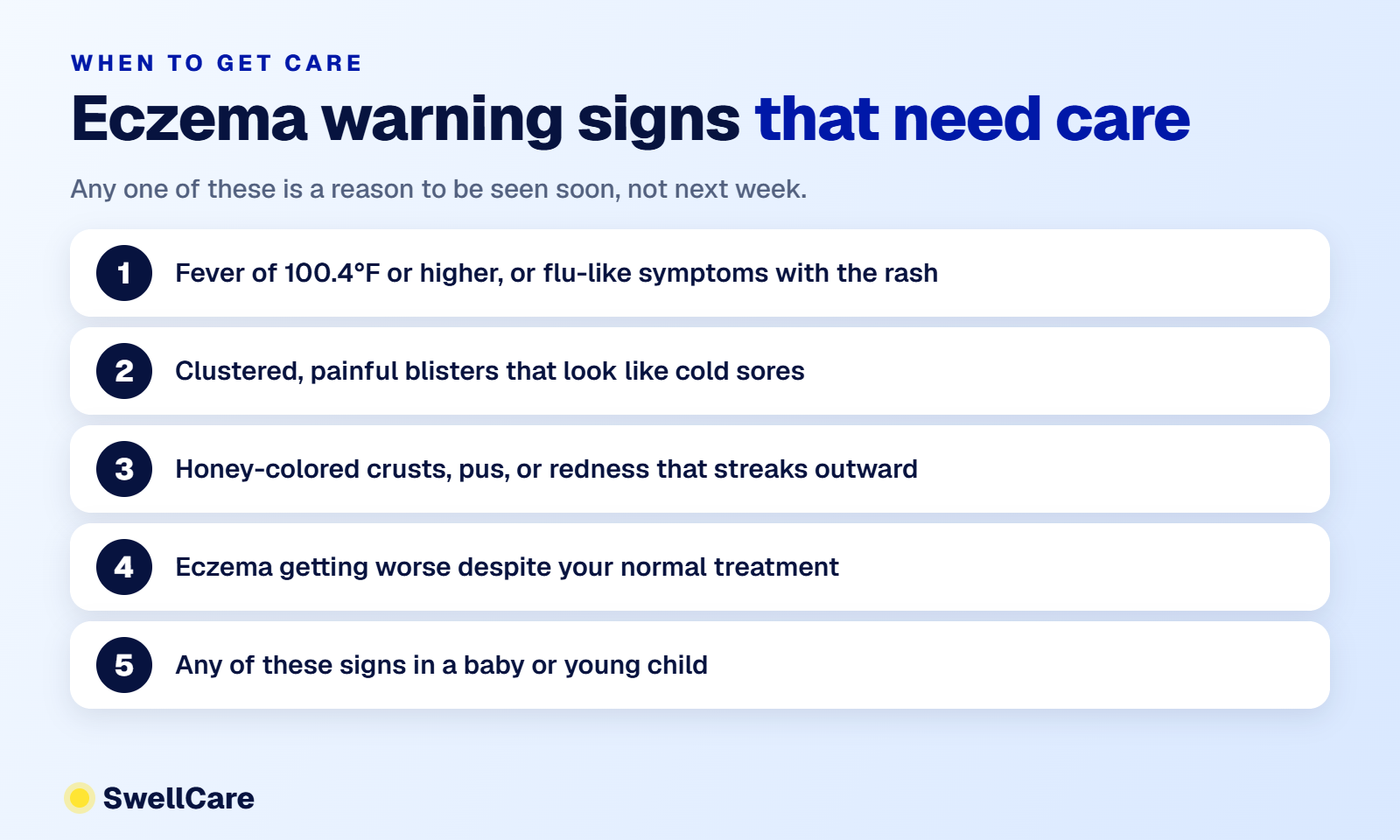
A dermatologist or online clinician can sort most of this out. Get care right away if you notice:
- A fever of 100.4°F or higher, or flu-like symptoms along with a rash
- Clustered, painful blisters that look like cold sores
- Honey-colored crusts, pus, or redness that streaks outward
- Eczema that’s getting worse despite your normal treatment
- A baby or young child with any of the above
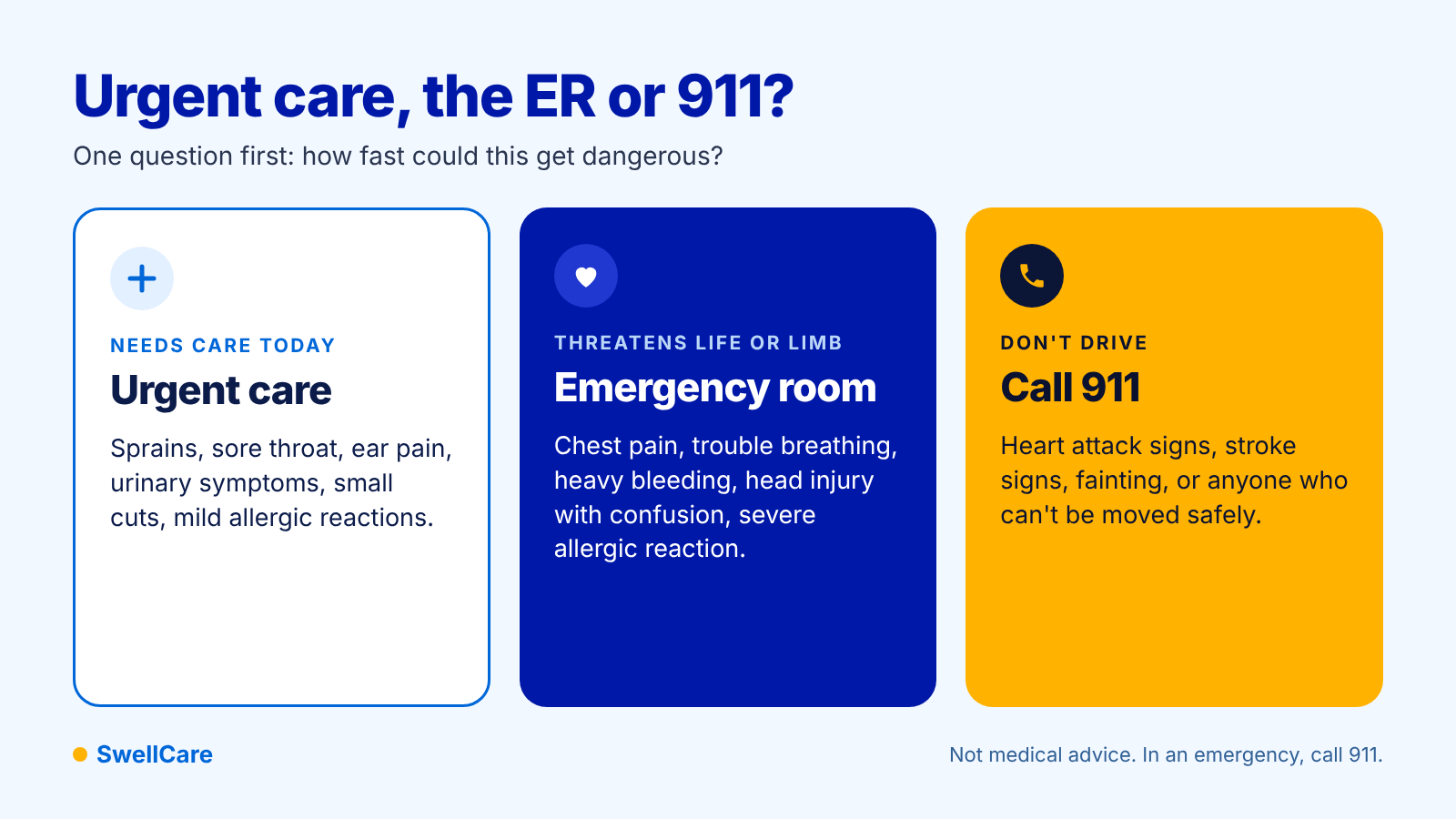
Fever with blisters can mean a viral infection that needs urgent treatment, so don’t sit on it. Severe symptoms, trouble breathing or rapidly spreading redness call for 911 or the emergency room.
For everything short of an emergency, SwellCare offers clinician-led, non-emergency urgent care around the clock by video or chat, so a flare-up at 11 p.m. doesn’t have to wait until morning. A clinician can look at the skin, tell you whether it looks like eczema or an infection, review your symptoms and say whether you need in-person care. Prescriptions are never guaranteed. Start your care and get a clear next step today.
Questions people ask about eczema and contagion
Can you catch eczema from someone else?
No. Eczema isn’t caused by a germ, so it can’t pass through touch, kissing or shared towels. What can spread is an infection on top of eczema. That’s the reason clinicians ask about crusting, blisters and fever.
Can eczema spread from one part of the body to another?
Eczema can show up in new spots, but it isn’t “spreading” like an infection. New patches appear when triggers, dryness or scratching irritate other areas of skin. Calming inflammation, moisturizing daily and cutting back on scratching usually keeps flare-ups in check.
Is eczema contagious to babies?
No, a baby can’t catch eczema from a parent, sibling or caregiver. Babies are more vulnerable to infections on eczema skin, though, especially herpes virus. Keep anyone with an active cold sore from kissing the baby, and call a clinician if fever or blisters appear.
Is infected eczema contagious?
It can be. The eczema isn’t, but the bacteria or virus causing the infection may pass through direct contact or shared items. Cover sores, wash hands often, don’t share towels, and get treatment. Impetigo usually stops being contagious about a day after antibiotics begin.
Can I kiss or hug someone with eczema?
Yes. Hugs and kisses can’t give anyone eczema. The one exception is an active cold sore on your lip, because that virus can make someone with eczema seriously ill. Wait until it heals.
Trusted references
Public-health, research, and medical-society resources related to this guide.