Your lab portal pinged this morning. One line is flagged in red, a few points over the range. You feel fine, so why does your stomach drop?
Here’s the short answer. Mildly elevated liver enzymes are common, and they often point to something fixable: fatty liver, a medication, a hard workout. They aren’t a diagnosis. They’re a nudge to look closer. This guide explains what the numbers mean, what usually causes them, and the steps that come next, so you can walk into your follow-up with a plan instead of a worry.
What mildly elevated liver enzymes actually mean
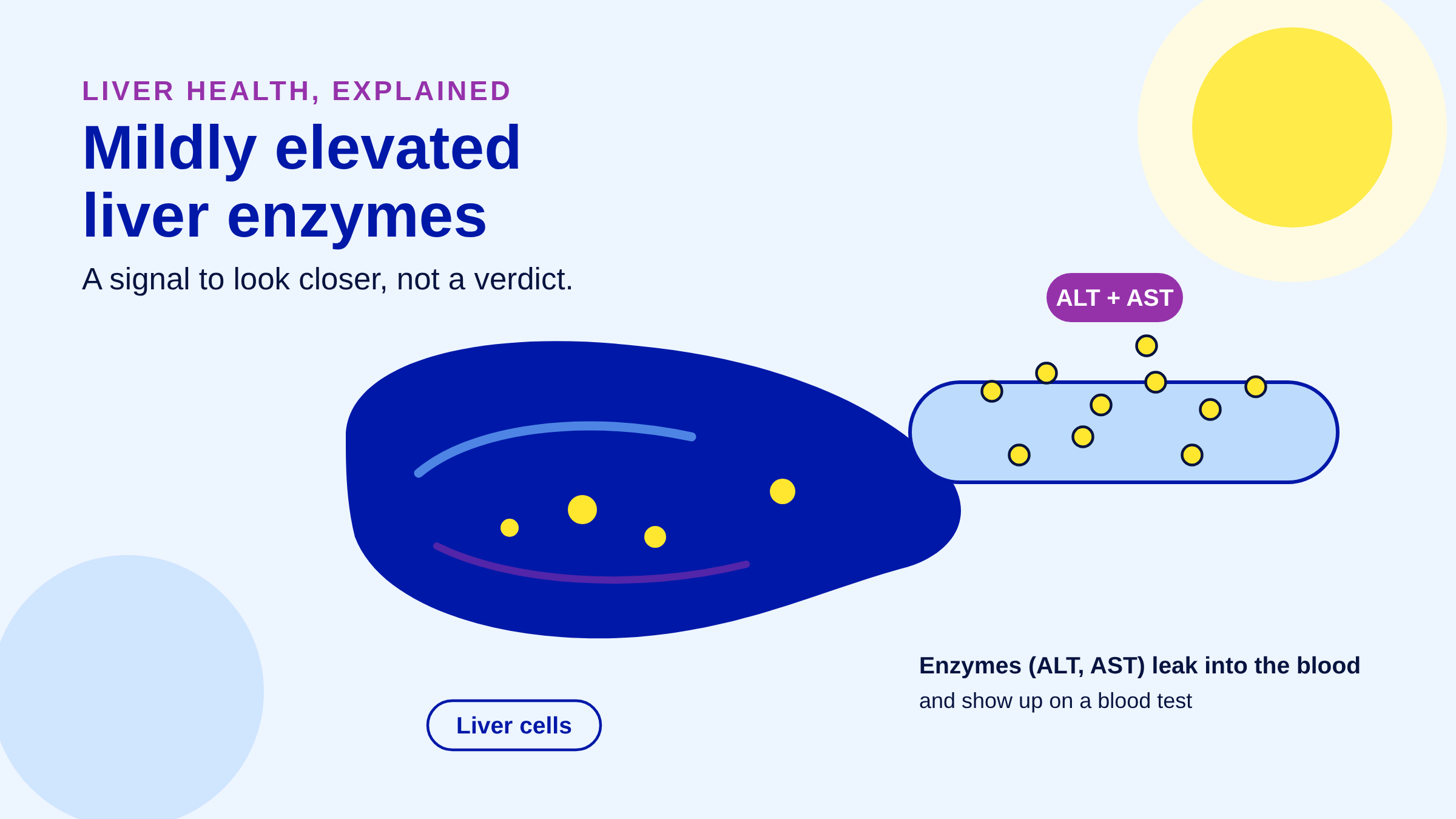
Liver enzymes are proteins that live inside liver cells. When those cells get irritated, a little of that protein leaks into your blood, and a blood test picks it up. The two you’ll see most often are ALT (alanine aminotransferase) and AST (aspartate aminotransferase). Doctors group them with a few other markers as liver function tests, though they track leakage, not how well your liver is working.
“Mild” has a rough definition. A review in American Family Physician describes mild elevation as ALT or AST below five times the upper limit of normal. Labs set their own ranges, so the one printed on your report is the one that counts.
Here’s what surprises people. The size of the number doesn’t tell you how much damage there is. MedlinePlus notes that the amount of ALT in your blood isn’t related to how much your liver is damaged. A small bump can come from a long-running problem. A bigger one can fade in weeks. One result is a clue, never a verdict. Liver enzymes also bounce around, shifting from one day to the next, so a single draw rarely tells the whole story.
Is it serious if you feel fine?
Usually it isn’t an emergency. It still deserves attention.
The most common cause, fatty liver disease, is quiet. The National Institute of Diabetes and Digestive and Kidney Diseases (NIDDK) describes it as a silent condition with few or no symptoms. So “I feel fine” is nice to hear, but it doesn’t settle anything. No symptoms is the norm here, not the exception. Early liver disease can hide behind ordinary days, and liver damage can build for years before anything hurts.
Think of the result like a check-engine light. The car still drives. You still don’t ignore the light.
The reverse is true as well. Normal liver enzymes don’t guarantee a healthy liver, and mildly raised ones don’t guarantee trouble. Context decides: your weight, your medicines, how much you drink, your family history.
What clinicians watch is the pattern. A level that returns to normal on a repeat test is a very different story from one that stays high for months. The AFP review suggests referral for further evaluation when elevations persist for six months or more.
Common causes of elevated liver enzymes
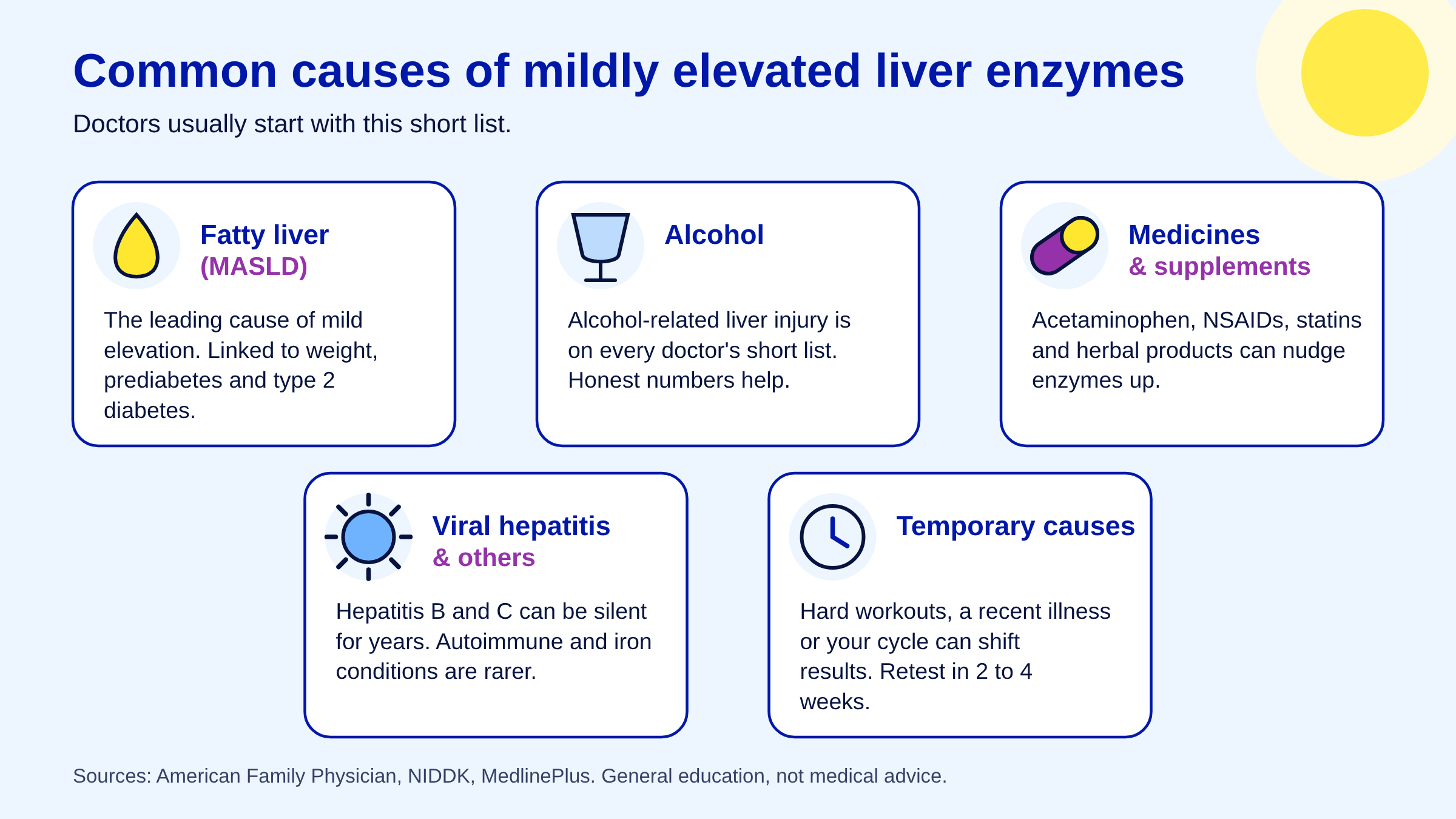
Doctors start with a short list of usual suspects whenever they see elevated liver enzymes. Most flagged results trace back to one of them.
Fatty liver disease
Fatty liver disease, now often called MASLD, is the leading cause of mild transaminase elevation in the AFP review. NIDDK estimates that about 24% of U.S. adults have it, while AFP puts the figure closer to 30%. Either way, it’s common: roughly one adult in four to one in three has MASLD. Most of those people have no symptoms.
Risk climbs with obesity, prediabetes, high triglycerides and type 2 diabetes. NIDDK reports that between one-third and two-thirds of people with type 2 diabetes have fatty liver.
There’s a clue in the lab pattern, too. AFP notes that an AST-to-ALT ratio under 1 leans toward fatty liver, while a ratio above 2 points toward alcohol.
Alcohol
Alcohol is the other big name on the list. The AASLD’s guide to elevated liver enzymes says about 90% of people with alcohol-associated liver disease have an AST-to-ALT ratio above 2.
Be honest with your clinician about how much you drink. Nobody’s grading you. The answer simply changes which tests make sense.
Medications and supplements
Plenty of everyday medications can nudge enzymes up. AFP’s list includes acetaminophen, NSAIDs, some antibiotics, some antidepressants and statins. One study it cites found that 4 grams of acetaminophen a day for 5 to 10 days raised transaminases in up to 58% of healthy non-drinkers. Alcohol may raise the risk even at lower doses.
Statins get blamed a lot. AFP reports that elevations resolved on their own in up to 70% of people who kept taking them, and that evidence of serious harm is sparse. Still, don’t stop a statin or any prescription on your own. Ask first.
Herbal products deserve extra suspicion. Kava and germander are on AFP’s list, and NIDDK advises talking with a doctor before taking supplements, since some herbal remedies can damage the liver.
Viral hepatitis and other liver conditions
Hepatitis B and C can keep liver enzymes mildly raised for years without symptoms. That’s why the first round of tests almost always includes a hepatitis screen. Hepatitis simply means liver inflammation, and viruses are only one reason for it.
Less common explanations include autoimmune hepatitis, where the immune system attacks liver cells, and hemochromatosis, which means too much iron. Wilson disease is rarer still. Thyroid problems, celiac disease and muscle injury can raise the numbers too, even when the liver isn’t the source.
Temporary causes
Liver enzymes shift with ordinary life. A tough workout the day before your draw can do it. So can a recent illness. MedlinePlus lists intense exercise, certain medicines, age, sex, body size and the menstrual cycle as things that can affect ALT. These bumps fade. That’s the logic behind testing twice.
What happens after an abnormal result
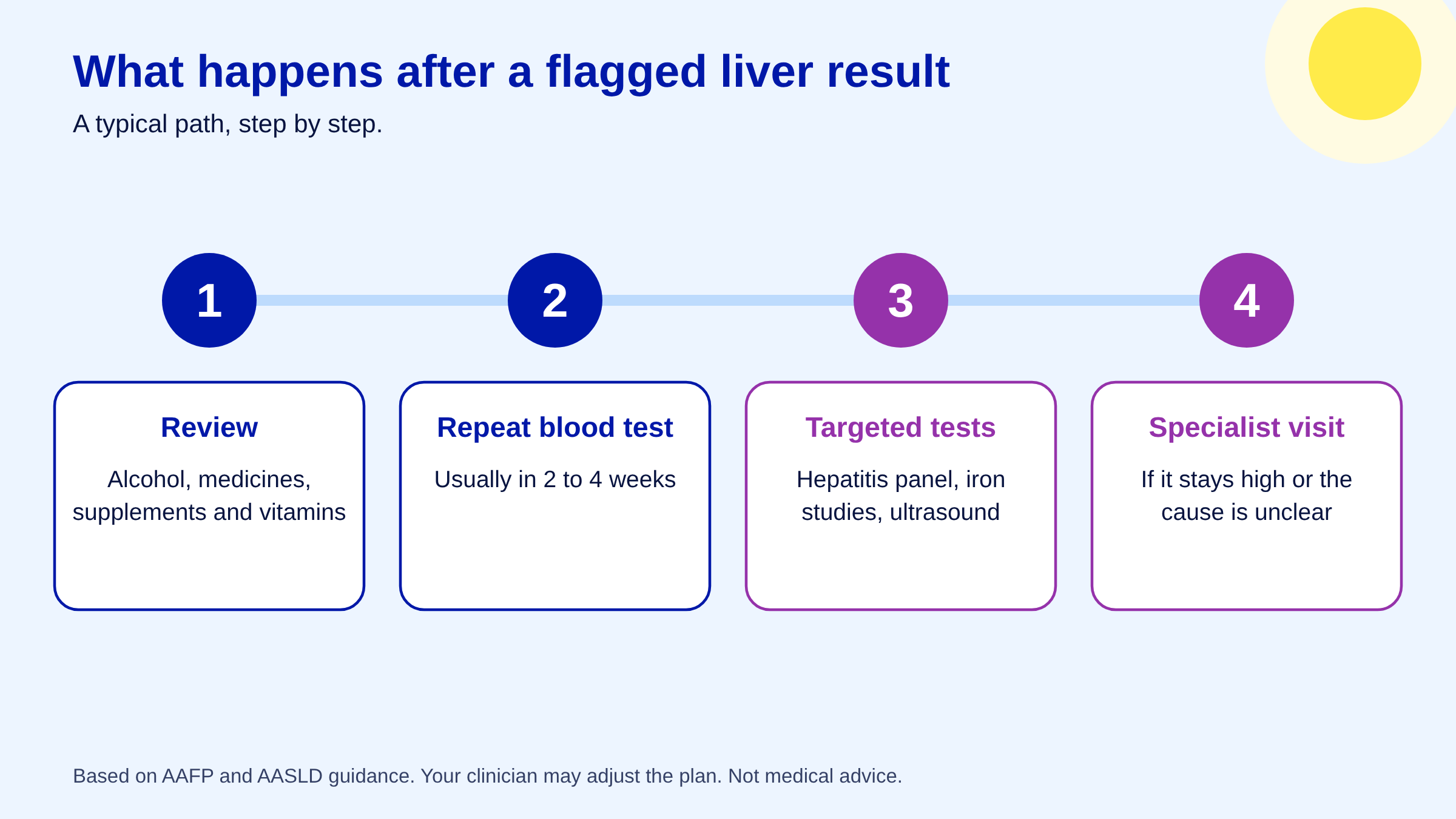
Expect a sequence, not a single test.
The repeat blood test
The first move is a conversation. Your clinician will ask about alcohol, medicines, supplements and vitamins, then look for anything that explains the number. Next comes a repeat blood test, and AFP recommends doing it in two to four weeks.
A sizable share of people with an initial flag come back normal on that second draw. Temporary causes of elevated liver enzymes fade, and that’s the whole point of waiting. If you’re one of them, you may simply recheck at a routine visit, with no further workup unless the number creeps back up.
Targeted tests if levels stay high
If the number holds, the testing widens. The AASLD guide lists other liver blood tests, a hepatitis panel, iron studies and an abdominal ultrasound as the usual starting set. An ultrasound is painless and quick, and it can show fat in the liver. It’s the imaging most people get first. Some clinics add transient elastography (FibroScan), which AASLD says can estimate liver fat, though availability is limited. That staged approach keeps testing in proportion to your result.
If nothing explains the result, your primary care clinician may refer you to a gastroenterologist or liver specialist. AASLD points to referral when the problem doesn’t resolve, the diagnosis is unclear or the disease needs staging.
How to bring liver enzymes down
There’s no magic detox. Sorry. What works is dull, and it works.
| Likely driver | Your first move |
|---|---|
| Fatty liver | Gradual loss, starting at 3% to 5% of body weight |
| Alcohol | Cut back, or stop completely if your clinician advises it |
| Medications and supplements | Review every one with a clinician before changing anything |
| Low activity | Move most days |
Weight is the lever with the best numbers behind it. According to NIDDK, losing 3% to 5% of body weight can reduce liver fat, while 7% to 10% may be needed to ease inflammation and scarring. At 200 pounds, that first step is 6 to 10 pounds.
Go slowly. NIDDK warns that rapid weight loss can make liver disease worse, so crash diets backfire. Physical activity helps even if the scale doesn’t move. If you’d like clinician support, Swell’s weight care program is one place to start.
Skip the “liver cleanse” products. Check every supplement with a clinician first.
Warning signs and when to see a doctor
Mild elevations without symptoms usually aren’t urgent. These symptoms are different, and jaundice is the one that shouldn’t wait. Contact a clinician promptly if you notice:
- Yellow skin or eyes, which is called jaundice and can creep in slowly
- Dark urine or pale stools
- Swelling in your belly, ankles or legs
- Pain in the upper right abdomen that doesn’t go away
- Constant itching, nausea, vomiting or unusual fatigue
These can signal more advanced liver disease, such as cirrhosis (scarring). Severe symptoms need urgent care, so call 911 or go to the nearest emergency room. Also make an appointment if your repeat blood test is still high, even if you feel perfectly well.
Getting your results reviewed with Swell
Waiting two to four weeks with a red flag on your chart is stressful. If you’re not sure what your liver enzymes mean or what to ask, a Swell clinician can walk through it with you by video, day or night.
You can start with how Swell works or see the labs and follow-up page. Bring your lab report, a list of your medications and supplements, and a rough idea of how much you drink. That’s all you need.
Questions people ask about mildly elevated liver enzymes
Can stress cause elevated liver enzymes?
Stress isn’t a standard cause on the usual lists. But stress can change habits that matter, like drinking more, sleeping badly or skipping meals. If your result is flagged, look at medications, alcohol and weight first, and mention any big life stress to your clinician.
Can exercise raise AST?
Yes. AST is found in muscle as well as the liver, and MedlinePlus lists intense exercise among the things that can affect results. If you lifted hard before your draw, say so. Ask whether to skip heavy workouts for a couple of days before the second draw.
How long do liver enzymes stay elevated?
It depends on the cause. Temporary ones often settle within weeks, which is why a repeat test at two to four weeks is standard. If elevation lasts six months or more, the AFP review suggests referral for further evaluation.
Can ibuprofen or Tylenol raise liver enzymes?
Both can. Acetaminophen (Tylenol) at high doses raised transaminases in a study cited by AFP, and NSAIDs such as ibuprofen are on its list of medications linked to elevated enzymes. Stay within label doses, avoid mixing with alcohol and tell your clinician what you take.
What foods should I avoid?
There’s no proven “liver diet” with a banned-foods list. Focus on what supports gradual fat loss and metabolic health, and skip alcohol if you’re advised to. Ask before trying any herbal liver cleanse, because NIDDK warns that some herbal remedies can damage the liver.
Trusted references
Public-health, research, and medical-society resources related to this guide.