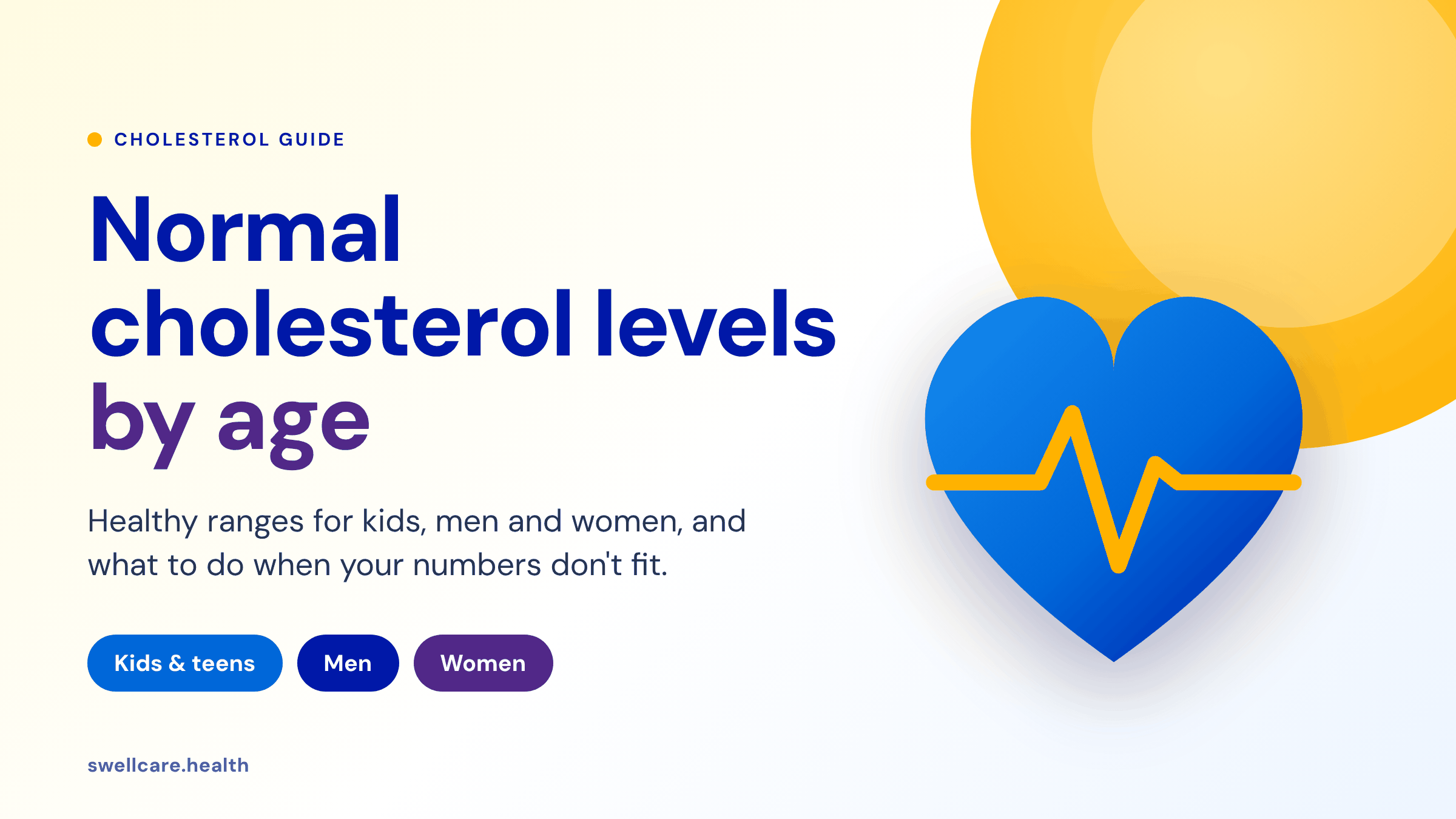
Here’s the part most charts skip. Once you’re 20, the numbers that count as normal cholesterol levels by age barely move. A 25-year-old and a 75-year-old start from the same chart: total cholesterol under 200 mg/dL and LDL under 100. What changes with age is how likely you are to miss those targets, and how much it matters when you do.
Below you’ll find the full chart, fresh US data on how cholesterol levels shift as we get older, and the 2026 heart guideline that brought LDL goals back.
Normal cholesterol levels by age at a glance
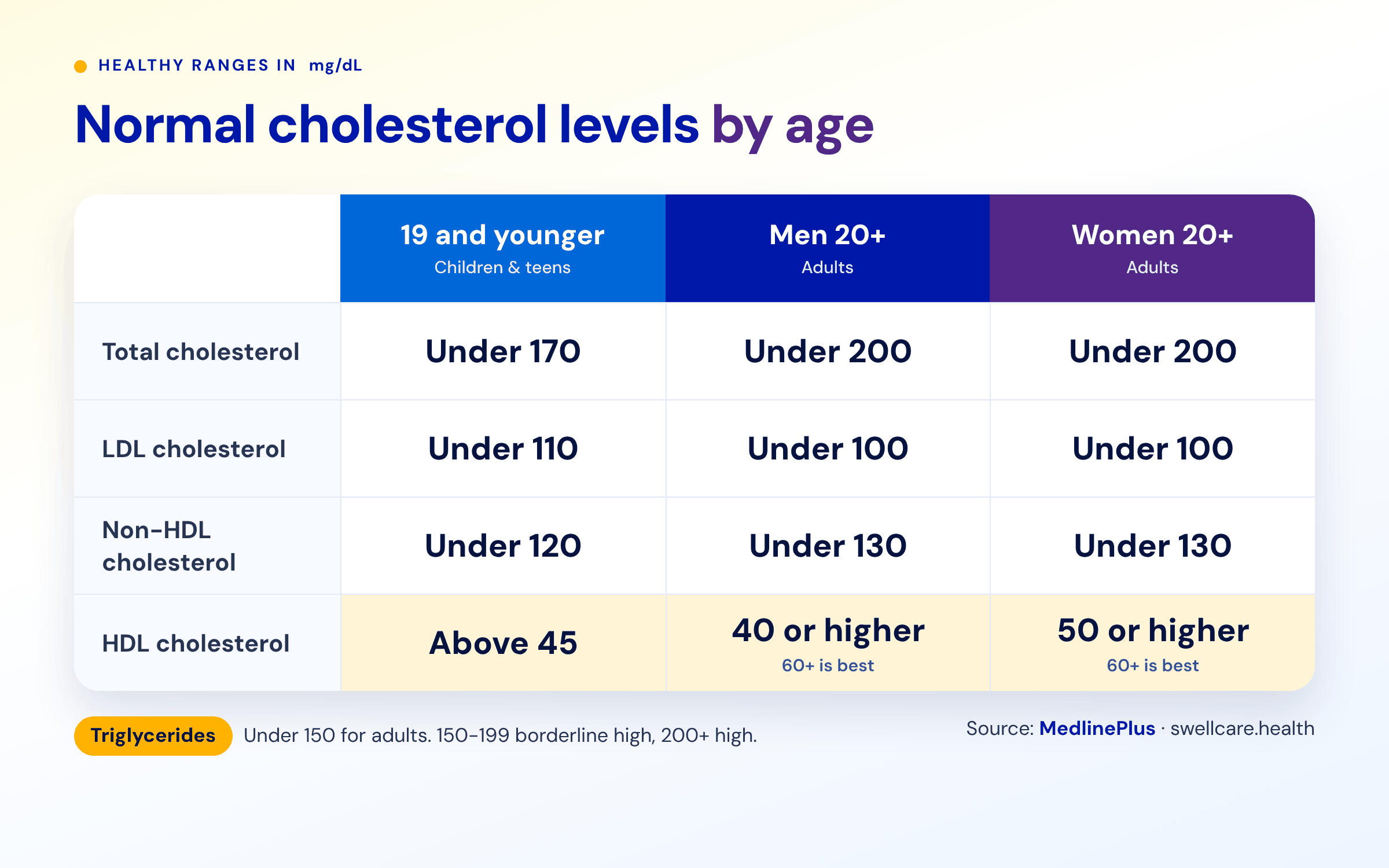
Every value is in mg/dL, the unit US labs use. The ranges come from MedlinePlus, the National Library of Medicine’s patient site, and non-HDL cholesterol (total minus HDL) gets its own row.
| Measure | 19 and younger | Men 20+ | Women 20+ |
|---|---|---|---|
| Total cholesterol | Under 170 | Under 200 | Under 200 |
| LDL cholesterol | Under 110 | Under 100 | Under 100 |
| Non-HDL cholesterol | Under 120 | Under 130 | Under 130 |
| HDL cholesterol | Above 45 | 40 or higher (60+ is best) | 50 or higher (60+ is best) |
Children and teens
Kids get lower targets because their cholesterol levels are judged against a lifetime ahead. The CDC advises one cholesterol test between ages 9 and 11 and another between 17 and 21. Children with obesity or diabetes may need cholesterol testing sooner and more often. High cholesterol has no symptoms in children either, so the blood test is the only way to know. Some children with a strong family history are tested as early as age 2.
Adults 20 and older
Adults share one set of targets, so cholesterol levels that count as normal look the same at 30, 50 and 70. HDL is the one split: men should stay at 40 or higher, women at 50 or higher, and 60-plus is best for both. Triglycerides should sit under 150. A reading of 150 to 199 is borderline high, and 200 or more is high. High triglycerides can add to your heart risk even when your LDL looks fine.
What each number on your lipid panel tells you
A lipid panel is a simple blood test that measures your cholesterol levels and triglycerides. It reports four numbers, and each one has a job in your story.
LDL cholesterol, short for low-density lipoprotein, is the type that can leave plaque in an artery wall. Think of it as the number to push down. HDL cholesterol, short for high-density lipoprotein, helps clear cholesterol out, so you want that one higher. Triglycerides are a fat your body stores for energy. They climb with extra weight, too much alcohol and high blood sugar. Total cholesterol adds it all up.
Subtract HDL from the total and you get non-HDL cholesterol. It captures LDL plus the triglyceride-rich particles, so it can flag trouble when triglycerides run high and LDL cholesterol looks fine. Plaque builds slowly inside the arteries, which is why one clean-looking number never tells the whole story.
How cholesterol changes as you age
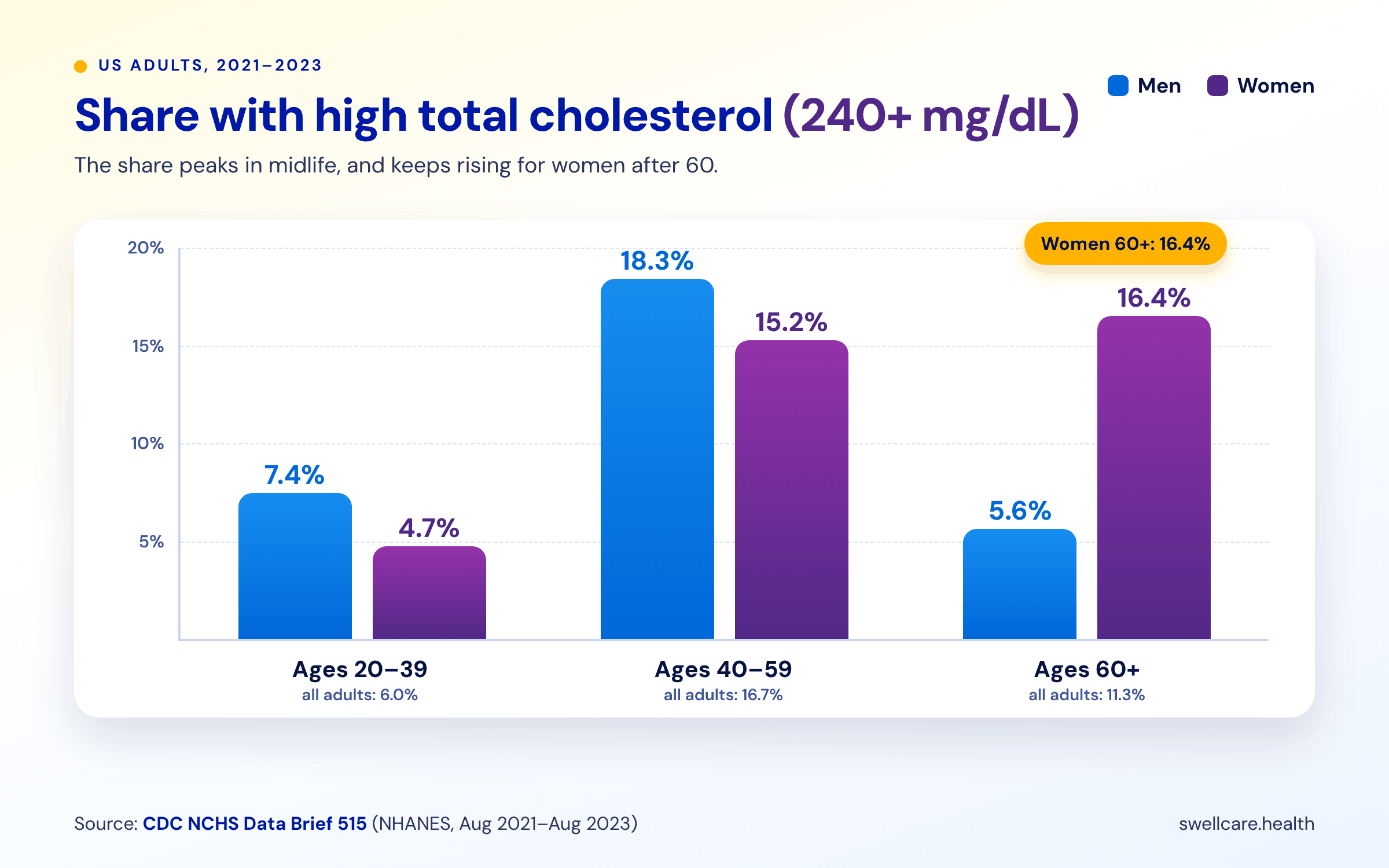
Cholesterol levels tend to rise with age, and the newest US survey shows when. In CDC data from 2021 to 2023, high total cholesterol (240 mg/dL or higher) affected 6.0% of adults ages 20 to 39. That jumped to 16.7% at 40 to 59 and eased to 11.3% from 60 on. High cholesterol rarely announces itself, so those percentages hide plenty of people who feel perfectly fine.
Men: the climb starts earlier
Among men, 7.4% of those 20 to 39 and 18.3% of those 40 to 59 had high total cholesterol. At 60 and older it fell to 5.6%. The survey can’t say why. Cholesterol medicines, which lower measured levels, may be one reason.
Women: the shift after menopause
Women run the other way. Just 4.7% of women 20 to 39 had high total cholesterol, then 15.2% at 40 to 59 and 16.4% at 60 and older. MedlinePlus notes that a woman’s risk rises after menopause as hormone levels drop. A Dallas Heart Study analysis saw LDL particle numbers climb most, by 8.3%, between perimenopause and postmenopause, while HDL particle numbers fell.
Family history and ethnicity matter too, and you can’t change either one.
Why a normal number can still be too high for you
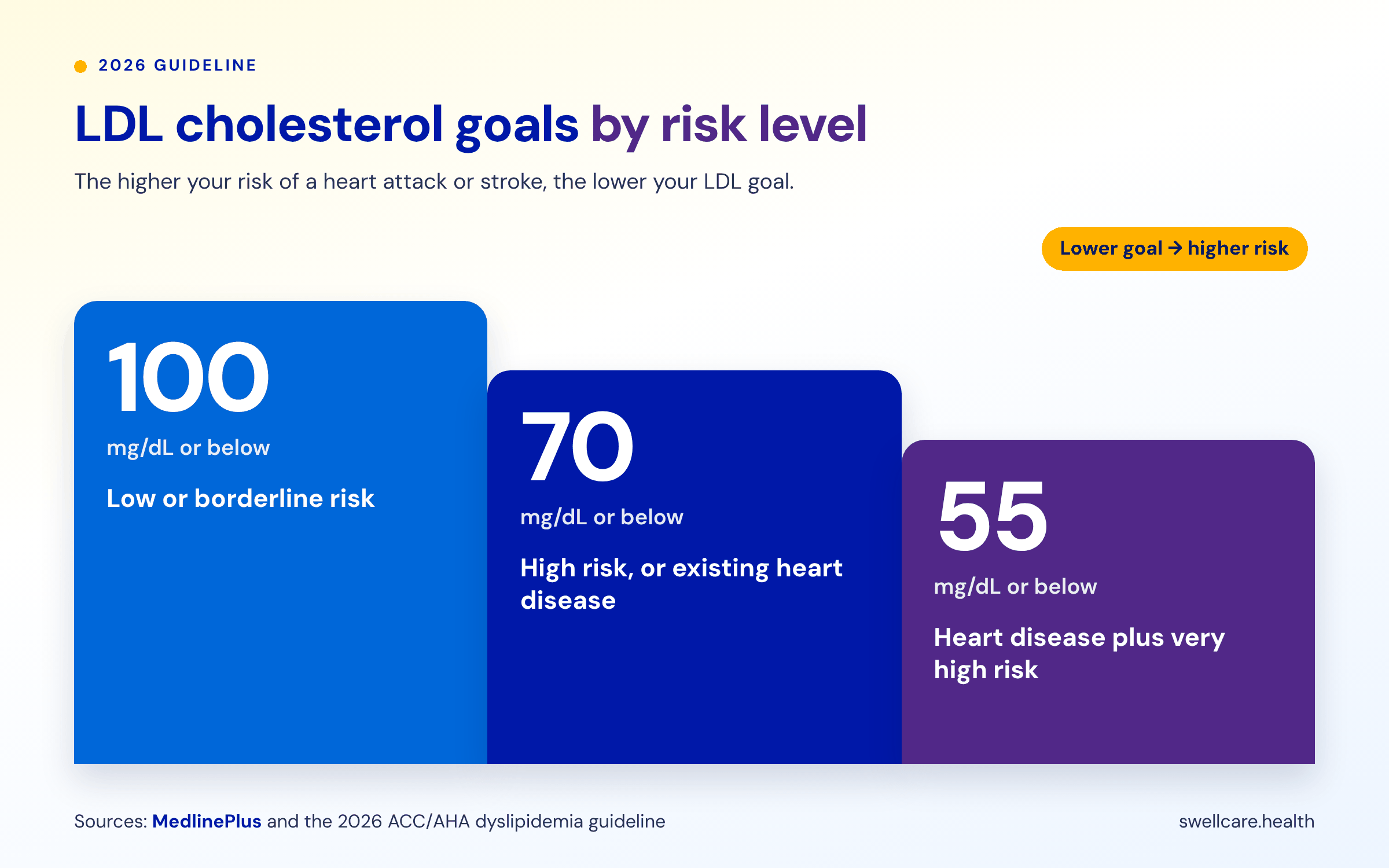
A chart shows the middle of the road. It doesn’t know your history. In early 2026 the American Heart Association and the American College of Cardiology replaced their 2018 cholesterol guideline and put specific LDL goals back, tied to your risk of heart disease. MedlinePlus lists them this way:
- 100 or below: low or borderline risk
- 70 or below: high risk of a heart attack or stroke, or existing heart disease
- 55 or below: existing heart disease with very high risk
Doctors now estimate that risk with the PREVENT equations for adults 30 to 79, and the guideline asks for a lipoprotein(a) test at least once. Your goal depends on your risk factors: type 2 diabetes, high blood pressure, smoking, or a parent with early coronary artery disease. Stack up more risk factors and your doctor will want LDL cholesterol lower. Left alone, high LDL feeds atherosclerosis, the slow plaque buildup that narrows arteries.
What moves your numbers in the right direction
Start with lifestyle changes. They work, and they’re free.
Diet comes first. Your overall diet matters more than any single food, but saturated fat, found in fatty meats, butter and full-fat dairy, is the main dietary driver of LDL cholesterol. Read labels for saturated fat and swap some of it for beans, nuts and fish to bring LDL down. Cutting back on alcohol and sugary drinks helps bring triglycerides down.
Then move. Regular physical activity and exercise help with weight and nudge HDL up, and a brisk daily walk counts as exercise. Smoking lowers HDL, so quitting helps too. Together, these lifestyle changes can slow plaque buildup in your arteries. If you carry extra weight and your cholesterol is high, losing 5% of your body weight is a solid first target. Swell’s clinician-guided weight care can help you plan it.
Medications come next, if you need them. Statins are the usual first choice, and other cholesterol medications exist for people who can’t take statins. If your numbers stay above goal after a stretch of lifestyle work, the guideline says to consider medication earlier than before.
How often to get your cholesterol checked
| Who | How often |
|---|---|
| Children and teens | Once at 9 to 11 and again at 17 to 21 |
| Healthy adults | Every 4 to 6 years (CDC) |
| Men 45 to 65, women 55 to 65 | Every 1 to 2 years (MedlinePlus) |
| Adults over 65 | Every year (MedlinePlus) |
| Heart disease, diabetes or family history | As your care team advises |
Sources differ a little, so let your doctor set your exact schedule for cholesterol testing.
When to talk to a doctor
Book a visit if your results fall outside the chart, or if a parent or sibling had high cholesterol, a heart attack or a stroke. Say so too if you live with obesity. Share all your risk factors, and ask about a cardiologist referral if LDL stays above goal despite treatment.
High cholesterol has no symptoms. Already told you have high cholesterol? Ask how often to recheck. Chest pain, pressure or sudden weakness on one side is different. Call 911.
Get your numbers explained
Got a result and no idea what it means? Swell’s labs and follow-up care helps you decide whether you need a test and what the result means. You get routine orders, results and clear next steps. See how it works.
Questions people ask about normal cholesterol levels by age
What is a normal cholesterol level by age?
Adults 20 and older should aim for total cholesterol under 200 mg/dL, LDL under 100, non-HDL under 130 and triglycerides under 150. HDL should be 40 or higher in men and 50 or higher in women. Children and teens aim for total cholesterol under 170 and LDL under 110.
What is a good cholesterol level for a 70-year-old?
The adult ranges still apply. What shifts is the LDL goal your doctor sets, which can be 100, 70 or 55 depending on your history and risk factors. MedlinePlus suggests testing every year after 65.
Does cholesterol go up with age?
Usually, yes. Cholesterol levels tend to climb through midlife. High total cholesterol was most common at 40 to 59 (16.7%), and among women it kept rising after 60 (16.4%).
Do I need to fast before a cholesterol test?
Sometimes. Your doctor may ask for fasting, meaning no food or drink for 8 to 12 hours, according to the CDC. Ask when you book so you don’t show up fed.
What are the new cholesterol numbers for 2026?
The 2026 guideline brought back LDL goals of 100, 70 or 55, based on your risk.
Trusted references
Public-health, research, and medical-society resources related to this guide.