It’s 2 a.m. Something aches low and deep, you keep rushing to the bathroom, and you’re typing “UTI vs kidney stone” into your phone with one hand while the other presses on your side.
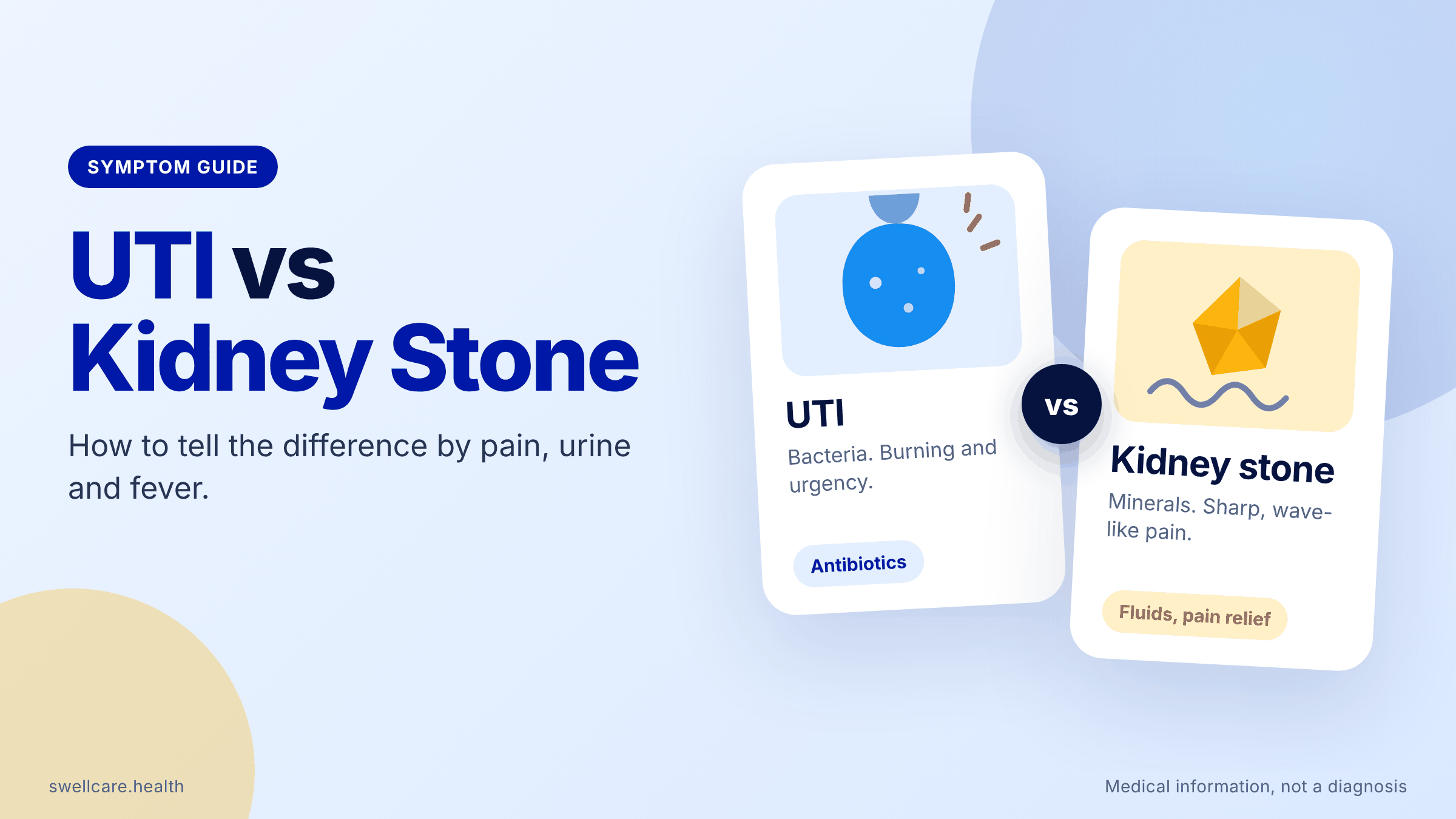
Here’s the fast answer. A UTI usually burns when you urinate and leaves a dull ache in the lower abdomen. A kidney stone usually sends sharp pain that comes in waves through your back or side, sometimes down into the groin. Both can turn your urine cloudy or bloody, which is exactly why people mix them up. Both also deserve a real diagnosis.
This guide shows you how to tell them apart, where their symptoms overlap, and which warning signs mean you should skip the waiting and head to the emergency room.
UTI vs kidney stone at a glance
If you only have a minute, this table compares UTI symptoms and kidney stone symptoms side by side. Think of it as a starting point, not a diagnosis. Your body doesn’t always read the textbook, and symptoms can overlap.
| UTI (lower urinary tract infection) | Kidney stone | |
|---|---|---|
| Typical pain | Pressure or cramping in the lower abdomen | Sharp pain in the back, side or groin that comes and goes in waves |
| When you urinate | Burning, strong urgency, only a little comes out | Pain, urgency, sometimes trouble passing urine |
| Urine | Cloudy, strong smell, sometimes blood | Pink, red or brown blood, sometimes cloudy |
| Fever or chills | Not usual unless the infection has reached the kidneys | Usually absent, and a warning sign if present |
| What’s behind it | Bacteria | Minerals that clump into a hard stone |
| Main treatment | Antibiotics from a clinician | Fluids, pain relief, sometimes a procedure |
One more point before we go deeper. Pain that makes it hard to sit still, plus a high temperature, is never a “wait and see” situation. We’ll come back to that.
Why a UTI and a kidney stone feel so alike
Your urinary tract is one connected plumbing line. Two kidneys filter waste from your body, two thin tubes called ureters carry urine down, the bladder stores it, and the urethra lets it out. When bacteria cause trouble in the lower part of the tract, doctors call it a lower urinary tract infection. Once it reaches the kidneys, it’s an upper urinary tract infection, and that’s a different level of concern. Trouble anywhere along that line irritates the same nerves and changes the same urine.
So a stone sitting near your bladder can make you dash to the toilet like an infection would. And an infection that climbs to the kidneys can cause side pain that feels just like a stone.
What a UTI actually is
A urinary tract infection, or UTI, means bacteria have set up camp where they shouldn’t be, most often in the urethra and bladder. The bacteria usually come from the bowel and enter through the urethra. Your body normally flushes them out every time you urinate, but sometimes they win. Typical UTI symptoms include burning when you urinate, frequent urges, discomfort in the lower abdomen and urine that looks cloudy or smells strong. Most are simple to treat when caught early.
Women get them far more often, and a first UTI raises the odds of a second. According to the National Institute of Diabetes and Digestive and Kidney Diseases, about half of women will have a UTI at some point, and roughly a quarter of those women will get another one. Men get UTIs less often, but they do get them.
What a kidney stone actually is
A kidney stone is a hard lump built from minerals in your urine, mainly calcium, oxalate and phosphorus. When urine gets too concentrated, those minerals can clump together. No bacteria needed. Typical kidney stone symptoms include sharp back or side pain, blood in urine, nausea and a constant urge to go. Kidney stones can form anywhere in the urinary tract, but they cause the most trouble when one leaves the kidney and squeezes into a ureter.
Kidney stones are common. NIDDK reports that about 11% of men and 6% of women in the US will have one. Most are calcium oxalate stones, so calcium and oxalate are the two minerals you’ll hear about most. Struvite stones are the odd ones out because they’re tied to repeated infections, which is one way the two problems get tangled together.
Where a kidney infection fits in
There’s a middle ground that most people forget. A kidney infection, also called pyelonephritis, is a UTI that has traveled up to one or both kidneys. The NIDDK explains that most kidney infections begin as UTIs.
It’s the one that fools people, because a kidney infection brings flank pain, nausea and a high temperature, so it looks like a stone with an infection’s urine changes. Treat a UTI late and it can become a kidney infection. That’s why “it’s just a UTI” isn’t always true. Kidney infection symptoms usually show up fast, and the kidney infection needs treatment the same day.
How the pain differs
Pain is the best clue you have in the UTI vs kidney stone puzzle, so pay attention to where it sits and how it acts.
Where it hurts
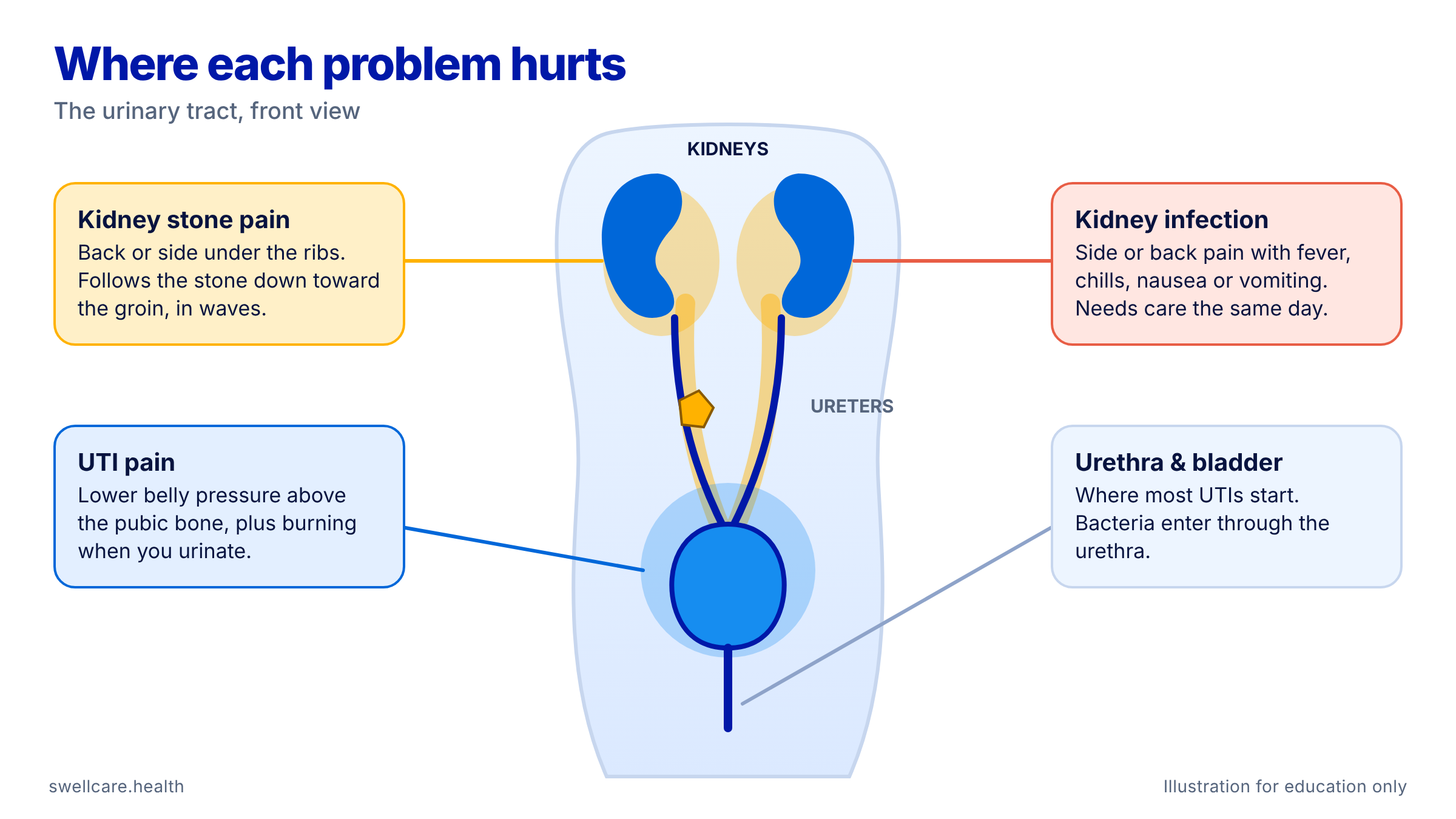
UTI pain lives low. You’ll feel pressure or cramping in the lower abdomen, right above the pubic bone, and often a burning sensation when you urinate. It’s a pelvic ache more than a stab.
Kidney stone pain starts higher and farther back. You’ll feel it in your back or side just under the ribs, which doctors call flank pain. As the stone moves down the ureter toward the bladder, the pain tends to travel with it, across the lower abdomen and into the groin.
How the pain behaves
This is the tell. Kidney stone pain comes in waves. It builds to a peak, eases, then returns, and people often can’t find a comfortable position. They pace, they shift, they get up and lie down again.
UTI pain is steadier and duller. It nags rather than stabs, and it usually flares with each trip to the bathroom.
Urine, fever and other symptoms side by side
Pain isn’t the whole story. The rest of your symptoms add up to a pattern, and the pattern matters. Here’s how to read the symptoms one group at a time.
What your urine is telling you
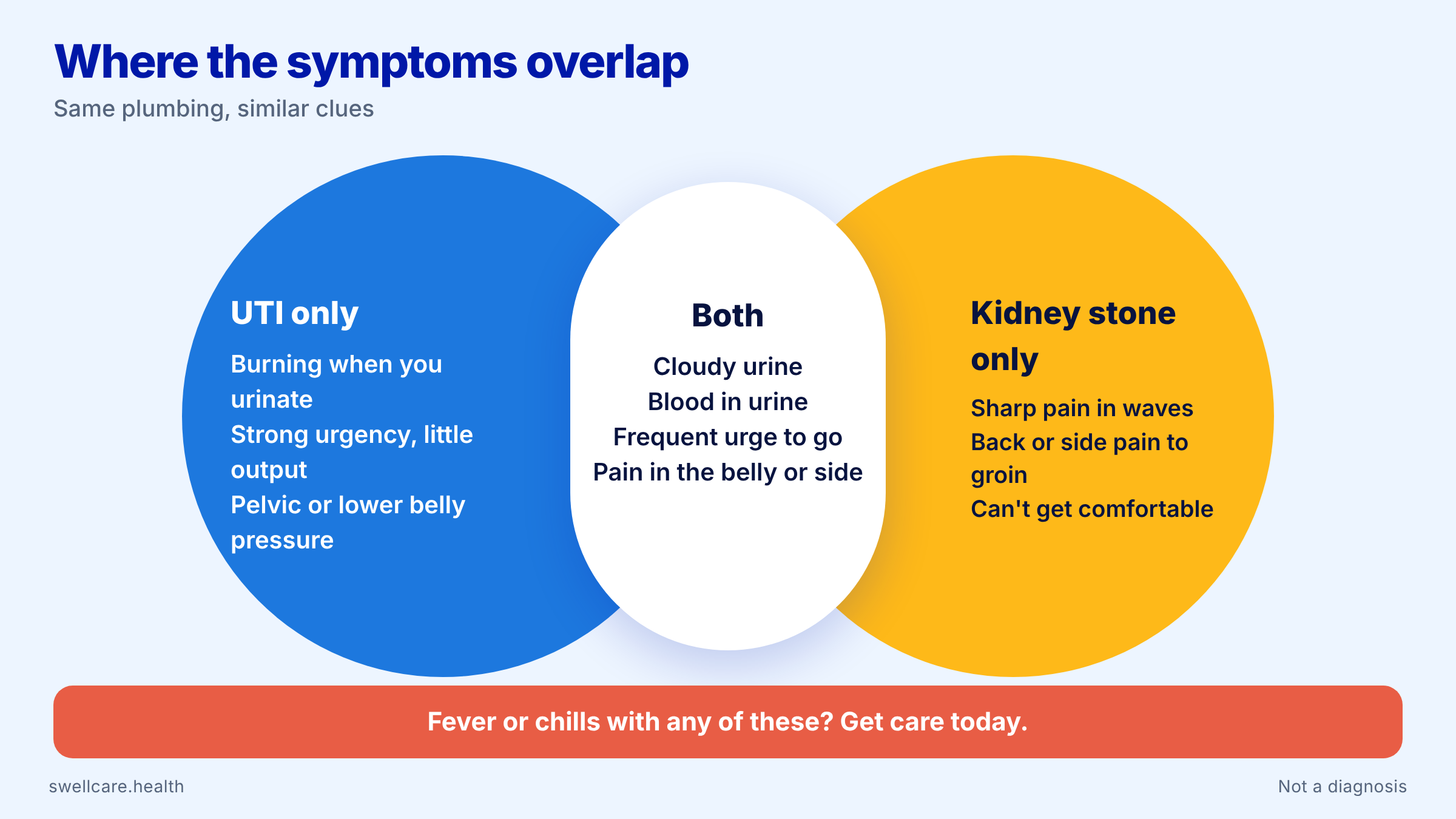
With a UTI, the classic symptoms are a burning feeling when you urinate, a strong urge to go even when little comes out, and urine that looks cloudy or smells strong. Sometimes you’ll see blood, too.
With a kidney stone, blood in urine is more common and more visible. It can look pink, red or brown. You may also feel a constant urge to go, have trouble getting urine out, or notice cloudy urine if an infection has joined the party.
Blood alone won’t settle the question. It can show up with either problem. Cloudy urine can too. That overlap is the reason a urine test matters.
Fever, chills, nausea and vomiting
Nausea and vomiting often come with stone pain, because severe pain upsets your stomach. They can also show up with a kidney infection.
Fever and chills point toward infection. Simple UTIs rarely cause them. If a high temperature shows up alongside back or side pain, think kidney infection or an infected kidney stone until a clinician says otherwise. The CDC lists lower back pain and vomiting among the signs a UTI may have spread to the kidneys.
Can you have a UTI and a kidney stone at the same time?
Yes, and it’s the combination doctors worry about most. Together, a UTI and a kidney stone can turn a bad day into an emergency, and the treatment can’t wait.
A kidney stone can block the ureter, the tube that drains urine from the kidney. Urine backs up behind the blockage. Bacteria multiply in that trapped urine and the kidney gets infected. The Sepsis Alliance points out that this can lead to sepsis, a life-threatening reaction to infection, and that a kidney stone together with a high temperature needs emergency care.
You can also get a kidney stone that follows repeated infections, as with struvite stones. So the two conditions don’t always compete. Sometimes they travel together.
The signs of the dangerous version look like this: severe side or back pain, a high temperature, shaking chills, nausea or vomiting, and maybe confusion. If that’s you, don’t wait for a callback. Go to the emergency room.
How doctors tell a UTI from a kidney stone
Symptoms alone can’t settle the UTI vs kidney stone question, and guessing only gets you so far, so clinicians use tests. The diagnosis sequence is usually quick, and the first test is simple.
First comes a urinalysis. You give a urine sample, and the urinalysis looks for white blood cells, bacteria and blood. A urinalysis can point to a UTI, but it can’t see a stone, and the urinalysis result often comes back the same day, and blood in urine shows up with both. If an infection is suspected, a urine culture grows the bacteria to confirm which one it is and which antibiotics will work. That result can take a day or two.
Imaging comes next if a stone is possible, and it can look at the whole urinary tract. An ultrasound is gentle and uses no radiation, so it’s often the first scan, including for pregnant patients. It can spot kidney stones and swelling in the kidneys. When the pain is severe or the ultrasound doesn’t settle things, a CT scan gives more detail. Some clinics choose a low-dose CT scan to limit radiation. Lab work can also check how well the kidneys are working and whether the infection has spread.
A good diagnosis for UTI vs kidney stone answers two questions: is there an infection in the urinary tract, and is something blocking the flow of urine? The second question is what separates a manageable day from an emergency.
Treatment: what usually helps for each
The two problems need different treatment, which is another reason not to guess. Treatment for a UTI looks nothing like treatment for a kidney stone, and the wrong treatment wastes precious time.
UTI treatment
UTI treatment starts with antibiotics prescribed by a clinician. The right antibiotics and the length of treatment depend on the bacteria, your history and whether the infection is limited to the lower tract. Drink plenty of water and take every dose, even if you feel better by day two. Early treatment keeps a simple UTI from turning into a kidney infection.
Please don’t borrow leftover antibiotics from a friend or your medicine cabinet. The CDC specifically warns against sharing or saving them. They can mask the problem without clearing it.
Kidney stone treatment
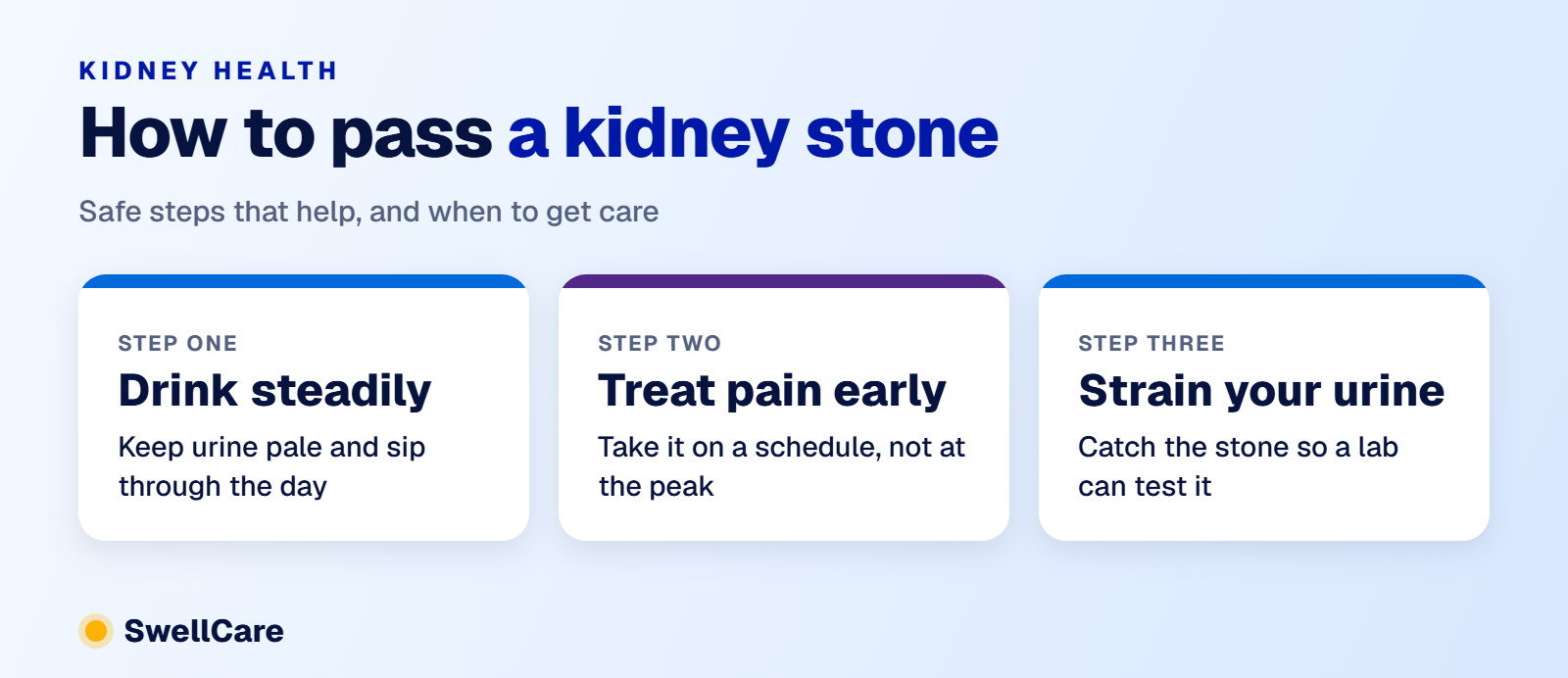
Many small kidney stones pass on their own, and treatment for them often means waiting, fluids and pain relief. According to the NIDDK, drinking plenty of water can help move a stone along, and a clinician may prescribe pain medicine. You may be asked to catch the stone in a strainer so a lab can check what it’s made of.
Bigger stones, stones that block the urinary tract, and stones with unbearable pain may need a procedure for kidney stone treatment. Shock wave lithotripsy uses shock waves to break a stone into small pieces. Lithotripsy is done as an outpatient procedure under anesthesia, and your urologist can tell you whether lithotripsy or ureteroscopy fits your stone’s size and location. Ureteroscopy sends a thin scope up the urethra to find and remove or break up the stone. For large stones, a surgeon may go in through the back.
To prevent stones from coming back, water is the unglamorous hero. Sip water all day so your urine stays dilute, which makes it harder for minerals to clump. If your stone is calcium oxalate, your clinician may talk with you about oxalate-rich foods and salt, and please don’t cut calcium on your own. A UTI can be easier to prevent than people think, too: urinate when you feel the urge and don’t hold it for hours.
When to go to the ER instead of waiting
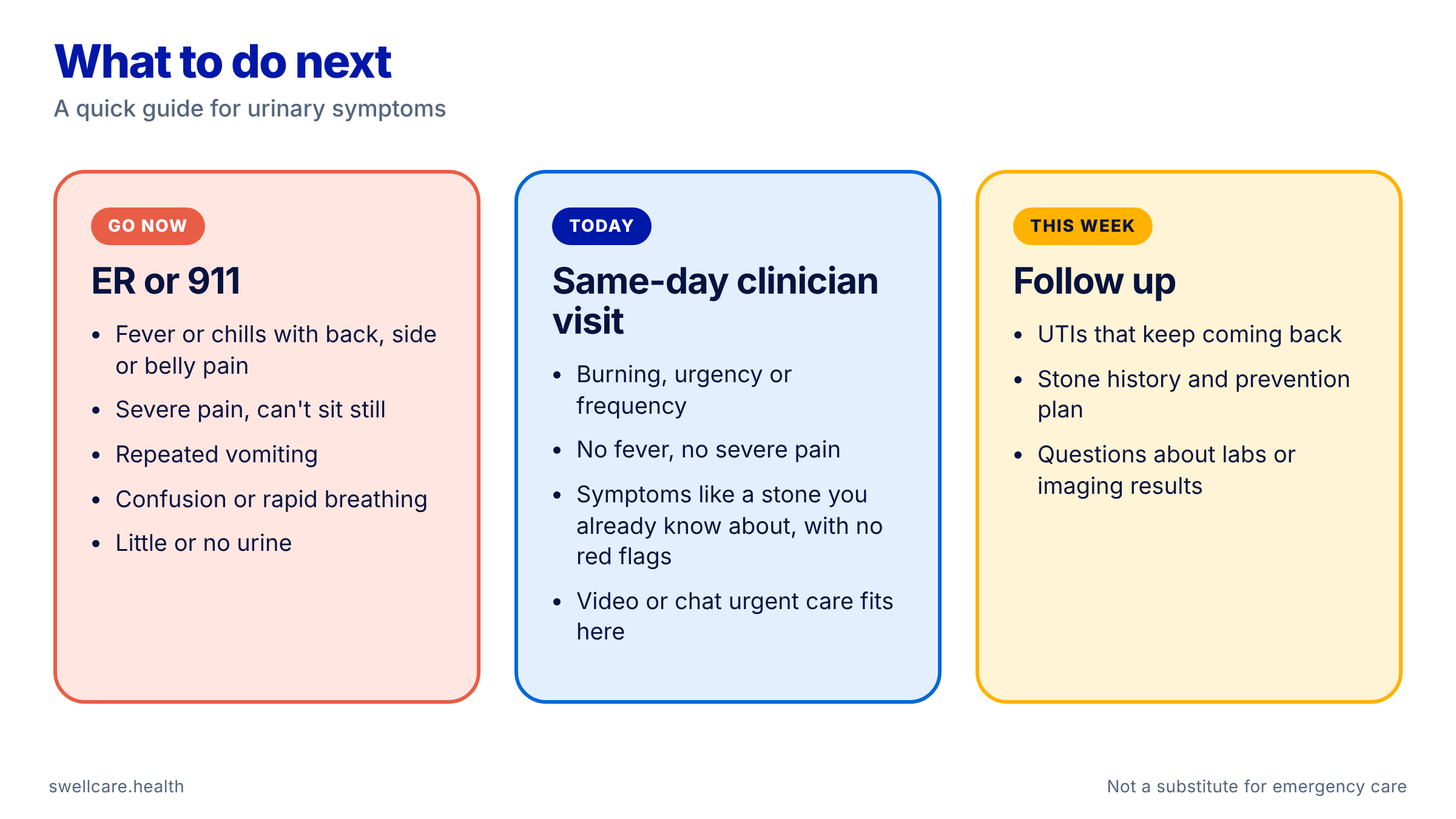
Some symptoms don’t belong in a “let me try telehealth first” plan. Go to the emergency room, or call 911, if you have any of these symptoms:
- Fever or chills together with back, side or abdominal pain
- Severe pain that makes it impossible to sit or lie still
- Repeated vomiting, or you can’t keep fluids down
- Confusion, a very fast heartbeat or rapid breathing
- Little or no urine coming out
- A known kidney stone and a sudden change in how you feel
Also, a baby under 3 months with a fever of 100.4°F (38°C) or higher needs care right away, according to the CDC. Pregnant? Have only one kidney, a weak immune system or kidney disease? Lower your threshold and get seen sooner.
Not sure which side of the line your symptoms fall on? When in doubt, get checked in person. Treatment in a hospital can include IV fluids for dehydration and antibiotics for infection, and it works best when it starts early.
Get your symptoms checked with Swell today
Here’s the realistic middle path. If you have classic UTI symptoms like burning, urgency or frequency, and your other symptoms are mild with no red flags, you don’t have to sit in a waiting room for hours.
Swell’s 24/7 non-emergency urgent care lists UTI symptoms among the urinary tract symptoms it handles over video or secure chat. It also covers symptoms that resemble a kidney stone you’ve already been diagnosed with, as long as you have no emergency warning signs. A clinician reviews what’s going on, may order labs and follow-up, and tells you plainly if a telehealth visit isn’t enough and you need in-person care. Prescriptions aren’t guaranteed, because the goal is the right care, not a quick script.
First-ever severe flank pain, a high temperature with back pain, or vomiting? Skip the screen and head to the ER. If it looks like a simple UTI, start a Swell visit and let a clinician sort it out.
Questions people ask about UTI vs kidney stone
Can a kidney stone feel like a UTI?
Yes. A kidney stone near the bladder can cause burning, urgency and a constant urge to urinate, and blood in urine can make the symptoms look like a UTI. The giveaway is usually the pain: stone pain tends to come in waves through the back or side. Urine tests and sometimes imaging settle it.
What are the symptoms and warning signs of kidney stones?
Sharp pain in the back, side, lower abdomen or groin that comes and goes in waves is the classic sign. Blood in the urine, nausea, vomiting, painful urination and a constant urge to go are common kidney stone symptoms too. Fever and chills mean an infection may be involved, and that needs prompt medical care.
How can I tell if it’s a UTI or a kidney infection?
While it stays in the lower tract, a UTI gives you burning, urgency and pelvic pressure, all in the urinary tract’s lower half. A kidney infection adds fever, chills, nausea or vomiting, and pain in your back or side. If your UTI symptoms come with any of those extra symptoms, see a clinician the same day. Don’t wait it out.
How long does it take for a UTI to turn into a kidney infection?
There’s no set timeline, and early treatment is the best way to stop it. Drinking water helps prevent UTIs and stones alike. A UTI that goes untreated or keeps coming back can spread to the kidneys, sometimes within days. Don’t wait to see what happens. Fresh fever or flank pain after UTI symptoms is your cue to get care.
Can a kidney stone cause a fever?
The kidney stone itself usually doesn’t, but an infection around it can. Fever with a stone is a warning sign, because a blocked, infected kidney can progress to sepsis. Treat it as an emergency and go to the ER.
Can kidney stones cause a UTI?
They can raise the odds. A kidney stone that slows or blocks the flow of urine in the urinary tract gives bacteria a place to settle and multiply. Struvite stones also form in response to repeated infections. If you’ve had a stone and now have burning or a high temperature, get checked promptly.
Trusted references
Public-health, research, and medical-society resources related to this guide.