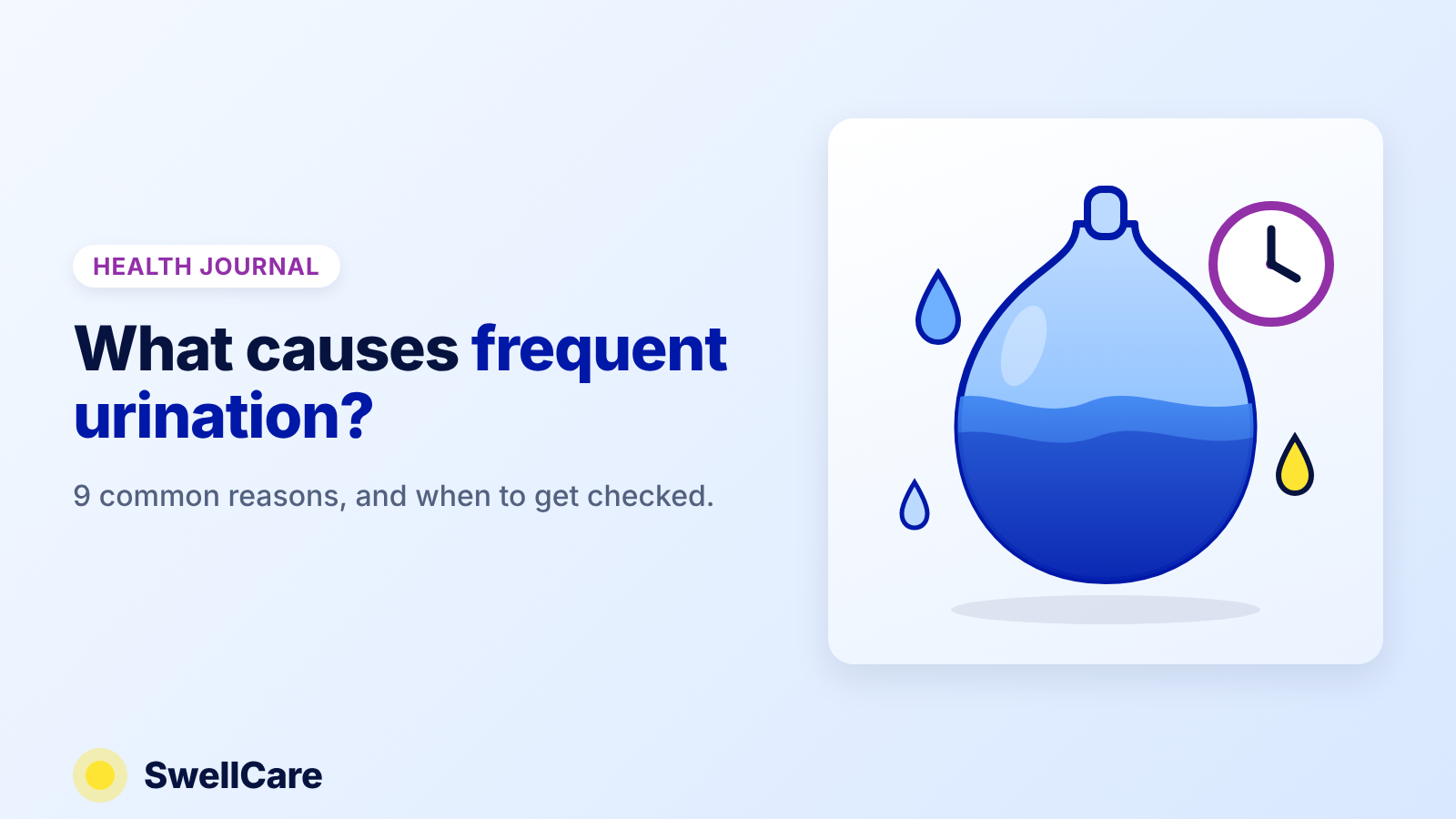
You’re on your third bathroom trip since lunch. You’ve started planning car rides around rest stops. Or you’re awake at 2 a.m. again, staring at the ceiling and wondering what’s wrong.
Maybe nothing is. Maybe something small and very fixable is going on. So what causes frequent urination? Usually it’s one of nine things: how much and what you drink, a urinary tract infection, an overactive bladder, diabetes, pregnancy, an enlarged prostate, bladder inflammation, certain medications, or a nerve or pelvic problem. This guide explains what causes frequent urination in each case, so you can spot the likely match and know when to call someone.
How often is too often to pee?
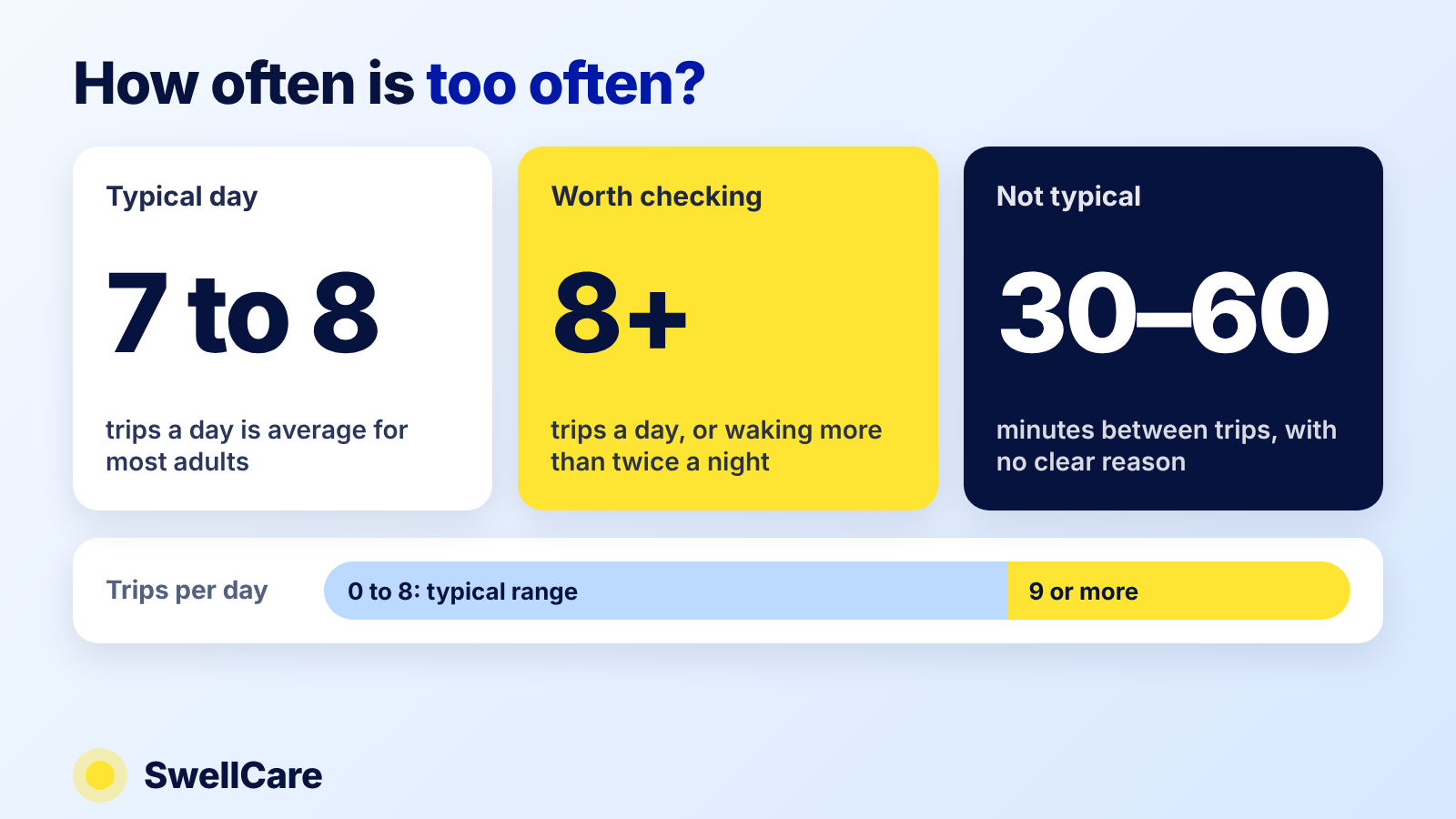
Most adults urinate about 7 to 8 times a day, according to Cleveland Clinic. You probably have frequent urination if you go more than 8 times a day, wake more than twice a night, or the number just bothers you. Needing to go every 30 to 60 minutes isn’t typical.
Doctors call this pattern urinary frequency. It’s a symptom, not a diagnosis, and your urinary system is telling you something.
Your own baseline matters most. A giant water bottle, two coffees and a water pill will push any bladder past 8. Age shifts the numbers too. One nighttime trip is common in your 40s and 50s, two in your 60s and 70s, and two or three after 80.
| Feature | Typical | Worth checking |
|---|---|---|
| Daytime trips | About 7 to 8 | More than 8 |
| Nighttime trips | 0 to 1 in midlife | More than 2 |
| Time between trips | A few hours | Every 30 to 60 minutes |
9 common reasons you’re urinating more often
Some of these come down to your drink order. Others need a clinician. Start with the everyday ones and work down.
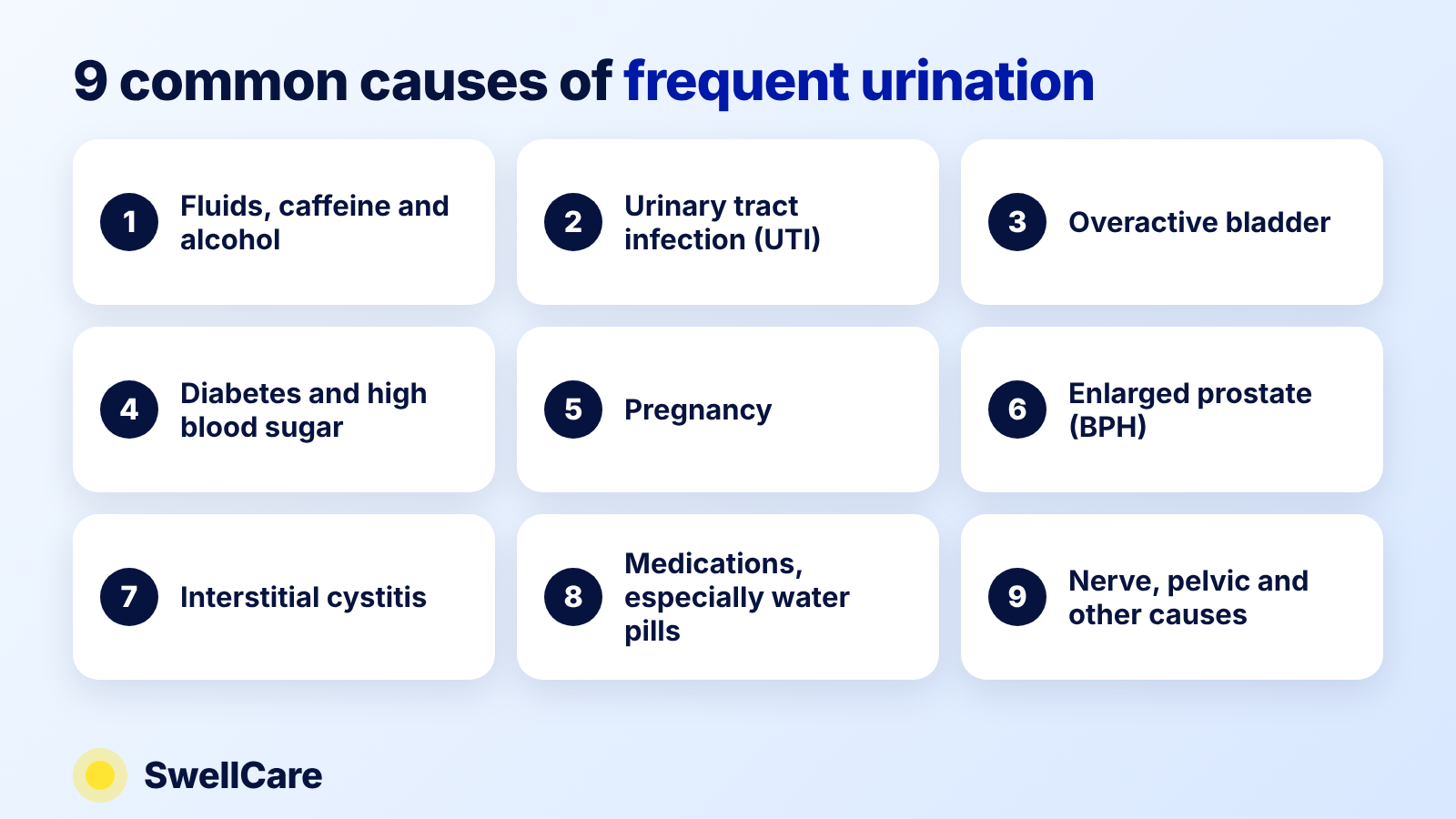
1. You’re drinking more (or drinking the wrong things)
Caffeine and alcohol both push your bladder to fill faster. So does simply taking in more than your body needs. If your trips jumped after a new coffee habit or a hydration kick, start here. Track your fluid intake for a few days and the pattern often jumps out. When you urinate right after a big drink, that’s just normal plumbing.
2. A urinary tract infection (UTI)
A urinary tract infection is the most common cause of frequent urination. Bacteria creep in through the urethra and irritate the lining of your bladder, so you feel constant urgency even when only a little urine comes out. Burning, cloudy or bloody urine and a strong smell are the usual giveaways, according to NIDDK. Antibiotics are the standard treatment. Left alone, a UTI can climb to your kidneys.
3. Overactive bladder
Overactive bladder (OAB) is a classic reason for frequent urination. It brings sudden urgency that’s hard to ignore, and sometimes urinary incontinence. It’s common. A 2003 study in the World Journal of Urology put the rate near 16 percent for both men and women. Pelvic floor physical therapy and bladder training can calm it down, and Kegels help some people, but get guidance first.
4. Diabetes and high blood sugar
When glucose runs high, your kidneys work overtime and make extra urine to flush it out. About 40.1 million Americans have diabetes, and roughly 27.6 percent of them don’t know it, the CDC estimates. Frequent urination plus unusual thirst, hunger, fatigue or weight loss is a combination worth testing for.
5. Pregnancy
Early in pregnancy, hormones raise urine output. Later, the growing uterus presses on the bladder. That’s why the first and third trimesters tend to be the busiest, and the second trimester usually brings a break. It’s normal. Burning or pain, though, deserves a urine test, because the two can overlap.
6. An enlarged prostate
An enlarged prostate, called benign prostatic hyperplasia (BPH), squeezes the urethra and keeps the bladder from emptying well. NIDDK reports that about 5 to 6 percent of men aged 40 to 64 have BPH, and around 29 to 33 percent of men 65 and older. Look for a weak stream, dribbling and frequent urination at night. A urologist can sort out the options. Can’t pass urine at all? That’s an emergency.
7. Interstitial cystitis
Interstitial cystitis, also called bladder pain syndrome, is a long-running condition with pressure and tenderness in the lower belly. Urgency can strike before the bladder is even full, and the pain often builds as it fills and eases afterward, per NIDDK. It flares and fades, which makes it easy to dismiss.
8. Medications, especially water pills
Diuretics are the obvious culprit, since they tell your kidneys to release more water. Cleveland Clinic also lists alpha-blockers, calcium channel blockers, lithium, SSRIs, tricyclic antidepressants and SGLT2 inhibitors, a class of drugs that flushes extra glucose out in your urine. Medications are an easy cause to overlook. Don’t stop a prescription on your own. Ask your prescriber whether an earlier dose time helps.
9. Nerve, pelvic and less common causes
Damaged nerves from a stroke or spinal cord injury can scramble bladder signals. Bladder stones, which a cystoscopy or scan can reveal, a pelvic organ prolapse such as a cystocele, a narrowed urethra and past pelvic radiation can all do it. So can anxiety. Diabetes insipidus is a rare hormone-related condition, unrelated to the usual kind of diabetes, that makes the kidneys produce huge amounts of watery urine. Bladder cancer is a rare cause, which is one reason a persistent change deserves a proper look.
Why do I wake up to pee so much at night?
Waking more than once or twice to urinate has a name: nocturia. The cause is often simple. Late drinks, an evening glass of wine or an afternoon coffee all show up around 2 a.m.
Other causes hide in the list above. Benign prostatic hyperplasia (BPH) and sleep apnea both raise nighttime trips, and so does high blood sugar. Rarely, diabetes insipidus is behind them. Nocturia also becomes more common as your bladder changes with age.
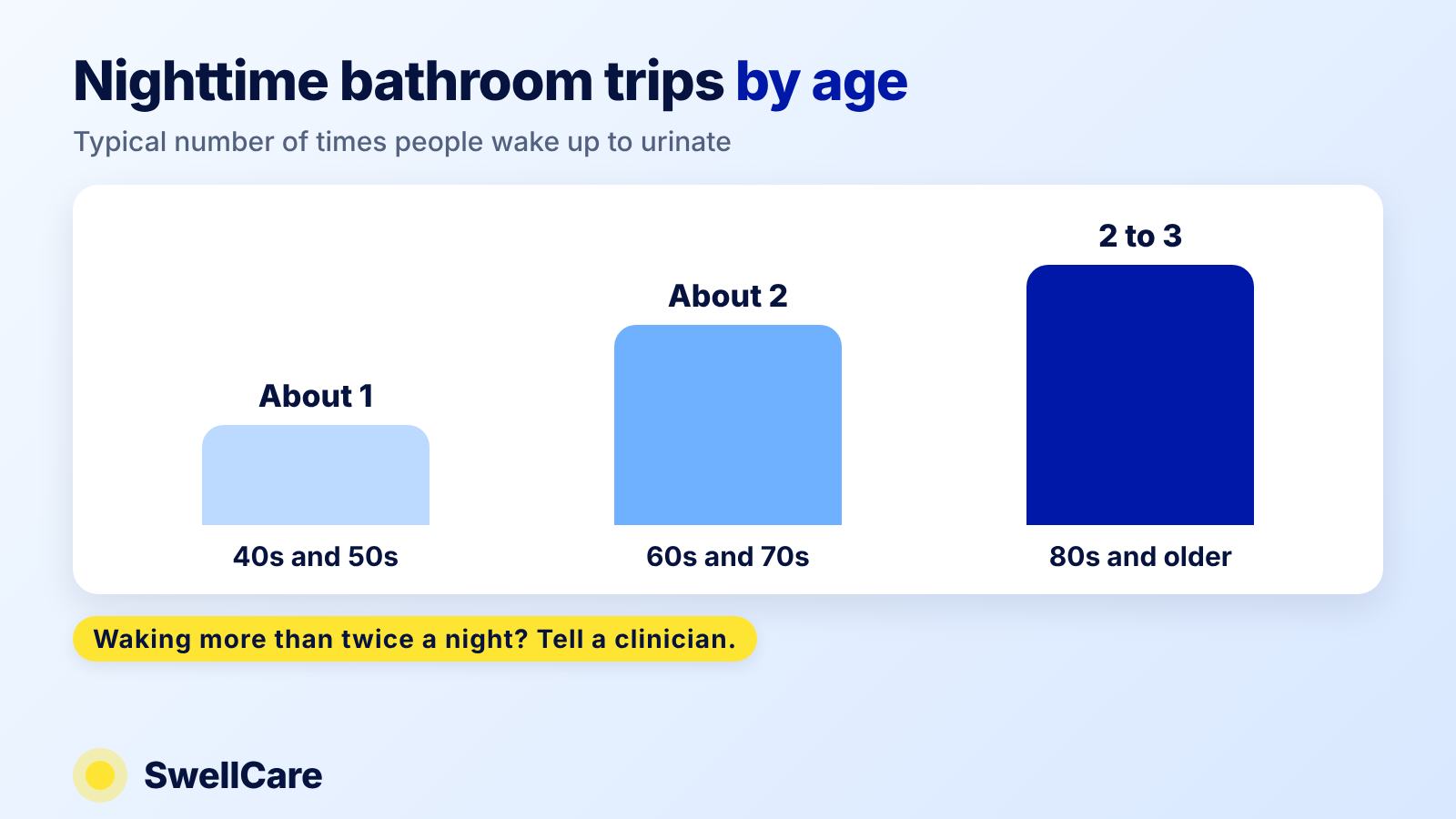
Try this first. Stop drinking fluids about two hours before bed, and trim alcohol and caffeine late in the day, as Cleveland Clinic advises. If frequent urination at night continues after that, tell a clinician. Nocturia deserves attention.
When to see a doctor about frequent urination
Make an appointment if there’s no clear reason, such as extra fluids or caffeine, or if the trips are wrecking your sleep or your day. Some signs shouldn’t wait, according to Mayo Clinic and MedlinePlus.
| Get care right away | Book a visit soon |
|---|---|
| Blood in the urine, or red or dark brown urine | No clear reason for the change |
| Fever, shaking chills, nausea or vomiting | Trips that disrupt sleep or daily life |
| Pain in your side, back, lower belly or groin | Other urinary symptoms that worry you |
| Trouble passing urine or emptying your bladder | Unusual thirst, hunger or fatigue |
Severe or sudden symptoms? Don’t wait. Go to an emergency room or call 911.
How to find the cause (and what helps in the meantime)
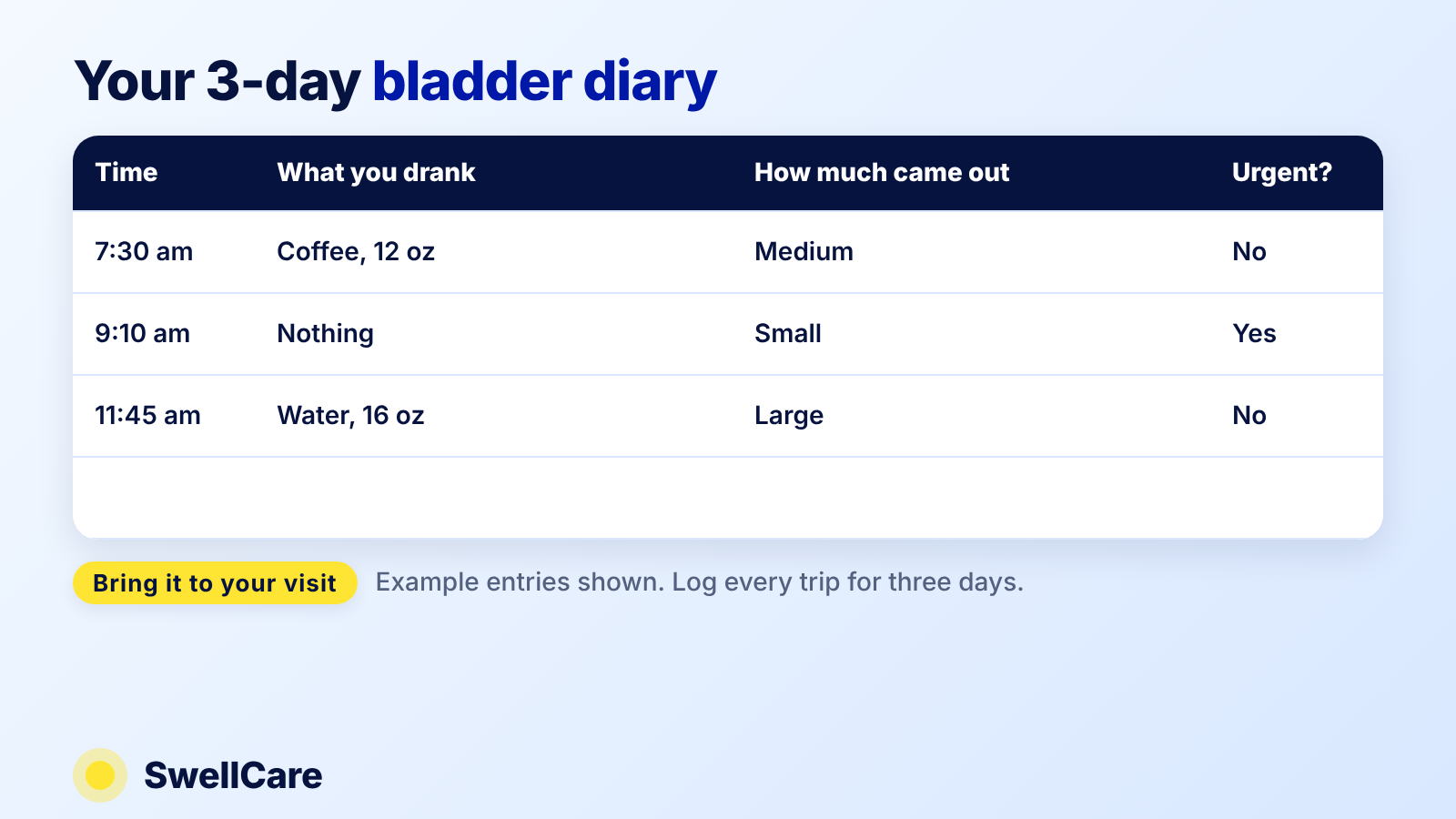
What causes frequent urination in your case? A free tool often answers it. Keep a bladder diary for three days. Write down what you drink, when you urinate, roughly how much comes out, and whether the urge felt sudden. Bring it to your visit. It often points to the answer faster than a stack of tests.
If a clinician needs more, the usual tests are a urinalysis, which checks for infection and can pick up glucose, an ultrasound or CT scan, and sometimes a cystoscopy, which uses a thin camera to look inside the bladder. A urologist handles the more complex cases.
Until you know, a few safe moves help. Front-load your fluid intake earlier in the day. Ease off caffeine. Try Kegels only if a provider recommends them. Treatment follows the cause: antibiotics for a UTI, tighter control for high glucose, bladder retraining for OAB.
Get a clinician to look at your symptoms
You don’t have to wait for the perfect moment. A licensed clinician at SwellCare reviews what you’re feeling, explains what can be handled online, and tells you what to do next. It’s a telehealth visit, so you can start from your couch. Tell us what’s going on, or see how a visit works. SwellCare isn’t for emergencies. For severe symptoms, call 911.
Questions people ask about frequent urination
What are the most common causes of frequent urination?
The most common causes of frequent urination are extra fluid, coffee or alcohol, a urinary tract infection, OAB, diabetes, pregnancy and prostate problems. Certain medications, especially diuretics, also raise urine output. A short symptom diary usually narrows down which one fits you.
Is it normal to pee every 30 minutes?
Not usually. Going every 30 to 60 minutes is more often than most people need to, unless you’ve just had a lot to drink. If it keeps happening without an obvious reason, or comes with burning, pain or fever, get it checked. An infection or another treatable problem is possible.
How do you fix frequent urination?
You fix it by treating the cause. An infection needs antibiotics, high blood sugar needs better control, and OAB may respond to bladder training or pelvic floor therapy. Meanwhile, cut back on coffee and alcohol and stop fluids about two hours before bed.
What can I drink to stop frequent urination?
No drink stops it. Water is still the best choice. Cutting out coffee, alcohol and fizzy drinks helps, and spreading fluids across the day beats chugging all at once. Don’t cut fluids drastically, though. Drinking too little can leave urine concentrated and irritate the bladder.
Can anxiety cause frequent urination?
Yes, it can. MedlinePlus lists anxiety among the less common causes, and stress can make the bladder feel more urgent. Still, rule out an infection, high blood sugar and other physical causes first, especially if you have burning, thirst or pain.
Trusted references
Public-health, research, and medical-society resources related to this guide.
- Cleveland Clinic: Frequent Urination ↗
- NIDDK: Bladder Infection (UTI) in Adults ↗
- PubMed: Overactive Bladder Prevalence Study (World Journal of Urology, 2003) ↗
- CDC: Diabetes Data and Research ↗
- NIDDK: Enlarged Prostate (BPH) ↗
- NIDDK: Interstitial Cystitis (Bladder Pain Syndrome) Symptoms and Causes ↗
- Mayo Clinic: Frequent Urination Causes ↗
- MedlinePlus: Frequent or Urgent Urination ↗