It’s 9 p.m., your doctor’s office closed at five, and your daughter’s ear has hurt for two hours. You don’t need an ambulance, but you don’t want to wait until Monday either. That gap is exactly what urgent care is for.
So, what is urgent care? It’s walk-in or same-day medical care for illnesses and injuries that need attention soon but aren’t life-threatening. This guide explains what it covers, how it differs from your regular doctor and the ER, what to expect, and where virtual urgent care fits.
What is urgent care?
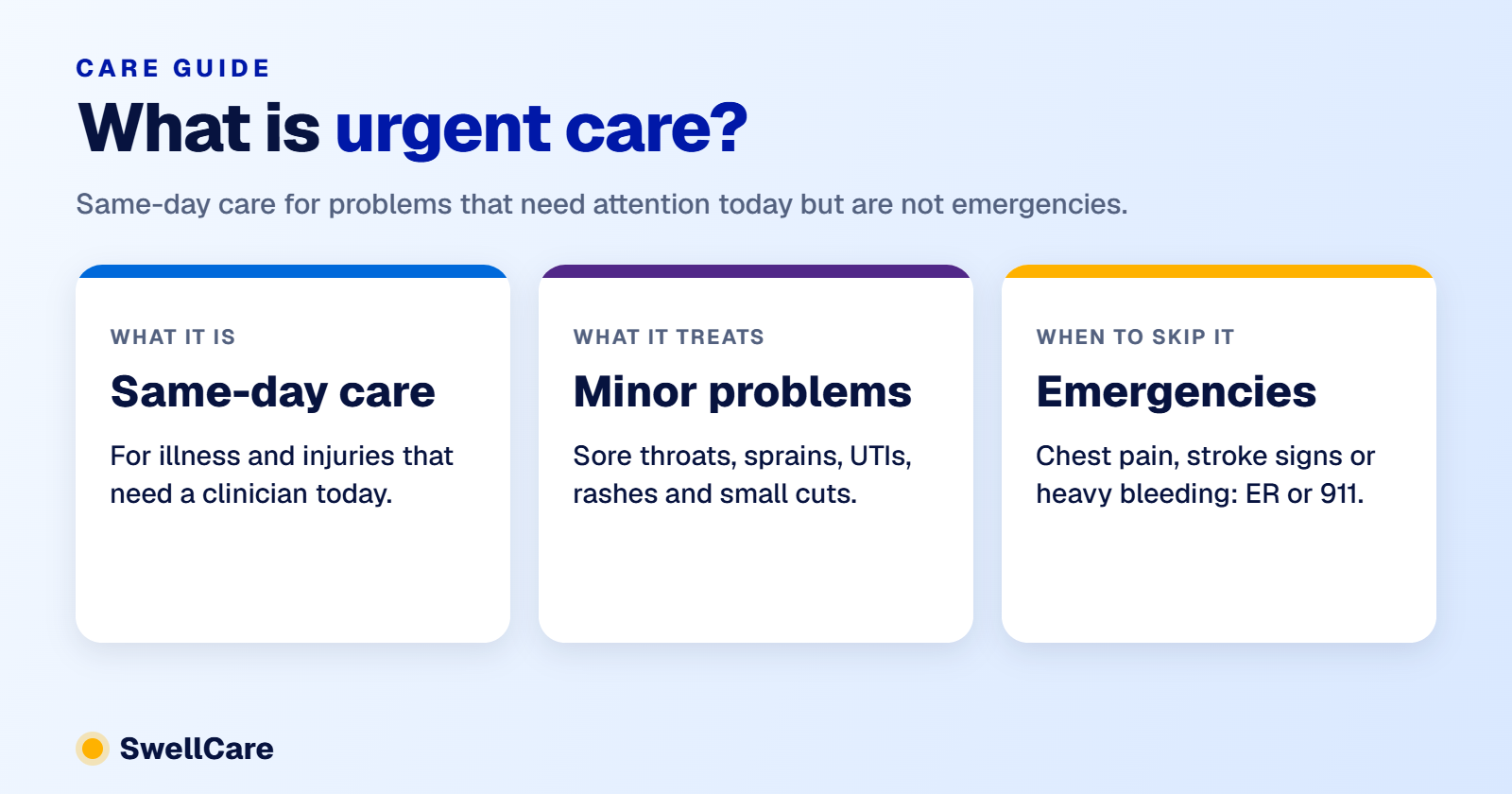
Urgent care sits between your primary care provider and the hospital. It’s built for problems that can’t wait for a regular appointment but don’t threaten your life or a limb. Most urgent care centers take walk-ins, keep evening and weekend hours, and can run basic tests on site.
Think of it as the middle rung. Primary care handles checkups and long-running conditions. The emergency room handles true emergencies. Urgent care handles the “I need someone to look at this today” problems in between.
What urgent care can treat
Urgent care covers a wide range of everyday problems:
- Colds, flu, fever, sore throat and cough
- Ear pain, sinus pressure and urinary tract infections
- Sprains, strains and some minor fractures that need an X-ray
- Small cuts that may need stitches but have stopped bleeding
- Rashes, insect bites and mild allergic reactions
- Vomiting or diarrhea when you can still keep fluids down
What these share: they’re uncomfortable, they won’t fix themselves by Friday, and none of them threatens your life in the next hour. If symptoms stay mild and you can walk, talk and think clearly, urgent care can usually sort it out.
What urgent care can’t treat
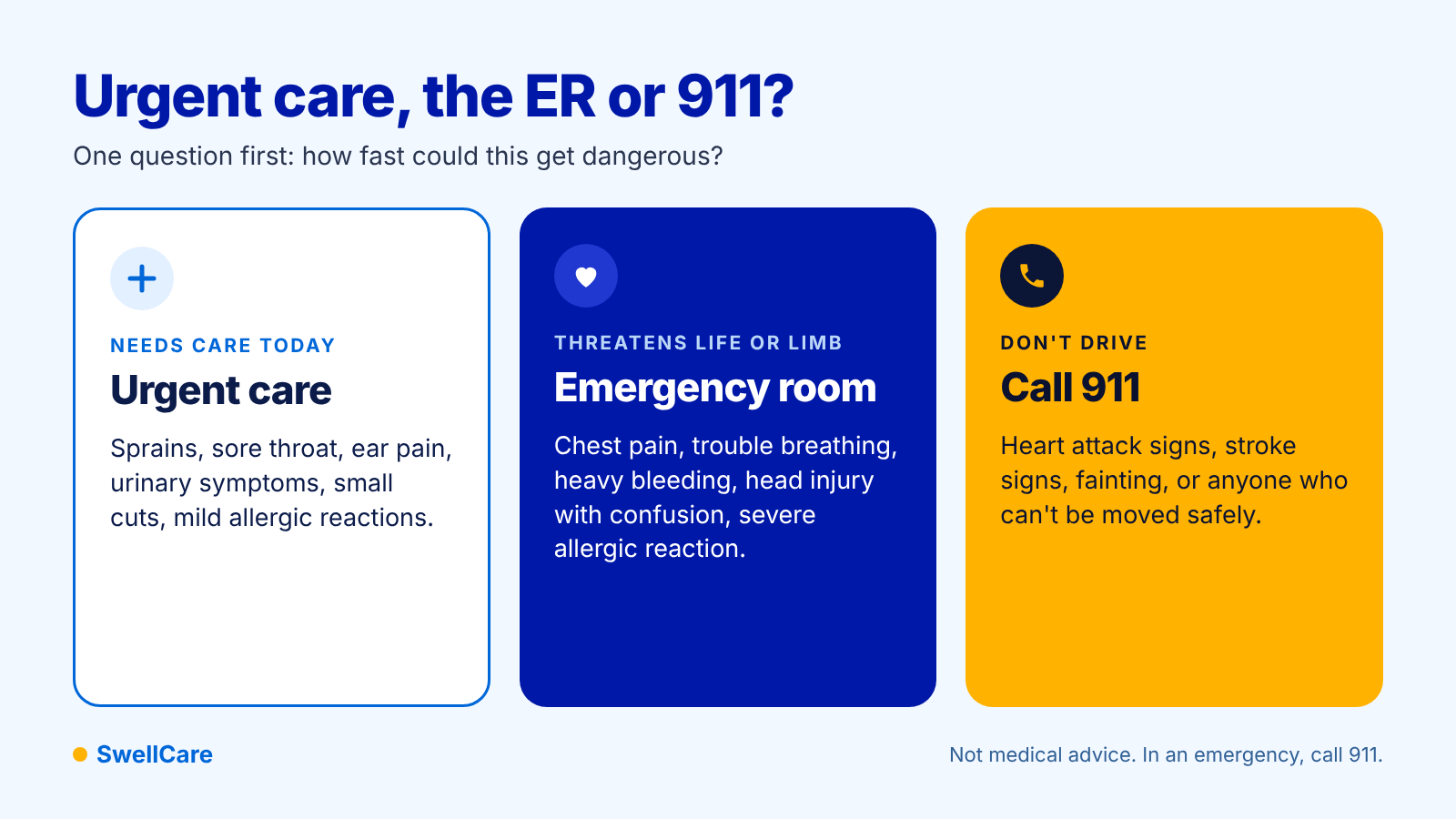
Urgent care isn’t equipped for emergencies. Go to the emergency room, or call 911, for chest pain or pressure, trouble breathing, signs of a stroke, bleeding that won’t stop after ten minutes of firm pressure, a head injury with confusion or vomiting, swelling of the face or throat, seizures, a bone through the skin, severe burns or poisoning.
Call 911 rather than driving if you might pass out or the symptoms are severe. The CDC lists chest pressure, discomfort in the jaw, neck, back or arms, and trouble catching your breath among the signs of a heart attack. Don’t wait to see if it passes.
Worried about the bill? Federal law (EMTALA) requires hospital emergency departments to screen you and offer treatment to stabilize an emergency condition, whatever your insurance or ability to pay, and CMS explains your rights in plain terms. If you’re having thoughts of harming yourself, call or text 988 any time.
Urgent care vs the ER at a glance
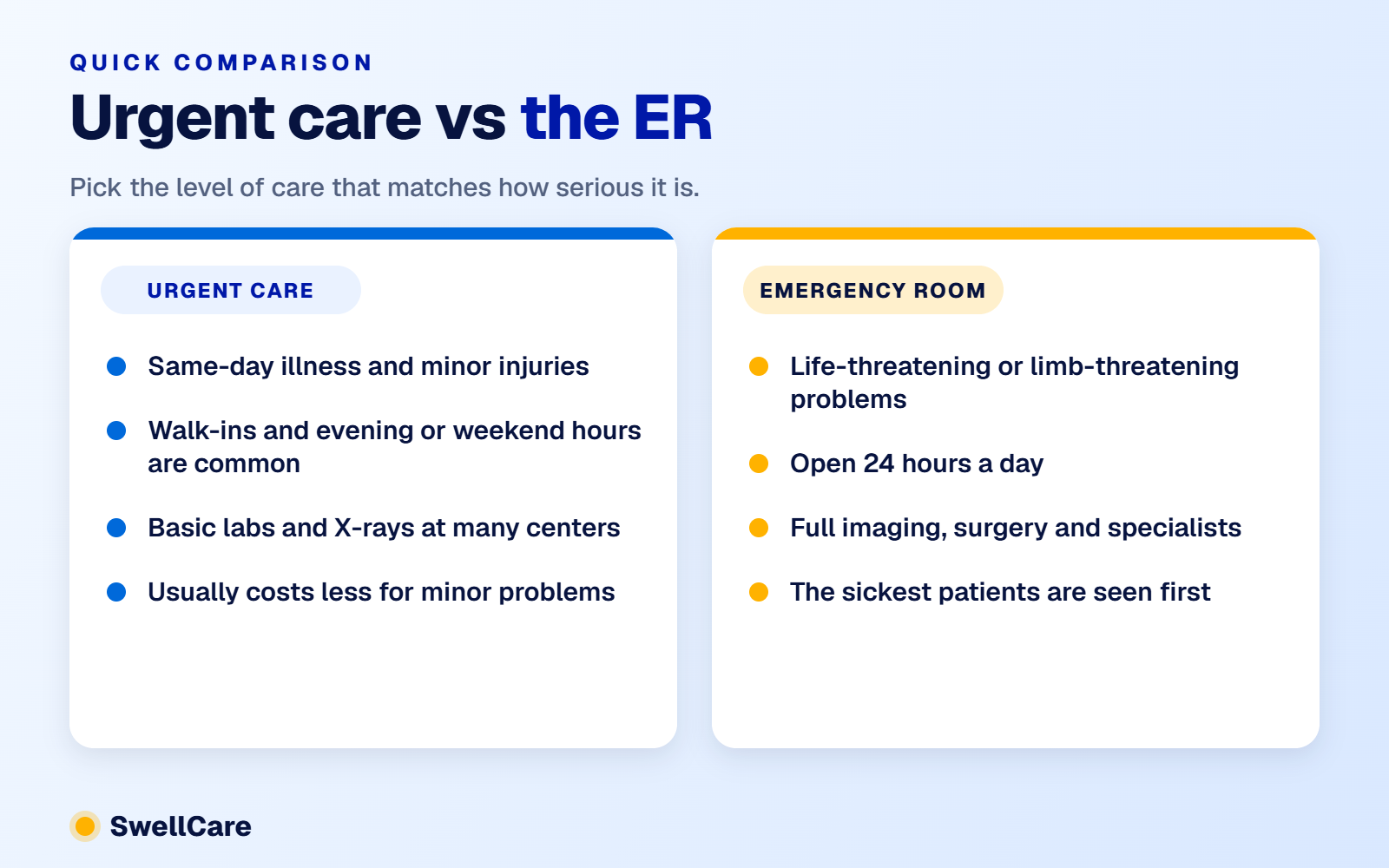
| Urgent care | Emergency room | |
|---|---|---|
| Best for | Same-day illness and minor injuries | Life-threatening problems |
| Appointment | Often walk-in | Never needed |
| Hours | Evenings and weekends common | Open 24/7 |
| Tests on site | Basic labs and X-rays at many centers | Full imaging, surgery, specialists |
| Cost | Usually lower than the ER | Usually highest |
Want the full side-by-side on symptoms? Our guide on when to go to urgent care vs the ER walks through it.
What does urgent care cost?
Cost depends on your insurance plan, the center and what you need done. In general, urgent care costs less than an ER visit for the same minor problem, but more than a routine primary care visit. Before you go, check your plan’s copay for urgent care, and ask whether the center is in your network. If it’s a true emergency, price shouldn’t decide where you go.
What to expect at a visit
The process is simple:
- You check in, often online or at the front desk, and share your symptoms and insurance.
- A nurse or medical assistant checks your vitals, such as temperature and blood pressure.
- A clinician examines you and may order a quick test, like a strep swab, urine test or X-ray.
- You get a diagnosis, a treatment plan and, if it fits, a prescription sent to your pharmacy.
- You get follow-up advice, including what to watch for and when to see your regular doctor.
Wait times vary by day and hour, so a quick call or a look at the center’s website can save a long sit in the lobby.
Kids, babies and older adults
The lines move with age. For a baby under three months, a rectal temperature of 100.4°F or higher needs emergency care right away. For older babies and kids, a fever with trouble breathing, extreme sleepiness, refusing to eat, a seizure, or no wet diaper in six hours points to the ER. A fever on its own in a child who’s still playing and drinking can often wait for the pediatrician or a same-day visit.
Older adults can have quieter symptoms. A fall with a bump to the head, or sudden confusion or weakness, deserves emergency care.
Where virtual urgent care fits
Virtual urgent care is urgent care by phone, chat or video. For flu symptoms, a sore throat, a rash, urinary symptoms or a stubborn cough, it can save you the drive, the waiting room and the exposure to whatever everyone else brought in.
The limits are real. A screen can’t X-ray your wrist or stitch a cut. If your symptoms need a hands-on exam, a good clinician will say so and point you to in-person care.
Not sure? Use this 60-second test
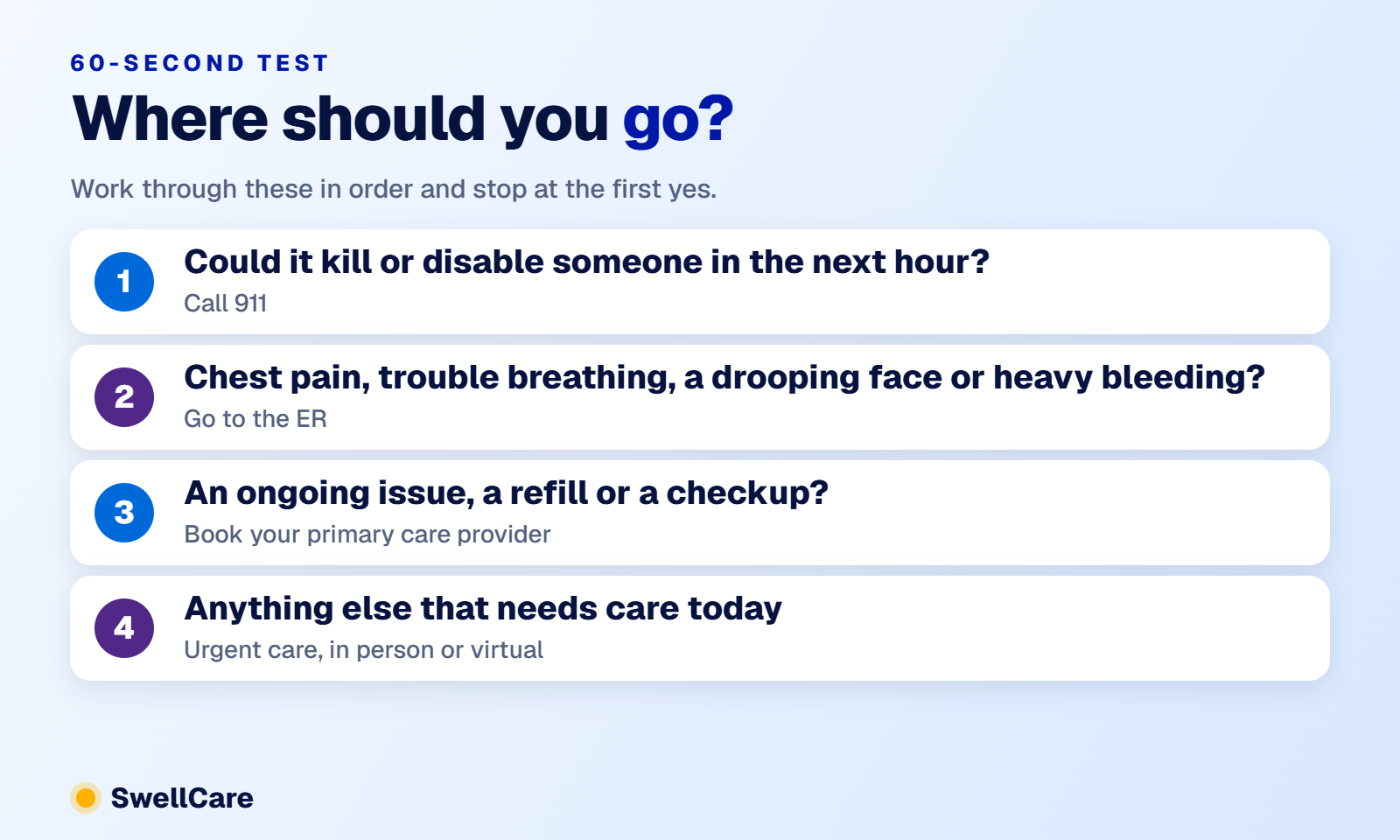
Run through these in order and stop at the first yes. Could this kill or disable someone in the next hour? Call 911. Is there chest pain, trouble breathing, a drooping face, heavy bleeding, fainting or new confusion? Go to the ER. Is it an ongoing problem, a refill or a checkup? Book your primary care provider. Otherwise, it’s probably urgent care. And if you’re torn between two levels, pick the higher one. A wasted copay is cheaper than a missed emergency.
Get urgent care from home with SwellCare
SwellCare offers clinician-led, non-emergency online urgent care around the clock by video or chat. See the conditions we treat and how a visit works. A clinician reviews your symptoms, tells you what’s likely going on, and says whether you need in-person care. Prescriptions are never guaranteed. If anything above matches the ER or 911 lists, don’t start an online visit. Get emergency help now. Otherwise, you can start your care from wherever you are.
Questions people ask about urgent care
Do I need an appointment for urgent care?
Usually not. Most centers take walk-ins, and many let you check in online to hold a place in line. Wait times swing by day and hour, so a quick call can help.
Is urgent care open 24 hours?
Most in-person centers keep extended evening and weekend hours, but many aren’t open around the clock, so check your local center. Virtual urgent care can be available at any hour.
Can urgent care prescribe medication?
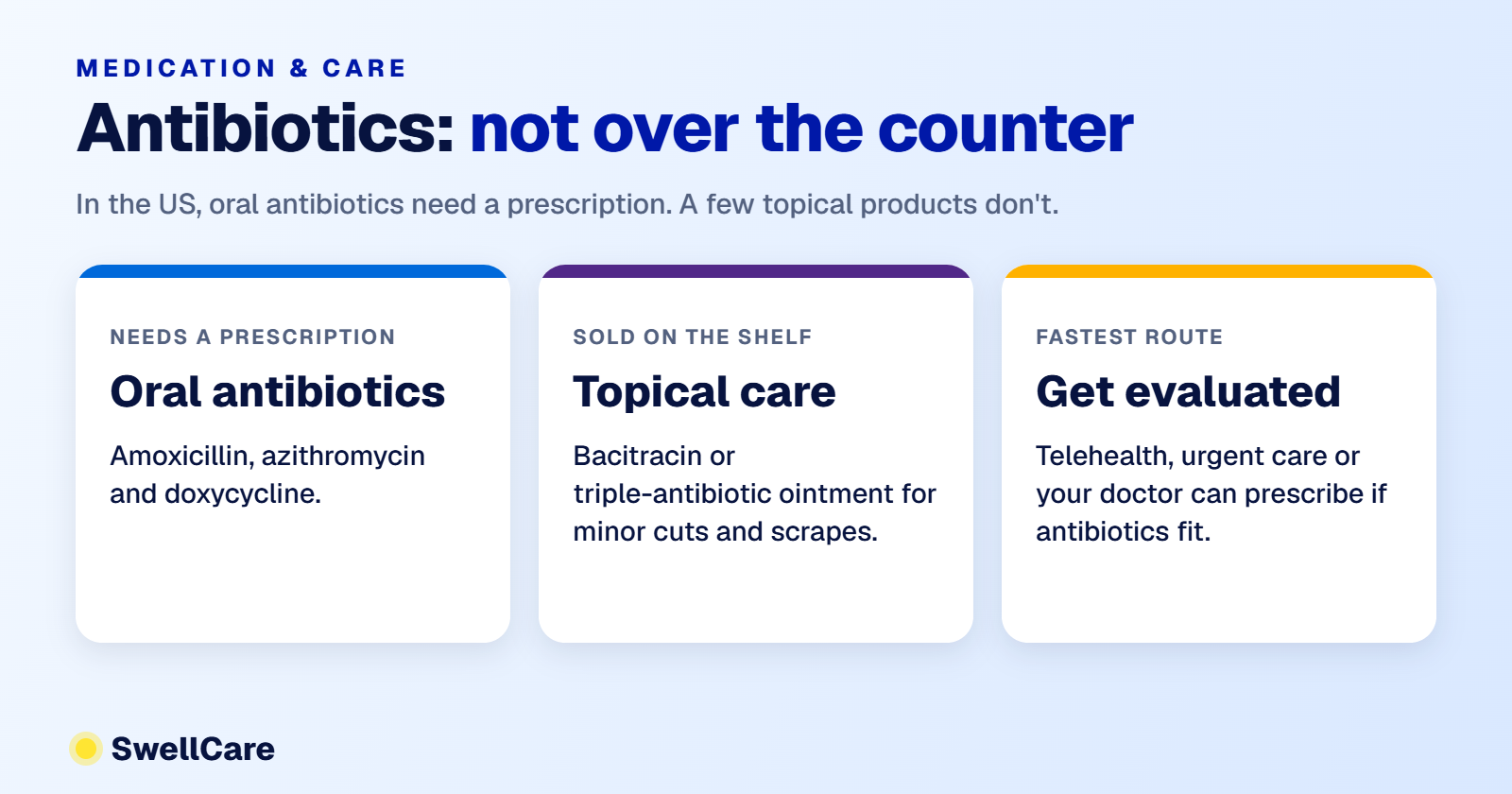
Often, yes, when it fits your diagnosis, such as an antibiotic for a confirmed bacterial infection. Many illnesses are viral and don’t need antibiotics, so a prescription isn’t automatic.
Can urgent care do X-rays?
Many can, and can splint a suspected fracture or treat a sprain. Not every location has X-ray on site, so call ahead. Complex breaks, bones through the skin or major trauma belong in the ER.
Is urgent care the same as the ER?
No. Urgent care treats minor illnesses and injuries that need same-day care. The ER handles life-threatening emergencies and has full imaging, surgery and specialists. If you’re unsure, choose the higher level of care.
Trusted references
Public-health, research, and medical-society resources related to this guide.