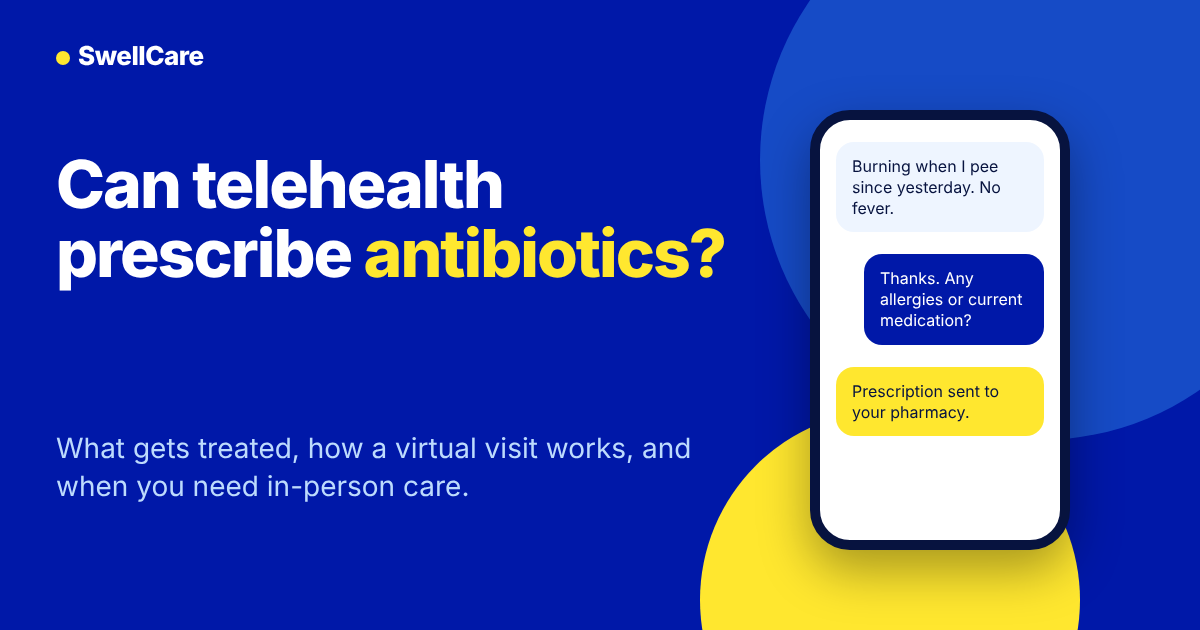
It’s 9 p.m. Your throat feels like swallowed glass, or every trip to the bathroom burns, and the clinic down the road closed hours ago. So you wonder: can telehealth prescribe antibiotics, or are you stuck waiting until morning?
Often, yes. A licensed telehealth provider can prescribe antibiotics for many common bacterial infections after a proper virtual evaluation. The word that matters is “appropriate.” Antibiotics only work on bacteria, and a good clinician won’t hand them out just because you asked. Treatment should match the cause. Here’s how it really works, what gets treated, and when you need to be seen in person. Most telehealth providers will prescribe only after they’ve weighed your risks, and the best ones explain their reasoning.
Yes, telehealth providers can prescribe antibiotics
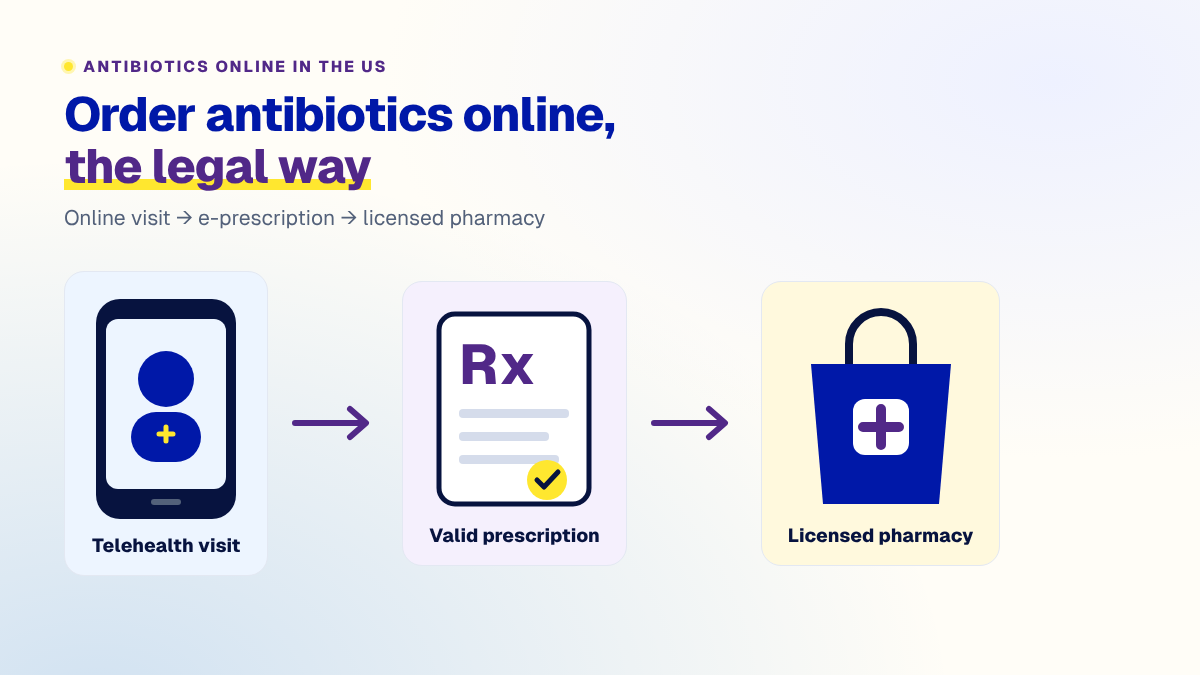
Federal and state rules let licensed clinicians prescribe most non-controlled medications, antibiotics included, after a real-time or store-and-forward evaluation. Your telehealth provider reviews your symptoms and medical history, decides whether a bacterial infection is likely. If it is, treatment can begin right away, and sends an electronic prescription to the pharmacy you pick.
That’s the same legal footing as a prescription written in a clinic. The difference is the setting, not the standard of care.
Think of it as a three-part test. Is the illness likely bacterial? Is the risk low? Can the diagnosis be confirmed without a hands-on exam? When all three answers are yes, antibiotics are a reasonable treatment, and the prescription can reach your pharmacy within the hour. When one answer is no, telehealth providers change course. That might mean testing, a different treatment, or a trip to see someone in person. Good telehealth providers document that reasoning, and the best telehealth providers share it with you.
Virtual care has limits, though. Your provider can’t listen to your lungs or press on your belly. So the treatment decision rests on what you describe, what they can see on video, and whatever testing you can complete nearby. When that picture is clear, treatment can start the same day. When it isn’t, a good provider will tell you so and point you to in-person care.
Which infections can telehealth treat with antibiotics?
Telehealth works best for bacterial infections that are common, follow a recognizable pattern, and rarely turn dangerous when caught early.
| Usually workable by telehealth | Usually needs in-person care |
|---|---|
| Uncomplicated UTI in otherwise healthy adults | Severe back or flank pain with chills |
| Strep throat (with a confirming test when possible) | Trouble breathing or chest pain |
| Bacterial sinusitis after symptoms linger | Deep, spreading, or very painful skin infection |
| Mild skin problems such as small impetigo patches | Infection during pregnancy with complications |
| Some ear infections and pinkeye | Symptoms that return again and again |
Urinary tract infections
A UTI is the classic telehealth case. Burning, urgency and frequent trips with little output point strongly to a bladder problem, and every provider has a well-worn playbook for it. The diagnosis often rests on symptoms alone, with a urine test as backup. The Mayo Clinic notes that a urine test and culture can identify the bacteria, and common first choices include nitrofurantoin or trimethoprim-sulfamethoxazole. Fluoroquinolones are generally avoided for simple cases.
Chills or pain in your back suggest the kidneys are involved. Don’t wait on an app for that one.
Strep throat and sinus infections
Most sore throats are viral. The CDC says a quick test is needed to confirm strep, since cough, runny nose and hoarseness usually mean a virus instead. Many telehealth providers will order a rapid strep test at a nearby lab before they prescribe anything. The testing takes minutes, and it spares you a course of medication you don’t need.
A sinus infection is trickier. Most clear up without antibiotics, since viruses cause the majority of them. A provider typically considers antibiotic treatment when symptoms drag on for more than about ten days, or when they worsen after starting to improve.
Skin infections
A small, localized skin infection can often be judged from a clear photo or live video, and a short course of antibiotics may follow. Anything hot, spreading, or paired with fever needs hands-on care.
When an antibiotic is the wrong answer
Here’s what most “telehealth antibiotics” pages skip: saying no is part of the job.
Colds, flu, most bronchitis and most sore throats are viral, and antibiotics do nothing against them. Treatment for a viral infection is mostly rest, fluids and symptom relief, and your provider should say so plainly. The CDC lists rash, diarrhea, severe allergic reactions and C. diff among the harms, and it warns that any use of these drugs can feed antibiotic resistance, which makes future bacterial infections harder to treat. A CDC study published in JAMA found that at least 30% of antibiotics prescribed in offices and emergency departments were unnecessary.
Virtual treatment isn’t automatically worse here, and it isn’t automatically better. A JAMA Network Open analysis of virtual respiratory visits for children found that telemedicine from a primary care practice led to fewer antibiotic fills than direct-to-consumer telehealth (28.9% vs 37.2%). The researchers’ takeaway: who provides the treatment, and whether they know you, may matter more than the screen. Your regular primary care office may offer a virtual option worth trying first.
So pick a provider who’s comfortable saying “you don’t need these.” That’s good medicine, not a failed visit. A solid diagnosis beats a fast prescription every time, and sound testing beats a hunch.
How a virtual visit for an infection works
Most virtual visits follow the same arc, whether by chat or video.
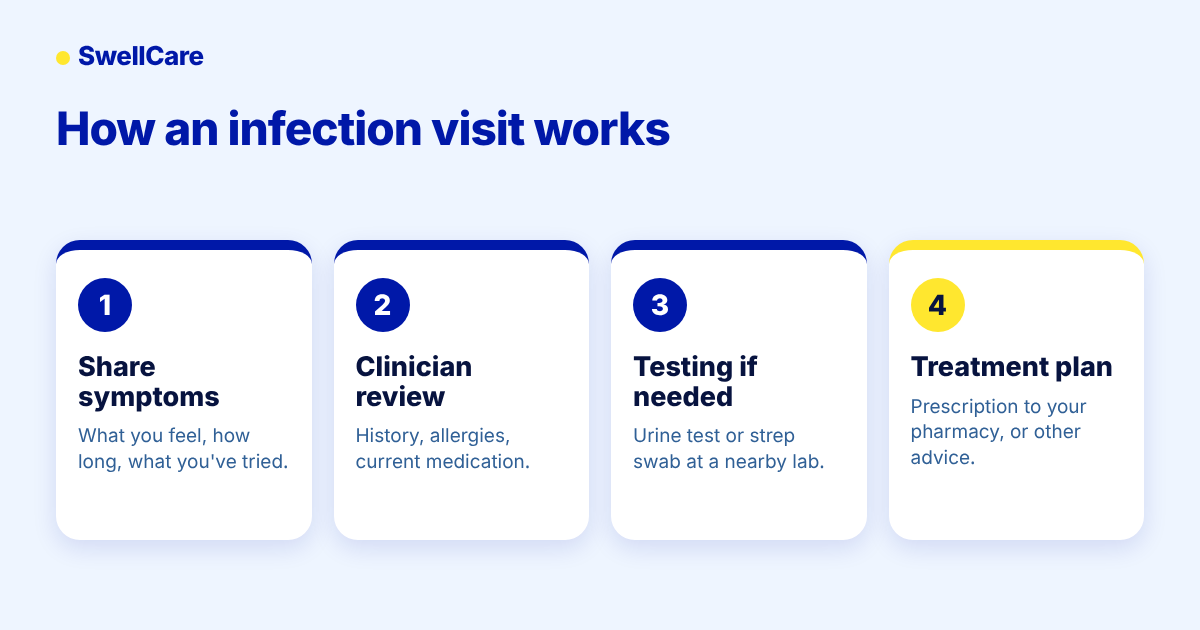
- You describe what’s going on. Your symptoms, how long they’ve lasted, and what you’ve tried so far.
- The provider reviews your medical history. Allergies, current medication, pregnancy, kidney disease and any recent antibiotics all matter here.
- Testing happens if it’s needed. Think a urine test for a suspected UTI, or a swab for strep.
- You get a treatment plan. It might be a prescription sent to your pharmacy, advice for a viral illness, or a referral to urgent care.
Testing is where telehealth has quietly improved. A rapid strep swab or a urine sample from a nearby lab gives your provider hard data instead of a guess. Results often come back the same day, and smart testing keeps antibiotics for the people who actually need them. It also guards against antibiotic resistance.
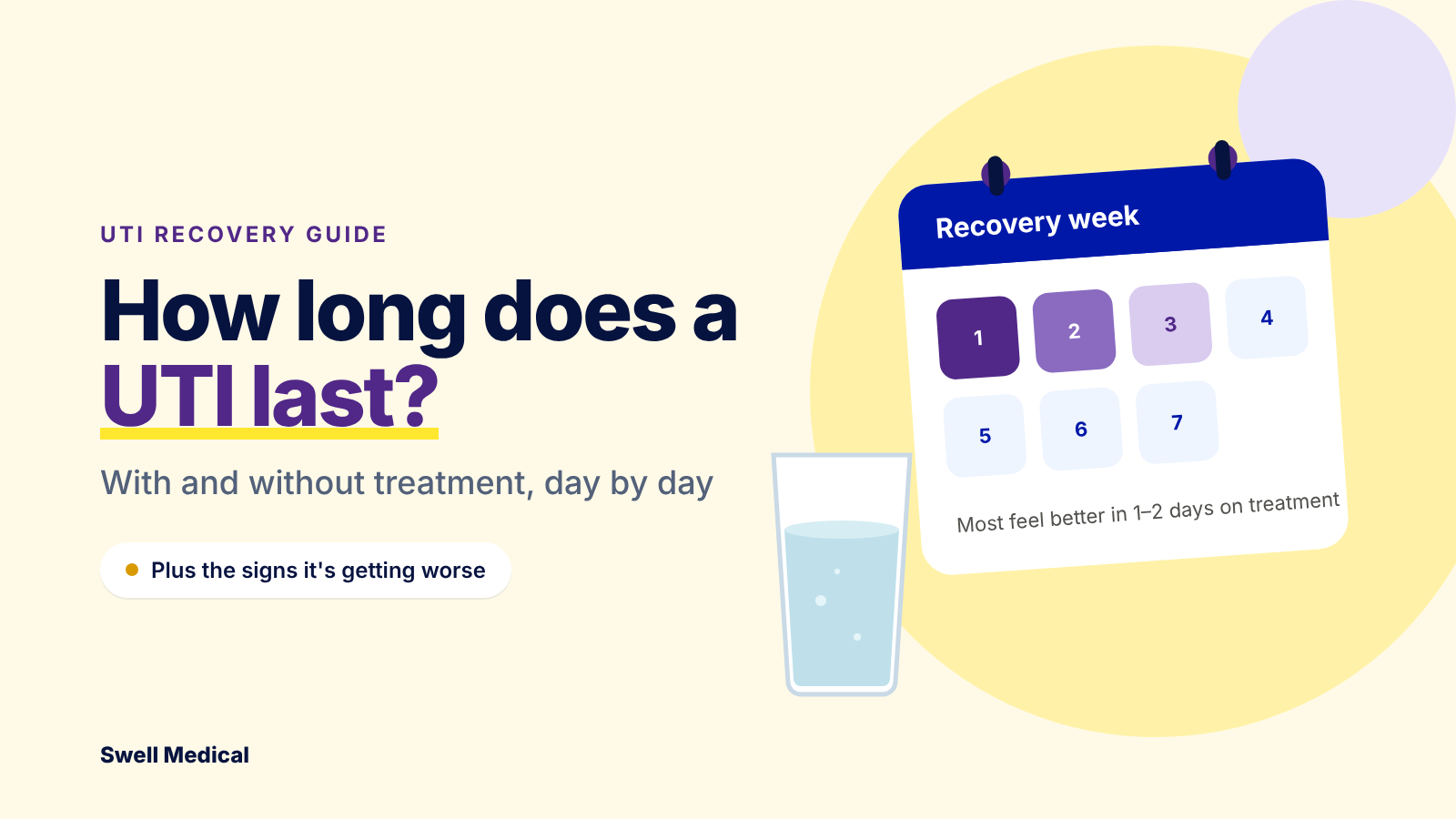
Expect follow-up too. Your provider should tell you what improvement looks like, how many days to give the medication before worrying, and when to check back in. Most bacterial illnesses start easing within a couple of days of starting treatment. If you aren’t improving, a follow-up message to your provider is better than waiting it out.
When you need in-person care instead
Telehealth is a front door for treatment, not a replacement for every exam, and no virtual treatment plan should override a gut feeling that something is seriously wrong. Go to urgent care or an emergency room if you have:
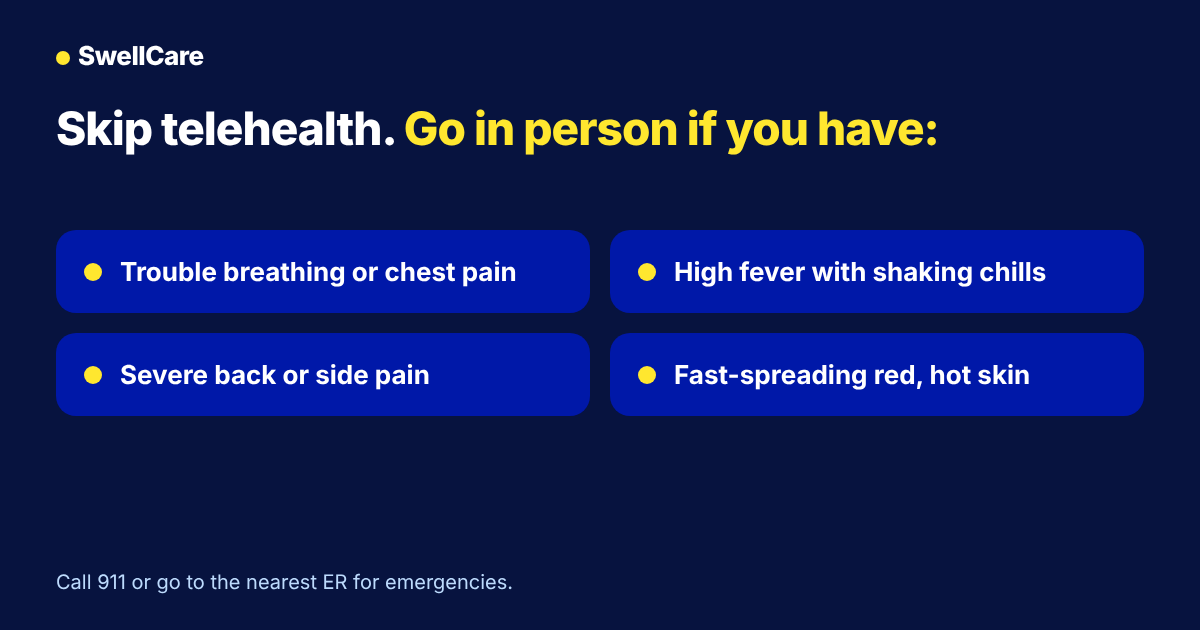
- Trouble breathing, chest pain, or confusion that comes on suddenly
- A fever that won’t come down, with shaking chills
- Severe pain in your side or back
- Red, hot, swollen skin that’s spreading fast
- Signs of dehydration, like dizziness or very little urine
Your primary care clinician is the right call for illness that keeps coming back or doesn’t respond to the first round of treatment. Recurring problems deserve a deeper look, and a hands-on exam may turn up something telehealth can’t see.
What about state rules and controlled substances?
State law sets who can prescribe and whether a clinician needs to be licensed where you are during the visit. That’s why reputable services match you with a provider licensed in your state.
Antibiotics aren’t controlled substances, so they sit outside the stricter federal rules. Those rules do affect other drugs. DEA and HHS extended telemedicine prescribing flexibilities for Schedule II to V medications through December 31, 2026, while permanent rules are finished. None of that changes how antibiotics are prescribed.
How to get the most from your telehealth visit
A little preparation speeds things up.
Have a list of your current medication and allergies ready, with doses if you know them, plus any past reactions to antibiotics. Note when symptoms started, your temperature if you have a thermometer, and whether anything makes it better or worse. Pick a pharmacy in advance, ask which medication they have in stock, and check that it’s open when you expect your prescription. For a suspected UTI, ask whether you can drop off a urine sample.
And be honest if you took leftover antibiotics last month. It changes the diagnosis. Never save medication for next time; the wrong drug for the wrong bug is how resistance grows.
Get care now with SwellCare
At SwellCare, you can start with a free screening chat, then book a chat or video consultation with a clinician, 24/7, in all 50 states and DC. A completed consultation is $45, cash-pay, with no membership. Medication and lab costs are billed separately.
We’re blunt about what virtual care can’t do. If your symptoms point to something a screen can’t safely handle, we’ll say so and send you where you need to go. Our clinician decides on treatment case by case, and we’ll arrange follow-up when it makes sense, and a prescription is never promised up front. Browse the conditions we treat, see how it works, or start urgent care now.
Questions people ask about telehealth and antibiotics
Can a telehealth doctor prescribe antibiotics without an in-person visit?
Yes, for many bacterial infections. A licensed provider can evaluate you by chat or video, review your medical history, and send a prescription to your pharmacy. Telehealth providers handle this every day. Some infections need testing or an in-person exam first, and your provider will tell you which.
Can telehealth prescribe antibiotics for a UTI?
Often. An uncomplicated UTI in a healthy adult is one of the most common reasons people use telehealth. If you have fever, back pain, are pregnant, or get frequent infections, expect to be sent for a urine test or an in-person exam.
Can telehealth prescribe antibiotics for strep throat or a sinus infection?
For strep, usually after a confirming rapid test. For a sinus infection, only if your symptoms and timeline suggest bacteria. Many sinus infections are viral and resolve without antibiotics.
Does telehealth guarantee I’ll get a prescription?
No. The provider decides based on your symptoms and history. If you have a viral illness, you’ll get supportive advice instead.
Can I request a specific antibiotic?
You can mention what has worked before, but the provider chooses based on the likely bacteria, your allergies, and current guidelines.
Trusted references
Public-health, research, and medical-society resources related to this guide.
- Mayo Clinic: Urinary Tract Infection, Diagnosis and Treatment ↗
- CDC: About Strep Throat ↗
- Healthcare Packaging: CDC, One in Three Antibiotic Scripts Not Necessary ↗
- CIDRAP: Direct-to-Consumer Telemedicine Tied to More Antibiotic Prescribing ↗
- Becker’s Hospital Review: DEA Extends Telemedicine Prescribing Flexibilities Through 2026 ↗