Your throat feels like swallowing glass, a swab came back positive, and one question beats all the others: when can life get back to normal?
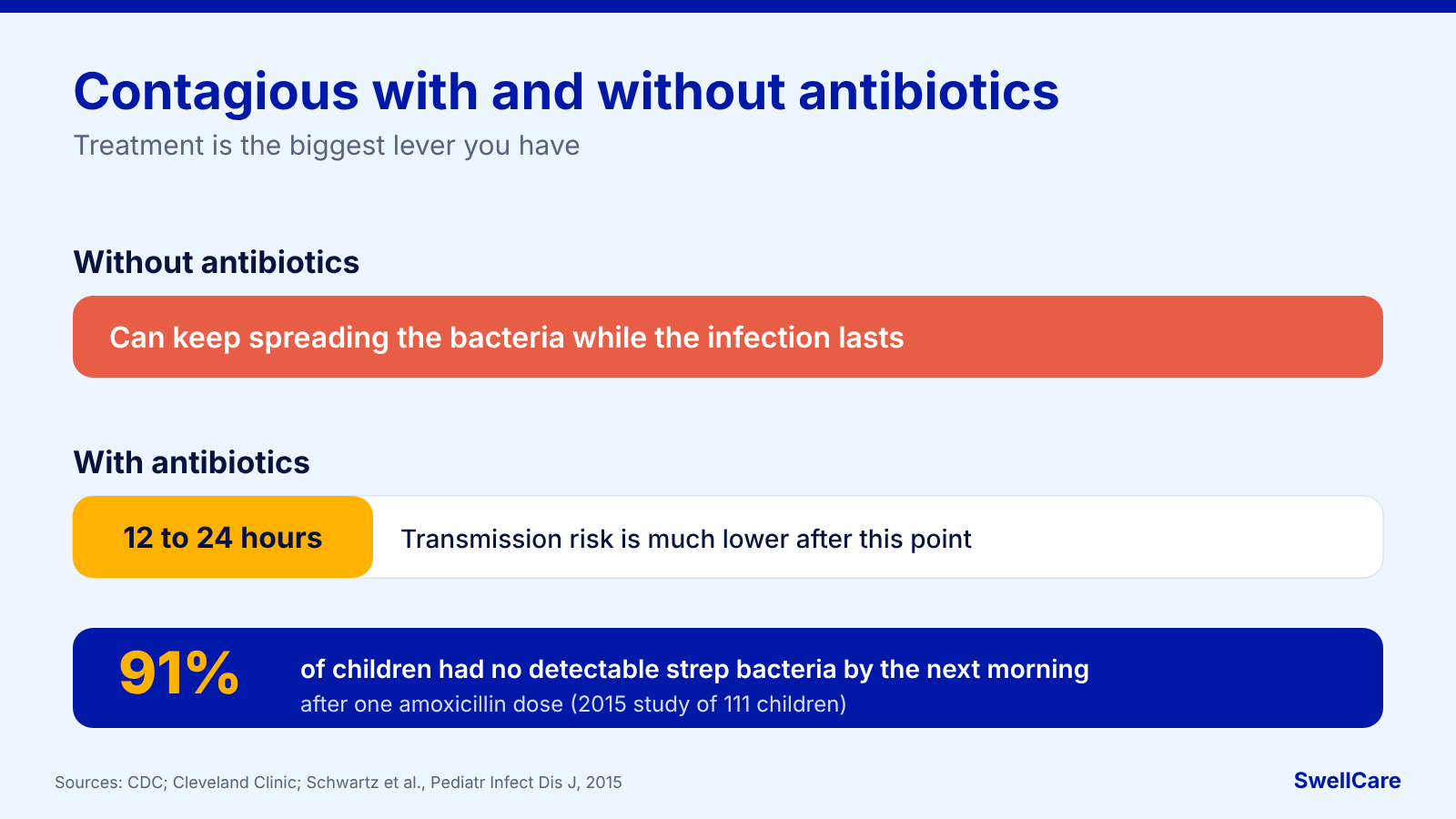
Here’s the blunt answer to how long is strep throat contagious. Without treatment, you can keep passing the bacteria on for as long as the infection lasts. With the right antibiotics, the risk falls sharply after about 12 to 24 hours, and most people can return to work or school once they’ve passed that mark and have no fever.
How long is strep throat contagious? The short answer
Strep throat is a bacterial infection caused by group A streptococcus. It’s contagious, and the clock depends almost entirely on one thing: whether you’ve started antibiotics.
Untreated, strep throat stays contagious while the infection is active. Treated, the CDC’s clinical guidance says antibiotics taken for 12 hours or longer limit transmission to other people. Cleveland Clinic puts the drop in spread at roughly half a day to a day after the first dose.
So the practical rule is simple. Start treatment, wait out that window, and stay home until your temperature is normal. Starting early also lowers the chance of complications.
The strep throat contagious timeline, day by day
Strep throat doesn’t switch on the moment you feel sick. Symptoms usually show up about two to five days after exposure, according to the CDC, and that incubation period is part of why strep throat moves through families so easily.
You can spread the infection before you feel terrible, and a few people carry group A strep with no symptoms at all. CDC notes that people without obvious illness can still pass the infection on.
Roughly:
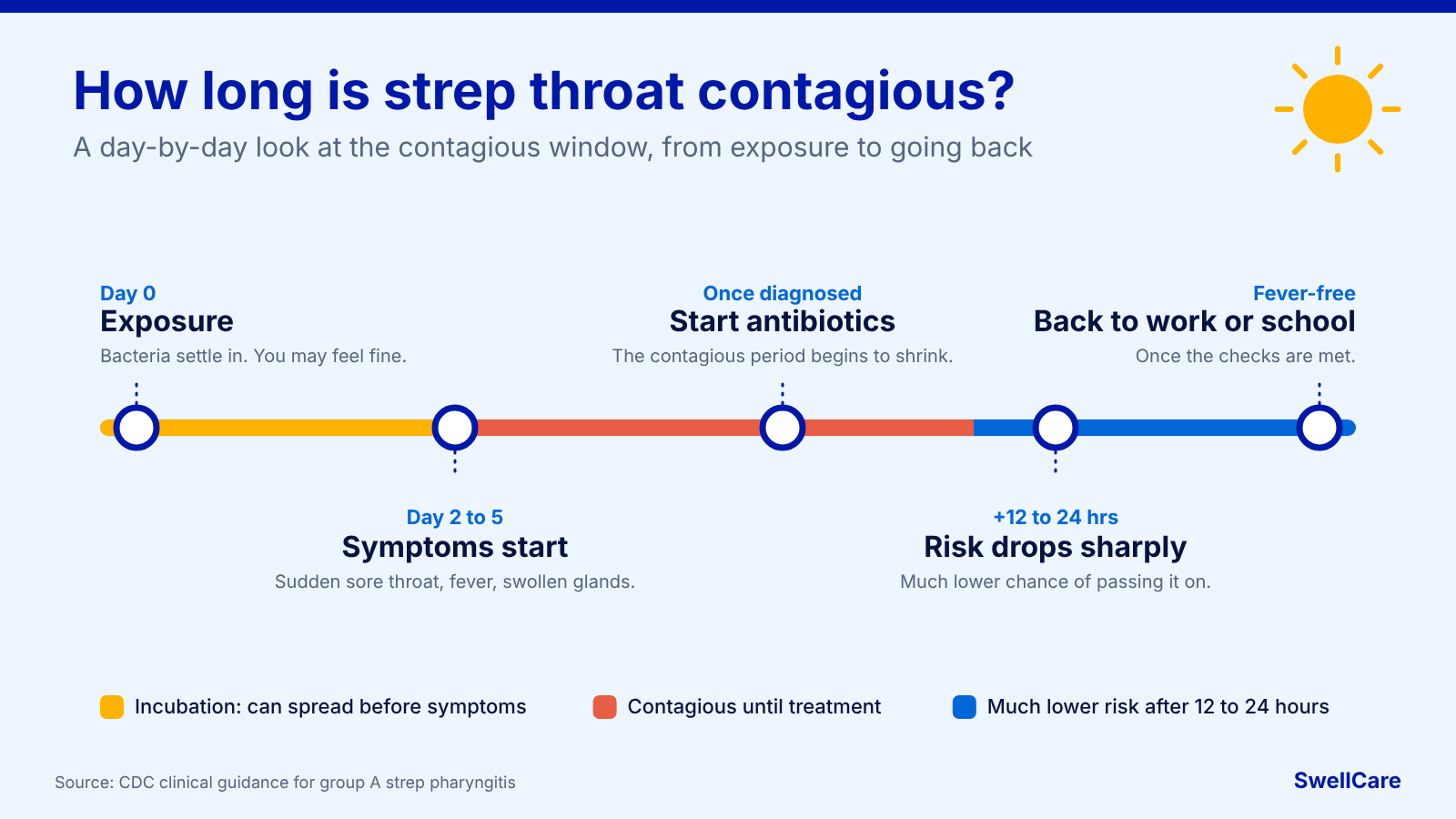
- Days 0 to 5: you’re exposed and the bacteria settle in. You may feel fine, even while the infection takes hold.
- Day 2 to 5: symptoms hit. Sudden sore throat, red tonsils, pain with swallowing, fever, swollen lymph nodes in the neck, and sometimes a scarlet fever rash.
- Start of antibiotics: the contagious period shrinks.
- 12 to 24 hours later: transmission risk is much lower.
- Day 2 or 3 of treatment: most people feel noticeably better.
If your symptoms haven’t improved after 48 hours on antibiotics, call your provider.
How long after antibiotics are you still contagious?
Roughly half a day to a full day. Most evidence points to the shorter end for children who respond quickly.
A 2015 study in the Pediatric Infectious Disease Journal followed 111 school-age children with a positive strep throat test. After a single dose of amoxicillin, 91 percent had no detectable bacteria on a rapid test or culture by the next morning. The authors argued that children treated by late afternoon could often return to school the next day if they felt better and their temperature was normal.
Penicillin or amoxicillin are the usual first-line treatment, and the standard course runs 10 days. Allergic to penicillin? Your clinician has other options. You feel great on day three, so you stop. Don’t. A full course of antibiotics clears the bacteria and the infection and lowers the risk of complications, even when symptoms vanish early.
When can you go back to work or school?
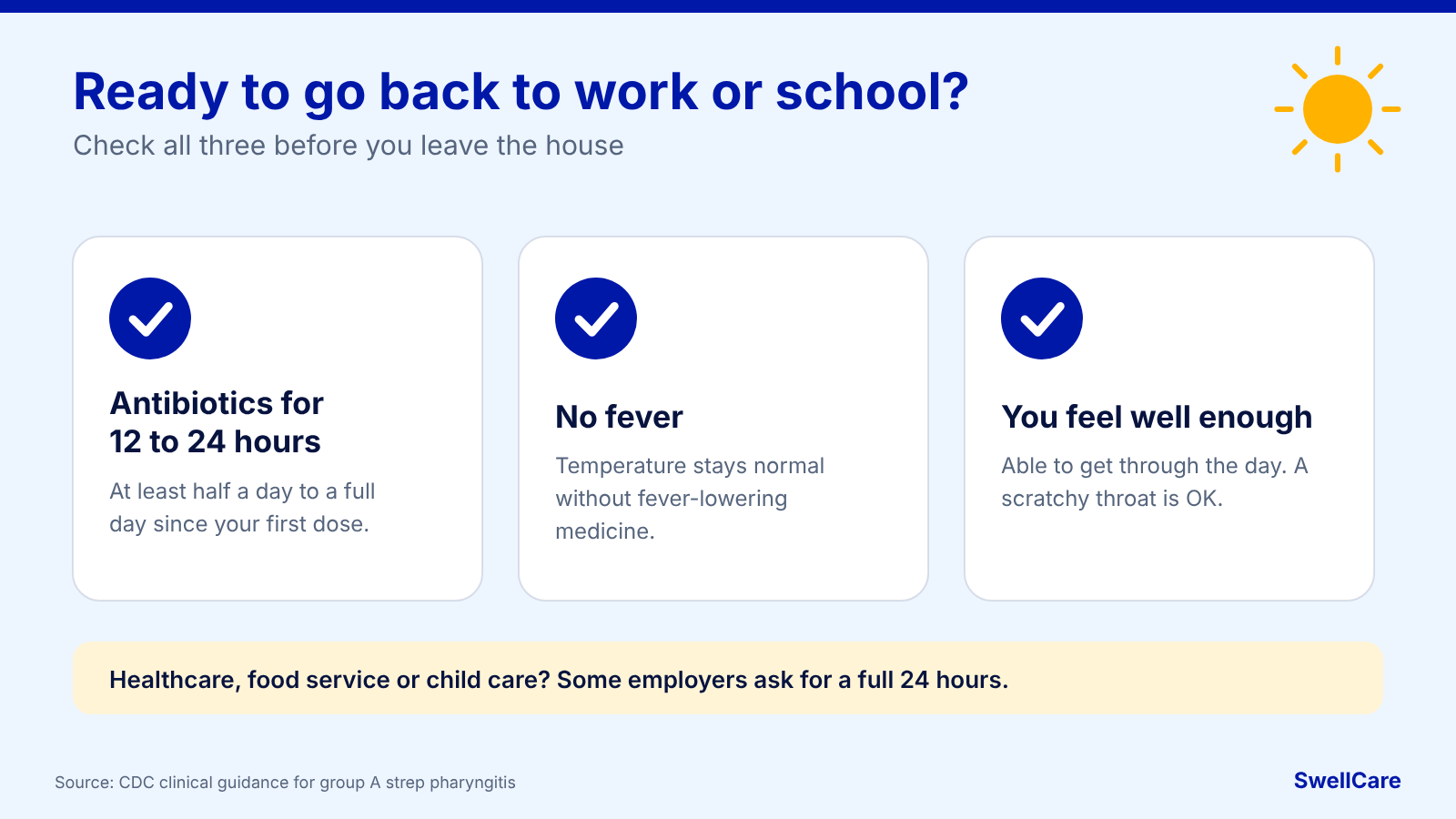
Most guidance, including CDC’s, says to stay home until you have no fever and at least 12 to 24 hours have passed since your first antibiotic dose.
Before you go back, make sure that:
- You’ve taken antibiotics for at least 12 to 24 hours.
- Your temperature has stayed normal without medicine to lower it.
- You look and feel well enough to get through the day.
Some settings are stricter. If you work in healthcare, food service or with young children, your employer may ask for a full day. A daycare center may have its own rule, too. When in doubt, ask for the written policy.
The day you go back isn’t the day you’re fully healed. You may still have a scratchy throat. That’s fine, as long as the three boxes above are checked.
How strep throat spreads from person to person
Group A strep bacteria travel in respiratory droplets. When someone coughs, sneezes or talks, tiny respiratory droplets carry bacteria into the air. You breathe them in, or you touch a surface where they landed and then touch your mouth or nose.
Close contact is the biggest risk factor for transmission. Households, classrooms and daycare rooms are the usual hot spots. Sharing cups, plates and utensils also spreads the bacteria, which is why one sick kid can become three sick family members in a week.
Wash shared items in hot, soapy water. CDC says properly washed dishes are safe to reuse.
Is it strep throat or just a sore throat?
Most sore throats aren’t strep throat. Group A streptococcus causes roughly 20 to 30 percent of sore throats in children and about 5 to 15 percent in adults. Colds and other viruses cause the rest, and antibiotics don’t help those.
Symptoms that point to strep throat: a sudden sore throat, fever, red or swollen tonsils, white patches, tiny red spots on the roof of the mouth and swollen lymph nodes in the neck. Some children also get a sandpapery scarlet fever rash. Cough, runny nose, hoarseness or pink eye lean viral.
You can’t tell by looking, though. A confirmed diagnosis needs a test. A rapid strep test uses a throat swab and gives results in minutes. If a child’s rapid test is negative, doctors often follow up with a throat culture, which is slower but more sensitive.
How to protect your household while you’re contagious
You need good hygiene habits for the first day or two.
- Practice hand hygiene: wash often, especially after coughing or sneezing.
- Cough into your elbow.
- Use your own cup, plate and utensils, and don’t share food or drinks.
- Replace your toothbrush once you’ve had antibiotics for a day.
Good hygiene beats worry. Keep sick children out of group settings until they meet the return-to-school checklist. Watch other family members closely for symptoms, because strep throat tends to pass between siblings through close contact, and a quick test beats guessing. Acetaminophen or ibuprofen can ease the throat pain and lower your temperature while the antibiotics work.
What happens if strep throat goes untreated
Most strep throat infections clear on their own eventually, but that’s the wrong bet. Skipping treatment keeps the infection going, keeps you contagious longer and raises the odds of complications such as rheumatic fever.
The infection can spread beyond the throat and cause abscesses near the tonsils, ear and sinus infections, or kidney inflammation. Scarlet fever is one more sign that group A strep is active. The most serious of the complications is rheumatic fever, which can damage the heart, joints and nervous system.
Rheumatic fever and other complications are uncommon when strep throat is treated properly, which is why a quick test matters.
When to see a doctor (and when it’s urgent)
Call a provider if you or your child has a sore throat with a high temperature, white patches or swollen lymph nodes, or if someone at home has confirmed strep throat and you’re getting sick.
Seek urgent care right away for any of these:
- Trouble breathing
- Severe trouble swallowing, or drooling that won’t stop
- Severe neck swelling
- Intense pain on one side of the throat that keeps building
- Signs of dehydration, such as dizziness, fatigue or very little urine
- Symptoms that are getting worse quickly instead of better
And if you haven’t improved after 48 hours on antibiotics, call back instead of waiting it out.
Get strep throat checked from home with SwellCare
A sore throat at 9 p.m. doesn’t wait for office hours. SwellCare’s clinician-led virtual urgent care is open 24/7 in all 50 states and D.C., so you can talk to a clinician about your symptoms, find out how likely strep throat is, and get pointed to the right test or treatment without a waiting room full of other sick people.
Here’s how it works: pick your care topic, start a video or chat visit, and get a clear plan. You can see how it works and what it costs before you book.
Feeling sick right now? Get care now and find out what your sore throat really is.
Questions people ask about strep throat contagion
Can you spread strep throat without symptoms?
Yes. Some people carry group A strep with no symptoms and can still pass the bacteria to others. It’s more common than you’d think. That’s why a proper diagnosis for every sick family member matters.
Can adults get strep throat?
Yes, though it’s less common than in children. Strep throat is most frequent between ages 5 and 15, but parents and anyone who spends time around kids have higher exposure. Adults follow the same contagious timeline and return-to-work rules.
How long does strep throat last?
Most people feel better within one to two days of starting antibiotics, and a child usually bounces back within a few days. Without treatment, the infection can drag on and the risk of complications goes up, so don’t wait it out.
Can you go to work with strep throat?
Not until you’ve had antibiotics for at least half a day and you’re fever-free. Healthcare and food-service jobs may require a full day. A virtual visit can get you a work note without sitting in a waiting room.
How long can strep throat bacteria live on surfaces?
The bacteria can survive on surfaces for a limited time, but most spread comes from droplets and close contact rather than doorknobs.
Trusted references
Public-health, research, and medical-society resources related to this guide.