You’ve been coughing for nine days. Your chest feels raw, you’re tired of sleeping upright, and you keep asking the same thing: how long does bronchitis last?
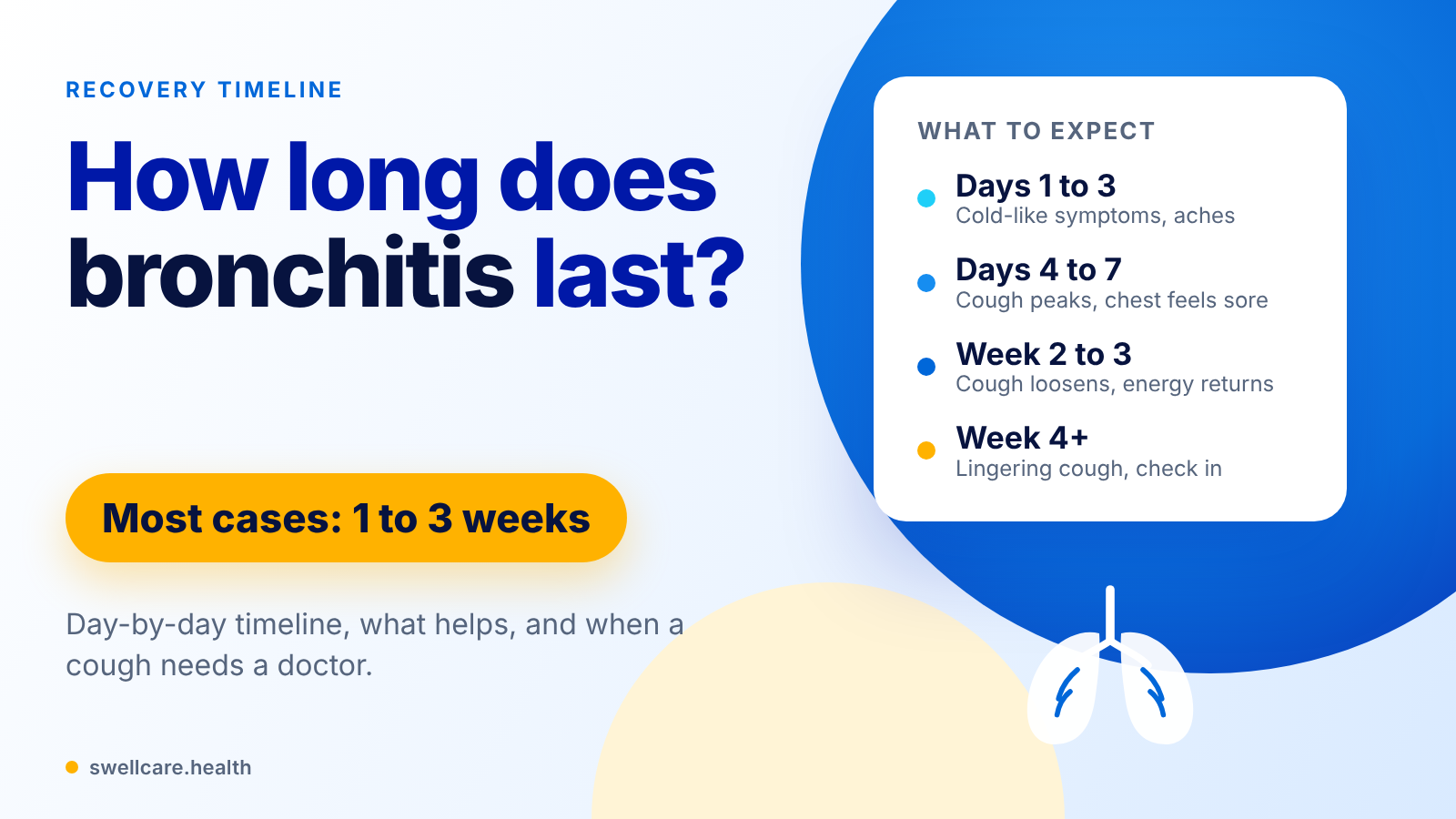
Here’s the blunt answer. Most cases of acute bronchitis clear up in one to three weeks. The chills and body aches fade in the first few days, but the cough hangs on. It can run four weeks, and that’s still within the normal range.
That gap between “I feel better” and “I’ve stopped coughing” is where most bronchitis worry comes from. This guide walks through the bronchitis timeline week by week, explains why the cough lingers, and tells you exactly when waiting stops being a good plan.
How long does bronchitis last? The short answer
Acute bronchitis, often called a chest cold, is inflammation in the airways that carry air to your lungs. A viral infection is behind at least 90% of cases, according to the American Academy of Family Physicians. Bacteria cause only a small slice.
So how long does bronchitis last in practice? The CDC says symptoms typically run less than three weeks. Cleveland Clinic puts the usual recovery at about two weeks, with some people needing three to six. Research reviewed by AAFP found the average cough lasts around 18 days.
Put those together and you get a simple rule of thumb:
- Fever, body aches and congestion: a few days to a week
- Cough: one to three weeks, sometimes four
- Energy: often the last thing to return
If your bronchitis is past the three-week mark with no improvement, that’s the point to get checked. We’ll cover the rest of the red flags below.
A week-by-week bronchitis timeline
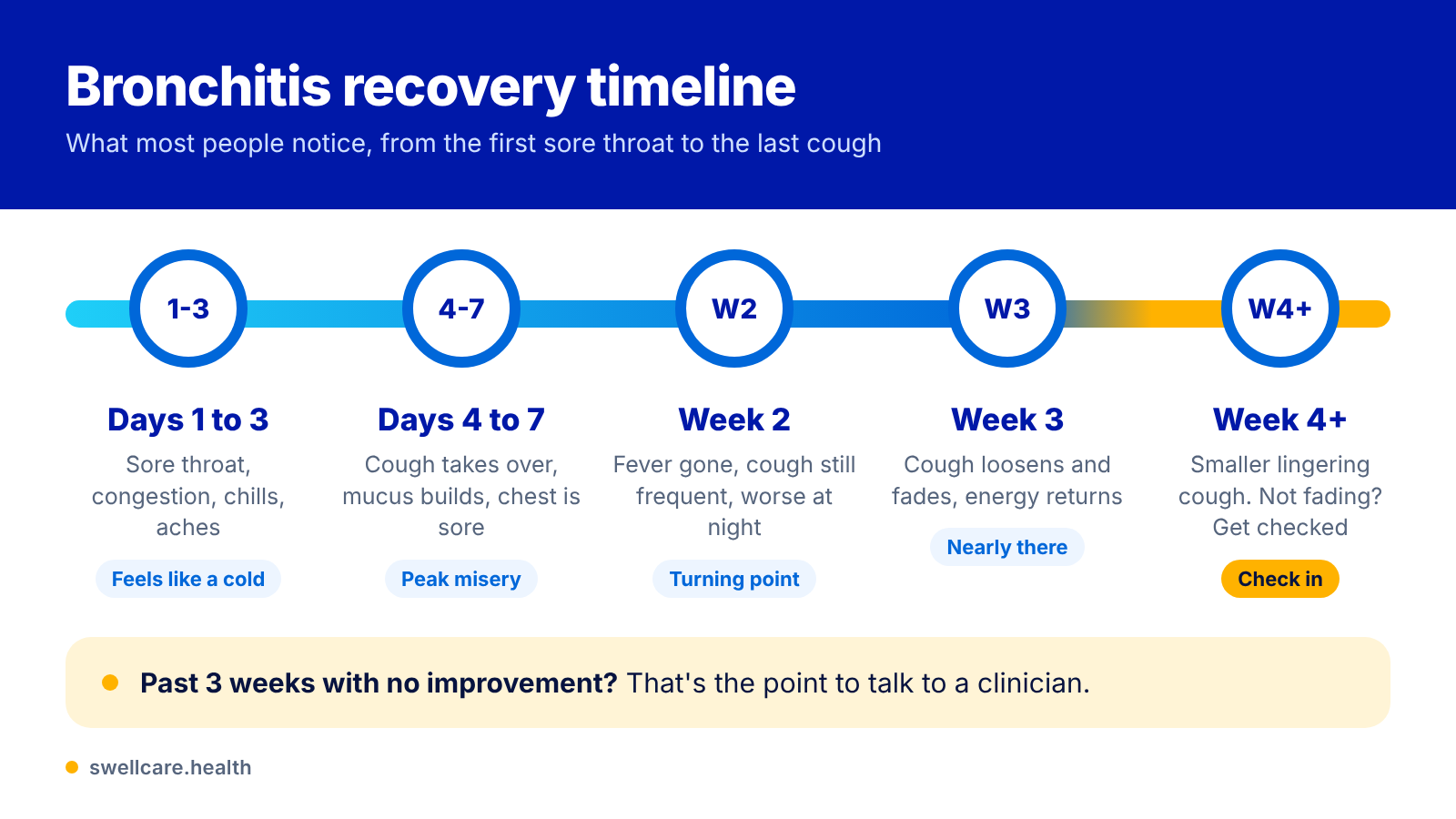
Every case of bronchitis runs a little differently. Still, most bronchitis symptoms follow a pattern, and knowing it helps you tell “slow but normal” from “something’s off.”
| When | What you’ll usually notice with bronchitis |
|---|---|
| Days 1 to 3 | Sore throat, congestion, mild fever or chills, body aches. It feels like a regular cold. |
| Days 4 to 7 | Coughing takes over. It may be dry at first, then turns wet as mucus builds. Chest soreness, wheezing and fatigue peak here. |
| Week 2 | Fever is gone. Coughing is still frequent, often worse at night or first thing in the morning. Mucus may look yellow or green, which doesn’t automatically mean bacteria. |
| Week 3 | The coughing loosens and happens less often. Energy slowly returns. |
| Week 4 and beyond | A lingering cough in a smaller dose. Worth a call if it isn’t clearly fading. |
One more thing most guides skip. Recovery rarely moves in a straight line. You’ll have a good morning, then a rough night, and decide you’re relapsing. You usually aren’t. Airways that have been inflamed stay twitchy for a while.
Why your cough lasts longer than the rest of it
The virus itself often settles in about a week. MedlinePlus notes that bronchitis symptoms other than the cough usually resolve in seven to ten days, while the cough itself can run two to three weeks, and a dry, nagging cough can last up to four weeks after the infection is gone.
Why the lag? Think of your airways like a sunburned patch of skin. The burn is over, but the surface stays tender and reacts to everything. The lining of your bronchial tubes swells during the infection, and that inflammation takes time to calm down. Until the inflammation settles, cold air, dust, a deep breath or a bit of mucus can set off a coughing fit.
Most cases start as a viral infection. The same viruses behind colds and flu, including influenza and RSV, can spread down into the bronchial tubes, and so can the virus that causes COVID-19. A viral bronchitis case follows the same script as the cold that triggered it: it runs its course.
Coughing is also doing a job. It clears mucus and debris from your lungs. Shutting it down completely isn’t always wise, especially in the daytime, when you want that mucus out.
The AMA’s guidance adds a useful outer limit: if your cough hasn’t improved or runs past six to eight weeks, it needs a proper look.
Acute vs. chronic bronchitis: two very different clocks
Everything above describes acute bronchitis. Chronic bronchitis is a separate condition, and it doesn’t follow a timeline at all.
Doctors define chronic bronchitis as a productive cough on most days for at least three months a year, two years in a row. It’s one of the main forms of COPD, which damages the lungs over time.
The biggest cause is cigarette smoke, and secondhand smoke counts too. Long-term exposure to air pollution and workplace smoke, dust and fumes plays a part as well. People with chronic bronchitis can also catch acute bronchitis on top, and those episodes tend to hit harder.
Chronic bronchitis doesn’t “clear up.” It’s managed with a clinician, usually with inhalers, smoking cessation and pulmonary rehab. If you have asthma, COPD or another lung condition, a bout of acute bronchitis can hit harder and last longer, so don’t wait it out alone.
So when someone asks how long chronic bronchitis lasts, the honest answer is that it’s long-term. This article is about the short-term kind.
What actually helps you recover (and what doesn’t)
Here’s where we take a firm position: for most people, the best bronchitis treatment is boring. Rest and fluids, plus time. Bronchitis recovery is mostly a waiting game, and the goal is to make the waiting easier.
Your immune system does the heavy lifting. What you can do is ease the symptoms and make the weeks more bearable.
What tends to help:
- Fluids and rest. Water, warm tea or broth keeps mucus thin, so it moves out more easily.
- A clean humidifier or a steamy bathroom. Moist air soothes irritated airways. Clean the humidifier daily so it doesn’t grow mold.
- Honey. The CDC suggests pasteurized honey for cough in anyone age one and older. AAFP also calls it a reasonable option for children over one.
- Saline nasal rinses. They cut congestion and the drip that triggers coughing.
- Guaifenesin. In one trial reviewed by AAFP, 75% of patients reported less cough at 72 hours versus 31% on placebo.
- Staying away from smoke. Skip cigarettes, vaping and secondhand smoke while your airways heal.
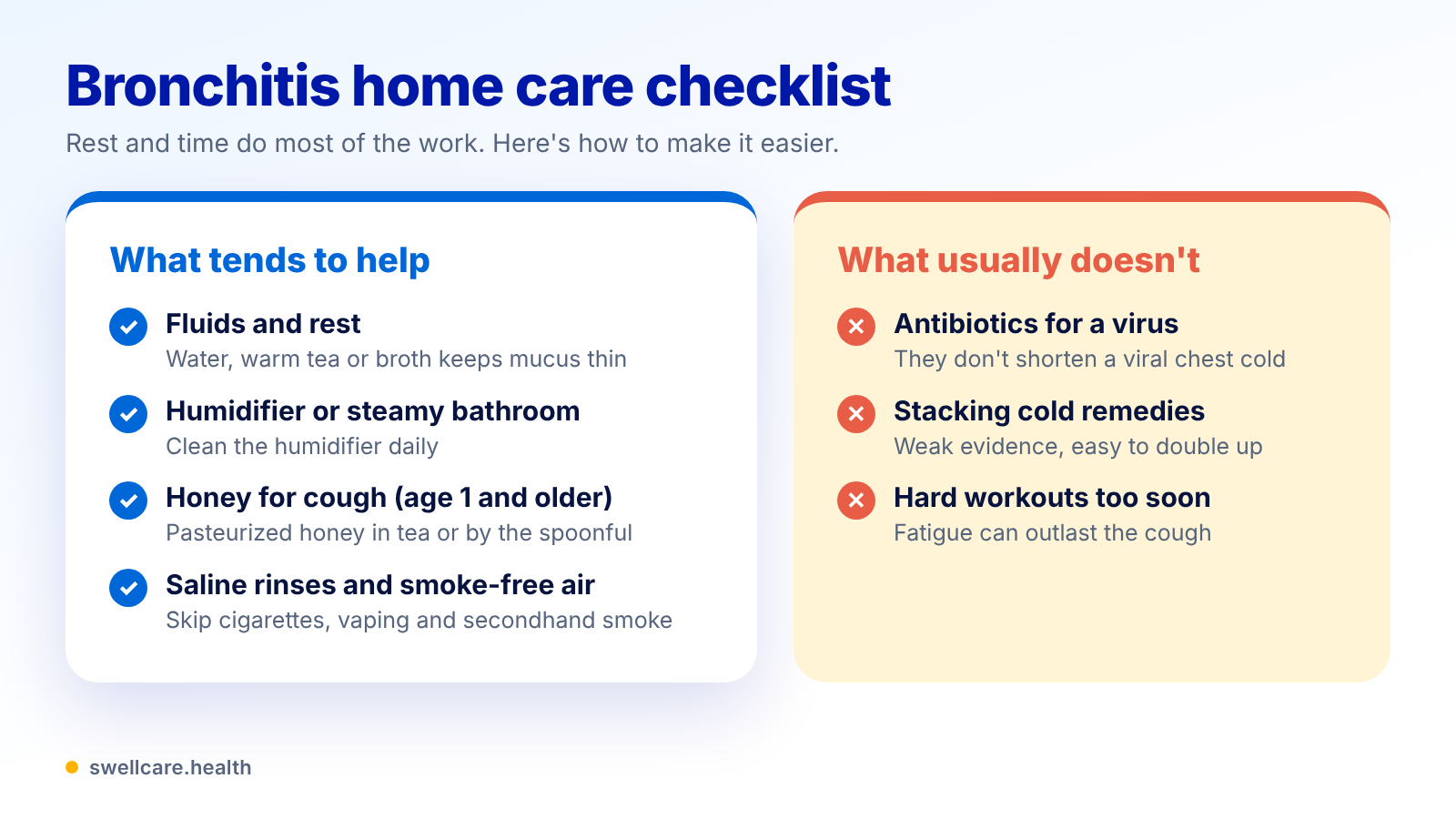
What usually doesn’t:
Antibiotics. They’re the request we hear most, so here’s the plain version. Because a virus causes nearly all cases, antibiotics don’t touch the problem. A Cochrane review found they shortened cough by about half a day, and roughly one in five people who took them had a side effect such as nausea, diarrhea or a rash.
The CDC says plainly that antibiotics won’t help you feel better if you have a chest cold. Bacteria do cause a small share of cases, and bacteria-driven illness such as whooping cough is the exception, but a clinician has to diagnose it. Taking antibiotics “just in case” also feeds antibiotic resistance, so they work less well when you truly need them. Skipping them for viral bronchitis isn’t neglect. It’s the evidence-based call.
Getting a flu shot and washing your hands also lowers your odds of catching the viruses behind bronchitis. Most over-the-counter cough and cold mixes also have weak evidence, and they’re not recommended for children under four to six. Check labels, and don’t double up on ingredients.
Go easy on your body, too. The AMA suggests easing back into exercise instead of jumping straight into hard workouts, because fatigue can outlast the cough.
When a cough is not just bronchitis
Plenty of things look like bronchitis early on: the flu, COVID-19, whooping cough, and pneumonia. Pneumonia is the one that matters most, because it needs different care. It infects the lungs themselves, while bronchitis stays in the airways. Some people call a mild form “walking pneumonia,” and it can feel like a bad cold that never turns the corner. Asthma and allergies can also cause a lingering cough that gets mistaken for bronchitis.
Here’s when to see a doctor. Contact one if you notice any of these symptoms:
- Fever above 100.4°F that lasts more than a few days, or a fever above 102°F
- Shortness of breath, wheezing or chest pain when you breathe in
- Coughing up blood
- A heart rate above 100 beats per minute at rest, or breathing faster than 24 breaths per minute
- Symptoms that were improving, then suddenly get worse at one to two weeks
- A cough lasting more than three weeks
- Repeated bouts of bronchitis, or an existing heart or lung condition
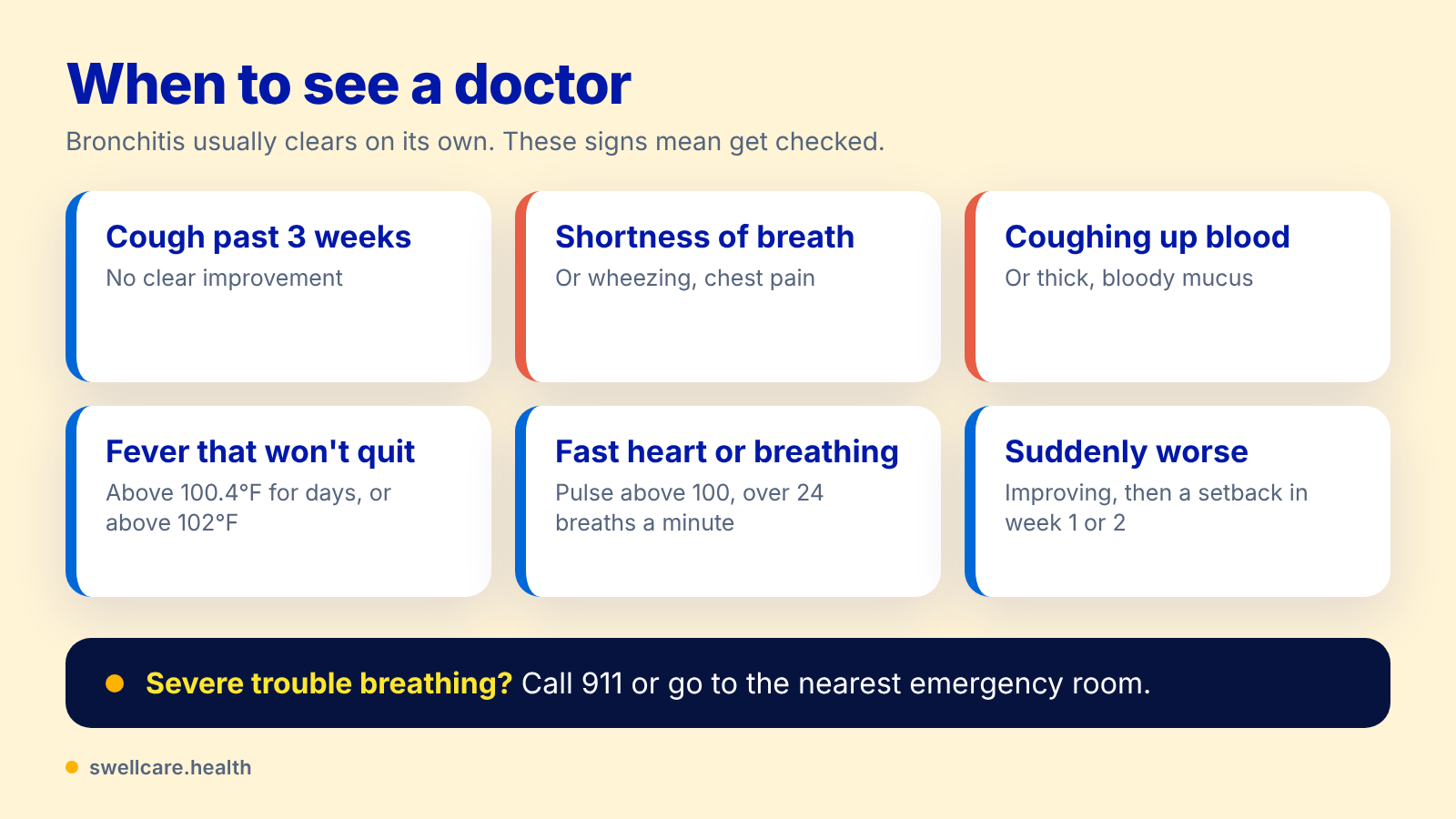
Older adults can have subtler symptoms, with a milder temperature than you’d expect. If something feels wrong, trust that. If you ever struggle to breathe or can’t speak a full sentence, call 911 or go to the nearest emergency room.
Getting checked without a waiting room
Most cases of bronchitis don’t need a visit. But the “is this normal?” question is a good one, and answering it early beats guessing for most of a month.
SwellCare’s virtual urgent care lets you talk through your symptoms with a clinician from home, any time of day. We can help you sort out whether this looks like routine acute bronchitis, whether something else is going on, and whether you need an in-person exam or chest imaging. If antibiotics or another prescription are appropriate, we’ll say so. If it isn’t, we’ll tell you that too, and give you a treatment plan for the coughing, sleep and recovery in the meantime.
Start with SwellCare urgent care, see the conditions we treat, or read how SwellCare works before your first visit.
Questions people ask about how long bronchitis lasts
How long does bronchitis last in adults?
Most healthy adults recover from acute bronchitis in one to three weeks. The aches fade first, while the cough can last up to four weeks. If you’re still coughing heavily after three weeks, or if you have asthma, COPD or a weak immune system, it’s worth getting checked sooner.
How long am I contagious with bronchitis?
Bronchitis itself isn’t contagious, but the viruses that cause it are. You’re most contagious in the first several days of symptoms, and Cleveland Clinic says a viral case can be contagious for a few days to a week. Wash your hands, cough into your elbow, and stay home while you have a fever.
Can bronchitis go away on its own?
Yes. Acute bronchitis usually resolves without medicine because your immune system clears the virus. The core treatment is rest and fluids, plus time. Antibiotics aren’t part of it. See a clinician if it isn’t improving by three weeks or if you develop a high temperature, blood in your mucus or shortness of breath.
How long does a cough last after bronchitis?
A lingering cough can last two to four weeks after the other bronchitis symptoms fade. It should slowly get weaker. Coughing that’s getting worse, or one that hasn’t improved by six to eight weeks, needs medical attention to rule out asthma, reflux, pneumonia or something else.
Is it bronchitis or pneumonia?
Both bronchitis and pneumonia cause cough and tiredness. Pneumonia is more likely to bring a higher temperature, fast breathing, shortness of breath or a racing heartbeat, chest pain with breathing and a sicker feeling overall. A clinician can listen to your lungs and may order a chest X-ray. If you’re unsure, get checked.
Trusted references
Public-health, research, and medical-society resources related to this guide.