You’ve been sitting there ten minutes. Nothing. Your stomach feels like a balloon, and the plan for tonight is a heating pad and regret.
Here’s the good news. Most constipation eases with simple moves you can start right now, and you don’t need to jump straight to the strongest product on the pharmacy shelf. This guide shows you how to relieve constipation one rung at a time, from a warm drink and a short walk up to over-the-counter laxatives, plus the signs that mean it’s time to talk to a professional.
What’s really going on when you’re backed up
Doctors define constipation as fewer than three bowel movements a week, or stool that’s hard, dry, lumpy or painful to pass, or the feeling that you haven’t fully emptied (NIDDK). That last one counts. You can go every day and still be constipated.
What counts as normal varies a lot from person to person, so your own usual pattern matters more than any single number.
So why does it stall? Digestion hands leftovers to the colon, and the colon pulls water out of stool as it moves along. The slower the trip through the colon, the drier and harder everything gets. Low fiber and too little water are the usual suspects. Stress and travel can slow things down, and so can a sedentary week or ignoring the urge. So can medications, including opioid pain relievers and some antidepressants.
How to relieve constipation fast, one rung at a time
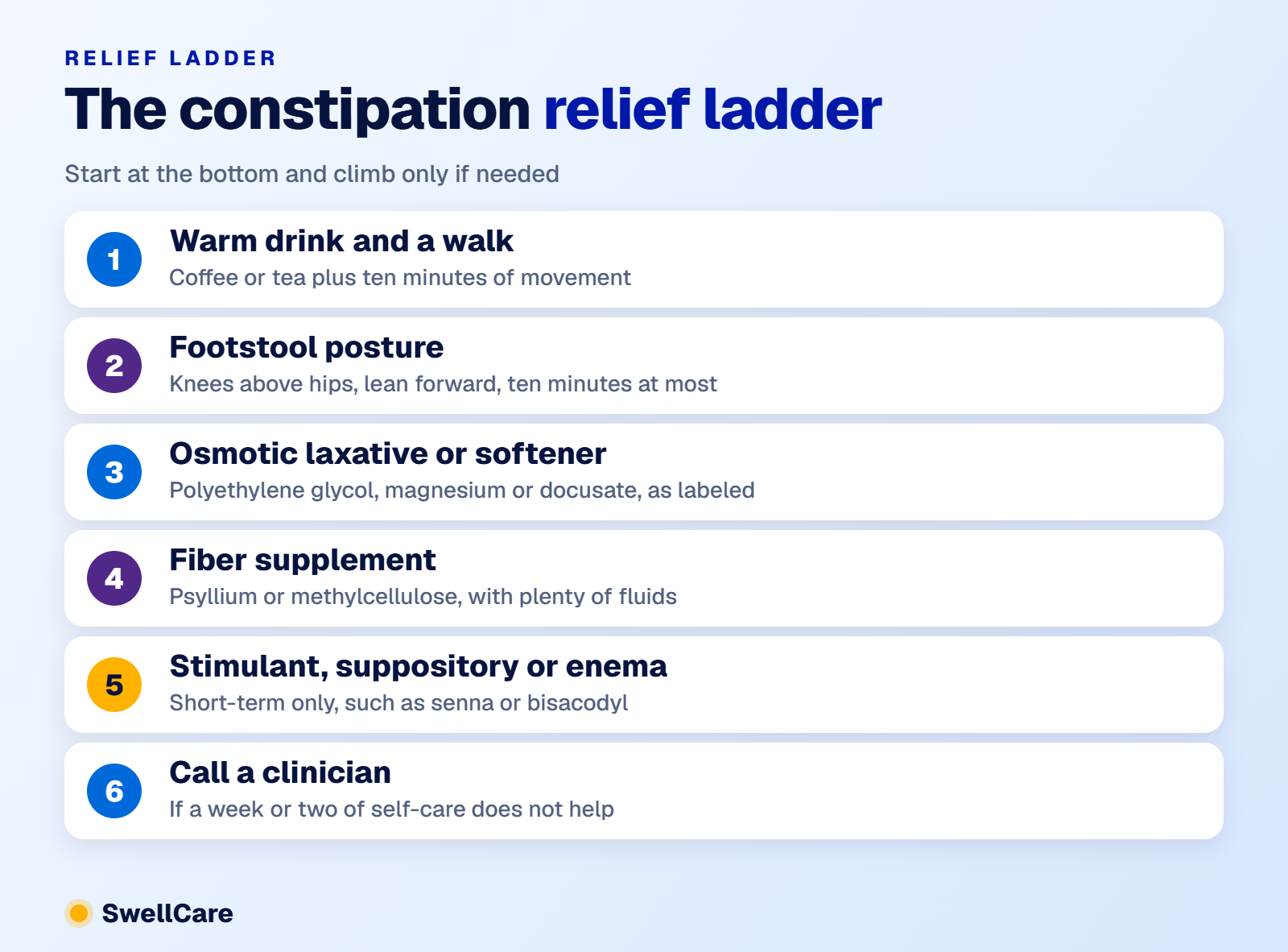
Think of this as a ladder. Start at the bottom with warm fluids and movement, then try stool softeners and osmotic laxatives, and save the stimulants for last. Climb only if the step below didn’t work.
Start with a warm drink and a ten-minute walk
Sip something warm. Coffee works for many people because caffeine can stimulate the gut, and a hot drink is a simple nudge. Pair it with a brisk ten-minute walk. Movement helps the muscles that push things along. Exercise doesn’t have to be intense, and gentle exercise like chair marches counts. Regular exercise pays off over weeks.
Drink a full glass of water while you’re at it. Hydration won’t fix a stalled colon alone, but a dehydrated gut makes everything harder.
Change how you sit on the toilet
Prop your feet on a small stool so your knees sit above your hips. Lean forward a little and rest your forearms on your thighs. This squat-style position lines up the rectum better than sitting upright, as Cleveland Clinic explains. Stay for about ten minutes at most, and leave your phone outside. Longer sessions mean more straining, and straining is how hemorrhoids start.
One caveat: the best-known toilet stool study had no control group, and the manufacturer ran it. The posture is cheap and harmless, so try it, but don’t expect miracles.
Reach for an over-the-counter laxative the right way
If a few hours pass with no luck, move up a rung. Most people should start with the gentlest class of OTC products:
- Osmotic laxatives (polyethylene glycol, magnesium products) draw water into the colon.
- Stool softeners (docusate) help the hard stuff mix with water and fat so it passes easier.
- Fiber supplements (psyllium, methylcellulose) add bulk, but they work slowly and need plenty of fluids.
The 2023 American Gastroenterological Association and American College of Gastroenterology guideline for chronic constipation strongly recommends polyethylene glycol and conditionally recommends fiber, senna and magnesium oxide, among other options (Healio summary). Follow the label, and pair any of these OTC options with extra fluids.
Know what stimulants, suppositories and enemas are for
Stimulant laxatives such as senna and bisacodyl make the intestinal muscles contract. By mouth they usually take six to eight hours, while a stimulant suppository can work in 15 to 60 minutes, according to Harvard Health. An enema goes straight to the rectum and is meant for a one-time rescue.
Keep these short-term. Harvard warns that regular stimulant use can leave the colon reliant on them, and it flags mineral oil by mouth as risky because it can end up in the lungs. Never use an enema as a weekly habit.
Foods and fiber that keep constipation from coming back
Quick constipation relief is one thing. Not needing it again is the real win. Fiber is the foundation of regular bowel movements.
Mayo Clinic puts daily fiber targets at 25 grams for women 50 and under, 21 grams for women over 50, 38 grams for men 50 and under and 30 grams for men over 50 (Mayo Clinic).

Build fiber slowly
Soluble fiber (oats, beans, apples, citrus) forms a gel that softens stool. Insoluble fiber (wheat bran, nuts, cauliflower, green beans) adds bulk and moves things through. Most high-fiber foods carry both soluble fiber and insoluble fiber, so variety beats any single food. Oatmeal with kiwis, or whole wheat toast with beans, covers both.
Add a few grams every few days. Jump from 12 grams to 35 overnight and you’ll trade constipation for gas and cramps. Aim for high-fiber foods at every meal, and keep up your hydration as the fiber goes up, or it can make things worse.
Prunes: what one small trial found
In a University of Iowa trial of 40 adults with constipation, 50 grams of prunes a day raised weekly spontaneous bowel movements from 1.8 to 3.5, while psyllium raised them from 1.6 to 2.8. Consistency also improved more with prunes. The study was funded by the California Dried Plum Board, so keep that in mind, but prunes are cheap and low risk. They also bring sorbitol, a sugar alcohol that pulls water into the gut.
Yogurt and kefir are popular sources of probiotics, and Cleveland Clinic lists them as an option. Evidence for probiotics and digestion varies by product, so treat them as a bonus rather than a fix. Ginger tea gets plenty of attention online, and ginger shows up in many home remedies, yet solid trials are thin.
Daily habits that make the biggest difference
Small routines add up. Try a few of these for two weeks and see.
Go when you feel the urge. Holding it trains your gut to stop sending the signal. Set aside unhurried time after breakfast, when your gut is already active and bowel movements tend to come more easily.
Stress matters more than most people expect. It triggers the fight-or-flight response, and the hormones involved can slow digestion. Deep breathing, a short walk or a few minutes of quiet can help your gut as much as your mood.
When constipation is more than a rough week
Most episodes pass on their own, and bowel movements return to normal. Don’t ignore these, though:
- Severe or constant belly pain
- Blood in the stool or rectal bleeding
- Vomiting along with constipation
- Unexplained weight loss
- No improvement after a week or two of self-care
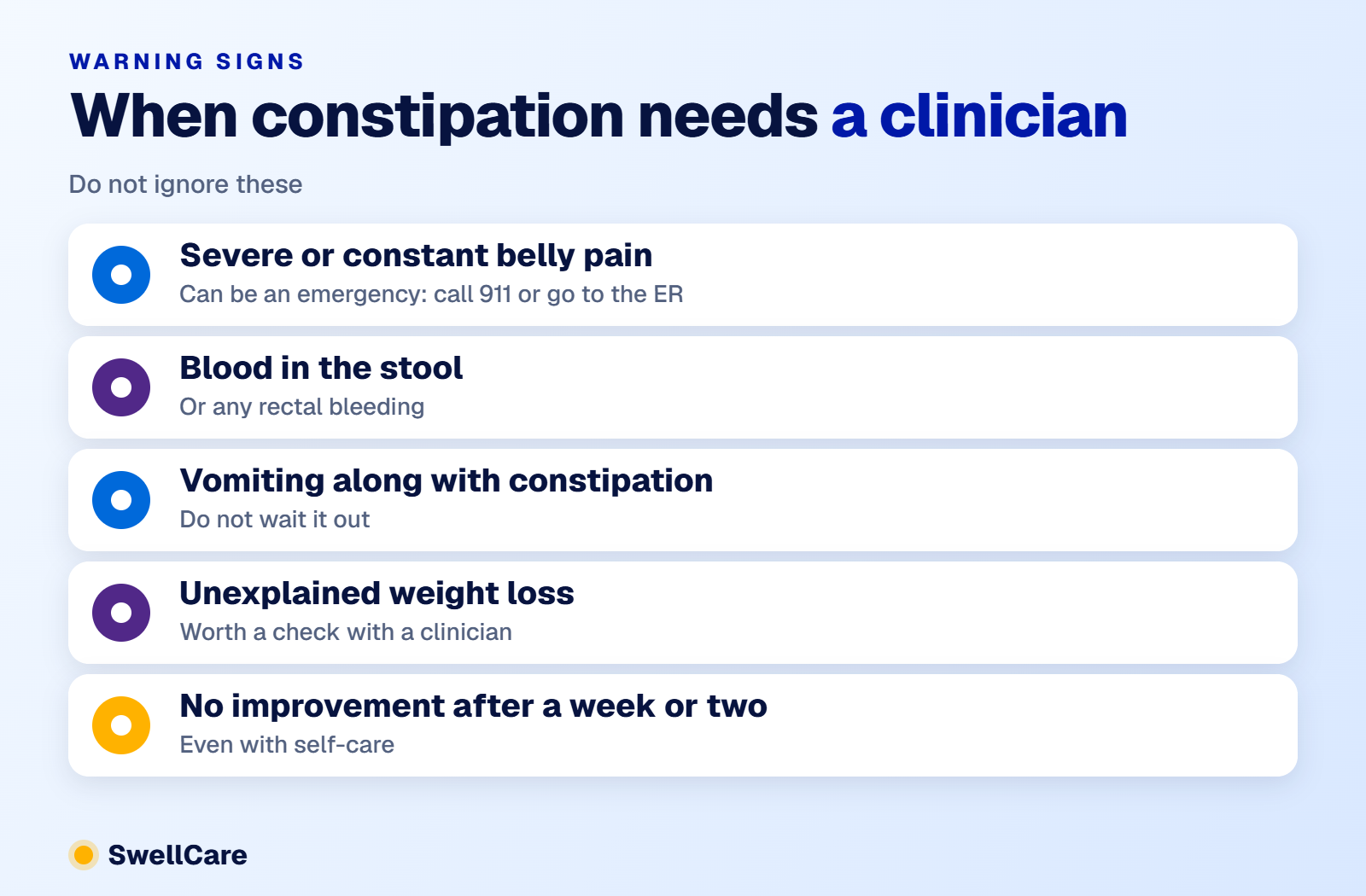
NIDDK says to see a health professional if constipation doesn’t respond to self-care or lasts a long time. Severe pain, vomiting or bleeding can be an emergency, so call 911 or head to the ER. Not sure which setting fits? Our guide on urgent care versus the ER can help.
It’s also worth reviewing your medications. Opioids and iron supplements can slow the gut. So can some antidepressants and certain weight-loss medicines. Don’t stop a prescription on your own. A clinician can adjust the dose, add a safe regimen or rule out something else.
Get constipation checked with SwellCare
Not sure whether to wait it out? SwellCare’s online urgent care offers clinician-led, non-emergency care by video or chat, so a clinician can review what’s going on, talk through your medications and tell you what to do next. Prescriptions are never guaranteed, and SwellCare is not for emergencies.
Questions people ask about how to relieve constipation
How do you relieve constipation in 30 minutes?
A stimulant suppository is the fastest OTC option, with effects in roughly 15 to 60 minutes. A warm drink plus a walk can also get things moving within the hour, especially from a squat-style position. Stool softeners and fiber supplements work too slowly to count here. Don’t push through severe pain.
What is the fastest way to poop when constipated?
Combine the easy rungs first. Have a warm drink, move around a bit, and raise your feet on a stool. If that fails, a suppository or enema targets the rectum directly.
Does drinking water help constipation?
Sometimes. Being well hydrated softens things up, and it helps fiber work. Harvard says most people need about four to six cups of plain water a day, though needs vary. If you’re already well hydrated, extra water alone won’t cure a backup.
Can you become dependent on laxatives?
Stimulant laxatives are the ones to watch, because the colon can come to rely on them with regular use. Use them only as directed and for brief periods, and ask a clinician if you need something more than occasionally.
How long is too long to go without a bowel movement?
There’s no single number, because normal ranges widely. Fewer than three bowel movements a week meets the definition of constipation. If you’ve gone a week with no relief, or you have pain, vomiting or bleeding, get medical advice.
Trusted references
Public-health, research, and medical-society resources related to this guide.