You booked a “telehealth visit,” your insurer’s letter says “telemedicine,” and your neighbor swears they’re the same thing. Who’s right?
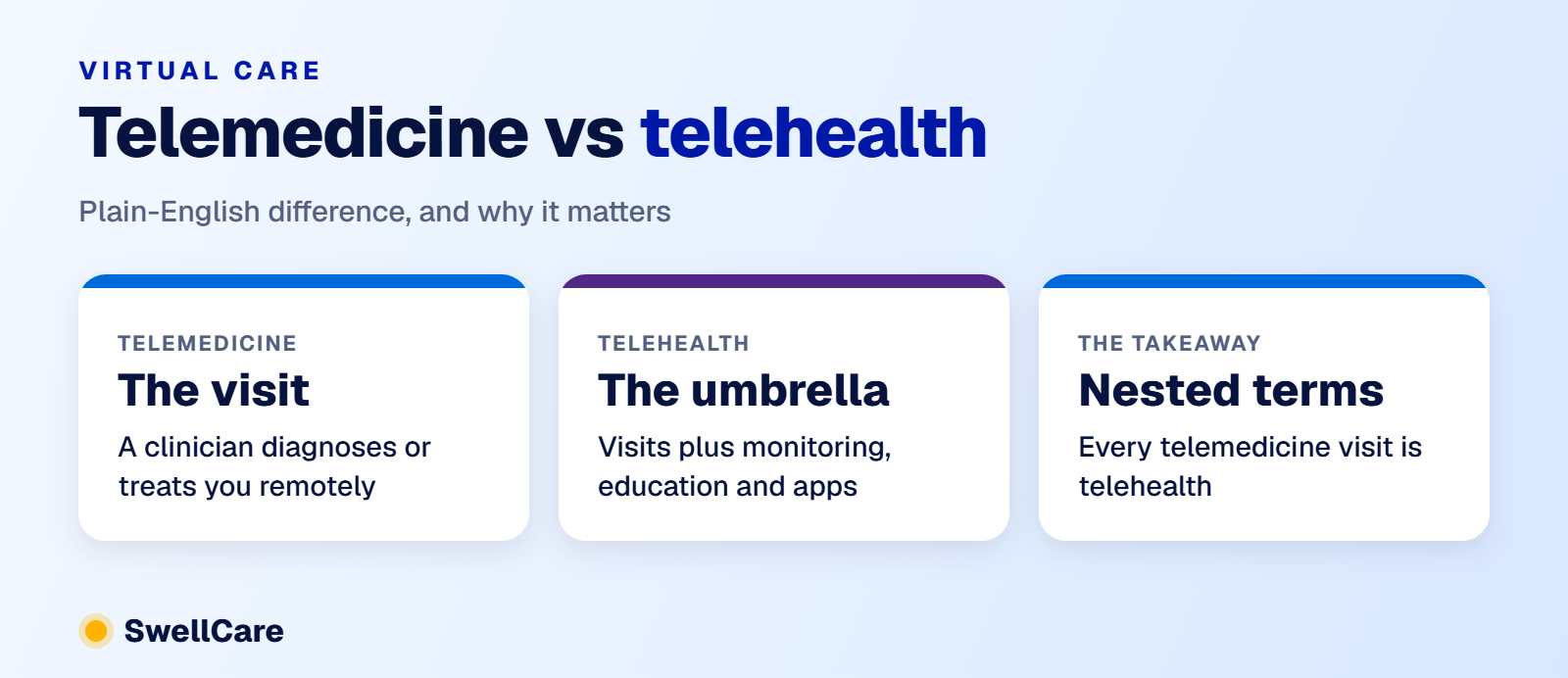
Both, mostly. Here’s the short version of telemedicine vs telehealth: telemedicine is a clinical visit with a doctor, nurse practitioner or other clinician done remotely. Telehealth is the bigger umbrella, covering those visits plus remote monitoring and patient education. Health apps and the behind-the-scenes work that keeps care connected sit there too. Every telemedicine appointment is telehealth. Not every telehealth service is a medical visit.
Does the wording matter to you as a patient? Sometimes. It can change what your insurance pays for, what a provider is allowed to do across state lines, and what kind of help you’ll actually get. Keep reading and you’ll know which term applies to your situation, plus what to ask before you click “book.”
Telemedicine vs telehealth: the short answer
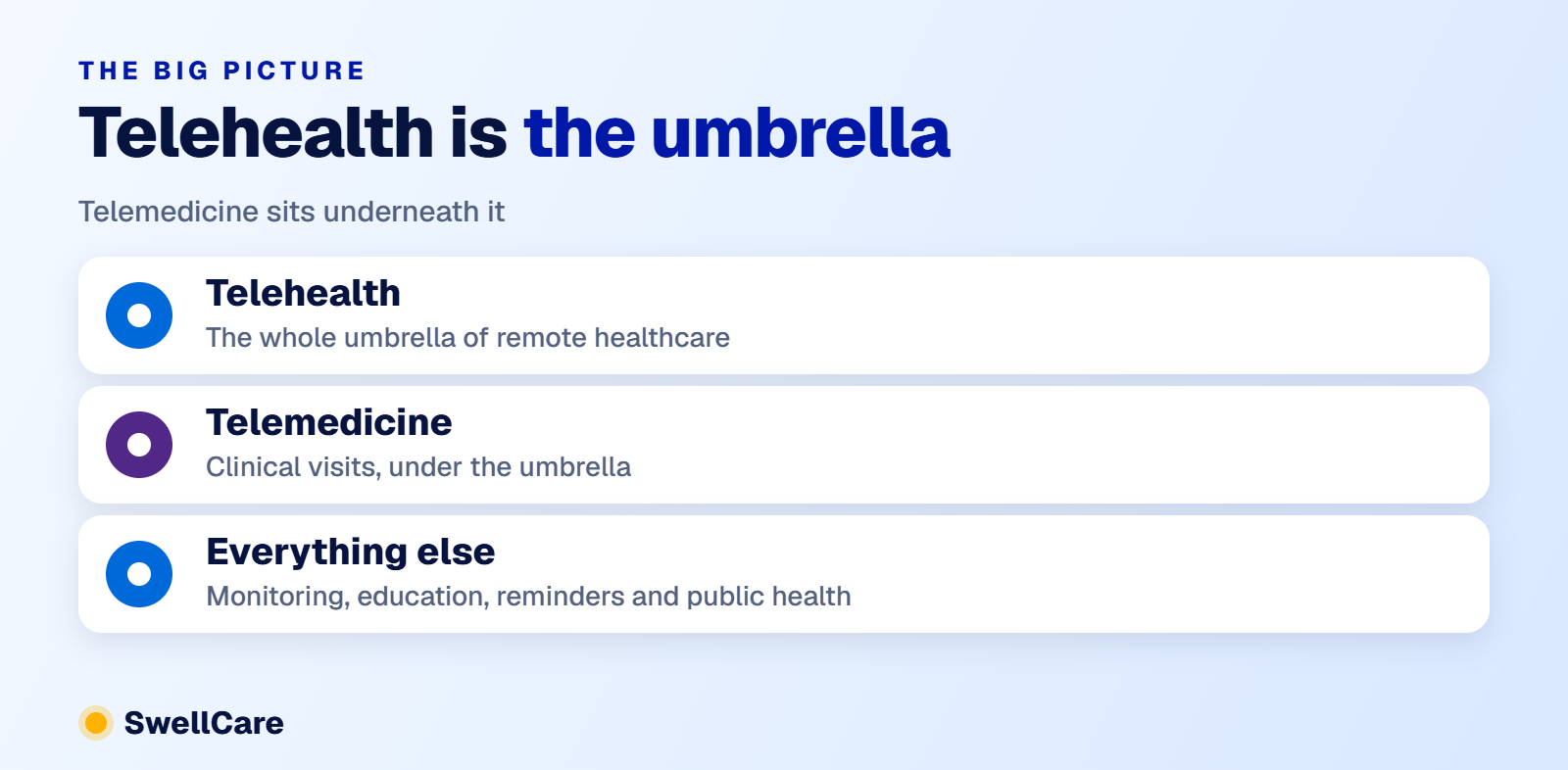
Think of an umbrella with a smaller shape sitting underneath it.
The umbrella is telehealth. The U.S. Department of Health and Human Services, citing HRSA, describes it as using electronic information and communication technology to support long-distance clinical care, health education for patients and professionals, public health and health administration. That’s a wide net.
The shape underneath is telemedicine. It’s the clinical piece: a licensed clinician evaluating, diagnosing or treating you from a distance.
Federal websites don’t always keep the terms apart. The Office of the National Coordinator for Health IT, for instance, treats the two as the same thing: getting care from a provider without going to a physical office. So if you hear them used interchangeably, you aren’t hearing a mistake. You’re hearing the way most people talk. The distinction matters most to insurers and state regulators, plus the people who write medical billing rules.
What telemedicine means
Telemedicine is about the visit itself. A patient has a problem, a clinician looks at it remotely, and something happens: a diagnosis, a treatment plan, a prescription, a referral or a “come in and let’s examine you.”
Most telemedicine today happens over secure video, a format sometimes called a virtual visit. Some of it is audio-only, meaning a phone call with no video. Both count when the clinician is delivering clinical care.
The CDC’s National Center for Health Statistics counted telemedicine as any appointment with a doctor, nurse or other health professional by video or by phone. By that measure, 37% of U.S. adults used telemedicine in 2021, and use was higher among women and older adults than among men and younger ones.
For the patient, telemedicine is the part that feels most like going to the doctor. Your provider asks questions, looks at what the camera shows, reviews your history and decides what happens next. Remote care also saves the commute and the waiting room, which for a lot of people means saving an afternoon. It won’t replace every in-person exam, but for many everyday healthcare needs it’s faster and just as thorough.
Everyday telemedicine examples
Nothing exotic here. A few of the most common examples:
- A virtual visit for a urinary tract infection or sinus infection, with a prescription sent to your pharmacy
- A phone call to review lab results and adjust a medication
- A follow-up visit for a chronic condition such as high blood pressure or diabetes
- Urgent care for a rash, pink eye or a bad cough when you’d rather stay home
Notice what they share. Someone with clinical training is making a medical decision about you. Curious what that kind of visit covers? See what urgent care is.
What telehealth covers
Telehealth is the umbrella term, and it’s deliberately broad. It includes everything above, then keeps going.
A nurse calls to remind you about an appointment. You read a lab result in your patient portal. A pharmacist teaches you to use an inhaler over video. A hospital trains rural clinicians through a remote course. A public health agency sends text alerts during flu season. None of those is a diagnosis, yet all of it is virtual care, and all of it sits under telehealth.
From the patient side, telehealth is often what keeps care continuous. Telemedicine gets you through the sick day. The rest of telehealth helps your provider follow up, watch a chronic condition and spot trouble early. Good virtual care depends on both halves working together.
That breadth is why many hospitals and health systems prefer the word. It describes what the whole operation does, not just one type of encounter. For a patient, the practical takeaway is simple: when a provider says “telehealth,” ask whether you’re getting a clinical visit or one of the support services around it.
Four ways care travels
Telehealth reaches you through four main channels. Telemedicine lives mostly in the first two.
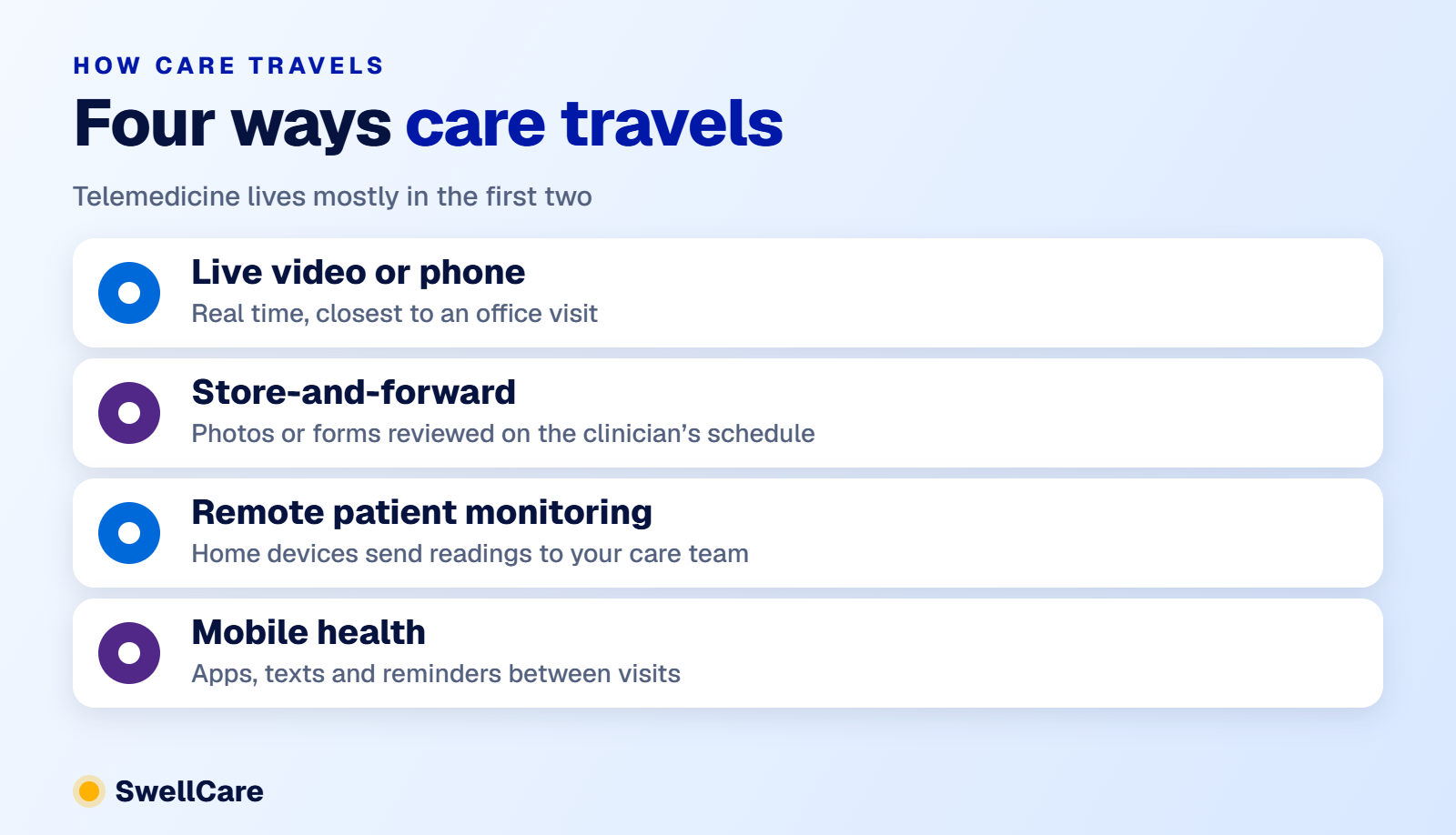
Live video or phone (synchronous). You and the clinician talk in real time. It feels closest to an office visit, and it’s what most people picture.
Store-and-forward (asynchronous). You send photos, scans or a questionnaire. A clinician reviews them on their own schedule and writes back. Skin concerns and some imaging reviews work well this way. Store-and-forward care is asynchronous, which just means nobody has to be online at the same moment.
Remote patient monitoring. Most patients meet this one through a chronic condition. A connected device at home, like a blood pressure cuff or glucose meter, sends readings to your care team. Remote monitoring shines for a chronic condition because small changes show up before they turn into emergencies.
Mobile health. Apps, texts and reminders that nudge you between visits. Small, but they add up.
Put plainly, synchronous care is a conversation, asynchronous care is a message, and remote patient monitoring is a steady stream of readings your care team watches for you. Together with store-and-forward images and apps, that’s the full toolkit of remote healthcare.
Telemedicine vs telehealth side by side
If you like things in one glance, here’s how the two compare.
| Telemedicine | Telehealth | |
|---|---|---|
| What it is | A clinical visit done remotely | The full umbrella of remote healthcare |
| Who delivers it | Licensed clinicians | Clinicians, nurses, pharmacists, educators, administrators |
| Typical purpose | Diagnose, treat, prescribe | Educate, monitor, coordinate, support |
| Examples | Video visit, phone consult | Portal messages, remote monitoring, training, public health alerts |
| Insurance billing | Usually billed as a clinical service | Mixed; some parts are billed, many aren’t |
| Where the rules live | Medical boards, payers, state law | Broader: health policy, privacy, public health |
One pattern worth remembering: when money or a license is involved, people lean on the narrower word, telemedicine. When they want to describe a whole program, they use telehealth.
Does the difference change coverage and cost?
It can, though less than the vocabulary suggests. Coverage usually turns on what happened during the appointment, not on which word was printed on the confirmation email.
Medicare. Medicare’s expanded telehealth flexibilities, which let patients use telehealth from home and allow audio-only visits where clinically appropriate, were extended through December 31, 2027 by the Consolidated Appropriations Act, 2026, signed in February. That’s a deadline set by Congress, not a permanent rule, so check again as it approaches.
Medicaid. Each state runs its own Medicaid program, so telehealth coverage, covered services and billing rules differ from one state to the next. Your state Medicaid website or your plan’s member services line is the quickest way to confirm.
Billing and reimbursement. Behind the scenes, an insurer decides whether to pay by looking at the billing codes a provider submits. Reimbursement for a telemedicine visit often follows the same logic as an office visit. Reimbursement for portal messages or monitoring follows narrower rules, which is why billing teams care about the word telemedicine so much while you mostly care what you owe. Ask for the cost and the billing method before the appointment, not after.
Private insurance. Many plans cover a virtual appointment at the same rate as an in-person visit, but not all do, and copays can vary. Look for the phrase “telehealth benefit” in your plan documents.
State law. A clinician typically has to be licensed in the state where you’re sitting during the visit. Prescribing rules, especially for controlled medications, can also differ. This is one more reason the telemedicine side of telehealth gets more scrutiny.
Privacy. Reputable providers use platforms that follow HIPAA, the federal privacy law for health information. Ask whether your video visit uses a secure, HIPAA-compliant platform and whether your records go into a chart you can access.
If you’re paying cash, the billing question goes away. You just want to know the price before you start. Our guide on how much urgent care costs without insurance can help.
Which one do you need?
You usually don’t have to choose. When you’re sick or unsure whether something is serious, what you want is telemedicine: a clinician who can listen, think and act. When you’re managing something long-term, you’ll likely want telehealth tools wrapped around it, such as a portal, monitoring and reminders.
At SwellCare, that first part is the point. SwellCare online urgent care offers clinician-led, non-emergency care by video or chat, for urgent concerns, medication refill review and lab follow-up. A telemedicine visit only works if you can get one when you need it, so we built ours to be easy to reach. Prescriptions are never guaranteed.
When a virtual visit works well
Virtual care tends to fit best when your concern is common and treatable, and doesn’t need hands-on testing. Think minor infections, rashes, medication questions, refill reviews, follow-ups after labs and everyday questions you’d otherwise lose half a day to ask.
When to see a doctor in person
Some problems need a physical exam, imaging or emergency equipment. Skip the virtual visit and go in person for:
- Chest pain, trouble breathing, signs of a stroke or severe bleeding
- A head injury or a serious fall
- Sudden confusion, fainting or a seizure
- Any symptom that feels like an emergency to you
For those, call 911 or go to the nearest emergency room. SwellCare is not emergency care, and any good virtual provider will tell you the same. If a clinician decides that your problem needs an in-person exam, they should say so clearly and help you plan your next step, rather than stretching a video call past what it can do. Not sure which you need? Read when to go to urgent care vs the ER.
Your next step
Now you know that telemedicine is the visit and telehealth is the umbrella. Put that to work. If you’d like a clinician to look at a health concern today, SwellCare’s urgent care page lists what we can help with and how to start a consultation from home.
Questions people ask about telemedicine vs telehealth
Are telehealth and telemedicine the same thing?
Not exactly, though people use them interchangeably all the time. Telemedicine means remote clinical care, like a video visit where a doctor diagnoses and treats you. Telehealth is the umbrella term. It includes telemedicine, plus education, monitoring and reminders for the patient and administration behind the scenes. If you’re a patient booking an appointment, the two usually mean the same experience.
Is telemedicine a type of telehealth?
Yes. Telemedicine is the clinical subset of telehealth. Telehealth also covers services that never involve a diagnosis, such as patient education, remote monitoring programs, clinician training and public health messaging.
Does insurance cover telehealth or telemedicine?
Often yes, but it depends on your plan and your state. Medicare and Medicaid both pay for virtual visits, as do many private insurers, and the details differ by service. Check your plan for a telehealth benefit, and confirm whether your provider bills insurance or charges cash.
Does Medicare still cover telehealth?
Yes. As of November 2026, Medicare’s expanded telehealth flexibilities run through December 31, 2027, under legislation signed in February 2026. Because Congress set that date, it could change, so verify current rules at Medicare.gov before you book.
Can I get a prescription through telemedicine?
Often, yes. A licensed clinician can prescribe many medications after a virtual visit when it’s clinically appropriate. Rules are stricter for controlled substances and vary by state, and a clinician may ask you to come in person if they can’t safely decide over video.
Is a telehealth visit private?
It should be. Reputable providers use secure, HIPAA-compliant platforms and keep your records in a protected chart. On your side, take the call somewhere private, use a trusted connection rather than public Wi-Fi, and ask your provider how they store your information.
Trusted references
Public-health, research, and medical-society resources related to this guide.