It’s 8:40 on a Sunday night. You reach for your blood pressure pills and the bottle rattles empty. The pharmacy says there are no refills left, and your doctor’s office doesn’t open until Tuesday.
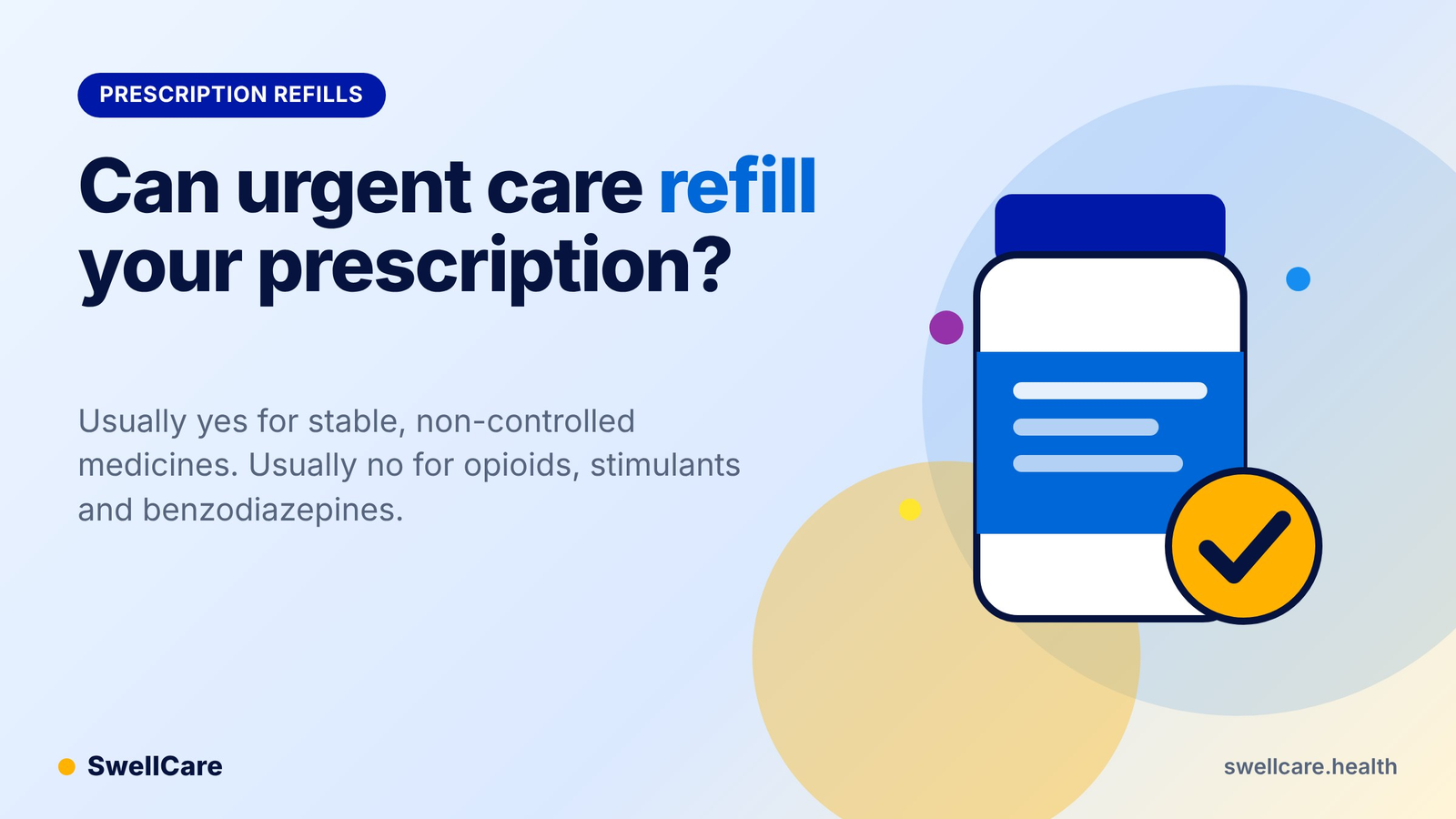
So, can urgent care refill prescriptions? Often, yes. Most clinics will write a short refill for a stable, non-controlled medication after a quick review. They won’t touch opioids, Adderall or Xanax. And a refill from urgent care is a one-time bridge, not a fix.
Below you’ll find what urgent care can and can’t refill, what to bring, what it costs, and a faster option if the waiting room sounds like the worst part of your night.
The short answer: yes, for many (but not all) prescriptions
Urgent care clinicians can prescribe medication, and that includes renewing one you already take. Think of it as a one-time refill. The clinician asks what you take, why you take it and whether anything has changed. If the drug is stable and low risk, you leave with a prescription for enough to reach your regular doctor.
The drug decides the answer, not the clinic. Medicines with a long safety record are fair game. Medicines that can be misused, or that need lab work every few months, usually aren’t.
Clinics also differ from one another. The Urgent Care Association counts 15,101 centers across the US, and no two run quite the same way. One may refill your asthma inhaler without a second thought. Another across town may send you to your primary care doctor. A two-minute call to the clinic saves the drive, and the clinician will send any new prescription to your pharmacy.
Prescriptions urgent care can usually refill
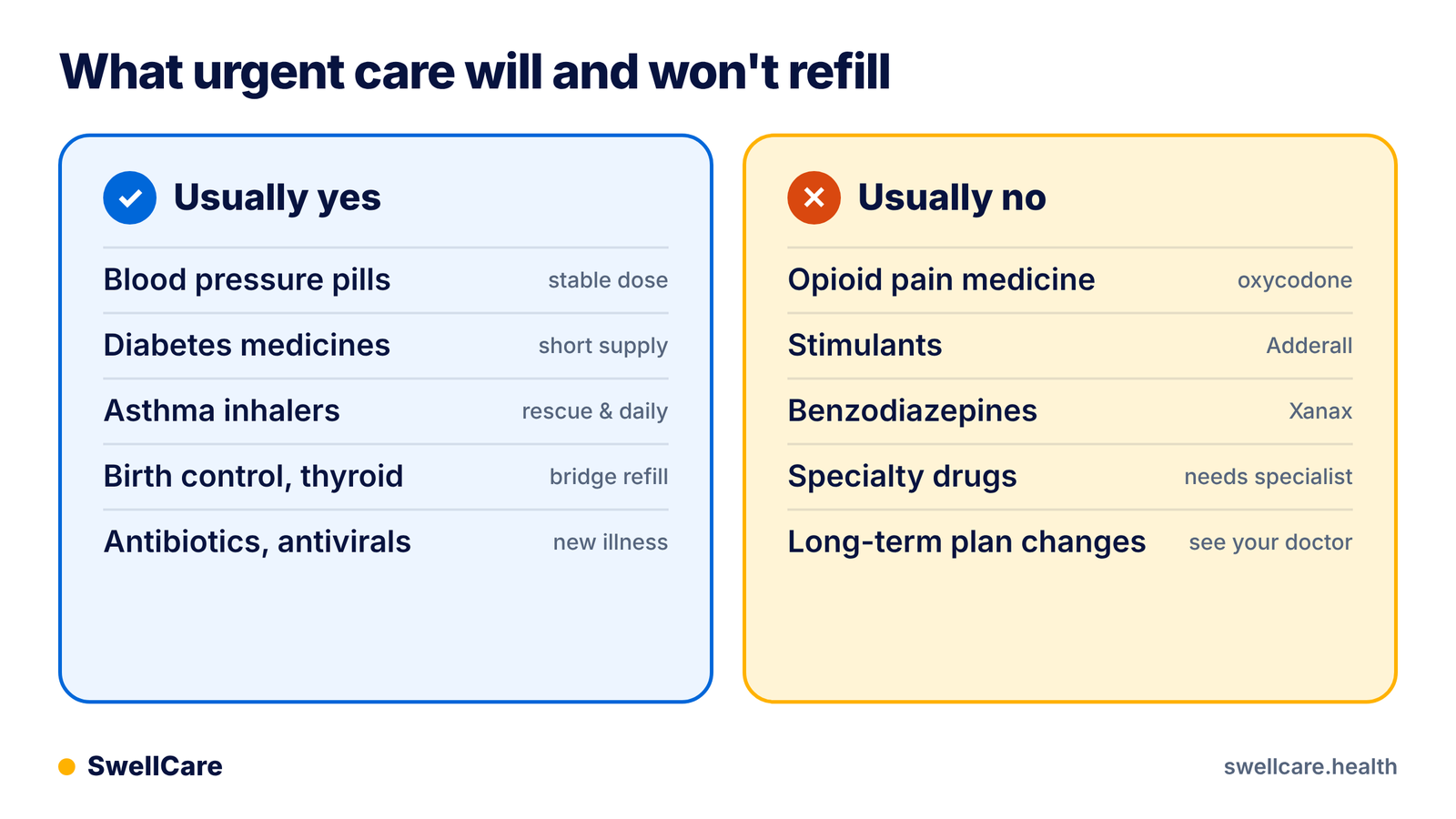
So, can urgent care refill prescriptions for your particular drug? It comes down to a pattern. Urgent care tends to say yes when a medication is stable, non-controlled and unlikely to cause harm if you take it for a few more weeks.
| Medication type | Common examples | What to expect |
|---|---|---|
| Blood pressure | lisinopril, amlodipine | A one-time refill, often after a quick blood pressure check |
| Diabetes | metformin | A short supply, with a push to book a follow-up |
| Asthma inhalers | albuterol | Usually yes, sometimes after a lung check |
| Thyroid | levothyroxine | A bridge refill until your next lab work |
| Birth control | daily pills | A short supply while you set up a regular visit |
| Antibiotics and antivirals | amoxicillin, oseltamivir | A new prescription for a new illness, not a refill |
Antibiotics and antivirals sit in a slightly different bucket. If you’ve got a new sinus infection or the flu, an urgent care clinician can prescribe antibiotics when bacteria are likely, or antivirals when the flu is caught early. An antibiotic won’t help a cold. Don’t expect one just because you asked.
Why it is usually a short bridge, not a new long-term plan
A refill at urgent care covers the gap, whether it’s an inhaler or a blood pressure pill. It isn’t a plan. The clinician can’t see your full history, your past labs or how your dose has changed over the years. So they’ll usually give you a limited supply and tell you to book with your primary care doctor.
Some medicines need monitoring, such as blood tests for thyroid or diabetes drugs. If that check is overdue, expect questions. That’s not red tape. It’s how a refill stays safe.
What urgent care won’t refill
Some prescriptions are a firm no, and a few clinics may also decline others on a case-by-case basis. The usual list includes:
- Controlled substances such as opioid pain medicine, stimulants, and benzodiazepines used for anxiety.
- Medicines that need close monitoring, like blood thinners that depend on regular lab checks.
- Specialty drugs managed by a specialist, such as some treatments for cancer, transplants or rare conditions.
- Anything you stopped taking months ago and now want to restart.
If you’re not sure which bucket your drug falls into, call the clinic and ask the front desk before you go.
Controlled substances: opioids, stimulants and benzodiazepines
This is the question clinics hear most. Oxycodone is a Schedule II drug. Adderall, a stimulant used for ADHD, is Schedule II too. Xanax is a benzodiazepine used for anxiety, and it sits in Schedule IV.
For Schedule II drugs, the federal rule is blunt. Title 21, section 1306.12 of the Code of Federal Regulations bars refilling them at all, so every fill needs a fresh prescription from a clinician who has judged it medically necessary.
Benzodiazepines are different on paper, since refills are allowed in some cases. In practice, most urgent care clinics still say no. They don’t know your history, they can’t monitor you over time and the risk of misuse is real. Anxiety medication belongs with a clinician who knows you. Ask your regular prescriber for a plan if you’re running low.
What to bring to a refill visit
You’ll get a faster, safer answer at urgent care if you show up prepared. Bring:
- The pill bottle, or a clear photo of the label.
- Your pharmacy’s name and number.
- A list of everything else you take, including supplements.
- The name of your prescriber and the date of your last visit.
- Your insurance card, or a way to pay if you’re self-pay.
Be honest about why you ran out. “I lost my last refill in the move” and “I stopped taking it for two months” lead to very different plans. Clinicians hear both, and neither one is a problem if you say so.
Urgent care, primary care, pharmacy or online: which refill route fits?
You’ve got more than one way to get a refill, and the best one depends on how fast you need it and what you take.
Urgent care wins on speed. The Urgent Care Association reports an average visit of about 56 minutes.
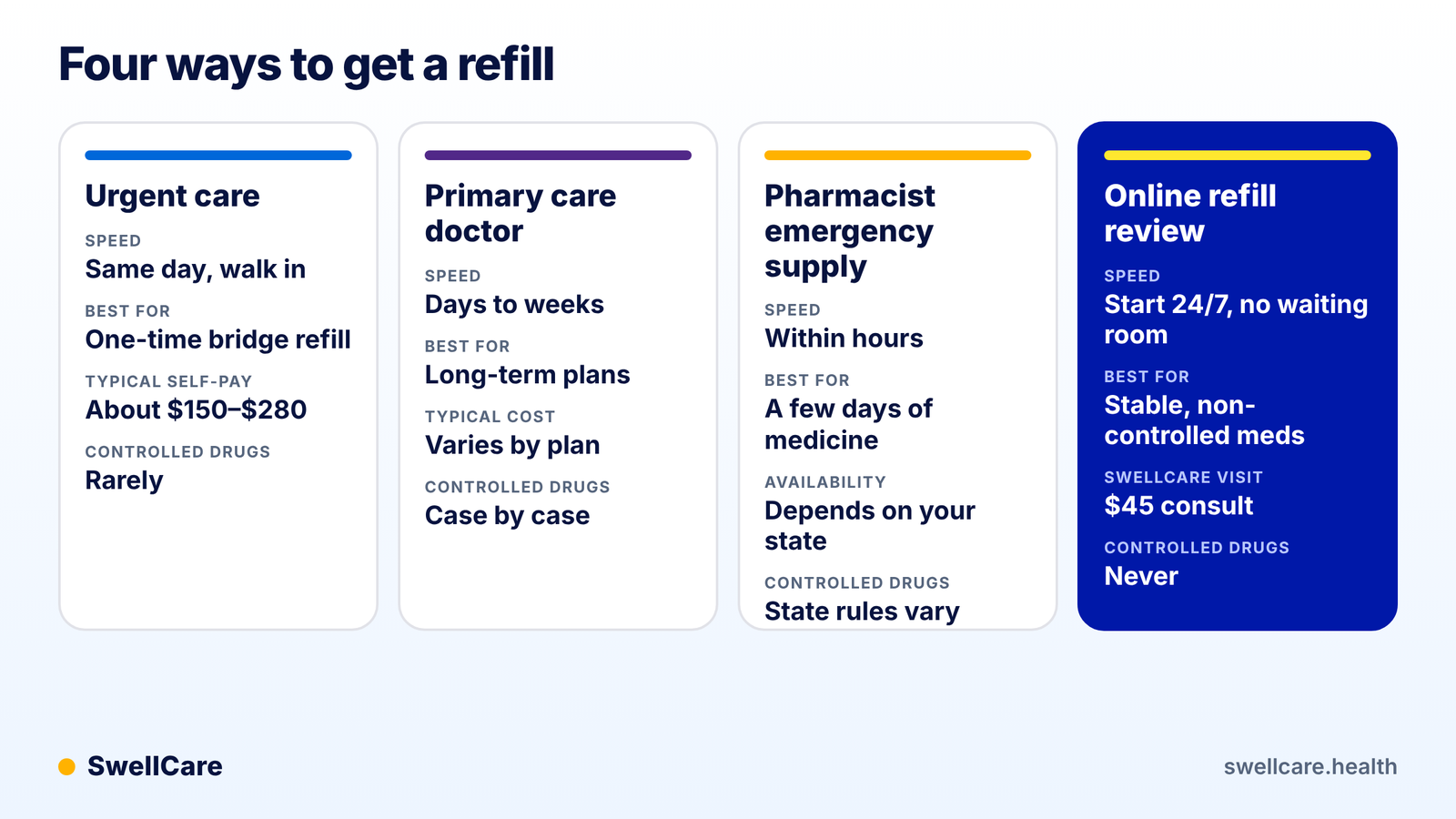
Your primary care doctor is still the best long-term answer. They know your history, and a refill from them comes with monitoring. The downside is waiting. In many practices that means days or weeks.
A pharmacist can sometimes help in a pinch. A 2022 review by Healthcare Ready found that 23 states have general emergency-refill laws, and in 15 of them the limit is 72 hours. Others have no such law. Ask your pharmacist about an emergency supply of your medication before you assume you’re stuck.
Telehealth is the fourth route. A licensed clinician reviews your medication by chat or video, and you skip the drive. It works well for a one-time bridge refill of stable medications. It isn’t built for controlled substances.
What it costs without insurance
Self-pay prices vary a lot. One 2026 guide from Solv Health puts a basic urgent care visit at roughly $150 to $280, before any tests (here’s what urgent care blood work costs). It puts an uninsured emergency room visit for a common problem at about $1,000 to $2,500. With a health plan, you’ll usually pay a copay instead.
If all you need is a refill, the ER is the most expensive place to ask. Urgent care costs far less.
A faster option when you just ran out
Sometimes the problem isn’t that you can’t get a refill. It’s that you can’t get one tonight. That’s the gap Swell was built for.
A Swell clinician can review many stable, non-controlled medications and tell you whether a short refill is safe. You start with a free screening chat. If you go ahead, the consultation is $45, with no monthly membership. Medication and lab costs are separate. It’s open 24/7, by chat or video.
Be clear about the limits. Swell doesn’t prescribe controlled substances, and no refill is promised before a clinician has looked at your history. The answer might be a limited refill, more testing, another evaluation, or a message to your usual prescriber. That honesty is the point.
When to skip the refill and get care now
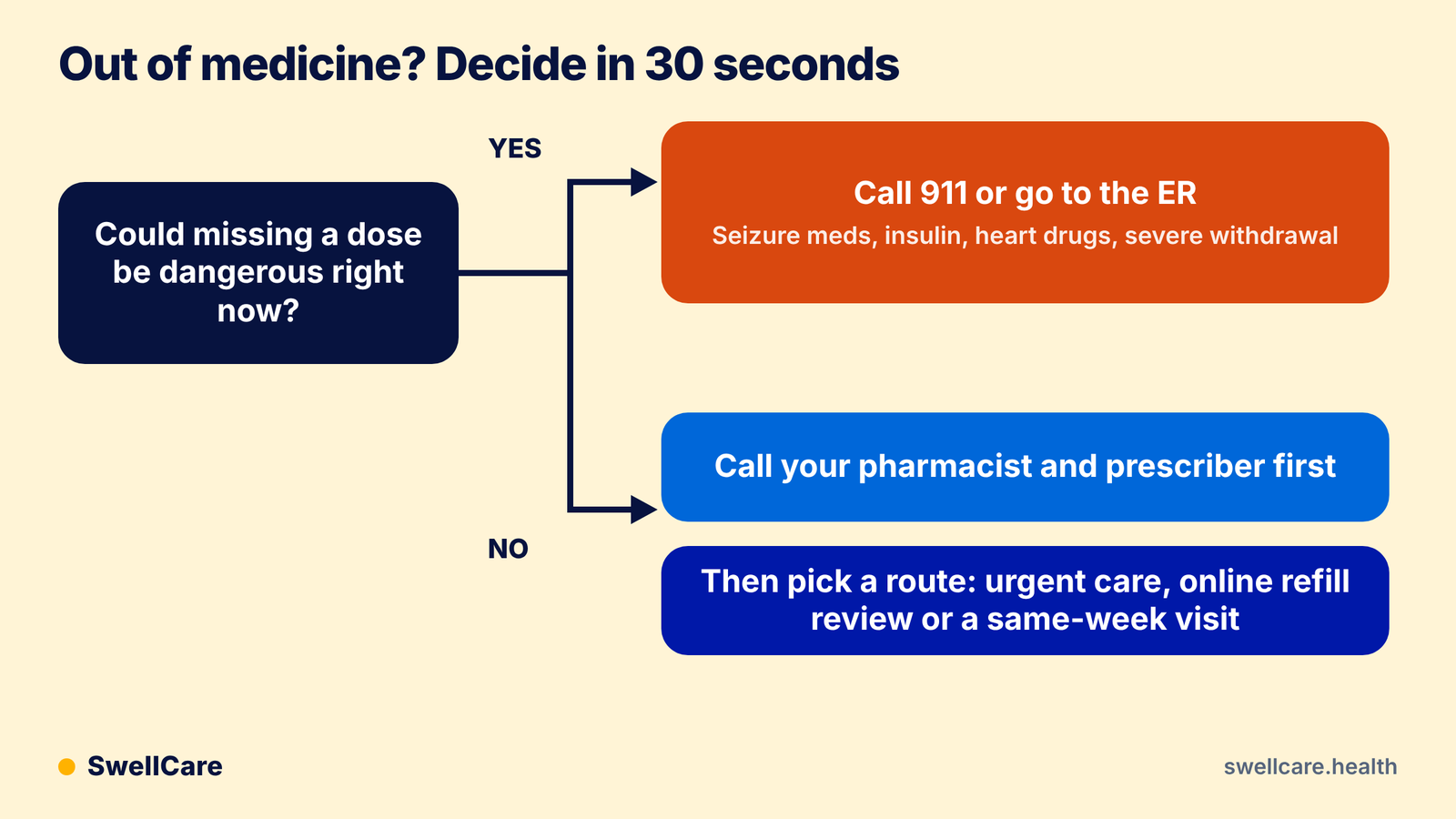
Some situations can’t wait for any refill route. Call 911 or go to the ER if missing a dose could put you in danger, for example with seizure medication, insulin, heart drugs, or when you’re facing severe withdrawal. The same goes for chest pain, trouble breathing or sudden confusion.
For anything less urgent, call the pharmacy and your prescriber first. Then pick the route that fits.
Your next step
Look at your bottle right now. How many doses are left? If the answer is “enough for tomorrow,” you’ve got time to do this properly.
Start with a call to your pharmacy. Then, if your medication is stable and non-controlled, start a free refill screening with Swell. You’ll know what the clinician can do, what it costs and what comes next before you pay for anything.
Questions people ask about urgent care refills
Can I go to urgent care to refill medication?
Yes, for many stable, non-controlled medications. The clinician will review your history and usually give a one-time supply to bridge you to your regular doctor. Controlled substances and drugs that need close monitoring are the usual exceptions. Call ahead, because policies differ from clinic to clinic.
Can urgent care prescribe oxycodone?
Rarely. It’s a Schedule II opioid, and federal rules don’t allow Schedule II refills. Some urgent care clinicians will write a short, new prescription after an injury or procedure, but most won’t renew a long-term supply. If you take it for ongoing pain, your regular prescriber should manage it.
Can urgent care refill Adderall?
Almost never. It’s a Schedule II stimulant, so it can’t be refilled, and clinics rarely start or renew ADHD treatment without a full evaluation. Contact the clinician who prescribes it. If you’ve lost your supply, ask them what the options are before you go anywhere else.
Will urgent care prescribe Xanax?
Usually not. It’s a Schedule IV benzodiazepine, and most clinics decline to prescribe it because they can’t monitor you over time. If you take it regularly for anxiety or panic, stopping suddenly can be risky, so call your prescriber or pharmacist today and ask for a safe plan.
Can urgent care refill a prescription without insurance?
Yes. Most urgent care clinics take self-pay patients, and many post their prices online or will quote one by phone. Expect to pay for the visit itself, plus the medication at your pharmacy. Ask about the self-pay price before you go, and compare it with an online option if cost matters most.
Trusted references
Public-health, research, and medical-society resources related to this guide.