You chewed a hangnail on Sunday. By Tuesday the skin beside your nail is puffy, hot and throbbing every time you type. Sound familiar?
Here’s the short answer. A mild case usually responds to an infected cuticle home remedy you already have the tools for: warm water, a clean towel and a little patience. Antibiotics come into play when pus won’t drain, redness spreads or your health puts you at higher risk. This guide walks you through the soak routine step by step, the red flags that mean “stop and get seen,” and how to tell whether you need a prescription at all.
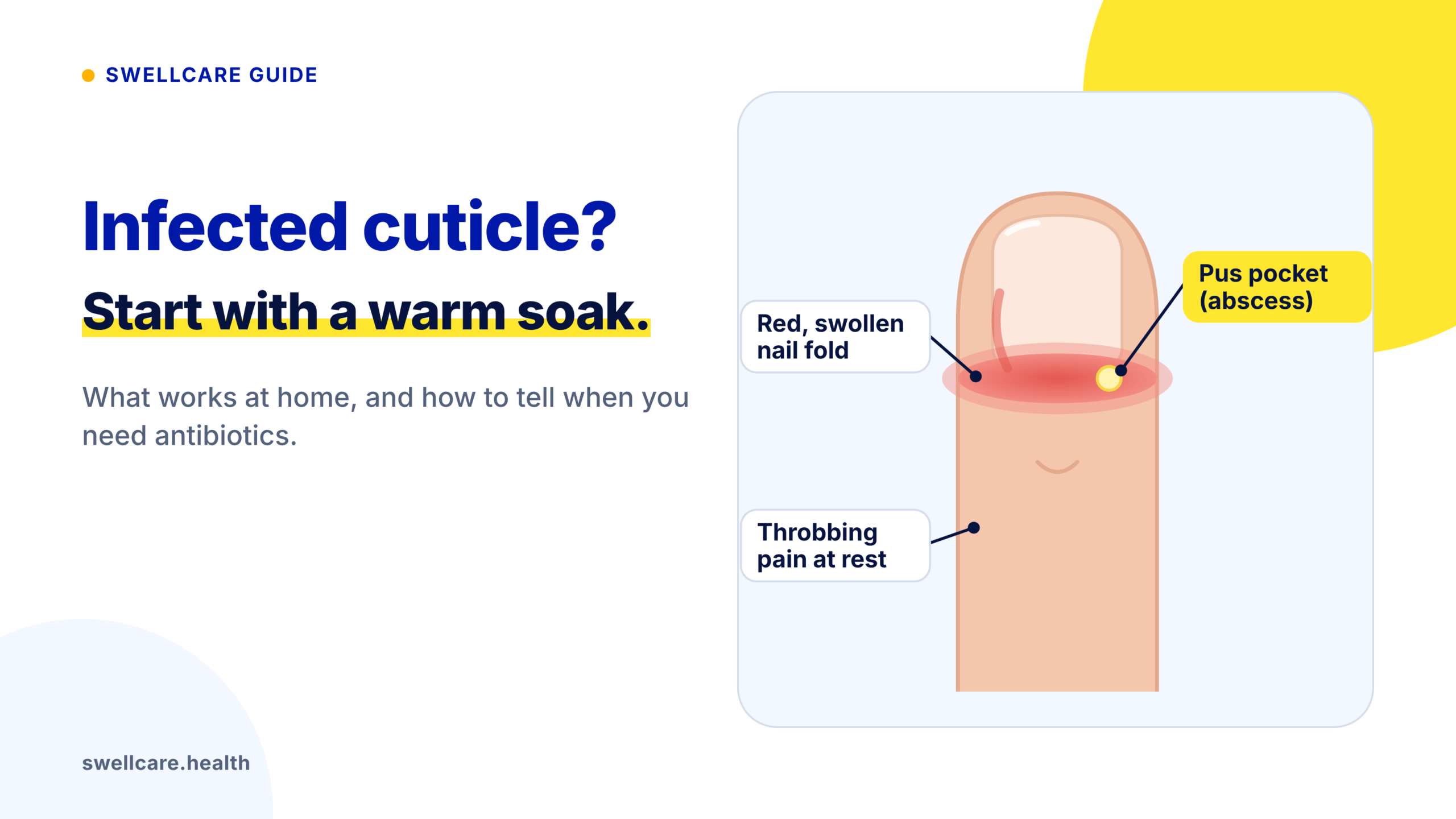
Is your cuticle really infected? What to look for
Doctors call an infection of the skin fold around a nail paronychia (pair-oh-NIK-ee-ah). The acute kind builds fast, over hours or a few days, and it usually hits one finger. The chronic kind creeps along for six weeks or more and often involves several fingers. Cleveland Clinic describes it as an infection that stays in the nail fold and clears up in under six weeks.
Irritated and infected can look alike on day one. This is how to tell them apart:
| What you notice | Probably just irritated | Probably infected |
|---|---|---|
| Redness | Mild, fades within a day | Spreading and warm to the touch |
| Pain | Sore when pressed | Throbbing, even at rest |
| Swelling | Slight puffiness | Tight, shiny nail fold |
| Pus | None | A yellow or white pocket under the skin |
| Trend | Better each day | Worse each day |
A greenish tint under the nail can point to Pseudomonas bacteria, according to the American Family Physician review of paronychia. That one’s worth mentioning to your doctor.
Why this infection starts
Your cuticle and the nail fold around it work like a gasket for the skin. They seal out germs. Break that seal and bacteria, usually staph or strep, walk right in. Most paronychia starts with a break in the skin so small you never noticed it. Moisture makes things worse, and fungal germs such as Candida love skin that stays wet.
The usual ways the seal breaks: biting or picking at a hangnail, trimming cuticles too close, rough manicures, and hands that stay wet for hours. A snagged nail edge or a bitten nail does the same job. Bartenders, dishwashers and housekeepers get it a lot. So do people who wear artificial nails. The AAFP review also notes that women are affected about three times as often as men.
The infected cuticle home remedy that actually works
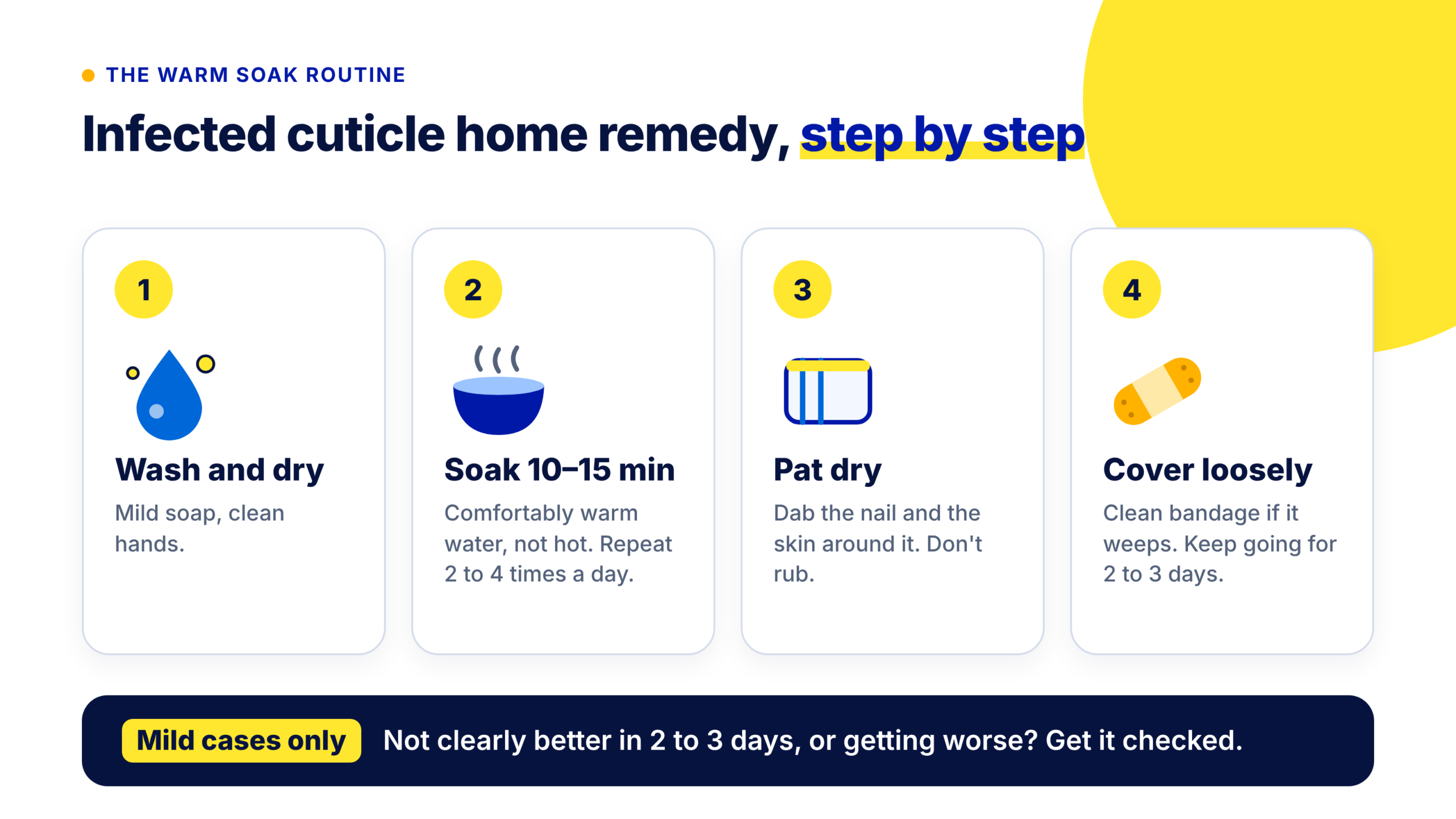
Warm soaks are the first-line move for a mild infection with no pus pocket. They ease swelling and pain, and they help pus drain on its own, which takes pressure off the nail and the skin around it. Here’s the routine:
- Wash your hands with mild soap and dry them.
- Fill a bowl with comfortably warm water. Warm, not hot.
- Soak the finger, nail and all, for 10 to 15 minutes. StatPearls recommends that length, repeated several times a day.
- Repeat two to four times a day, though MedlinePlus says two or three is plenty.
- Pat the nail and skin dry. Don’t rub.
- Cover it loosely with a clean bandage if it’s weeping.
Keep this up for two to three days, and most mild infections turn a corner in that window. If yours hasn’t, call your doctor.
Plain warm water is enough. Clinics sometimes add Burow’s solution or 1% acetic acid, but the AAFP review says those haven’t been studied much, so there’s no reason to hunt for them.
What not to do while it heals
Resist the urge to squeeze. Don’t pick at it, cut it or dig under the nail fold with a pin. You can push bacteria deeper into the nail fold and tear the skin.
Skip cuticle trimmers and removers until it’s healed, because they weaken the very seal you’re trying to rebuild. Hold off on nail polish and acrylics too, and cancel that manicure. Wear gloves for dishes and cleaning while it heals.
One more trap: many triple antibiotic ointments contain neomycin, and the AAFP review discourages it because roughly 1 in 10 people develop an allergic reaction. Check the label. Bacitracin on its own is a gentler choice, and a clinician can prescribe mupirocin.
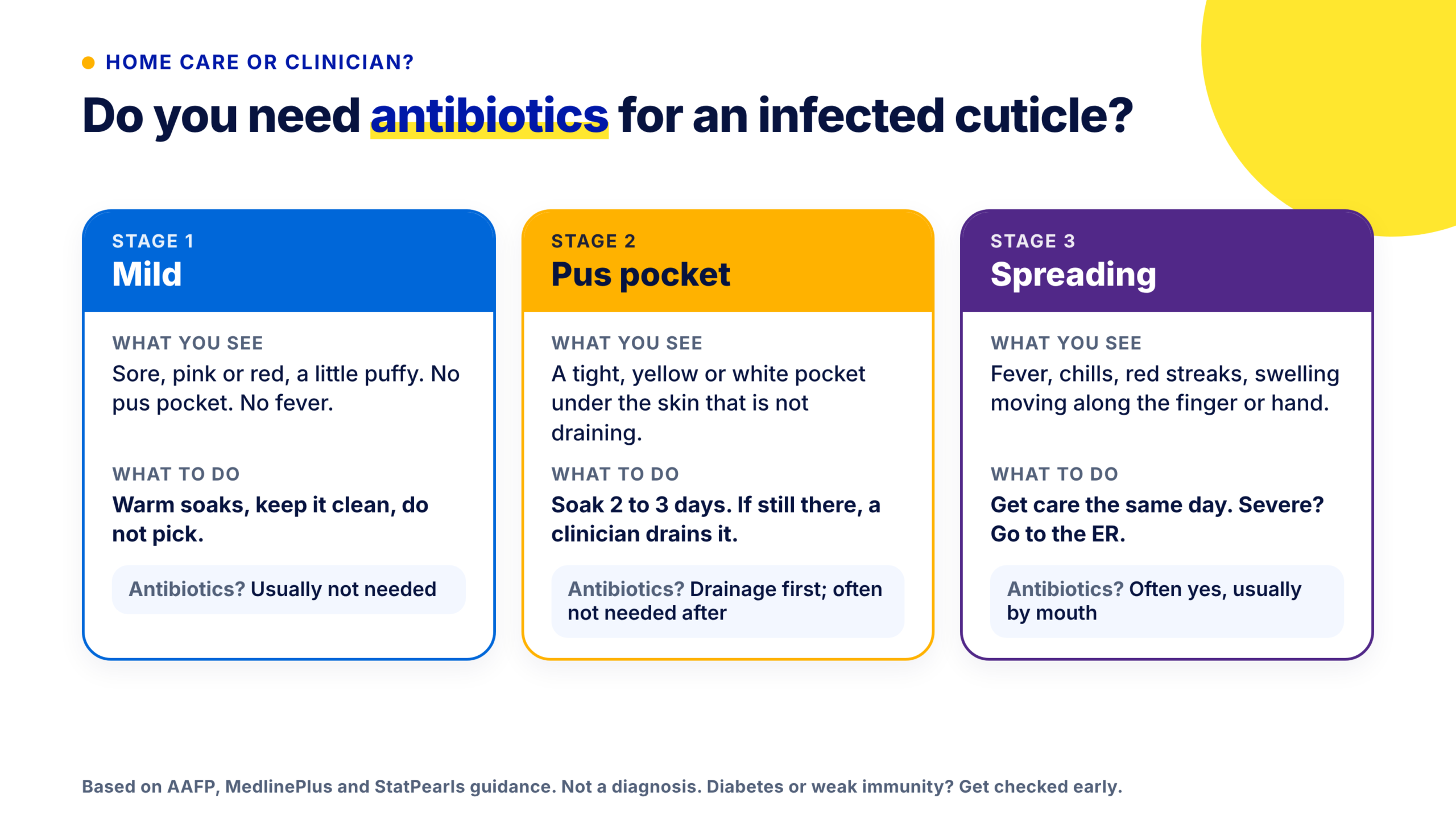
When do you actually need antibiotics?
Fewer people need them than you’d think. Whether you do depends on what’s going on under the skin. Antibiotics kill bacteria. They don’t calm irritation.
Antibiotics are not always the answer
For mild paronychia with no sign of cellulitis (a spreading skin infection), the AAFP says warm soaks with a topical antibiotic, sometimes plus a topical steroid, are the standard approach. Oral antibiotics are “limited” to specific situations: clear cellulitis, a weakened immune system, or a patient who’s seriously ill.
If there’s an abscess, a true pocket of pus, the fix is drainage. Once it’s properly drained, systemic antibiotics generally don’t improve the cure rate.
What a clinician may prescribe or do
A doctor may start with a prescription topical antibiotic. Adding a topical steroid can shorten the time to feeling better, according to the AAFP.
Oral antibiotics enter the picture when infection is spreading. For typical staph, cephalexin is a common pick. If MRSA is a concern, clindamycin, doxycycline or trimethoprim/sulfamethoxazole may be used instead, based on local resistance patterns. If you’re prescribed an oral antibiotic, finish the whole course even when the finger looks better.
And if soaks plus topical treatment haven’t helped after two to three days, or the pain is severe, the AAFP says a clinician should drain it. That means opening it with a fine needle or small blade.
Red flags: when to stop home care and get seen
Home care works on a mild infection, not a severe one. Use this table as a tripwire:
| Sign | What it may mean | What to do |
|---|---|---|
| Fever, chills, red streaks | Infection spreading | Same-day care |
| Pus pocket still there after 2 to 3 days of soaks | Abscess | Have a doctor drain it |
| Getting worse, or no better after a day or two | Needs evaluation | Book a visit |
| Swelling spreading up the finger or hand | Deeper infection | Urgent in-person care |
| Diabetes, poor circulation or a weak immune system | Higher risk | Get checked early |
MedlinePlus lists fever, chills, red streaks, a general ill feeling and joint or muscle pain as signs the infection has spread. Spreading infection can move fast, so don’t wait it out. Cleveland Clinic advises people with diabetes or a circulation condition to call their doctor as soon as they notice signs of infection.
When it keeps coming back: chronic paronychia
If the problem has dragged on six weeks or more, or it keeps hopping from finger to finger, you’re likely dealing with chronic paronychia. It’s usually less an infection than an irritant problem: constant moisture, soaps and chemicals breaking down the skin of the nail fold. A fungal infection, often Candida, can ride along with the bacteria, and the fungal part makes chronic cases stubborn. Fungal cases look similar but need different care.
Antibiotic soaks won’t fix that. The AAFP says the mainstay is cutting out the irritant and calming inflammation with a topical steroid, and it advises against antifungals as a first move. Chronic cases take weeks to months. One stubborn finger that won’t heal deserves a doctor’s look, since it could be something else.
How to keep your cuticles from getting infected again
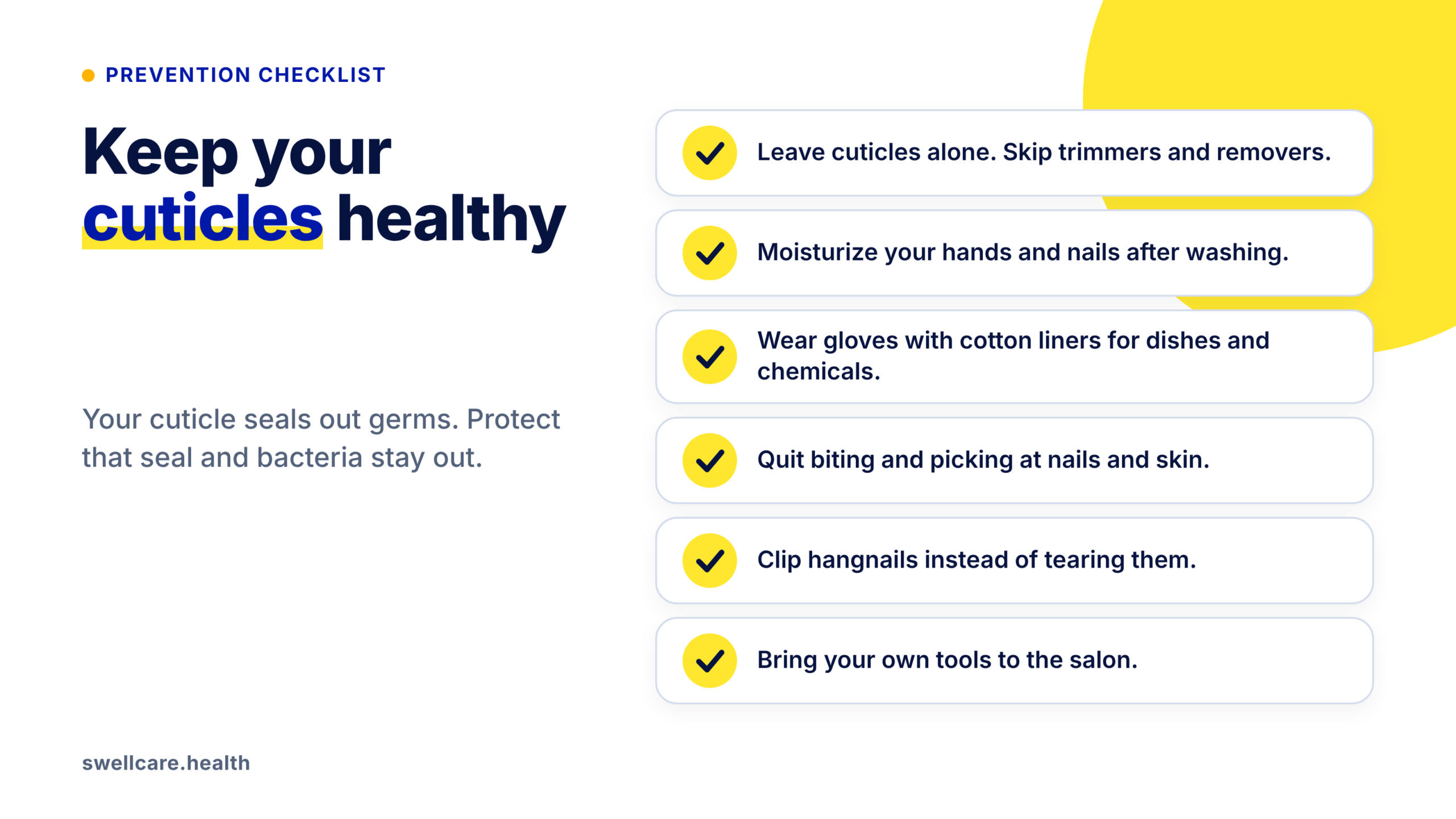
- Leave the skin alone. Cuticle trimmers and removers weaken the seal, so skip them.
- Moisturize your hands and nails after you wash them. Dry, cracked skin invites chronic paronychia.
- Wear rubber gloves with cotton liners for dishes and chemicals.
- Quit biting and picking. Clip hangnails instead.
- Bring your own tools to the salon.
Get a clinician’s eyes on it today
If you’re staring at your finger wondering whether yours needs antibiotics, that’s exactly the question Swell answers. Our clinicians are available around the clock by secure chat or video, and you start with a free screening. No waiting room, no insurance maze.
We’ll be straight with you about the limits. We can’t drain an abscess over video. If yours needs that, we’ll tell you plainly and point you to in-person care. And if you have a high fever or the redness is racing up your hand, skip us and call 911 or go to an emergency room.
Tell us what’s going on or see how it works first. More questions? See the Swell FAQ.
Questions people ask about infected cuticles
How do you treat an infected cuticle at home?
Soak the finger for 10 to 15 minutes in comfortably warm (not hot) water, two to four times a day. Pat it dry, keep it covered if it weeps, and don’t pick or cut the skin. Mild cases often improve within a few days. If it’s worsening or there’s a pus pocket, get it checked.
How long does an infected cuticle take to heal?
A mild acute infection usually settles within a few days of consistent soaking. Once a pocket is drained, recovery is usually quick. Chronic problems take weeks or months, because the irritation behind them has to stop first.
Can an infected cuticle go away on its own?
Sometimes, especially if the infection is mild and you keep it clean and soak it. But don’t just wait it out. If the redness spreads, the pain throbs or pus builds up, get it checked.
Should I pop or drain an infected cuticle myself?
No. Squeezing can push bacteria deeper and damage the nail fold. Warm soaks often let a pus pocket drain on its own. If it doesn’t, a clinician can open it safely with a sterile needle or blade.
Can I put antibiotic ointment on an infected cuticle?
You can, but pick carefully. Many triple antibiotic ointments contain neomycin, which causes allergic reactions in roughly 10% of people. Bacitracin alone is a gentler option. A clinician can prescribe mupirocin if you need something stronger.
Do I need antibiotics for an infected cuticle?
Often you don’t. Mild cases usually do fine with soaks, and a drained abscess typically doesn’t need oral antibiotics. You’ll likely need them if infection is spreading, if you’re immunocompromised or if you’re very unwell. A doctor can sort out which group you’re in.
Trusted references
Public-health, research, and medical-society resources related to this guide.