It’s 2 a.m. You’ve rolled left, rolled right, wedged a cushion behind you, and your lower back still feels like a clenched fist. You’re not alone. Learning how to sleep with lower back pain mostly comes down to one idea: keep your spine in a neutral line while you sleep for hours. Below you’ll find the four positions that help most, exactly where the pillows go, and the signs that a rough night is really a reason to call a doctor.
Why lower back pain feels worse at night
Sore backs are everywhere. A 2019 CDC survey found that 39% of US adults had pain in their backs in the previous three months, and the National Center for Complementary and Integrative Health says about 80% of adults will have a bout of it at some point.
Nights are tricky for a simple reason. During the day, your muscles are busy holding you upright. Lie down on a bed that sags, and your hips can drop, the lumbar curve flattens or over-arches, and the small muscles along your spine stay tense for hours. Your posture can’t adjust while you sleep, so a bad setup holds all night. Stress tightens those muscles further.
You wake up stiff. Sleep quality takes a hit, and a body short on sleep feels pain more sharply the next day. That loop is worth breaking.
The target isn’t a perfect sleeping position. It’s a supported one.
The best sleeping positions for lower back pain
Mayo Clinic and Cleveland Clinic give similar advice. Keep your head, shoulders and hips in alignment, and use pillows to fill the gaps your mattress leaves. Try each sleeping position while you’re awake, then sleep on it for three nights before you judge it.
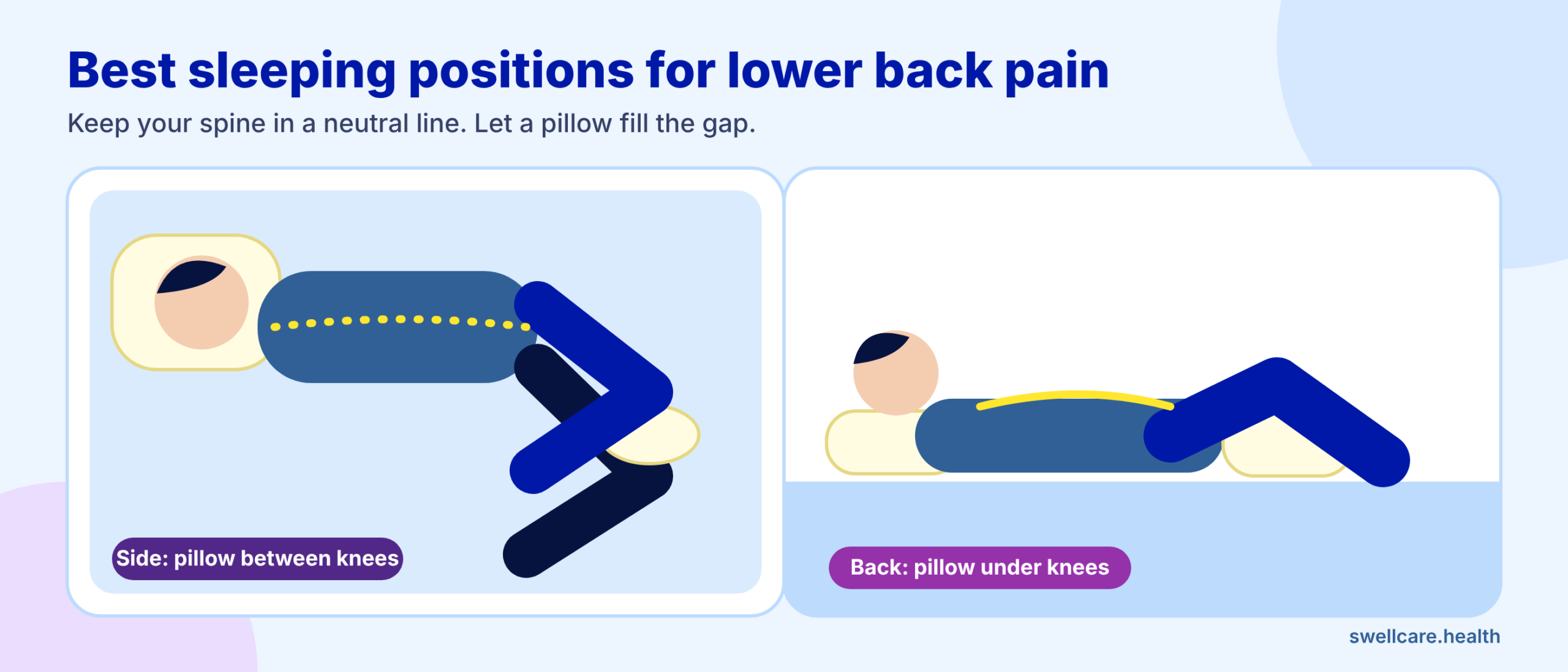
Side sleeping with a pillow between your knees
Of all the sleeping positions, this is the one most side sleepers can hold all night. Draw your legs up slightly and slide a firm pillow between your knees. A full-length body pillow works too. Without it, your top leg drops forward and twists the pelvis, which tugs on the lower back.
Mind your neck and posture, too. The support under your head should fill the space between your ear and the mattress, so your neck stays in alignment. Side sleepers with broad shoulders often need a taller one. Switch sides now and then so one hip doesn’t take all the pressure, and if you’re sleeping on your side and still ache, tuck a small rolled towel under your waist.
Back sleeping with a pillow under your knees
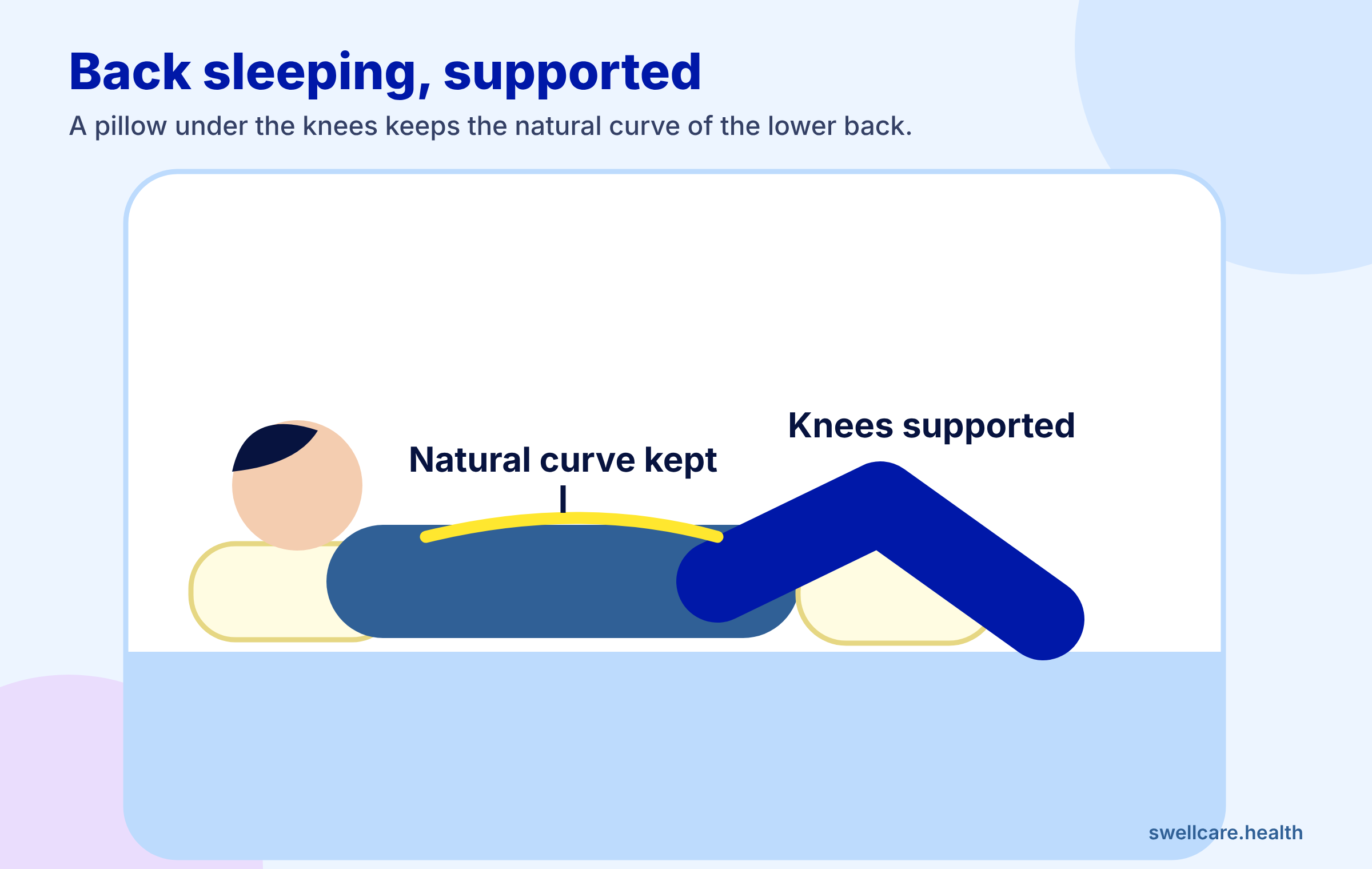
For many people with lower back pain, sleeping on your back is the least stressful choice for the spine. The catch is that straight legs pull on the lumbar region and flatten its curve. A pillow under your knees keeps spinal alignment closer to how you stand.
Here’s a quick test before you sleep. Slide a hand under your lower back. A little room is right. A big gap means you need more knee support, and no room at all means you need less. Back sleeping also suits many people with a herniated disc, though it’s worth testing rather than assuming.
The fetal position, stretched out
A tight curl feels cozy at midnight and cranky by morning. Loosen it. Keep a gentle bend at the hips, hug something soft if that helps, and let your back stay long rather than rounded.
Cleveland Clinic notes that curling up can ease pain tied to spinal stenosis, but it can make pain from other causes worse. Trust how your body responds. If the fetal position lets you sleep, keep it. If you wake up sorer, drop it.
Stomach sleeping, if you can’t switch
Be honest: most clinicians would rather you skipped stomach sleeping. It pushes the lower spine into an arch and turns your neck to one side for hours.
If it’s the only way you can sleep, slide a thin pillow under your pelvis and lower stomach, and use a very flat one under your head. Then retrain slowly. Start the night with side sleeping and a body pillow in front of you, and let your stomach be the backup, not the plan.
Pillows and mattress: what actually helps
Pillows do the heavy lifting for sleep, and they’re cheap. Mattresses are messier. You’ll see “medium-firm mattress” on nearly every list, and it’s a sensible starting point, but the evidence behind it is thin.
Harvard Health points to one survey of 268 people with sore backs: very hard mattresses went with the worst sleep quality, while medium-firm and firm beds showed no clear difference. Mayo Clinic says no single mattress has been proven best.
So skip the showroom promises. If your hips sink lower than your shoulders, a firmer base or a mattress topper is worth trying. When you do shop, test a new one for longer than a few minutes.
A wedge pillow, or an adjustable bed that lifts your head and knees a little, helps some people sleep. It tends to suit anyone whose pain eases in a reclined position, which is common with spinal stenosis.
A bedtime routine that eases a stiff back
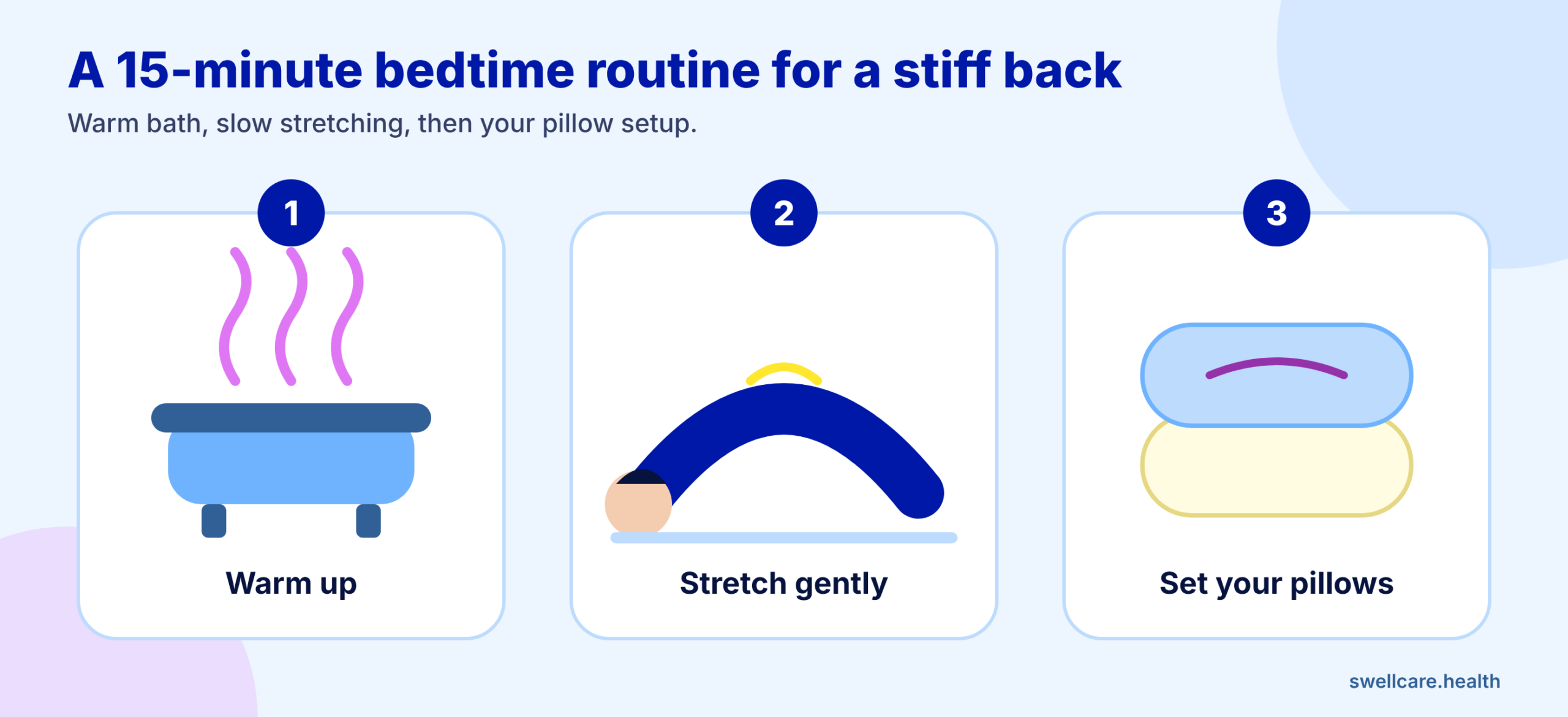
Knowing how to sleep with lower back pain also means winding down first. Good sleeping positions work better on a calm body, and a short bedtime routine of about 15 to 20 minutes is basic sleep hygiene.
Run a warm bath. A warm bath helps many people unwind, and Cleveland Clinic says moist heat may work better than dry heat. If you use a heating pad, set it aside before you drift off. Heating pads can burn skin.
Try gentle stretching. Slow movement, like cat-cow, child’s pose or a bridge, can loosen the lumbar muscles. Stop if anything hurts.
Cut the sleep thieves. Skip caffeine after lunch and keep alcohol light. A nightcap feels relaxing but chops up sleep, and broken sleep makes pain feel bigger.
Settle your stress. Slow breathing or a few quiet minutes beats scrolling in bed.
One myth is worth dropping: bed rest isn’t the answer. Cleveland Clinic says lying in bed too long doesn’t help, and light movement, like a short walk or some stretching, usually does.
Getting in and out of bed without a flare-up
Evenings and mornings are when many people tweak their backs, so use a log roll. To get in, sit on the edge of the bed, lower yourself onto one side, bring your legs up, and roll onto your back as one unit. To get out, reverse it: roll onto your side with legs bent, let them slide off the edge, and push up with your arms.
Keep your shoulders, hips and knees moving together so your spine doesn’t twist. Pause for a breath before you stand, and keep your posture tall when you do.
When to see a doctor about a sore back at night
Most flare-ups ease with self-care within a few weeks. Some patterns shouldn’t wait, and Mayo Clinic and the American Academy of Orthopaedic Surgeons draw the line in similar places.
Book a visit with a doctor or health care provider if your pain:
- lasts more than a few weeks or keeps costing you sleep
- is severe and doesn’t ease when you rest
- spreads down a leg, especially below the knee
- comes with weakness in a leg, or numbness and tingling that follow a nerve down it
- shows up alongside unexplained weight loss
Go to an emergency room right away if you have new trouble controlling your bladder or bowels, numbness in the groin or inner thighs, or pain after a fall or injury. Those can be signs of cauda equina syndrome, which Cleveland Clinic says often needs surgery within 24 to 48 hours.
Not sure which group you’re in? Swell’s clinicians can review your symptoms by secure chat or video, around the clock. It isn’t emergency care, and it doesn’t replace your primary doctor, but it can help you decide what’s next. See how Swell works or read more in the Swell Health Journal.
Questions people ask about sleeping with lower back pain
What is the best sleeping position for lower back pain?
There isn’t one winner, but two come up most: sleeping on your side with a pillow between your legs, or sleeping on your back with one under your knees. Both keep your spine and pelvis in alignment. Pick the one you can sleep in comfortably, and give it a few nights.
Is it bad to sleep on your stomach with lower back pain?
For most people it isn’t an ideal sleeping position. Stomach sleeping arches the lumbar spine and twists the neck. If you can’t sleep any other way, place a thin pillow under your pelvis and use a flat one for your head. Then move toward your side over a few weeks, using a body pillow as a bumper.
How can I sleep with lower back pain and sciatica?
There’s no perfect sleeping position for sciatica, which is irritation of a nerve running down the leg. Many people do best sleeping on your side opposite the pain with a pillow between the legs, or flat on the back with support under the knees. Keep your head, shoulders and hips in alignment. If leg pain or weakness is new, see a health care provider.
What kind of pillow helps with lower back pain?
You usually need two. A firm one between or under your legs supports the pelvis and spine, and a head pillow sized to your shoulders keeps your neck level. A full-length body pillow suits side sleeping. Replace any that go flat, or your alignment slips.
Does heat or ice help a sore back at night?
Cold packs may help fresh pain, and heat often feels better once swelling settles. Moist heat may beat dry heat. Put a cloth between you and the heat source, use a timer, and never sleep on a heating pad. If pain keeps getting worse, don’t keep treating it at home.
Trusted references
Public-health, research, and medical-society resources related to this guide.