Your lab report has a little “H” next to hemoglobin, and now you’re reading portal notes at 11 p.m. Take a breath. High hemoglobin causes run from a glass of water you forgot to drink to a rare bone marrow disease, and most people land at the gentle end of that range.
Here’s the short version. Hemoglobin is the protein in your red blood cells that carries oxygen. Your number climbs when you’re dehydrated, when your body is short of oxygen, when a medicine pushes red cell production, or, rarely, when the bone marrow overproduces on its own. One high result is a reason to look closer. It isn’t a diagnosis.
What counts as a high hemoglobin level?
Hemoglobin levels are reported in grams per deciliter (g/dL) on a complete blood count, or CBC. It’s a simple blood test, and every lab sets its own cutoffs. MedlinePlus lists typical adult ranges of 13.8 to 17.2 g/dL for men and 12.1 to 15.1 g/dL for women, and Mayo Clinic calls a count high above roughly 16.6 g/dL in men and 15 g/dL in women.
| Typical adult range | Often flagged as high | |
|---|---|---|
| Men | 13.8 to 17.2 g/dL | above about 16.6 g/dL |
| Women | 12.1 to 15.1 g/dL | above about 15 g/dL |
Your report may also show hematocrit, the share of your blood volume that red blood cells take up. The two numbers usually rise together, so doctors read them as a pair. Healthy red blood cells are good news; it’s the amount that matters.
Most outpatient cases are mild. Hemoglobin levels of 16 to 18 g/dL in a man, or 15 to 17 in a woman, are common and usually have an explanation. Any high hemoglobin level is worth a second look, though. The Blood Project puts the very high zone above 18.5 g/dL.
High hemoglobin causes: the common ones
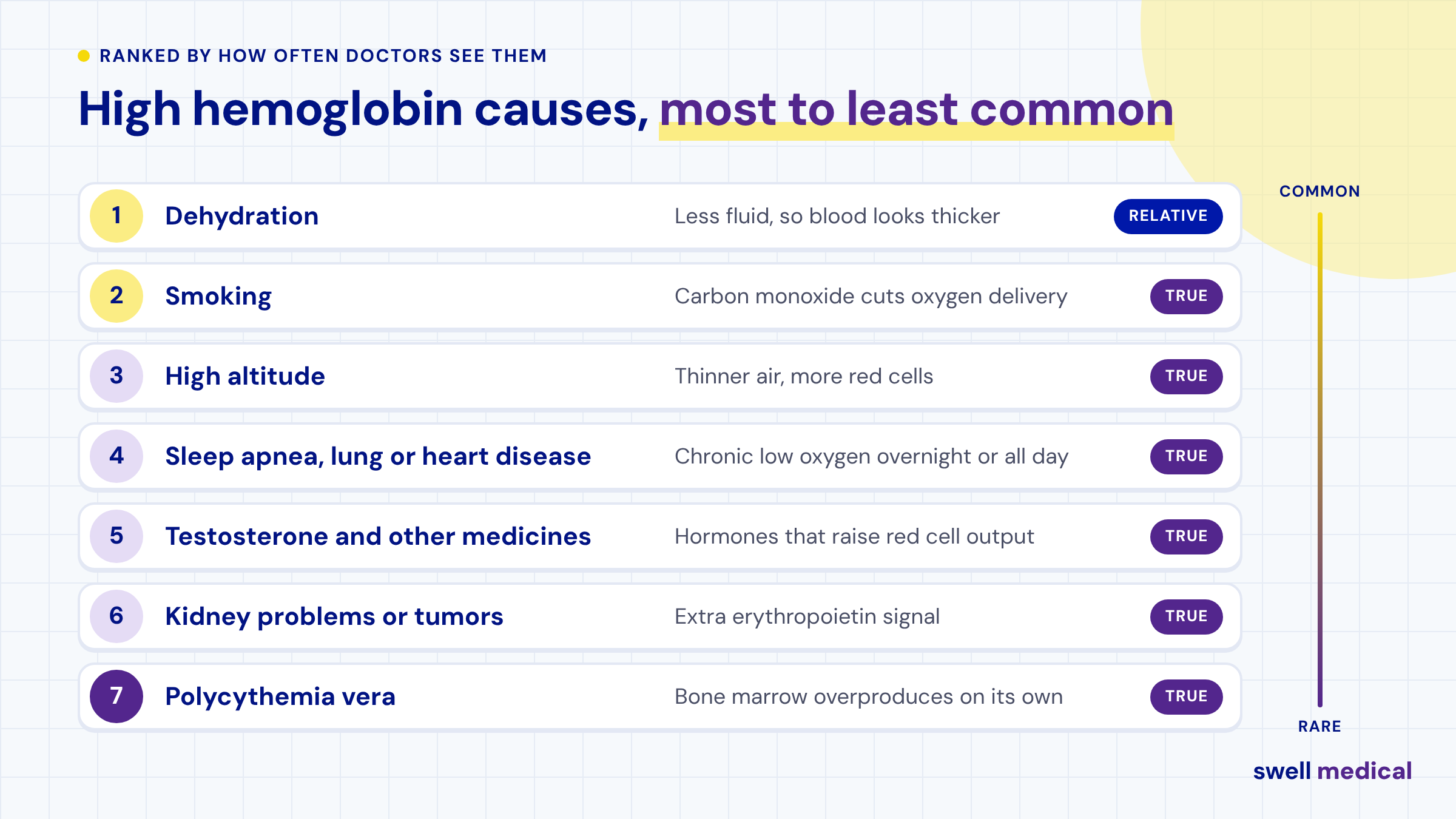
Doctors sort high hemoglobin causes into two buckets. In relative polycythemia, you have a normal number of red blood cells but less fluid around them, so the concentration looks high. In true polycythemia, your body is actually making extra red blood cells, usually because something is telling it that oxygen is short. Here are the usual suspects, roughly from most to least common.
Dehydration
Rule this one out first. When you lose fluid to vomiting, diarrhea, heavy sweating or water pills, the liquid part of your blood shrinks and the red cells become more concentrated. Your hemoglobin number rises even though you haven’t made a single extra cell. Good hydration often corrects it. Drink normally for a few days, then repeat the blood test.
Smoking and carbon monoxide
Tobacco smoke carries carbon monoxide, which latches onto hemoglobin and crowds out oxygen. Your body reads that as low oxygen, a state doctors call hypoxia, and builds more red blood cells to compensate. Mayo Clinic lists it among the most common causes of a high count. Because this one is usually reversible, quitting is the most useful change you can make.
Living at high altitude
Thinner air means less oxygen in every breath. MedlinePlus notes that hemoglobin keeps rising for several weeks after a move to a higher altitude. If you recently relocated to Colorado or Utah, a slightly higher number can be your body adapting, not disease.
Sleep apnea, lung disease and heart conditions
Anything that leads to low oxygen can push red cell production up, and good hydration won’t fix that. Obstructive sleep apnea does it overnight, while your breathing stops and starts. COPD and emphysema do it around the clock, and emphysema scars the lungs for good. Some heart problems do it too, including congenital heart disease carried into adulthood and right-sided heart failure. Congenital heart disease is the less obvious one, so tell your doctor if you were born with a heart defect.
Sleep apnea hides in plain sight. If you snore, wake up unrefreshed or your partner has noticed pauses in your breathing, say so. Those symptoms matter here. A sleep study can find what a standard blood test can’t.
Testosterone and other medicines
Testosterone therapy is a well-known trigger, and anabolic steroids are another. The Blood Project reports that a rise in red cells is the most frequent side effect in randomized testosterone trials, and that injections carry more risk than gels. Many guidelines call for action when hematocrit reaches about 54%, which usually means a lower dose, a different form or a pause.
If you’re on testosterone and your number is high, don’t stop on your own. Call whoever prescribes it.
Less common causes your doctor will rule out
When the everyday explanations don’t fit, a clinician starts looking at the bone marrow and the kidney. These causes are rarer. They’re also the ones worth catching early.
Polycythemia vera
Polycythemia vera (PV) is a slow-growing blood disorder in which the bone marrow makes too many red blood cells, and often extra white cells and platelets as well. MedlinePlus Genetics says nearly everyone with PV carries a change in the JAK2 gene. It usually shows up around age 60.
Symptoms can include itching after a warm shower, burning or redness in the hands and feet, and an enlarged spleen. The main danger is thicker blood, which raises the risk of blood clots, heart attack and stroke. Cleveland Clinic describes treatment that lowers those risks, so a diagnosis is a starting line, not a verdict.
Kidney problems and rare tumors
Your kidneys make erythropoietin, the hormone that tells bone marrow to build red cells. Kidney disease, a blocked kidney or, rarely, a kidney or liver tumor can turn that signal up. Mayo Clinic lists kidney cancer and liver cancer among conditions linked to a high count. That’s why an erythropoietin level is part of the workup when nothing obvious explains the number. It’s one more blood test on a short list.
Does a high hemoglobin mean something serious?
Usually not. Mayo Clinic notes that when the count is high but other tests look normal, a serious underlying condition is less likely. The Blood Project adds that secondary causes tend to be low-risk and reversible, while the real concern is mostly PV.
Plenty of people feel nothing at all. When blood gets thick enough to matter, symptoms can include headaches, dizziness, vision changes, ringing in the ears, easy bruising and itching. These symptoms have many other causes, so don’t self-diagnose. But if a high result and any of them show up together, call a clinician. Symptoms plus a high number is the combination that changes the plan.
How doctors find the cause
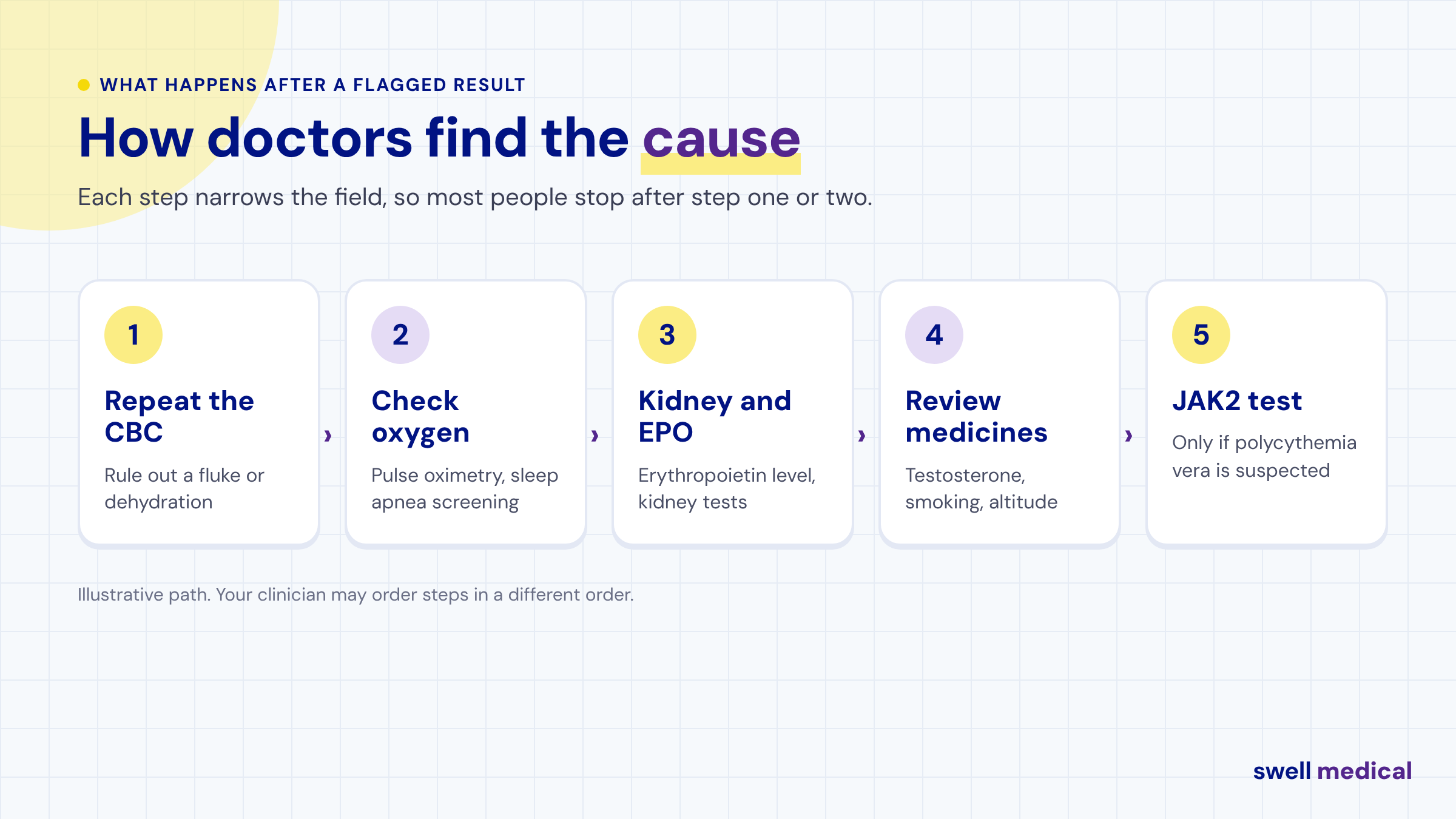
There’s a fairly standard path, and each step narrows the field.
- Repeat the CBC. One high value can be a fluke or a dehydration blip, so a second blood test comes first.
- Check your oxygen. That can mean a pulse oximeter reading, a sleep apnea screening or lung tests if you smoke or snore.
- Look at the kidney and erythropoietin. This is another blood test. Cleveland Clinic explains that a low level points toward PV, while a high one usually means something else is driving it.
- Review medicines, smoking and altitude. This takes five minutes and solves a surprising number of cases.
- Test for JAK2. A bone marrow biopsy comes later, and only if PV is still on the table.
How to lower high hemoglobin
You treat the cause, not the number. Dehydration needs fluids and steady hydration. Smoking needs a quit plan. Sleep apnea needs treatment. A testosterone-related rise needs a dose change from the prescriber.
For PV, the usual tool is phlebotomy, which means removing a measured amount of blood on a schedule. Cleveland Clinic says the aim is to keep hematocrit under 45 percent, and medicines such as hydroxyurea can help when phlebotomy isn’t enough.
No food or supplement lowers true over-production. Ask your clinician before taking iron you haven’t been told to take.
When to see a doctor about high hemoglobin
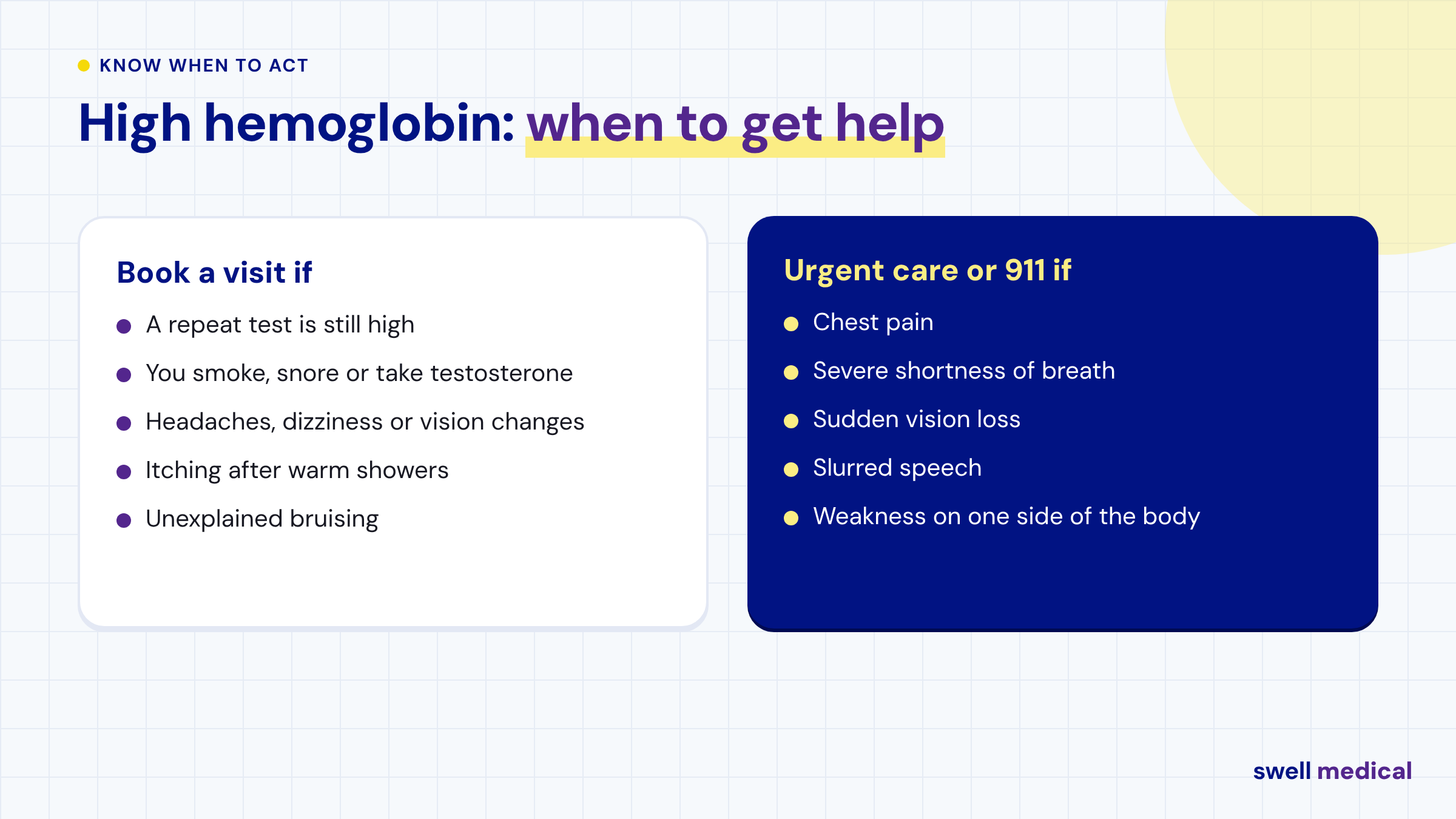
Book a visit if a repeat blood test is still high, if you smoke, snore or take testosterone, or if you notice headaches, dizziness, vision changes, itching after warm showers or unexplained bruising.
Get urgent care for these symptoms: chest pain, severe shortness of breath, sudden vision loss, slurred speech or weakness on one side of the body. Those can signal a clot or stroke. They shouldn’t wait for a lab review.
Get your result reviewed, without the waiting room
You don’t have to sit with a flagged number for a week. Swell’s licensed clinicians can look at your labs online, explain what can be handled from home and tell you what needs an in-person test. Start with labs and follow-up, or read how it works first. For an emergency, call 911.
Questions people ask about high hemoglobin
How can I lower my high hemoglobin?
Treat what’s driving it. If you’re dehydrated, drink fluids and retest. If you smoke, quit. Sleep apnea, testosterone doses and kidney problems each have their own fixes. For polycythemia vera, doctors use phlebotomy and sometimes medicine. There’s no diet that lowers it.
Should I worry about high hemoglobin?
Not automatically. High hemoglobin causes like dehydration or smoking are usually low-risk and reversible. A mildly high result with a clear cause is the easy case. Worry rises when the number stays high on repeat tests, climbs without a trigger or comes with symptoms such as dizziness or vision changes. Then it deserves a proper workup of hemoglobin levels and oxygen.
What happens to the body when hemoglobin is high?
Blood carries more red blood cells, so it gets thicker. Most of the time that causes no symptoms. When it’s severe, thick blood can slow flow, causing headaches, dizziness or blurred vision, and it raises the chance of blood clots. That risk is highest with polycythemia vera.
What not to eat if hemoglobin is high?
No specific food raises true hemoglobin, so there’s no strict avoid list. Don’t take iron supplements or multivitamins with iron unless a clinician says you need them. Drink enough fluids, because dehydration can make a normal number look high.
Can dehydration cause high hemoglobin?
Yes. Less fluid in your blood concentrates the red blood cells, so hemoglobin reads higher even though your total hasn’t changed. Vomiting, diarrhea, heavy sweating and diuretics are common triggers. Rehydrating and repeating the blood test usually shows whether that was the whole story.
Trusted references
Public-health, research, and medical-society resources related to this guide.