You wake up and swallowing feels like gulping broken glass. Fever, sore throat, maybe a neck that hurts to touch. Your first thought is strep. Your teenager’s friend just had mono, so now you’re torn. Strep throat vs mono is one of the most common sore throat puzzles we see, and the answer changes what you do next. One needs antibiotics. The other doesn’t, and the wrong drug can backfire.
Here’s how to tell them apart, which test settles it, and when to get seen.
Strep throat vs mono at a glance
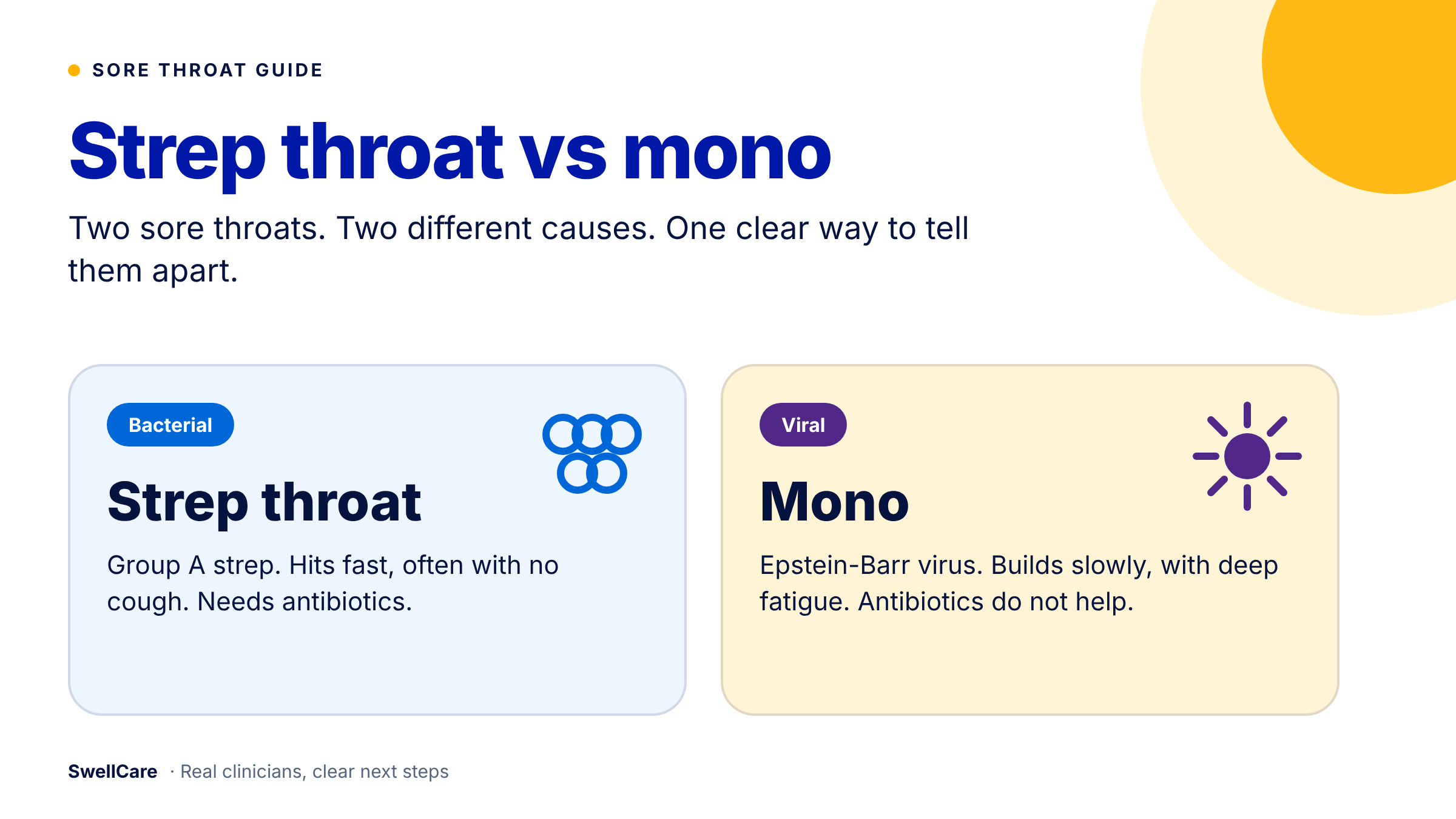
The short version: strep throat is a bacterial infection that hits fast. Mono, short for mononucleosis, is a viral illness caused by the Epstein-Barr virus that creeps in and drains your energy for weeks. Both bring a sore throat, a fever and swollen lymph nodes in the neck. Those overlapping symptoms are exactly why people mix them up. One is bacterial and the other is viral, and that single fact explains nearly every difference below.
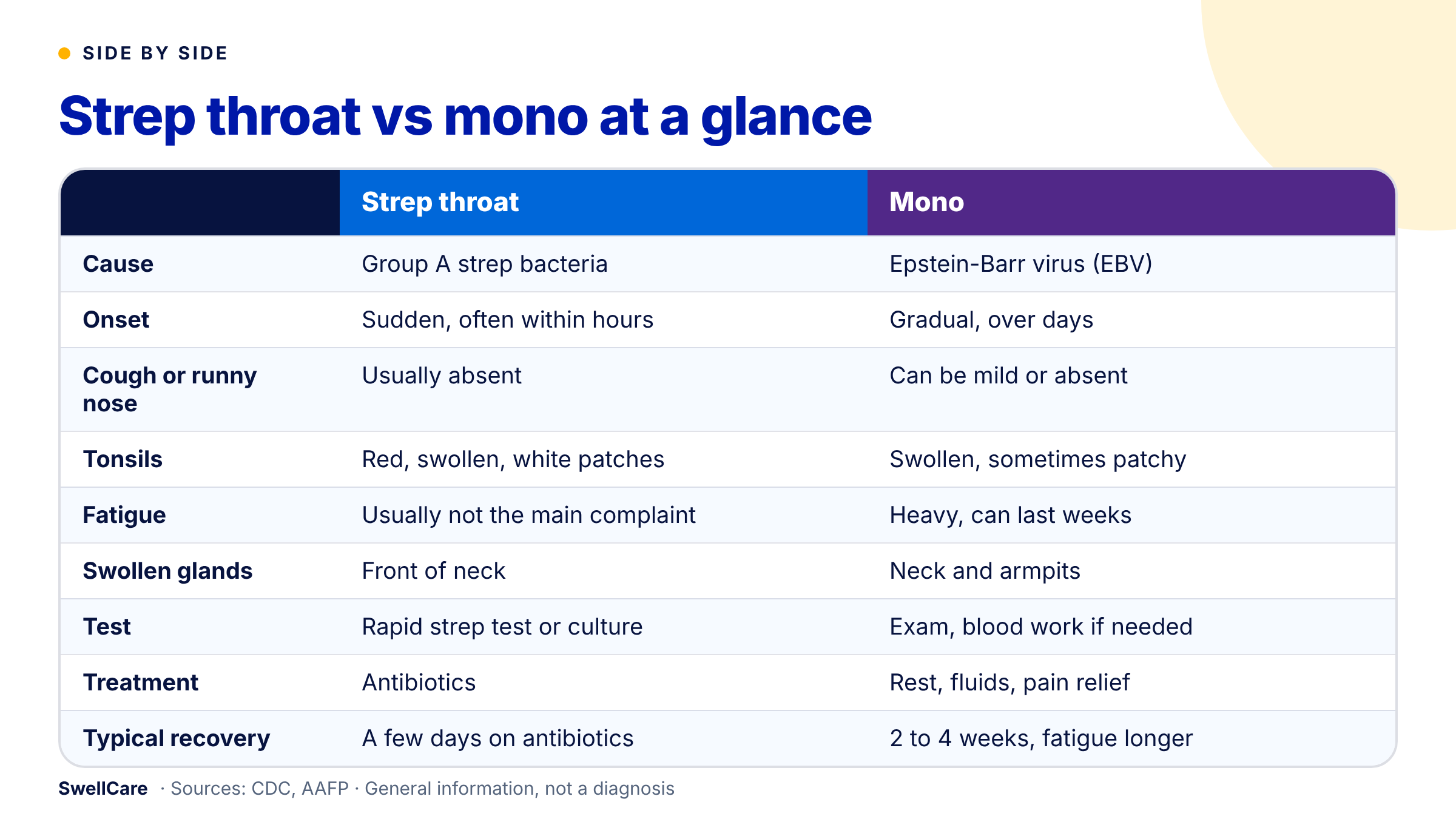
| Strep throat | Mono | |
|---|---|---|
| Cause | Group A strep bacteria | Epstein-Barr virus |
| Onset | Sudden | Gradual |
| Cough and runny nose | Usually absent | Possible, often mild |
| Fatigue | Rarely the main complaint | Heavy, lasts weeks |
| Treatment | Antibiotics | Rest, fluids, pain relief |
Most sore throats aren’t either one. The CDC says viruses cause most of them, and only about 1 in 10 adults and 3 in 10 children with a sore throat actually have strep throat.
What strep throat feels like
This one comes on quickly, usually 2 to 5 days after you’re exposed, and because it’s bacterial it responds to antibiotics. The throat pain is sharp, swallowing hurts, and a fever shows up with it. Look in the mirror and these symptoms may show up: red, swollen tonsils with white patches or streaks of pus. Tiny red spots on the roof of the mouth are another clue. Check the lymph nodes too, since tender ones in the front of the neck fit the pattern.
Swollen lymph nodes at the front of the neck are common, and they feel tender. Kids sometimes get a headache, stomach pain or vomiting. Symptoms vary a lot from child to child, so don’t expect a textbook picture.
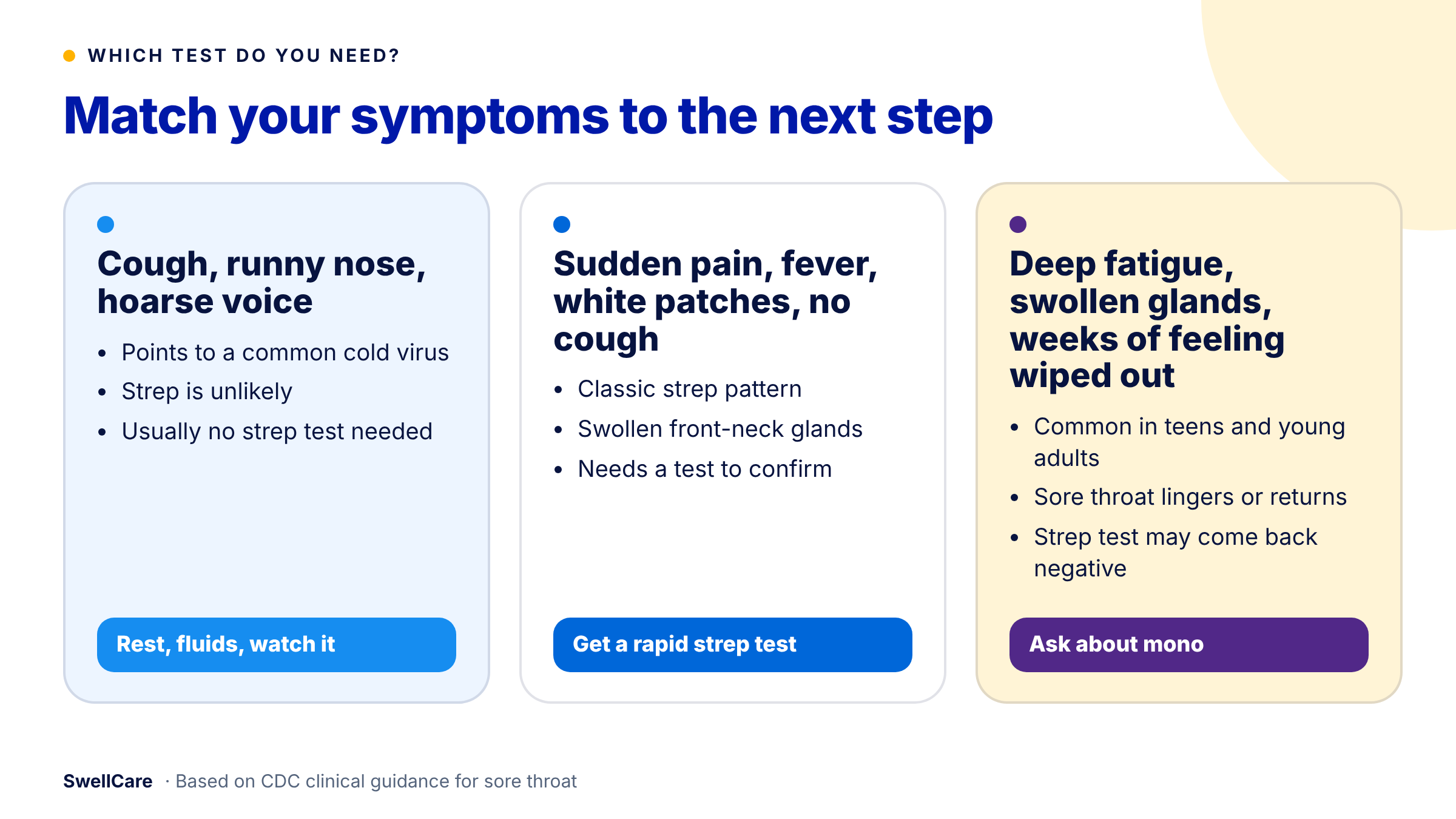
Here’s the tell we lean on most: what’s missing. Strep rarely brings a cough, runny nose or hoarse voice. If you’ve got those, a cold virus is the likelier culprit.
What mono feels like
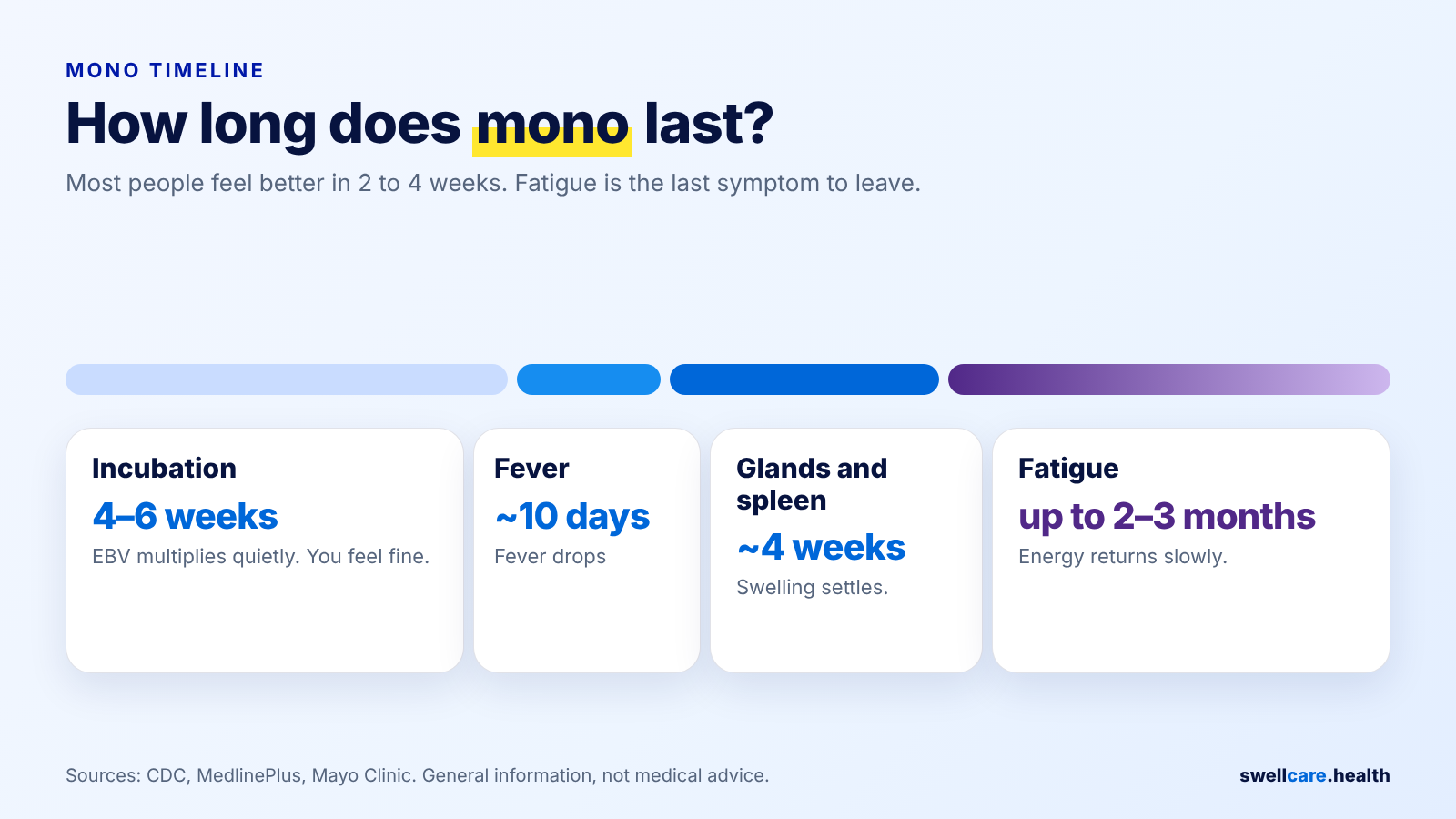
Mono is the slow burn. Symptoms usually appear 4 to 6 weeks after infection, so nobody remembers who gave it to you. Extreme fatigue is the signature. Not “I stayed up late” tired, but “I slept ten hours and still can’t climb the stairs” tired. The fatigue often outlasts the fever by weeks.
Other symptoms include a sore throat and fever, swollen lymph nodes in the neck and armpits, and body aches. Because mono is viral, no pill clears it. The tonsils can swell and show white patches, which looks a lot like strep. Some people also get an enlarged spleen or liver. Enlarged lymph nodes can stay puffy after you feel better, and recovery of your energy is the slowest part.
Mono spreads through saliva, which earned it the nickname kissing disease, but sharing cups and toothbrushes counts too. It’s most common in teens and young adults. The CDC notes that at least 1 in 4 people infected with the Epstein-Barr virus go on to develop mononucleosis.
Why the right diagnosis matters
You can’t reliably sort strep from mono by looking at a throat, even for an experienced clinician. The diagnosis needs a test, and a correct diagnosis protects you in two directions.
Miss strep and the bacteria can spread. Untreated infections can lead to abscesses around the tonsils, kidney inflammation and rheumatic fever, which can damage the heart. Treating strep promptly lowers that risk in children.
With mono, the spleen can swell and, rarely, rupture. Most documented ruptures happen within 4 to 21 days of the first symptoms, sometimes with almost no impact. That’s why sports guidance matters.
Mistake mono for strep and you take antibiotics that do nothing against a viral illness.
The amoxicillin rash
There’s a twist. People with mono who take amoxicillin or ampicillin often break out in a rash. Older papers put the rate as high as 95%. Newer studies suggest something closer to 15% to 33%, according to a Cleveland Clinic Journal of Medicine review. That rash usually isn’t a true penicillin allergy, but it can get labeled as one in your chart for life. That’s a real cost, and a good reason to test before you treat.
How doctors test for strep and mono
Strep testing is quick. A clinician swabs your throat for a rapid strep test, with results in minutes.
Strep tests
Rapid tests are very specific, 90% to 99% by the American Academy of Family Physicians’ numbers, and newer kits catch most true cases. If the result is negative, children older than 3 usually get a backup throat culture, because a false negative can slip past. Adults typically skip it. A throat culture, where the swab is grown in a lab, takes a day or two but remains the gold standard. And if you have cough, runny nose or hoarseness, the CDC says you probably don’t need testing at all.
Mono tests
Mono is often diagnosed from your symptoms and exam alone. Blood work, such as a Monospot or a complete blood count, is used when the picture is unclear or symptoms are severe. Because early tests can read negative, a clinician may repeat one if mono still looks likely.
Treatment and recovery
Strep throat treatment
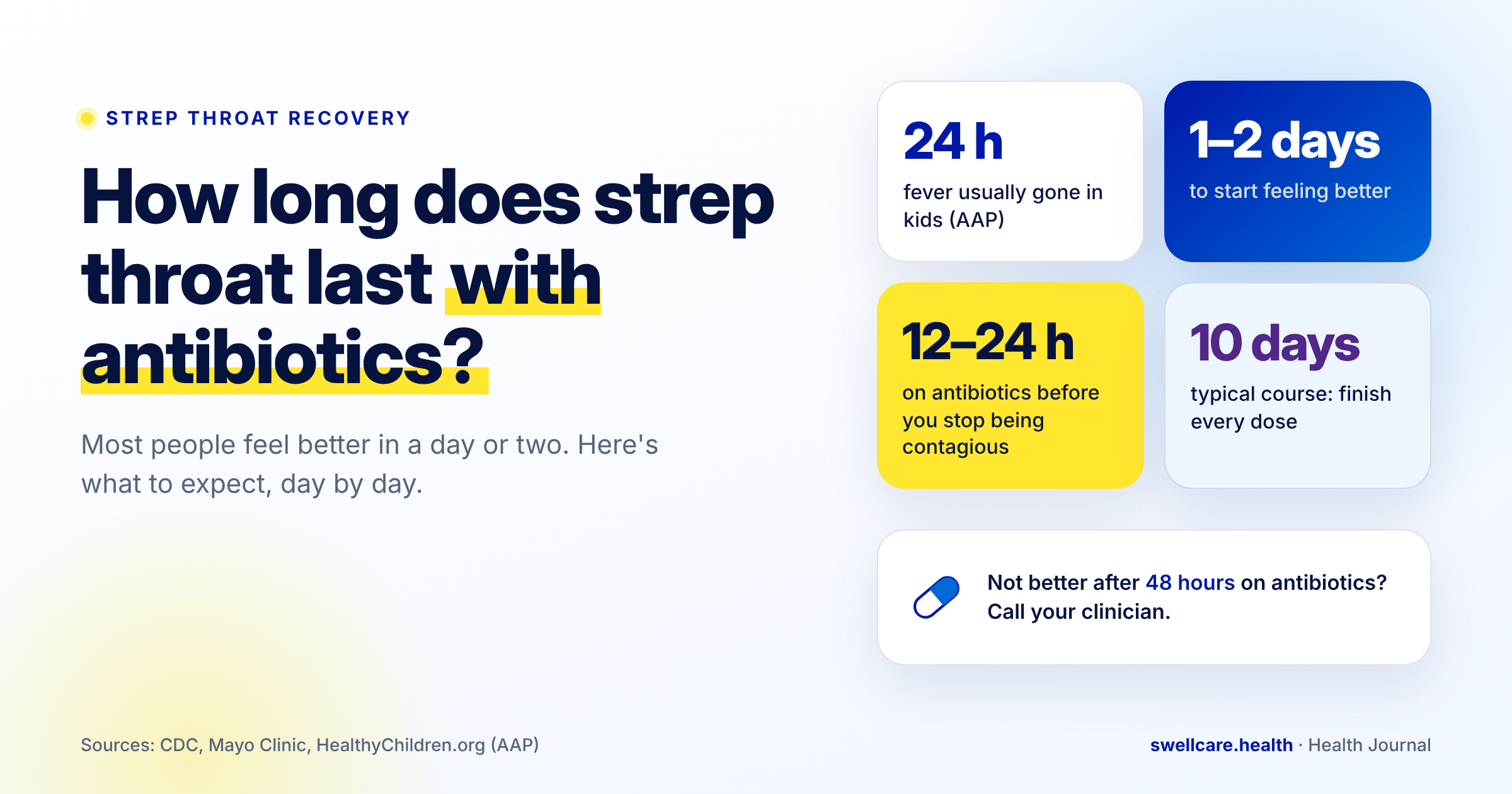
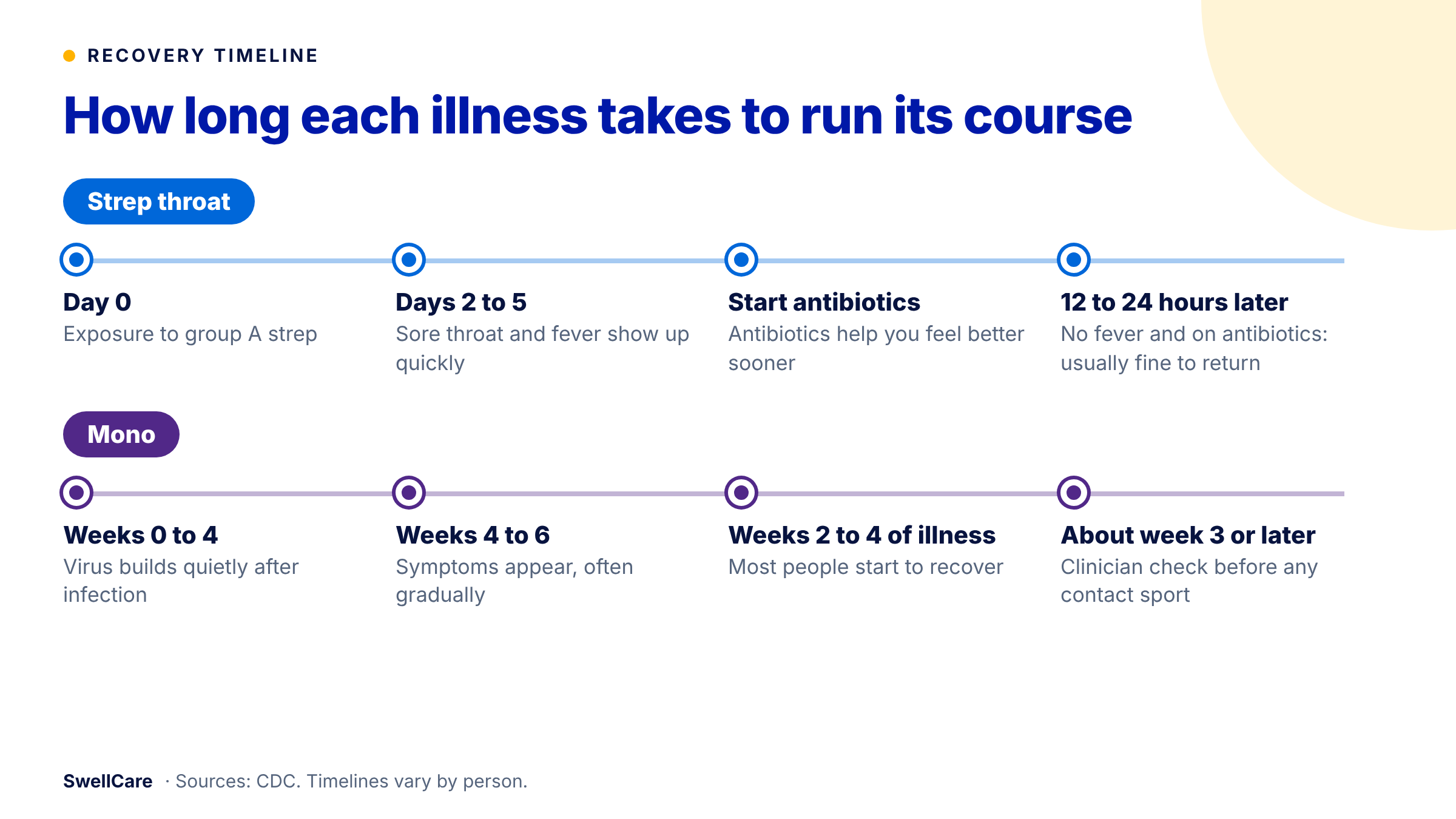
Antibiotics are the answer. Penicillin or amoxicillin for 10 days is the usual first choice, and you’ll feel better sooner. Rest at home until you’re fever-free and have taken antibiotics for at least 12 to 24 hours. Then you’re far less contagious.
Finish the full course even when you feel fine on day three.
Mono treatment
There’s no cure and no vaccine. Recovery means plenty of rest, fluids and over-the-counter pain relief. Don’t push through it. The CDC says most people bounce back within 2 to 4 weeks, though fatigue can hang on longer, so plan for a slow recovery. Skip penicillin-type antibiotics unless a clinician says otherwise.
Back to school, work and sports
For strep, the 12 to 24 hour rule applies. For mono, there’s no neat date. Contact sports are the sticking point. A common approach is waiting about 3 weeks from symptom onset, then trying a week of light, non-contact exercise before any hits or collisions. Your clinician decides, because a spleen that feels normal on exam doesn’t automatically clear you.
When to see a doctor
Don’t sit on a bad sore throat, and don’t wait for symptoms to settle on their own. See someone the same day if you have a fever with white patches and no cough, if swallowing is painful enough to stop you drinking, or if the sore throat hasn’t improved after a few days.
Go to urgent or emergency care for trouble breathing, drooling, a stiff neck, or sharp pain in the upper left belly after mono, which can signal a spleen problem.
At Swell, a licensed clinician can look at your symptoms, order the right test and tell you whether antibiotics make sense. Book a visit with Swell and skip the guessing.
Questions people ask about strep throat vs mono
Can you have strep and mono at the same time?
Yes. It’s uncommon, but a person with mono can pick up strep too, and a positive strep test doesn’t rule mono out. If symptoms drag on after strep treatment, ask about a mono test.
Can mono be mistaken for strep throat?
Often. Both cause a painful sore throat, fever, swollen glands and white patches on the tonsils. A rapid strep test and, when needed, mono blood work are the dependable way to separate them. Symptoms alone can’t make that call.
Does strep turn into mono?
No. They’re caused by completely different germs, a bacterium and a virus. One can’t become the other, though you can catch both close together.
How long does mono last compared with strep?
That infection improves within a day or two of starting antibiotics. Mono usually takes 2 to 4 weeks to settle, and the tiredness can linger for several more weeks.
Is strep or mono more contagious?
Both spread through close contact. Strep is easy to pass around households and classrooms until treatment is underway. Mono spreads through saliva.
Trusted references
Public-health, research, and medical-society resources related to this guide.