Week two. Two shots in, and the scale hasn’t budged. If that’s you, breathe. Nothing is wrong.
So, how long does semaglutide take to work? Many people notice their appetite quiet down within the first couple of weeks. Visible weight loss tends to follow over the next one to two months. The full effect takes much longer, because semaglutide, a GLP-1 medication, is raised in small steps over about four months, and semaglutide weight loss lasts only as long as you stay on it.
How long does semaglutide take to work? The short answer
It depends on what you’re watching. Here’s a rough guide to semaglutide timing, and I do mean rough.
| What you’re watching | When it usually shows up |
|---|---|
| Appetite, fullness and food noise | Often within the first 1 to 4 weeks (a common patient report, not a trial measurement) |
| The scale | Gradual change over the first 1 to 2 months for many people |
| Blood sugar on Ozempic in type 2 diabetes | Starts early, but HbA1c changes take weeks to months to show |
| Full semaglutide weight loss | Many months. Trials measure body weight at week 68 |
These are ranges, not promises. Semaglutide isn’t a light switch. Think of it as a slow dimmer that brightens over several weeks.
Why the first weeks feel quiet
Semaglutide copies a gut hormone called GLP-1. That hormone tells your brain you’re full, slows gastric emptying so food leaves your stomach more gradually, and turns down hunger and appetite. Less appetite means smaller meals, which is how semaglutide produces weight loss. Many people describe the biggest change as less food noise, the constant background chatter about your next meal.
Here’s why you don’t feel all of that after one shot. Semaglutide is a once-weekly injection with a half-life of about one week, according to the FDA prescribing information for Wegovy. A pharmacokinetics review estimates that semaglutide takes roughly four to five weeks of once-weekly dosing to reach steady state. Each shot stacks on the last. Your first shot gets you only part of the way to where the fifth one lands.
And the starting step is small on purpose. Semaglutide’s low first dose gives your gut time to adjust, which matters because the most common side effects are stomach-related.
Your semaglutide timeline, week by week
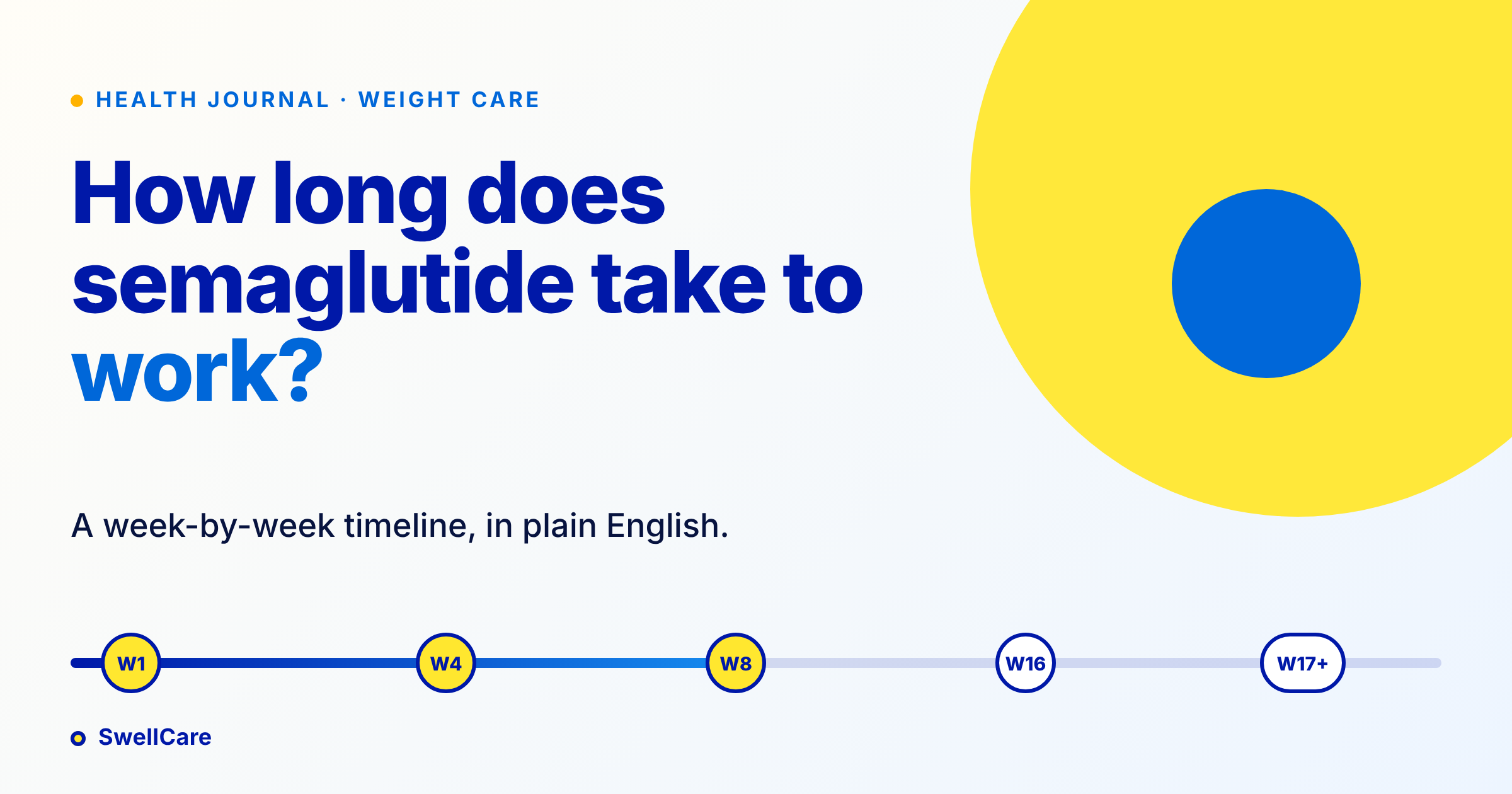
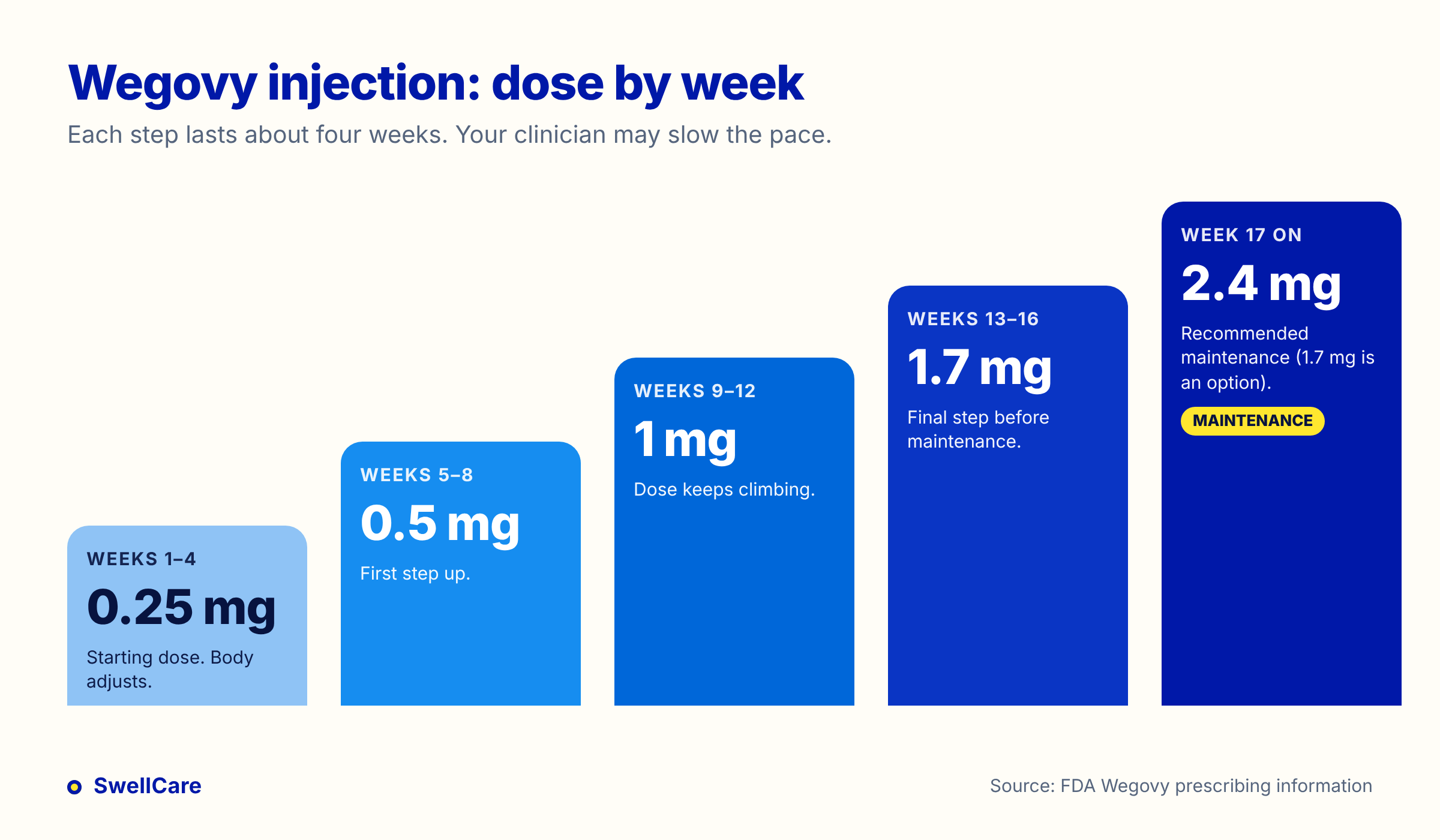
This is the dose escalation schedule for the Wegovy injection, taken straight from the FDA label. Your prescriber may move slower, and that’s fine. Ozempic, which is labeled for type 2 diabetes, follows its own dosage plan, so stick with what your prescriber gave you.
Weeks 1 to 4 on the starting dose
You take 0.25 mg once a week, the lowest step on the ladder. Your body is still learning semaglutide. Some people notice a smaller appetite and earlier fullness. Others feel almost nothing. Both are normal, and weight loss on the scale is usually small or absent at this stage.
Weeks 5 to 8 and the first step up
Your weekly shot goes up to 0.5 mg. This is where many people say meals start to feel different: smaller portions satisfy you, and cravings loosen their grip. Early semaglutide weight loss often starts to show here. Mild nausea can come along for the ride after an increase.
Weeks 9 to 16 on the way to maintenance
You move to 1 mg for weeks 9 to 12, then 1.7 mg for weeks 13 to 16. Each step adds to the effect on appetite and weight loss. It’s also the stretch where steady habits, such as regular meals and enough protein, plus a little exercise, pay off.
Week 17 and beyond at maintenance
From week 17 the recommended maintenance level is 2.4 mg, though 1.7 mg is an option if the higher amount doesn’t sit well. Semaglutide weight loss usually keeps drifting down for months from here.
Taking the daily tablet instead? The Wegovy pill, approved by the FDA in December 2025, ramps up over 90 days: 1.5 mg, then 4 mg, then 9 mg, then 25 mg from day 91, per the same label. In its clinical trial, people on the pill lost an average of 13.6% of their body weight over about 15 months, versus 2.2% on placebo, as NPR reported.
How long does semaglutide take to work for blood sugar?
If you have type 2 diabetes, the clock runs a little differently. Semaglutide was first sold as Ozempic for diabetes, and it lowers blood sugar through the same GLP-1 pathway. Glucose can start to drop soon after you begin, which is why people with diabetes sometimes see home blood sugar readings improve before anything changes on the scale.
But HbA1c is a rolling picture of your glucose over roughly three months, so a big shift on that lab test takes time to appear. In Novo Nordisk’s SUSTAIN 4 and 5 diabetes trials of Ozempic, the main A1C measurement was taken at week 30, as Novo’s trial summary shows. If you take other diabetes medicines, ask your prescriber whether they need adjusting as your glucose improves.
Two cautions. Wegovy and Ozempic both contain semaglutide, so never take them together. And if you have diabetes with retinopathy, tell your prescriber before starting, since the same Novo page notes that rapid improvement in glucose control has been linked to temporary worsening of the eye condition.
What results look like at 3, 6 and 12 months
The best-known data comes from the STEP 1 trial, a large clinical trial that followed 1,961 adults with overweight or obesity. At week 68, people taking semaglutide 2.4 mg had lost 14.9% of their body weight on average, compared with 2.4% on placebo, according to the published trial abstract.
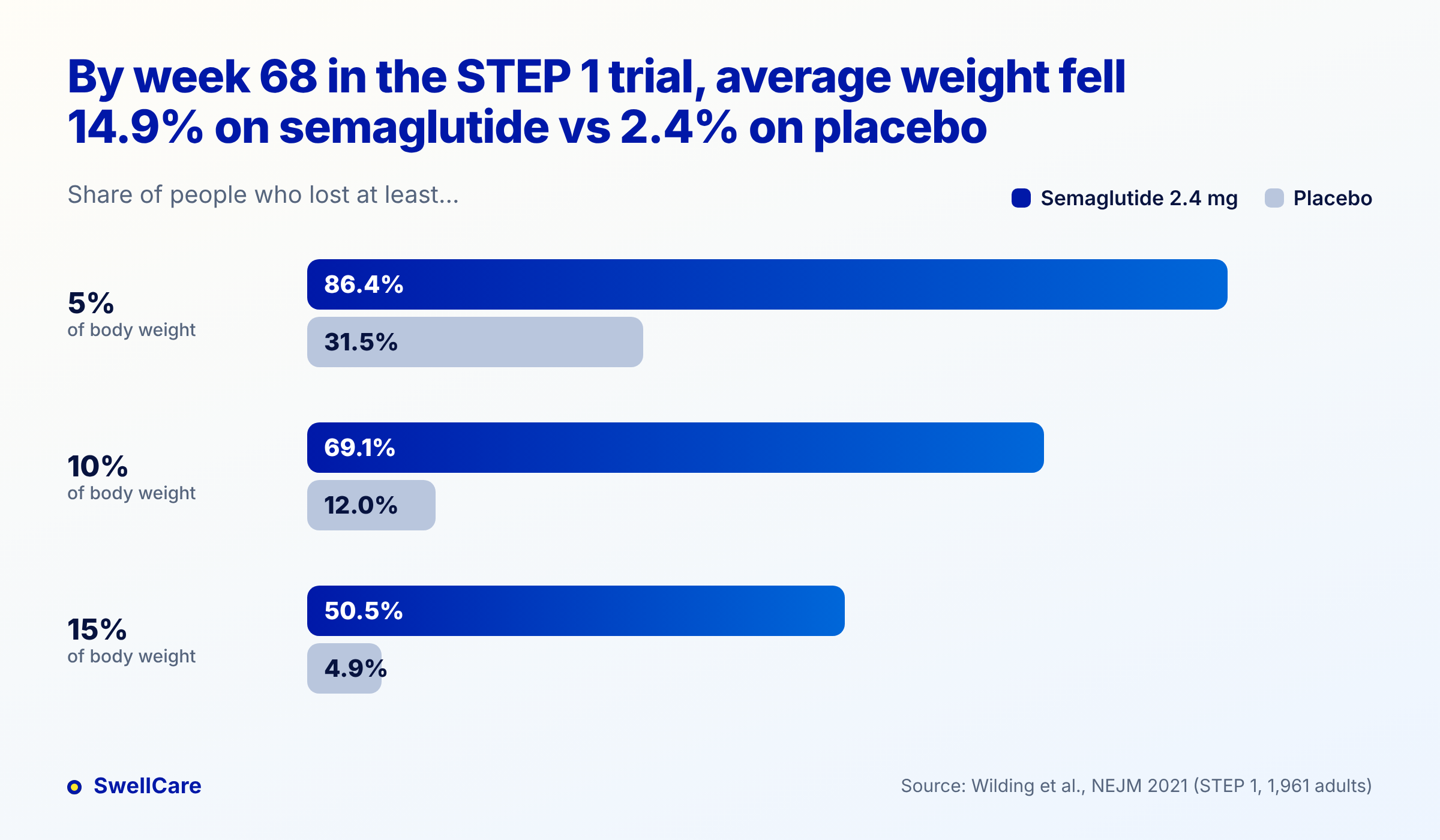
The same abstract reports that 86.4% of the semaglutide group lost at least 5% of their weight, 69.1% lost at least 10%, and 50.5% lost at least 15%. For someone starting at 200 pounds, an average 14.9% weight loss works out to about 30 pounds. On placebo, the same person would lose about 5 pounds. STEP 1 paired semaglutide with lifestyle changes, meaning diet and exercise counseling, so those numbers assume your habits are shifting too. The trial enrolled adults without diabetes, so results in people with diabetes can look different.
Notice the timing, though. The STEP 1 trial reports a 68-week result, roughly 16 months in. You don’t reach the maintenance dose until about week 17, so modest weight loss at month three isn’t failure. It’s what the schedule predicts. And weight loss can level off after months on a steady dose, which is a plateau, not a stall in treatment.
Why semaglutide may feel slower for you
Two people on the same semaglutide dose can see weight loss and appetite changes at different speeds. A few things move the dial.
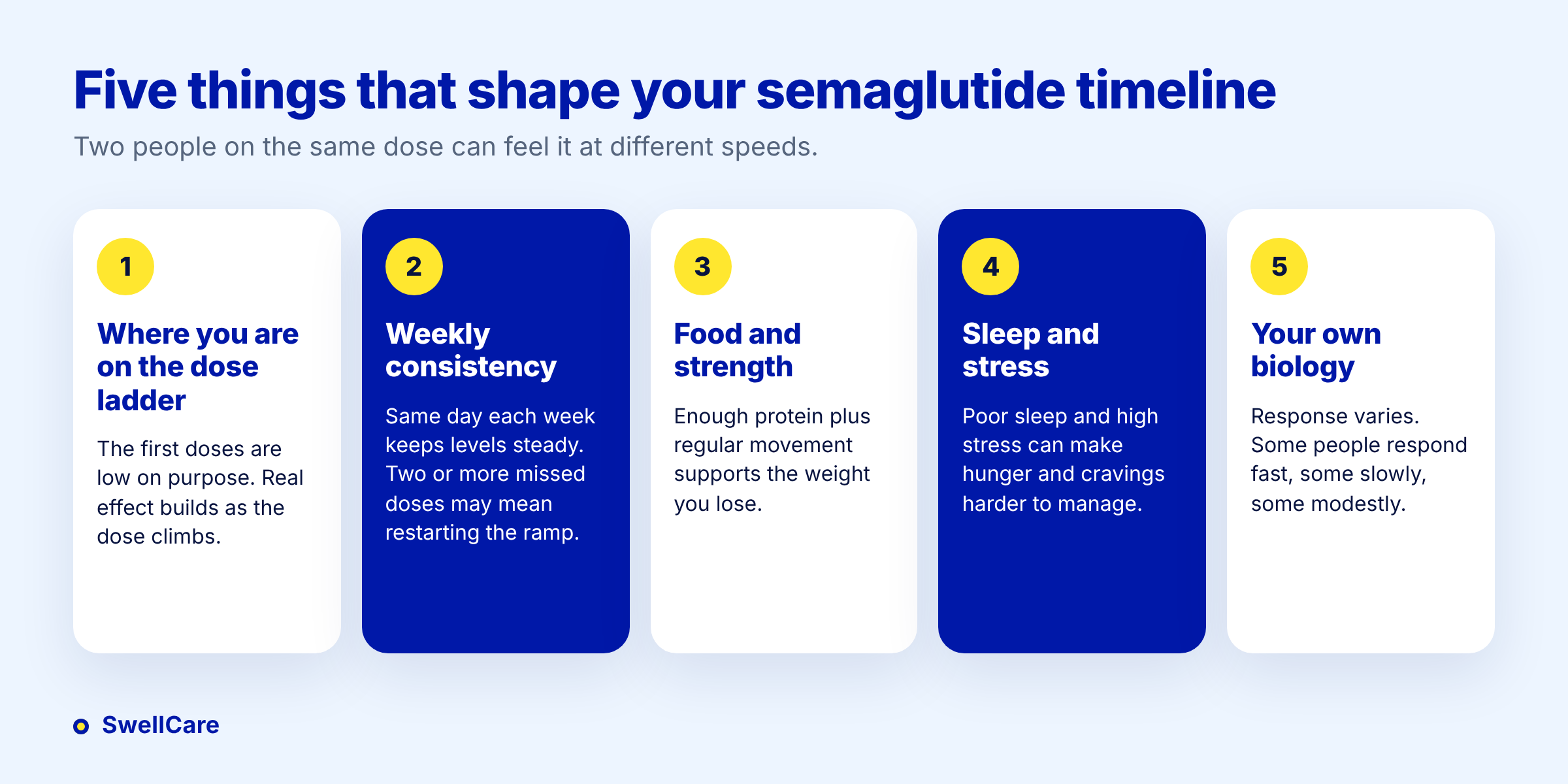
Where you are on the ladder. Early semaglutide doses are low by design. If you’re only on week three, you’re simply early.
Missed doses. The label says that after two or more missed doses in a row, you can resume as scheduled or restart the dose escalation, which may ease stomach symptoms. Ask your healthcare provider which to do.
Daily habits. Lifestyle changes matter more than people expect. Regular exercise, especially strength work, and enough protein help protect muscle while you lose weight. Sleep matters too. Poor sleep and high stress can make hunger and cravings harder to manage. Small lifestyle changes you can keep beat big ones you can’t, and even a daily walk counts as exercise.
Your own biology. Your metabolism and your starting weight play a part, and so do other medicines and health conditions. Metabolism isn’t destiny, but it does vary from person to person. Some people respond strongly. Others respond more modestly, and that’s allowed to be your story. Having type 2 diabetes can change the picture too, since your prescriber may be balancing glucose targets as well as weight.
Can you speed things up with faster titration? No. We’ll come back to why in the questions below.
Side effects, and when to call a clinician
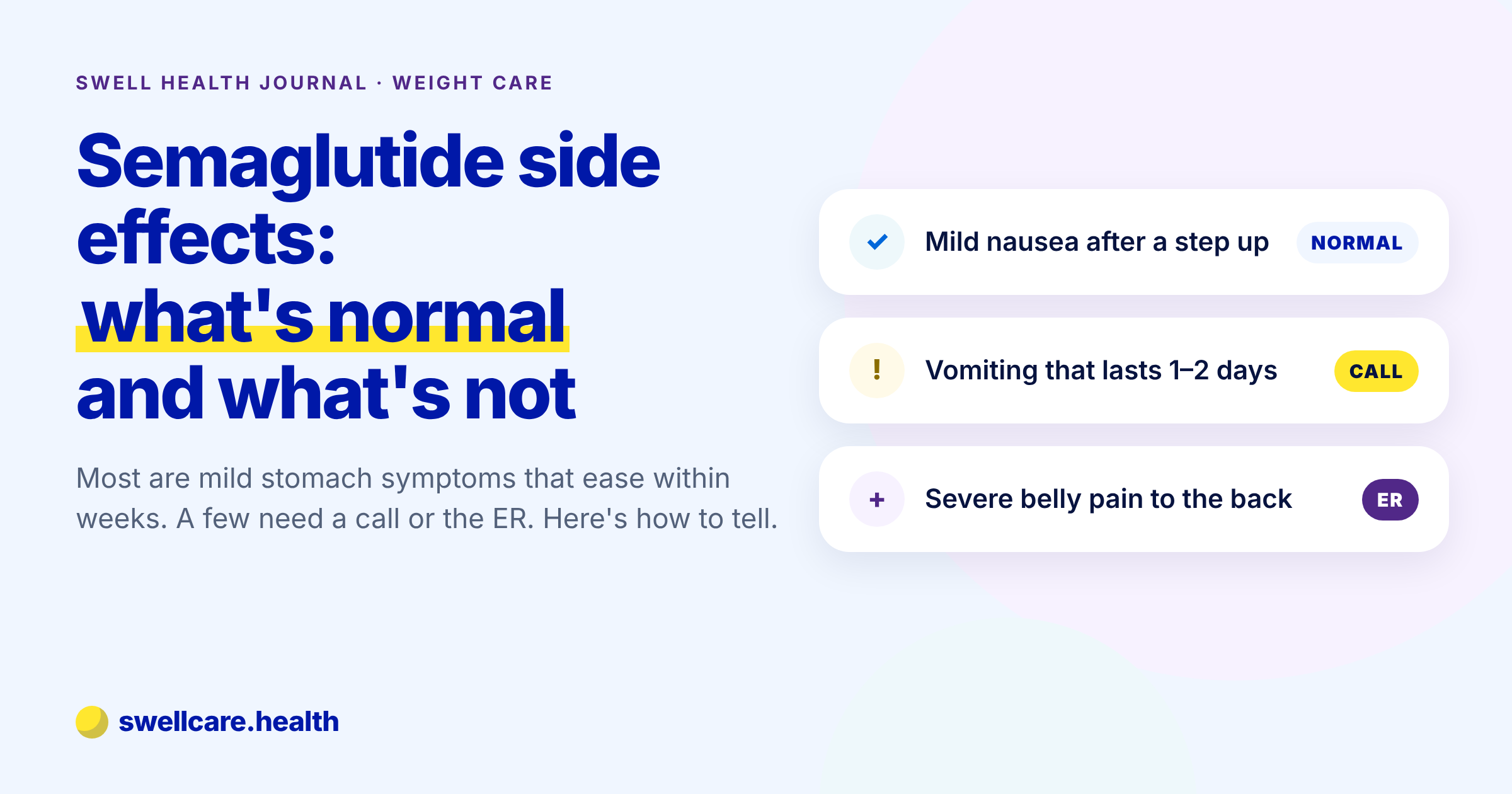
Stomach trouble is the main price of admission for semaglutide weight loss. In the Wegovy label’s clinical trial data for the 2.4 mg semaglutide injection, nausea affected 44% of people versus 16% on placebo, diarrhea 30% versus 16%, vomiting about 24% versus 6%, and constipation 24% versus 11%. Most cases are mild to moderate and fade. In STEP 1, 4.5% of people on semaglutide stopped treatment because of stomach side effects, versus 0.8% on placebo, per a summary from the American College of Cardiology.
Small meals and slow eating help. So does drinking plenty of fluids. Fatty, fried food often makes nausea worse.
Call your healthcare provider promptly if you have severe stomach pain that won’t ease, vomiting that keeps you from holding down fluids, swelling of the face or throat, or any thoughts of harming yourself. For trouble breathing or a severe allergic reaction, call 911. If you’re pregnant or planning a pregnancy, tell your prescriber right away; the label advises stopping at least two months before a planned pregnancy.
This article is general information, not medical advice. Only a licensed professional who knows your history can tell you whether semaglutide is right for you.
Take the next step with Swell
Waiting weeks for something to happen is easier with a clinician in your corner.
Swell’s weight care program is clinician-led. A licensed clinician reviews your health history and medications, asks about your goals, then talks through safe options, including whether a medication such as semaglutide makes sense for you. Follow-ups cover side effects and plateaus, and that’s where plan changes get made. Prescriptions aren’t guaranteed, and availability can depend on supply and pharmacy access, as well as cost. Wegovy is approved for adults with obesity, or with overweight plus a weight-related condition. In practice that usually means a BMI of 30 or higher, or a BMI of 27 or higher with a condition such as high blood pressure.
Sign-up and the screening chat are free, and the consultation is listed at $45, with medication and lab costs separate. Start with Swell weight care and see what a realistic plan looks like for you.
Questions people ask about semaglutide timing
What are the first signs semaglutide is working?
Quieter hunger, feeling full sooner on smaller meals, fewer cravings and less mental chatter about food usually come first. Weight loss on the scale tends to lag behind. Mild nausea can show up too, but it isn’t a sign semaglutide is working, only that your body is adjusting.
Does semaglutide suppress appetite right away?
Not instantly. The label says the injection peaks in your blood one to three days after a dose, but the 0.25 mg starting dose is low, so the effect is gentle at first. It builds over several weeks as semaglutide accumulates toward steady state and the dose rises.
How fast can you lose 20 pounds on semaglutide?
There’s no safe fast-forward for weight loss. For a 200-pound adult, 20 pounds is 10% of body weight. In STEP 1, 69.1% of people on semaglutide hit a 10% loss, but over 68 weeks, not a few weeks. Rapid weight loss isn’t the goal, and it isn’t what trials measured.
Why am I not losing weight in the first month?
You’re likely still on the starting dose, and the first steps are built for tolerability, not speed, so early weight loss is often small. Give each step several weeks. If your appetite hasn’t changed at all after you’ve reached higher doses, tell your healthcare provider so they can check the plan and your other medicines. Your metabolism and body size differ from the next person’s, so compare yourself to your own baseline. Check the basics too: sleep, protein and water.
Can I speed up the dose increases to get results faster?
No. Going faster raises the odds of nausea and vomiting without a proven payoff. The label actually points the other way: if you’re struggling during escalation, your prescriber may delay the next increase by four weeks. Never change your dosage or timing on your own. Slow can be the right pace.
Trusted references
Public-health, research, and medical-society resources related to this guide.