You glance down and the water is pink. Maybe red. Your stomach drops.
Take a breath. Blood in urine causes run from a simple bladder infection to kidney stones and, less often, something serious like cancer. Most respond well to treatment. But “most” isn’t a reason to wait, because only a urine test can tell you which one you’re dealing with. Here’s what could be behind it, what’s urgent, and what to do next.
Is it really blood? What else turns urine red
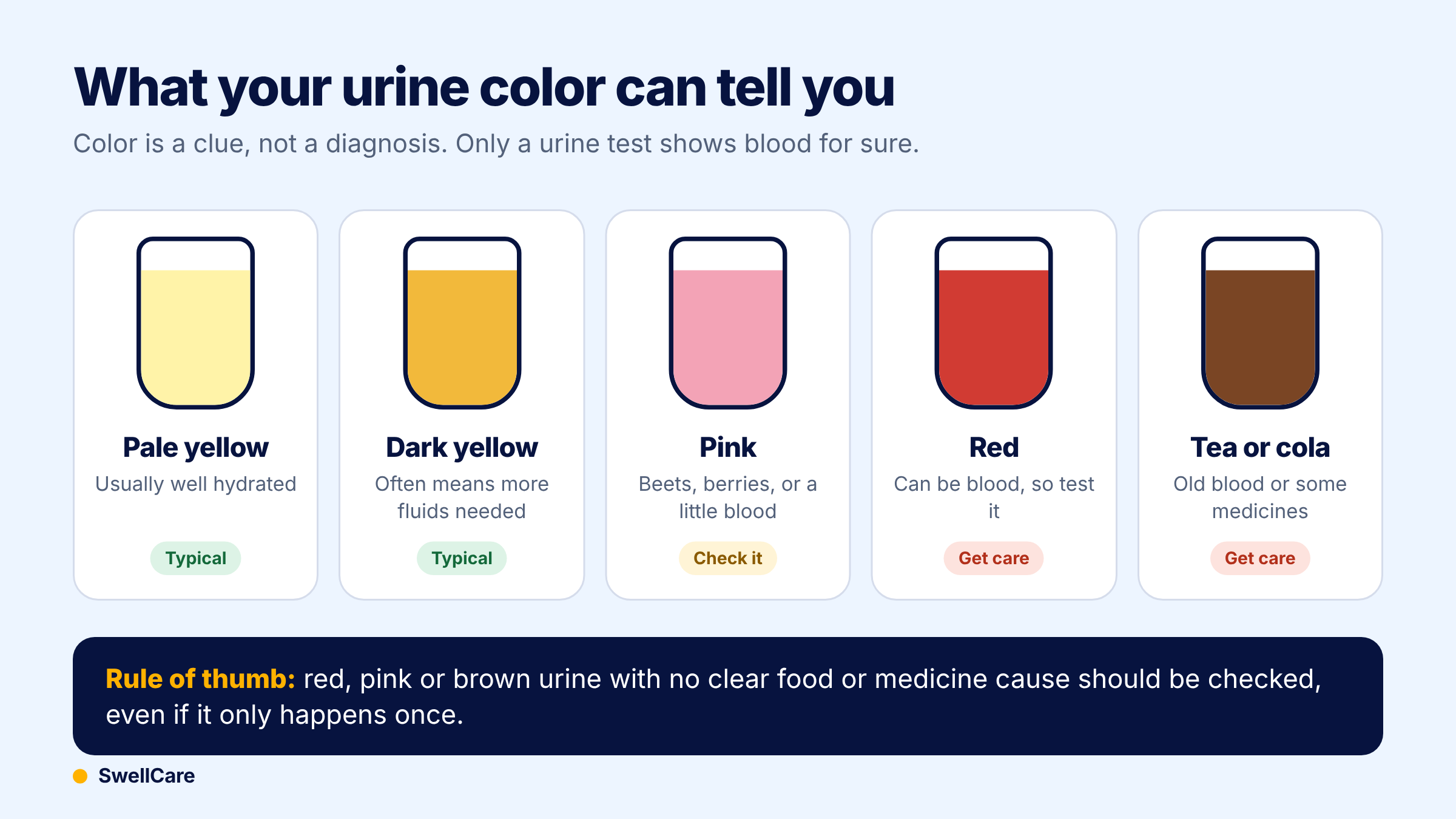
Not every red toilet bowl means bleeding. Beets, blackberries and rhubarb can tint urine pink or red, though Harvard Health notes beets affect only about 10 to 14 percent of people. Some medications do it too, including phenazopyridine, a urinary pain reliever that Mayo Clinic flags.
Here’s the catch. You can’t judge it by eye. A pink tint from beets and one from a bleeding bladder look identical. If you haven’t eaten anything unusual or started a new medicine, assume it could be blood.
The most common blood in urine causes
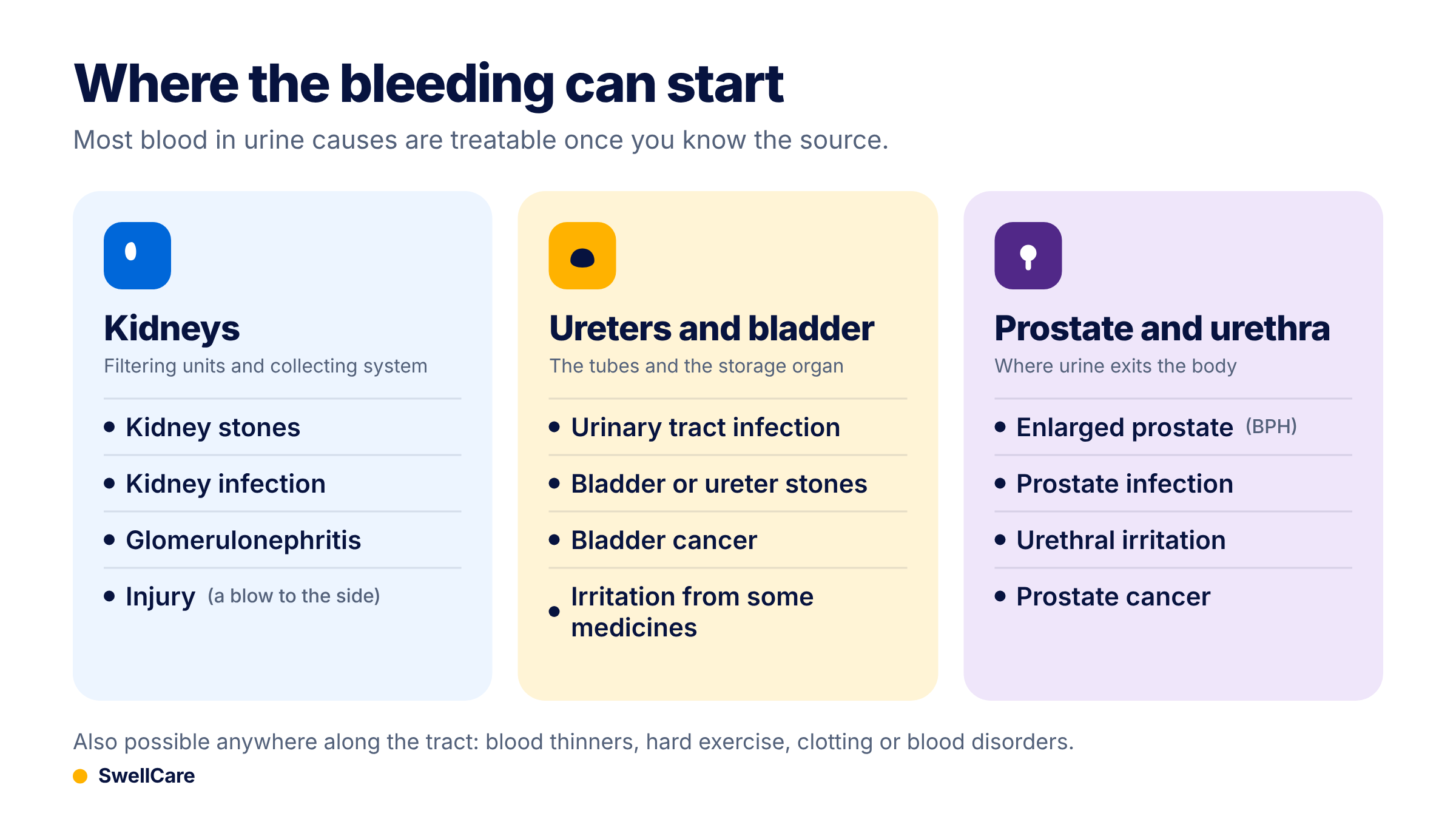
Doctors call blood in the urine hematuria, and urologists see it constantly. The NIDDK reports that at least 1 in 5 people evaluated by a urologist are diagnosed with it. The bleeding can start anywhere along the urinary tract, from the kidney to the bladder and urethra.
Urinary tract and kidney infections
The classic cause is a urinary tract infection. Bacteria reach the bladder and irritate its lining, and the lining bleeds. The symptoms are hard to miss: burning, a constant urge to go, cloudy or strong-smelling urine. Kidney infections add fever and an ache in your back or side. Both respond to antibiotics, so a UTI is among the easier causes of hematuria to fix. One that keeps coming back deserves a closer look, though.
Kidney stones and bladder stones
Kidney stones are hardened mineral crystals, and they’re a frequent source of hematuria. They scrape as they move, and the blood may be visible or only show up in a lab. Odd but true: stones can bleed without hurting until they block urine flow. Then the symptoms hit hard, usually as pain in the side or back, sometimes with blood clots. Small stones sometimes pass on their own. A CT scan can find the rest, and larger ones need treatment. A blocked stone with fever is an emergency.
An enlarged prostate
In middle-aged and older men, benign prostatic hyperplasia can swell the gland until it squeezes the urethra. The symptoms include a weak stream, trouble starting, or a little blood. Prostatitis can look similar. An enlarged prostate is common and its treatment is very manageable, but nobody should assume it’s the explanation without testing, because prostate cancer can look the same at first.
Less common causes that still matter
Some rarer causes are worth knowing. Kidney disease, especially inflamed filters called glomerulonephritis, often leaks blood too small to see. Chronic kidney disease can do it, and so can sickle cell disease. Glomerulonephritis sometimes follows a strep illness. Endometriosis that reaches the urinary tract is another cause, as is a hard blow to the back or side.
Blood thinners and a few other medications raise the odds of bleeding, but don’t let that excuse you. An AAFP review of the American Urological Association’s guidance says anticoagulants don’t appear to explain microscopic bleeding, so the usual workup still applies. Hard exercise, such as marathon running or contact sports, can cause blood in urine too, and it often clears within a week. Exercise doesn’t get to be the default answer, so still get it checked.
Then there’s cancer. About 20 percent of people with gross hematuria had bladder cancer in an AAFP summary, compared with roughly 2 percent of those with microscopic hematuria. Smoking is behind about half of those cases in developed countries. Kidney cancer and prostate cancer can bleed too, and early kidney cancer often causes no symptoms. That’s why a single episode of blood in urine counts.
Visible blood vs. blood only a test can find
If you can see it, that’s gross hematuria. If only a urinalysis or microscope catches it, that’s microscopic hematuria, defined as three or more red blood cells per high-power field. Microscopic hematuria is more common and carries a lower risk of serious disease. Gross hematuria is treated as higher priority, and it can come with blood clots.
Don’t take comfort when it stops. Hematuria that comes and goes still puts you in the group doctors want to evaluate, and blood in urine that shows up once can return.
When to get care for blood in urine
Here’s when to see a doctor, based on your symptoms and how fast they’re moving.
| What you notice | What to do |
|---|---|
| You can’t pass urine, you have a fever with chills and severe back or side pain, you’re passing large blood clots, or you feel faint | Go to the ER or call 911 |
| Visible blood, even once, even with no pain; burning that feels like a UTI; you take blood thinners | Get seen soon, don’t wait it out |
| Blood found on a routine urine test, repeat UTIs, or red urine that cleared after hard exercise, a food or a medicine | Schedule a visit |
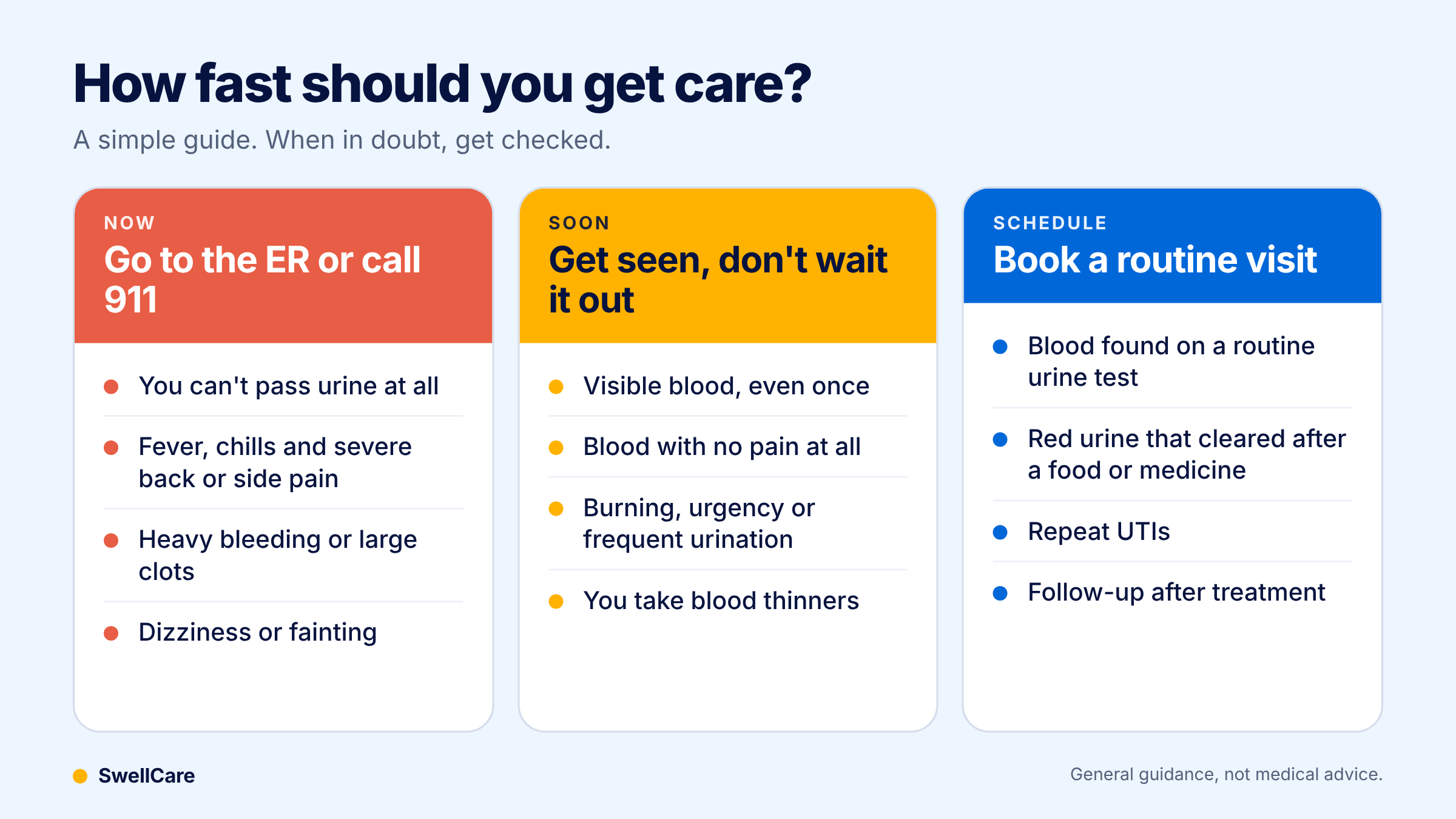
The most common mistake is waiting for more symptoms or a second episode, which only delays treatment. MD Anderson urges people to get checked for hematuria even if it only happens once.
What happens when you get it checked
The workup for hematuria starts with questions and a urinalysis. Dipsticks can read positive with no red cells present, so the lab confirms it under a microscope. Cultures check for bacteria. Women who are menstruating may be asked to retest afterward, since period blood or endometriosis can cloud the result.
Tell the clinician about recent exercise and new medicines. From there, your age, smoking history and how much blood showed up shape the next steps. Doctors may order an ultrasound or a CT scan. People 60 or older, or with gross hematuria, usually get a cystoscopy, which is a thin camera that looks inside the bladder.
Treatment for hematuria follows the cause: antibiotics for infection, stone removal if needed, medications or surgery for an enlarged prostate. Sometimes no cause turns up, and the NIDDK says treatment may not be needed then. A urologist handles the harder cases, including prostate cancer, and chronic kidney disease may bring in a kidney specialist.
Get checked with Swell
Spotting blood in urine at 2 a.m. doesn’t mean waiting for office hours. Swell offers virtual care around the clock, by chat or video. Your clinician can review your symptoms, talk through lab orders, results and treatment options, and tell you whether you need in-person imaging or a urologist. Each completed consultation is $45, with lab costs separate.
Tell us what’s going on and we’ll take it from there. Swell doesn’t replace your primary care doctor, and an emergency still means the ER.
Questions people ask about blood in urine
Can blood in urine be ok?
Sometimes. A period, hard exercise or a simple UTI can explain blood in urine, and many causes clear up with treatment. But “fine” is a conclusion for a clinician to reach after testing, not a guess made at home.
How much blood in urine is worrisome?
The amount isn’t a reliable guide. A few drops can color the whole bowl, and a small amount can come from a serious cause. Blood clots, trouble passing urine, fever with back pain, or dizziness are red flags. Any blood in urine you can see deserves a check.
Can lack of drinking water cause blood in urine?
Dehydration darkens urine and makes stones and infections more likely, but it isn’t a proven direct cause. Water won’t stop real bleeding, and exercise in the heat can make both worse. If your urine is red or brown after you’ve caught up on fluids, get tested.
How do you fix blood in the urine?
You treat what’s causing it, because hematuria is a sign, not a disease. That might mean clearing a UTI, passing or removing a stone, or medications for an enlarged prostate. Treatment depends on the answer. If testing finds nothing serious, you may only need a repeat urine test later.
Trusted references
Public-health, research, and medical-society resources related to this guide.