It’s 11 p.m. Dinner was hours ago, and a slow burn is creeping up behind your breastbone. You’ve felt it before. Lately, maybe you’ve felt it a lot. So what is it?
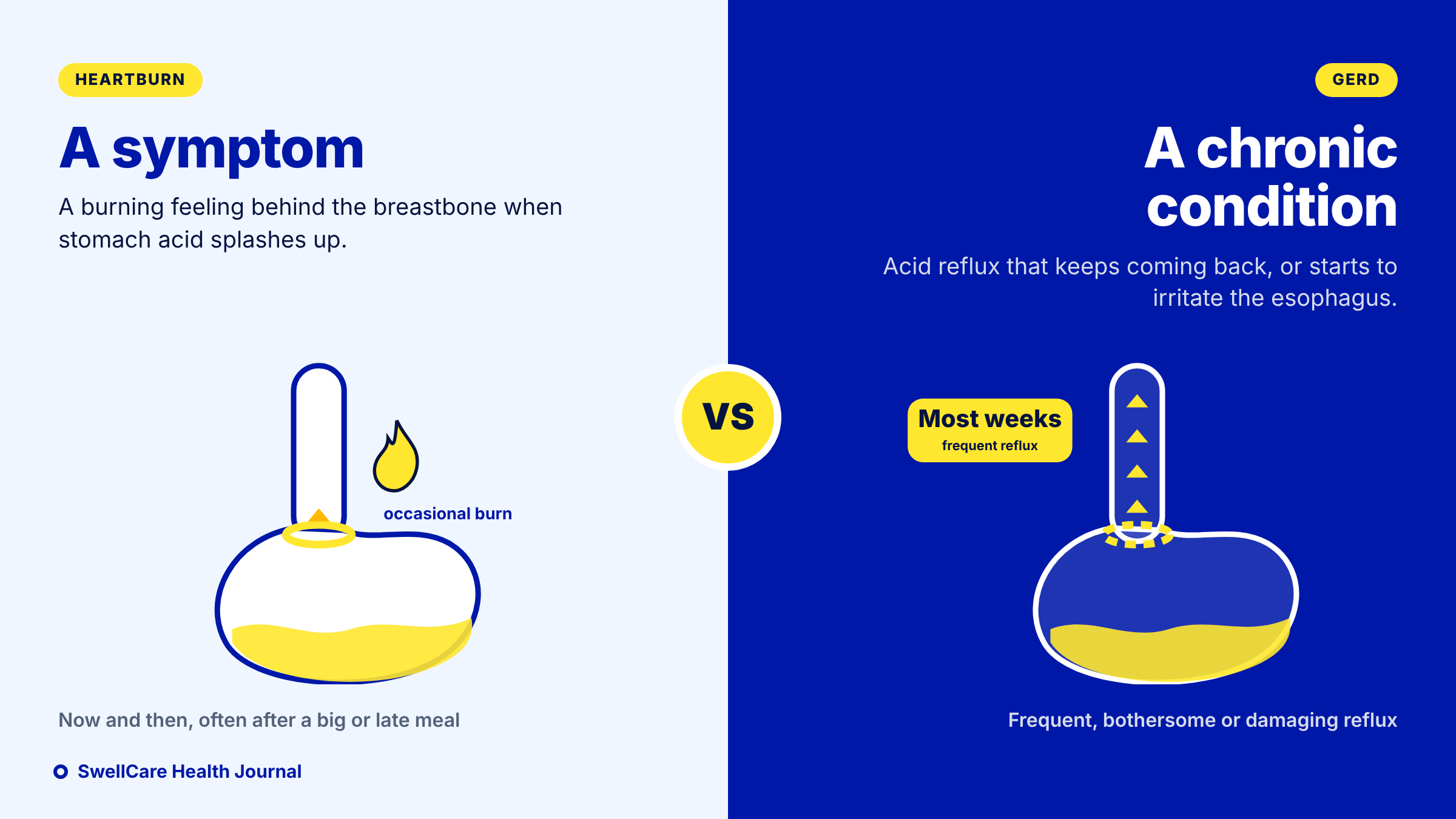
Here’s the short version of GERD vs heartburn: heartburn is a feeling, and GERD is a condition. Heartburn is the burning you notice when stomach acid washes up into your esophagus. GERD, short for gastroesophageal reflux disease, is what clinicians call it when that acid reflux keeps happening, keeps bothering you, or starts causing damage.
Almost everyone gets acid reflux now and then. Far fewer people have GERD. Knowing which group you’re in tells you whether an earlier dinner will do, or whether it’s time to talk to a clinician.
GERD vs heartburn: the short answer
Three terms get swapped around as if they mean the same thing. They don’t. Acid reflux is the event: stomach contents moving the wrong way. Heartburn is the most common sensation that event causes. GERD is the long-running pattern, where reflux is frequent or harmful enough to count as a disease. The National Institute of Diabetes and Digestive and Kidney Diseases (NIDDK) estimates that about 20% of people in the US have GERD.
| Heartburn | GERD | |
|---|---|---|
| What it is | A symptom: burning behind the breastbone | A chronic condition driven by repeated acid reflux |
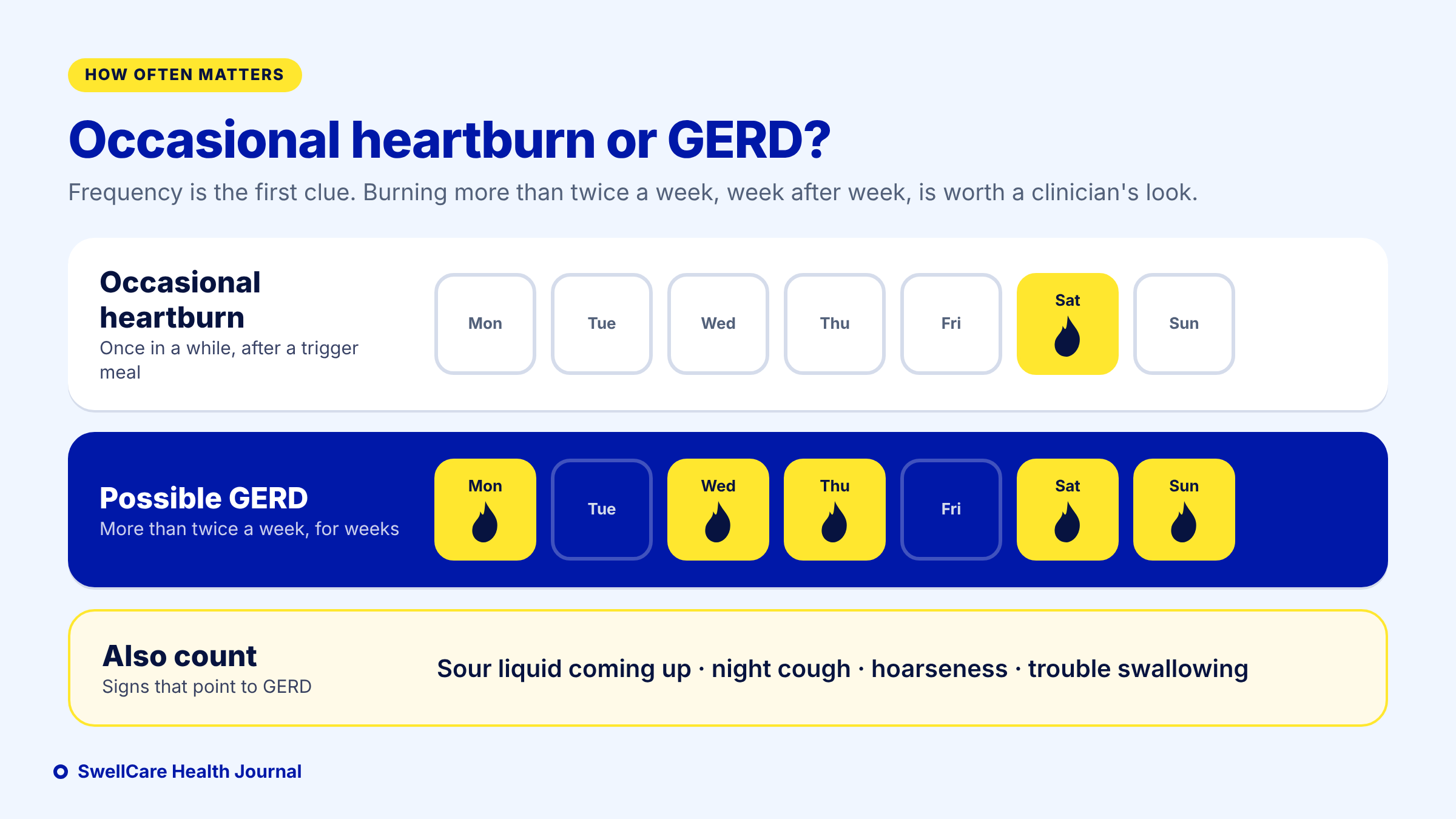
| How often | Now and then, often after a big or late meal | Frequent; symptoms more than twice a week are a common red flag |
| Other symptoms | Sour or bitter taste | Sour liquid coming up, cough, hoarseness, trouble swallowing |
| Risk to the esophagus | Low when it’s occasional | Irritation and scarring over time if untreated |
| Usual first step | Avoid triggers, use a quick-acting acid reducer as needed | A clinician-guided plan, often a daily acid reducer |
One caveat: you can have GERD with very little burning, so the label depends on your full set of symptoms rather than the burn alone.
What heartburn feels like and why it happens
At the bottom of your esophagus sits a ring of muscle called the lower esophageal sphincter. It opens to let food into your stomach, then closes again. When that sphincter relaxes at the wrong moment, stomach acid slips back up into a tube that has no real defense against it.
The result is a hot, rising burn in the middle of the chest. It often starts after eating, gets worse when you lie down or bend over, and can leave a sour taste at the back of the throat. Some people call it indigestion; others worry it’s their heart.
Triggers are personal, but the usual suspects include large portions, eating late, fried or fatty food, spicy meals, coffee and alcohol. Spicy food gets blamed a lot, yet many people handle it fine.
When heartburn turns into GERD
There’s no single magic number, but frequency is the first clue. Mayo Clinic advises seeing a doctor when heartburn happens more than twice a week or keeps coming back despite over-the-counter medications. At that point, the acid reflux has often become chronic.
The second clue is impact. Acid reflux that wakes you up, makes you dread certain meals or has you buying antacids by the jumbo bottle is telling you something. One rough night after a chili cook-off doesn’t make it GERD. A months-long pattern might.
GERD symptoms that aren’t heartburn
Acid reflux doesn’t always announce itself with a burn. Regurgitation is the big one: sour liquid or bits of food rising into your mouth. Other signs are sneakier. A dry cough that hangs around at night. Hoarseness, a raw throat or a lump-in-the-throat feeling. New or worsening asthma, chest pain that isn’t tied to exercise, or food that seems to stick on the way down can all come from reflux.
Two or three of these together? Talk to a clinician, even if the burning seems mild.
Who is more likely to get GERD
Anyone can develop it. The main risk factors listed by the NIDDK include obesity, pregnancy, smoking or regular secondhand smoke, and certain medications. A hiatal hernia, where the top of the stomach pushes up through the diaphragm, also makes acid reflux easier.
Reflux during pregnancy often fades after delivery, but most other risk factors stick around until something changes.
Why the difference matters for your esophagus
Occasional heartburn is uncomfortable but rarely harmful. Years of untreated GERD is another story. Repeated contact with stomach acid causes ongoing inflammation, which can lead to:
- Esophagitis: inflammation of the lining that can cause sores and bleeding
- Esophageal stricture: scar tissue that narrows the passage and makes swallowing harder
- Barrett’s esophagus: the lining changes into tissue that looks more like the intestine
Barrett’s esophagus raises the risk of esophageal cancer, although only a small share of people with Barrett’s ever develop that cancer. That’s no reason to panic, but years of acid reflux deserve a check-up rather than another bottle of antacids.
How heartburn and GERD are treated
Treatment works like a ladder. Most people start on the bottom rung and only climb if their symptoms don’t settle.
Lifestyle changes that help both
These sound basic. They also work better than most people expect.
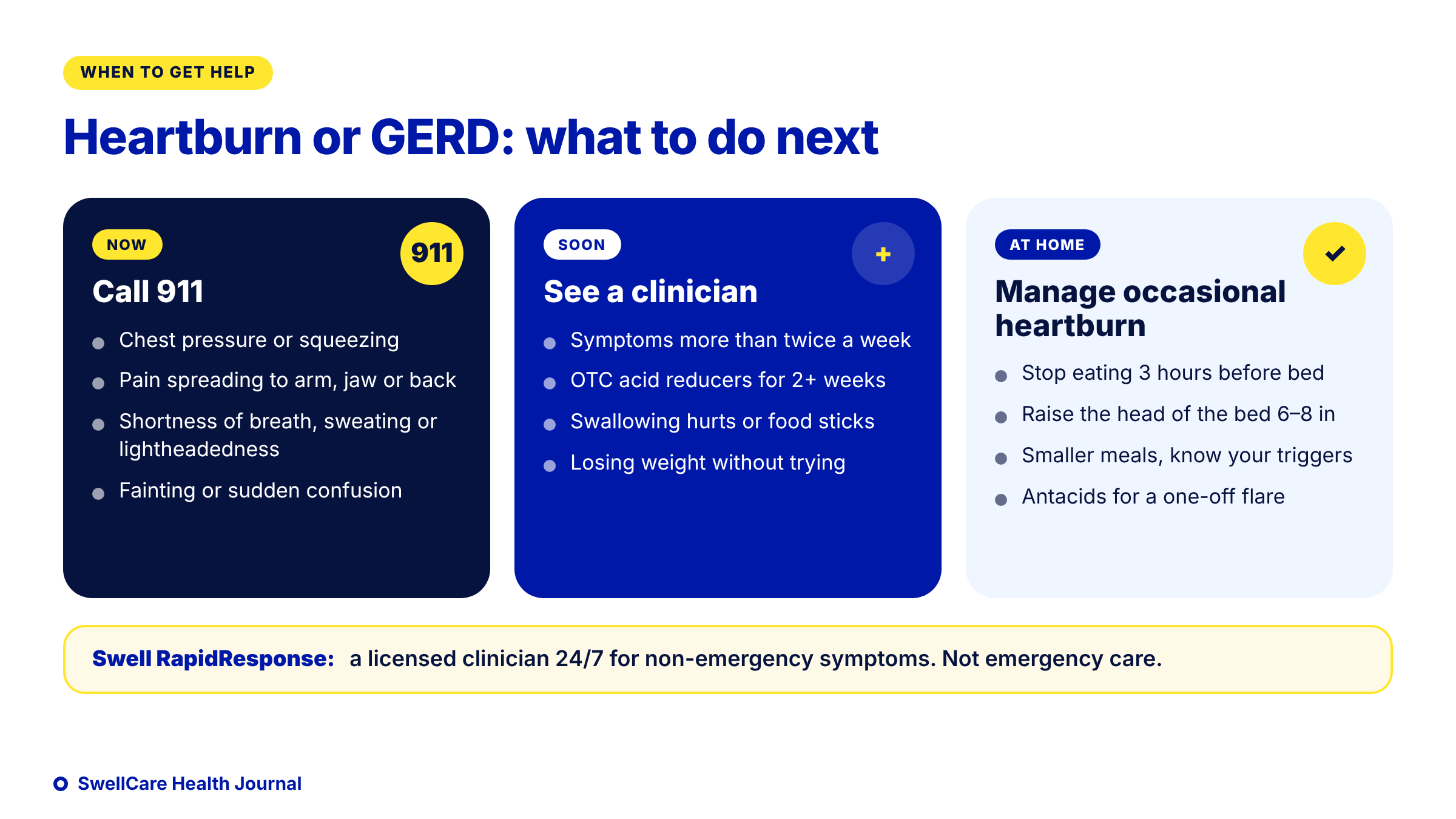
- Finish eating at least three hours before you lie down.
- Raise the head of your bed 6 to 8 inches with blocks or a wedge. Extra pillows mostly bend your neck.
- Eat smaller portions, and keep a short list of foods that set you off.
- If you carry extra weight, even modest weight loss can ease reflux.
- Cut back on alcohol and stop smoking.
The NIDDK’s reflux guidance recommends several of these lifestyle changes, and they’re the same habits that calm occasional heartburn.
Medicines, from antacids to PPIs
Over-the-counter medications fall into a few groups:
- Antacids, such as calcium carbonate chewables, neutralize acid within minutes. They’re good for a one-off flare and wear off fast.
- Alginates form a foamy raft on top of your stomach contents that helps keep them down.
- H2 blockers such as famotidine lower acid production for several hours. Take one before a meal you know will cause trouble.
- Proton pump inhibitors (PPIs) such as omeprazole are the strongest acid reducers and the usual mainstay for GERD.
The FDA labels over-the-counter PPIs for a 14-day course, no more often than every four months, unless a doctor tells you otherwise. Reaching for round three? That’s a sign your medications need a clinician’s review. Prescription-strength famotidine or a PPI is often part of a longer-term plan.
When surgery comes up
For people whose reflux doesn’t respond to medications, or who would rather not take pills for life, surgery is an option. The most common procedure is Nissen fundoplication, where the top of the stomach is wrapped around the lower esophagus to tighten the valve. Before that, a gastroenterologist will usually confirm the diagnosis with an upper endoscopy and pH monitoring.
When to see a doctor, and when to call 911
Call 911 right away if chest pain or burning comes with pressure or squeezing, pain that spreads to your arm, jaw or back, shortness of breath, sweating or lightheadedness. Heart attack symptoms can feel a lot like heartburn. Nobody should try to tell the two apart at home.
Book a visit soon if:
- symptoms show up more than twice a week
- you’ve needed an over-the-counter acid reducer for longer than two weeks
- swallowing hurts or food sticks
- you’re losing weight without trying
- you vomit blood or have black, tarry stools (this needs same-day, in-person care)
A clinician can sort out whether you need a gastroenterologist and an endoscopy, or whether a treatment plan can start now.
Talk to a Swell clinician tonight
Acid reflux loves to flare at night and on weekends, right when your regular office is closed. Swell Medical’s RapidResponse connects you with a licensed clinician 24/7. The screening chat is free. A completed consultation costs $45, with no membership.
A clinician can help you sort occasional heartburn from likely GERD, recommend or prescribe treatment when it’s safe, and tell you plainly when you need in-person care. Already on a reflux medicine and ran out? A medication refill review may help.
Start your free screening. Swell isn’t emergency care, so for chest pressure or any other heart attack warning sign, call 911.
Questions people ask about GERD vs heartburn
What does a GERD episode feel like?
Most people describe a burning that climbs from the upper belly toward the throat, often after eating or when lying down. Some taste sour fluid, feel food coming back up, or wake up coughing. Episodes can last minutes or hours, and they keep coming back, which is what separates GERD from a one-off bout of heartburn.
Can you have GERD without heartburn?
Yes. Some people with GERD rarely feel a burn. Their reflux shows up instead as a lingering cough, hoarseness, constant throat clearing, hard-to-control asthma or trouble swallowing. If those symptoms last for weeks without a clear cause, ask a clinician whether acid reflux could be behind them.
Is GERD curable?
Gastroesophageal reflux disease is usually managed rather than cured. Many people go long stretches without symptoms thanks to lifestyle changes and medications, and some can step down their acid reducers over time. Weight loss, repairing a hiatal hernia or anti-reflux surgery can reduce reflux a great deal. The realistic goal is control, plus protecting the esophagus from damage.
How do I make GERD go away?
Start with what you control: smaller meals, fewer spicy or fatty dishes, no eating for three hours before bed, a raised head of the bed, less alcohol and no smoking. Use over-the-counter relief for flare-ups. If symptoms still show up more than twice a week after a few weeks, a clinician can start a structured treatment plan, usually a daily acid reducer, and check whether anything needs testing.
Can stress cause heartburn?
Many people notice heartburn gets worse during stressful stretches, though researchers are still sorting out exactly why. Stress tends to change sleep, meal timing and food choices, and it may make you more sensitive to the burn you already have. Managing stress won’t replace medical treatment, but it can be one useful piece of the plan.
Trusted references
Public-health, research, and medical-society resources related to this guide.