Your lab portal pings. You open it, scan the list, and one line is flagged in red: bilirubin, high. Nobody has called yet, and it’s 11 p.m.
Take a breath. High bilirubin causes run from completely harmless to serious, and the number alone can’t tell you which one you’re dealing with. In most adults it turns out to be something manageable. This guide covers the most common high bilirubin causes, the symptoms that actually matter, and the exact steps to take next, so you can stop guessing and start acting.
What bilirubin is and what your number means
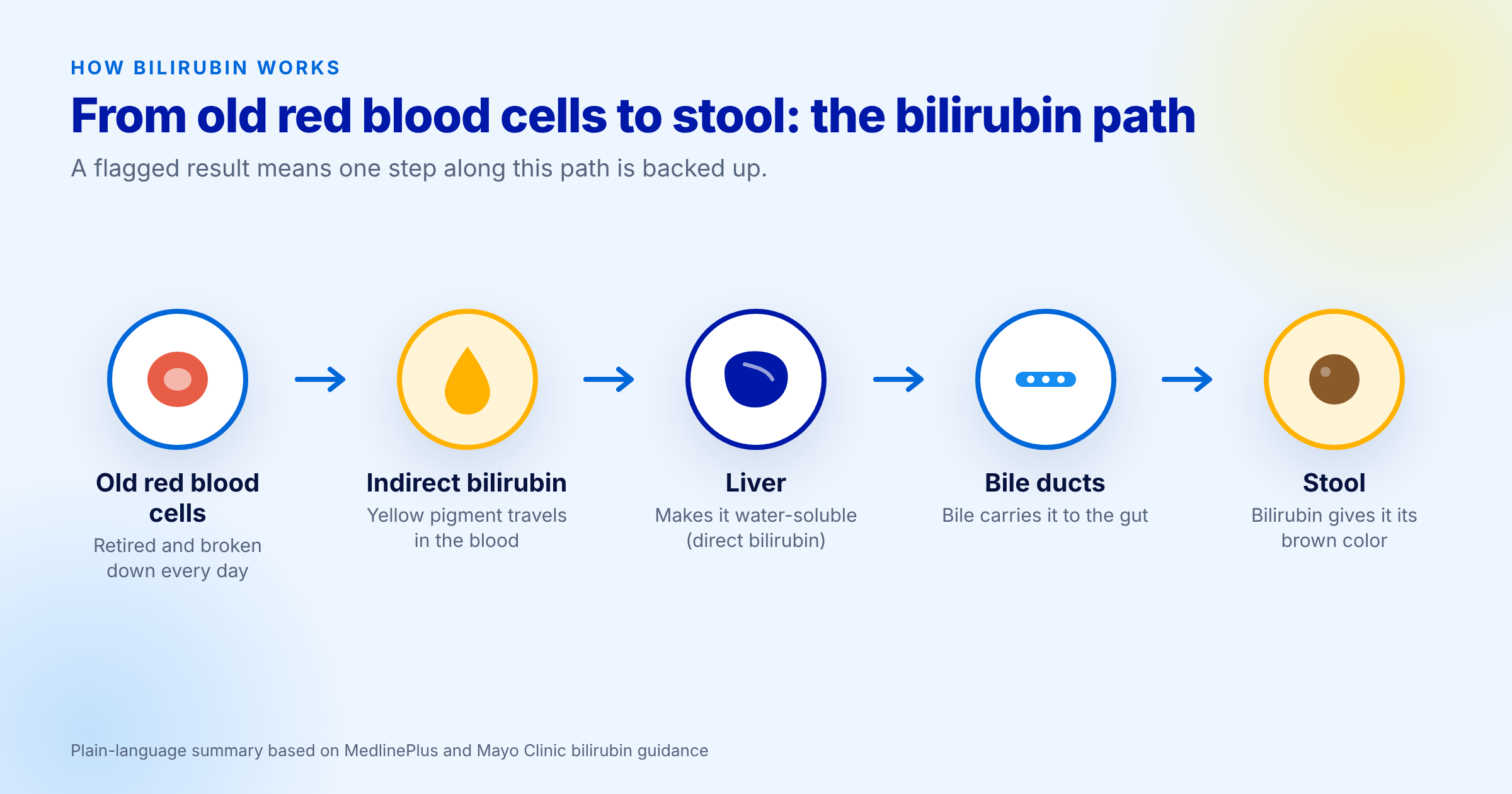
Bilirubin is a yellow-orange pigment. Your body makes it every day when old red blood cells are retired and their hemoglobin gets broken down. The pigment travels in your blood to the liver, which attaches a sugar molecule to it so it dissolves in water. That step is called conjugation. From there bilirubin leaves in bile, moves through the gut, and gives stool its brown color. An average adult produces about 250 mg a day, according to a clinical review in American Family Physician.
A blood test reports total bilirubin, and usually splits it into two parts:
- Direct bilirubin is the conjugated form, the kind the liver has already processed.
- Indirect bilirubin is the unconjugated form, still waiting for the liver. You get it by subtracting direct from total.
For adults, MedlinePlus lists a normal total bilirubin of about 0.1 to 1.2 mg/dL and direct bilirubin below 0.3 mg/dL. Labs differ a little, so go by the range printed on your own report. Jaundice, the yellow tint in skin and eyes, usually shows up once total bilirubin passes about 3 mg/dL, per Mayo Clinic.
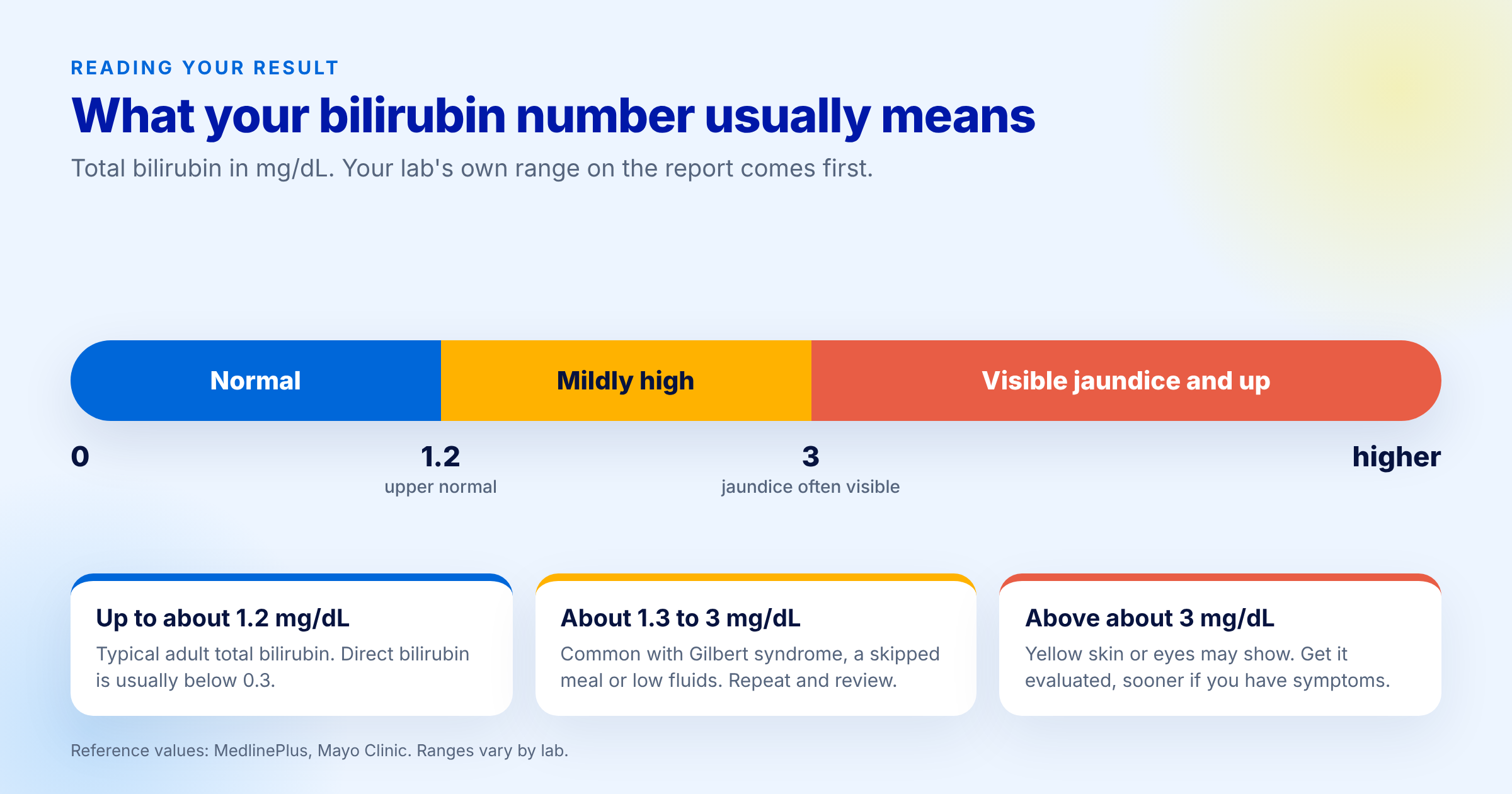
Here’s the part that surprises people. A small bump, say 1.3 or 1.8 mg/dL, is very common and often means nothing. A level of 8 mg/dL with dark urine is a different conversation. Context matters more than the flag.
You may not even have asked for this test. A bilirubin blood test is often tucked inside a routine liver panel or metabolic panel, which is why the flag can feel like it came from nowhere. Doctors also order it on purpose when someone has jaundice, dark urine or belly pain.
Because bilirubin levels shift with meals, hydration and medicines, a single reading is a snapshot, not a verdict. Your clinician will care more about how your bilirubin levels move over time than about one lonely number.
High bilirubin causes: where the problem starts
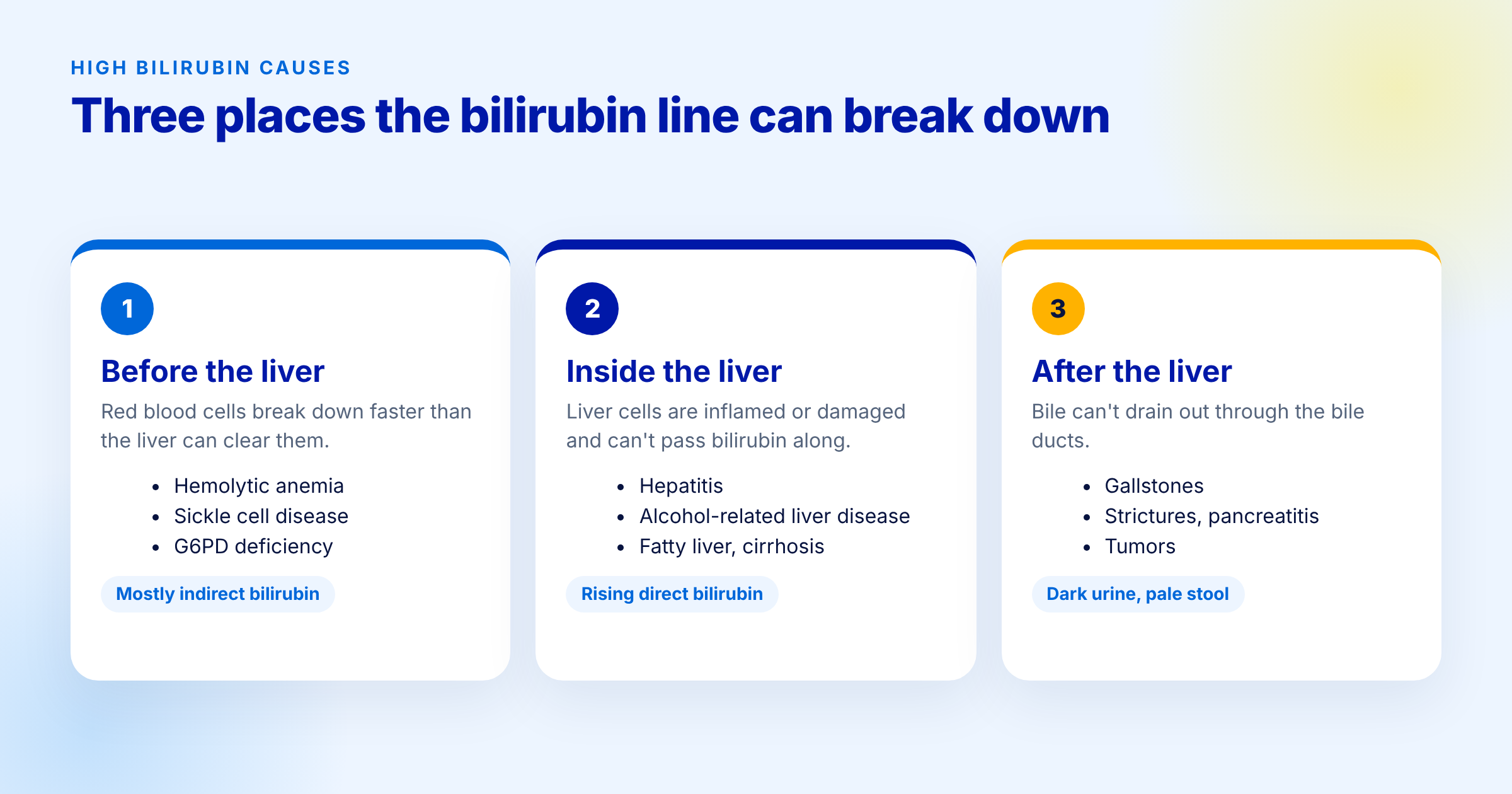
Picture a production line with three stations: supply, processing and shipping. Bilirubin levels climb when any one of them fails. Doctors sort high bilirubin causes the same way, because each station leaves a different fingerprint on your blood work.
| Where it goes wrong | What’s happening | Common examples | What the blood test often shows |
|---|---|---|---|
| Before the liver | Red blood cells break down faster than the liver can clear them | Hemolytic anemia, sickle cell disease, G6PD deficiency | Mostly indirect (unconjugated) bilirubin, normal liver enzymes |
| Inside the liver | Liver cells are inflamed or damaged and can’t pass bilirubin along | Hepatitis, alcohol-related liver disease, fatty liver disease, cirrhosis | Rising conjugated bilirubin, often with high ALT and AST |
| After the liver | Bile can’t drain out through the bile ducts | Gallstones, strictures, pancreatitis, tumors | Mostly direct bilirubin, high alkaline phosphatase |
Total bilirubin alone can’t place you on that table. The split does the heavy lifting. A rise that’s mostly indirect bilirubin points toward the first station, or toward a slow-processing quirk like Gilbert syndrome. A rise that’s mostly direct bilirubin, the conjugated kind, points toward the liver or the pipes after it. Your doctor reads the split, then the enzymes, then your story.
Before the liver: red blood cells breaking down too fast
Doctors call this hemolysis. If red blood cells are destroyed faster than normal, the liver gets flooded with more bilirubin than it can handle, and the unconjugated kind, called indirect bilirubin, piles up.
The list is long. It includes inherited conditions such as sickle cell disease or thalassemia. G6PD deficiency, autoimmune hemolytic anemia and some medications can do it too. The AAFP review says roughly 150 drugs have been tied to red blood cells breaking apart early. You might also feel tired, short of breath or pale, because anemia usually comes along for the ride.
In this group the liver itself is fine. It’s just buried in work. That’s why enzyme tests are typically normal and the jaundice, if it appears at all, is mild.
Inside the liver: hepatitis, fatty liver and scarring
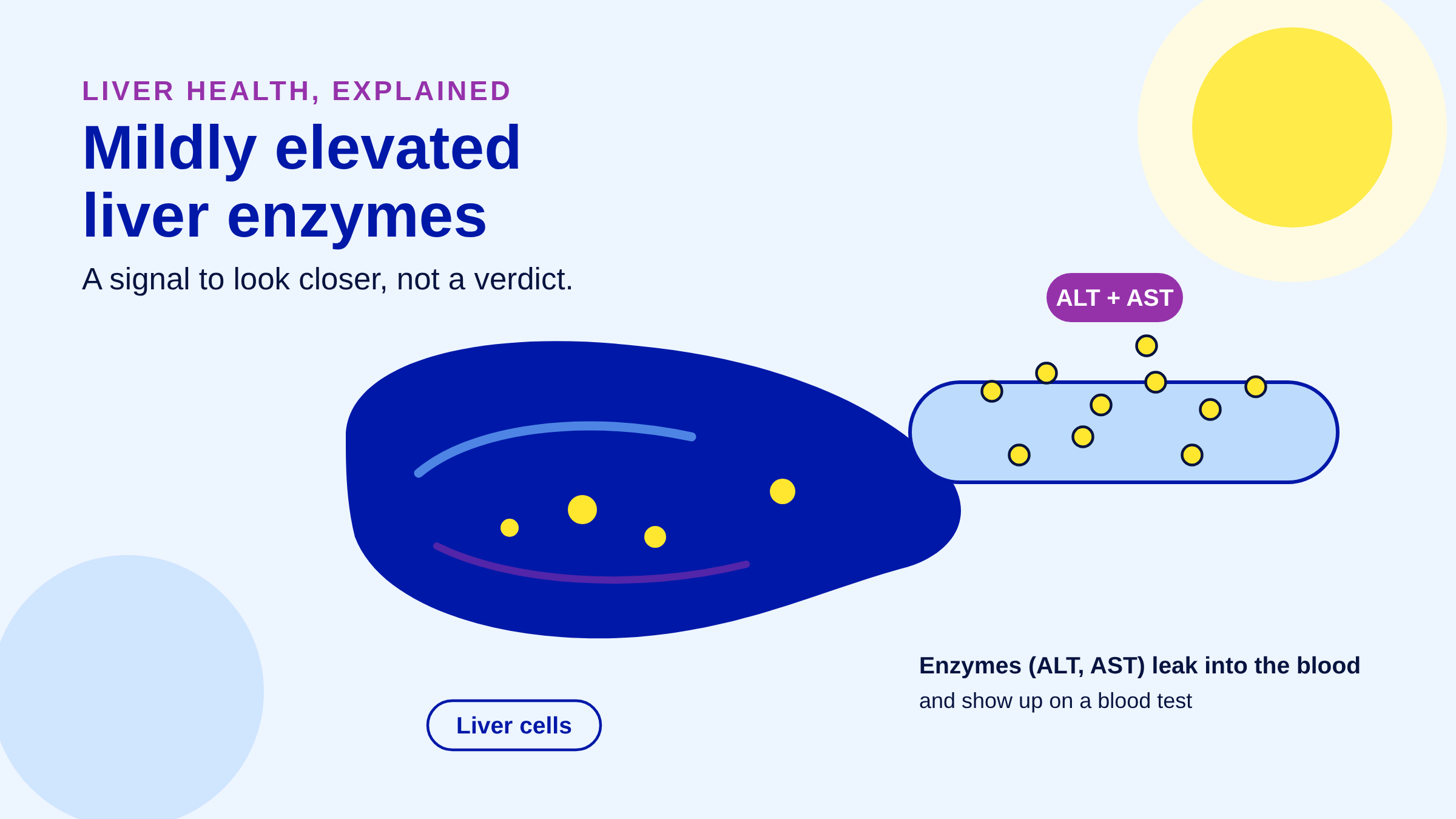
Here the liver cells themselves are the problem. Viral hepatitis, alcohol-related liver disease, fatty liver disease and autoimmune liver conditions can all stop the liver from handling conjugated bilirubin properly. So can drug-induced liver injury. Cirrhosis, the scarring that follows long-term damage, does the same.
Liver disease often shows up as high conjugated bilirubin plus raised enzymes. Not always, though. In advanced cirrhosis the numbers can look normal even when the liver is struggling, which is one reason doctors never read bilirubin in isolation. Conjugated bilirubin that’s high while the red blood cell count is normal also makes hemolysis less likely.
After the liver: blocked bile ducts
If bile can’t drain, conjugated bilirubin backs up into the blood. Think of the bile ducts as a small drainage system running from the liver to the intestine. One stone, one narrowing or one swollen neighbor can plug it. The most common non-cancer culprit is a gallstone lodged in the common bile duct. In the AAFP review of adults with new jaundice, stones in the bile ducts accounted for about 14% of cases and tumors for about 6%.
Other causes include narrowed ducts (strictures), a bile duct infection called cholangitis, chronic pancreatitis, and cancers of the bile ducts, gallbladder or pancreas. Cancer is the less common answer, but it’s the reason a blocked-duct pattern is never ignored.
This is the pattern that tends to announce itself: dark urine, pale stool, itching all over, and pain in the upper right belly. Gallstones that move can also cause on-and-off pain after fatty meals before they ever block a duct.
Gilbert syndrome: a harmless reason for a mildly high result
If your only abnormal result is a mildly raised bilirubin, Gilbert syndrome is the first thing most clinicians think of. It’s an inherited variation that makes the enzyme responsible for conjugation work a little slower. MedlinePlus says it affects about 1 in 10 people in some white populations.
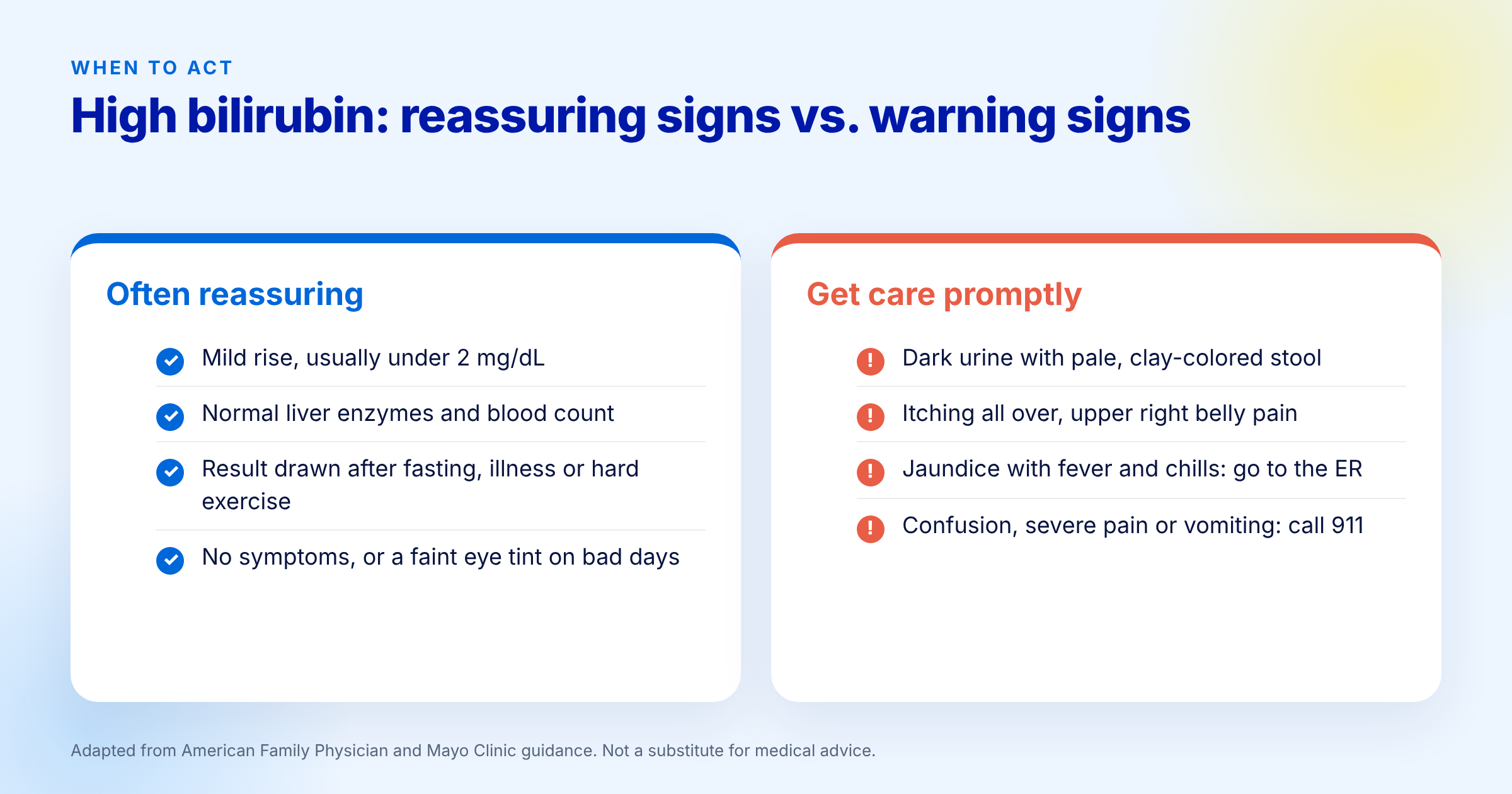
The classic picture is total bilirubin under 2 mg/dL, mostly unconjugated (indirect bilirubin), with normal conjugated bilirubin and normal liver tests. Many people only find out by accident, from a routine panel.
What makes the number jump? Mayo Clinic lists fasting or very low-calorie eating, not drinking enough, illness like a cold or flu, strenuous exercise, menstruation and stress. That’s why a result drawn after a long gap without food can look worse than one drawn after a normal breakfast.
Most people with Gilbert syndrome notice nothing. A few see a faint yellow tint in the eyes during a bad week. Both are normal for this condition, and neither damages the liver.
No treatment is needed. One practical catch: the slower enzyme can change how your body handles a few drugs, including irinotecan and some HIV protease inhibitors, so mention Gilbert syndrome to any new prescriber.
Medications, alcohol and other everyday causes
Not every high reading points to a disease, and several everyday high bilirubin causes are temporary. MedlinePlus notes that some medicines, certain foods and strenuous exercise can nudge bilirubin up, and Mayo adds a long fast and low fluid intake to the list.
A few worth checking against your own routine:
- Medications. Many drugs can affect the liver or bilirubin processing, including some antibiotics and HIV medicines. Too much acetaminophen can injure the liver outright. Don’t stop a prescription on your own, though. Ask first.
- Alcohol. Regular heavy drinking can lead to fatty liver, alcohol-related hepatitis and eventually scarring of the liver, all of which raise bilirubin.
- Supplements. Some herbal and bodybuilding products have been linked to liver injury. Bring the bottles to your appointment.
- Skipped meals and low fluids. A missed meal and too little water can push an otherwise normal number over the line. If you’d gone without food or water at the draw, tell your clinician.
Pregnancy usually lowers bilirubin slightly, so it can mask a problem rather than cause one.
Signs your high bilirubin needs attention
The number is one clue. Your body gives you the rest. Symptoms that suggest the cause is more than a quirk of fasting include:
- Yellowing of the skin or the whites of the eyes (jaundice)
- Urine the color of tea or cola
- Pale, clay-colored stool
- Itching without a rash
- Pain or fullness in the upper right abdomen
- Unusual tiredness, or unplanned weight loss
Dark urine and pale stool together deserve a call to a clinician that same day or the next. They point toward a drainage problem in the bile ducts rather than a supply problem.
When to go to the emergency room
Jaundice with fever and chills, severe abdominal pain, vomiting you can’t stop, confusion or unusual sleepiness needs emergency care, not an online visit. Fever with jaundice can signal a bile duct infection or sepsis, and confusion can signal that the liver is failing to clear toxins. Call 911 or go to the nearest ER.
How doctors find the cause
Finding the cause is a sorting exercise, and it usually moves in a predictable order.
- Split the bilirubin. Fractionated bilirubin separates direct from indirect. It’s the first fork in the road.
- Check the blood count. A complete blood count (with a smear) looks for anemia and signs of hemolysis.
- Test the liver. ALT and AST flag damaged liver cells. Alkaline phosphatase leans toward a blocked duct. Albumin and clotting tests show how well the liver is working.
- Look inside. An abdominal ultrasound is the usual first scan for gallstones and widened bile ducts. MRCP or ERCP maps the bile ducts in more detail when needed, and ERCP can sometimes fix the blockage on the spot.
If everything else is normal and the rise is mild, your clinician will often just repeat the blood test after a few days of normal eating and good hydration. If it’s still high, the workup widens to hepatitis and autoimmune panels. This sequence follows the approach in the AAFP review.
A heads-up on the scans: a clean ultrasound doesn’t close the case on its own. It can miss small stones low in the duct, so a doctor who still suspects a blockage may order a second kind of imaging even after a normal first look.
Can you lower high bilirubin?
The honest answer: you treat the cause, not the number, and the right fix depends on which of the high bilirubin causes you have. There’s no tea, cleanse or supplement that “flushes” bilirubin, and products that claim to are selling a story.
What works depends on the problem:
- Gilbert syndrome: nothing to fix. Eating regularly and staying hydrated keeps bilirubin levels steadier.
- Hemolysis: treatment targets the reason red blood cells are breaking down, whether that’s an autoimmune condition, a medication or an inherited disorder.
- Liver disease: treatment depends on whether it’s hepatitis, alcohol, fatty liver or something else. Cutting alcohol helps nearly every liver cause.
- Blocked bile ducts: treatment usually means a procedure to reopen the duct.
Good treatment starts with a diagnosis, which is why self-treating a raised number is a poor bet. If a medicine turns out to be the trigger, your prescriber may switch it. Never stop one on your own.
Newborn jaundice is its own topic, with different thresholds and light therapy called phototherapy. This guide is about adults.
How to get a reliable repeat bilirubin blood test
A repeat test only helps if it’s a fair comparison. A few habits make the second bilirubin blood test easier to trust.
Ask the lab or your clinician whether you need to fast. Many people don’t, and an unnecessary fast is one of the easiest ways to nudge bilirubin levels up by accident. If fasting is required, keep it as short as the instructions allow, and drink water. Eat normally the day before, and skip hard workouts for a day or two.
Bring a list of everything you take. That means prescriptions, over-the-counter pain relievers, herbal products and the occasional drink. Use the same lab if you can, since reference ranges differ slightly from lab to lab, and compare the total and the direct figure side by side, in mg/dL, with the first report. Tracking total bilirubin this way beats trusting memory.
If the repeat comes back in the normal range, you’ve probably just caught a passing trigger or Gilbert syndrome. If it’s higher, or the jaundice is visible, don’t wait for the next routine checkup.
What to do next if your bilirubin is high
Here’s a simple plan you can start tonight.
- Read the whole report. Find direct bilirubin, total bilirubin, ALT, AST and alkaline phosphatase. Are the other liver tests normal? A lone mildly high bilirubin with normal liver enzymes is far less worrying.
- Check yourself against the warning signs above. Dark urine, pale stool, fever or severe belly pain change the timeline from “this week” to “today.”
- Write down what might have pushed it up. Skipped meals, a stomach bug, hard workouts, new medications, supplements, and how much you drink.
- Eat normally and drink water until you’re retested. Skip crash diets and heavy drinking.
- Get it reviewed and repeated. Most mild elevations deserve a clinician’s eye within days to a couple of weeks, with a repeat blood test. A clinician can also decide whether any treatment or imaging is needed.
Swell can help with that last step. Swell’s clinicians offer routine lab orders and follow-up through a virtual visit, and you can start the process through how it works. Sign-up and screening are free, a completed consultation is $45, and lab costs are separate. If your symptoms feel urgent but not life-threatening, online urgent care is open 24/7.
One boundary, so there are no surprises: Swell isn’t emergency care, and a virtual visit can’t replace an ultrasound. If your results point toward a blockage in the bile ducts, you’ll be sent for in-person imaging.
Questions people ask about high bilirubin causes
Is high bilirubin an emergency?
Not by itself. A mildly raised level with no symptoms is usually not urgent. It becomes an emergency when jaundice comes with fever, severe abdominal pain, confusion or repeated vomiting. In that case go to the ER rather than waiting for an appointment.
Does high bilirubin always mean liver damage?
No. Gilbert syndrome, fasting, dehydration and red blood cell breakdown can all raise bilirubin levels while the liver is perfectly healthy. The pattern of direct versus indirect bilirubin, plus liver enzymes, tells doctors whether the liver is actually involved.
Can dehydration cause high bilirubin?
Yes, mildly. Mayo Clinic lists low fluid intake, long gaps without food and hard exercise among the things that can temporarily alter results. If the rise was small and you were dehydrated at the draw, a repeat test after eating normally and drinking water often settles it.
What level of bilirubin is dangerous in adults?
There’s no single cutoff, because symptoms and the cause matter. Visible jaundice generally starts around 3 mg/dL. Bilirubin levels well above that, especially with dark urine, pale stool, fever or pain, need prompt medical evaluation.
Should I worry about slightly high bilirubin with normal liver enzymes?
Usually not. This combination, especially when the rise is mostly indirect bilirubin, fits Gilbert syndrome or a temporary trigger. Still have your clinician confirm it with a repeat test and a review of your medications.
How long does it take for bilirubin to return to normal?
It depends on the cause. With a temporary trigger such as a missed-meal day or a viral illness, levels may settle within days to a few weeks. With Gilbert syndrome they can drift up and down for life. With liver or bile duct disease, it follows treatment of the underlying problem.
Trusted references
Public-health, research, and medical-society resources related to this guide.