You’ve been stuffed up for a week. Your face feels like it’s wearing a helmet two sizes too small, and you can’t tell whether this is still a cold or something worse. How long does a sinus infection last, anyway?
So, how long does a sinus infection last? Most improve within 7 to 10 days. Some stretch to four weeks. Past 12 weeks, it gets a different name and a different plan. Here’s how to tell where you are, what actually helps, and when a clinician should take a look.
How long does a sinus infection last? The short answer
Most sinus infections come from a cold virus, so they run on the same schedule as a cold. Doctors call a sudden one acute sinusitis, and the broader term is simply sinusitis. Symptoms usually ease within about 7 to 10 days, and the CDC says most sinus infections get better on their own without antibiotics.
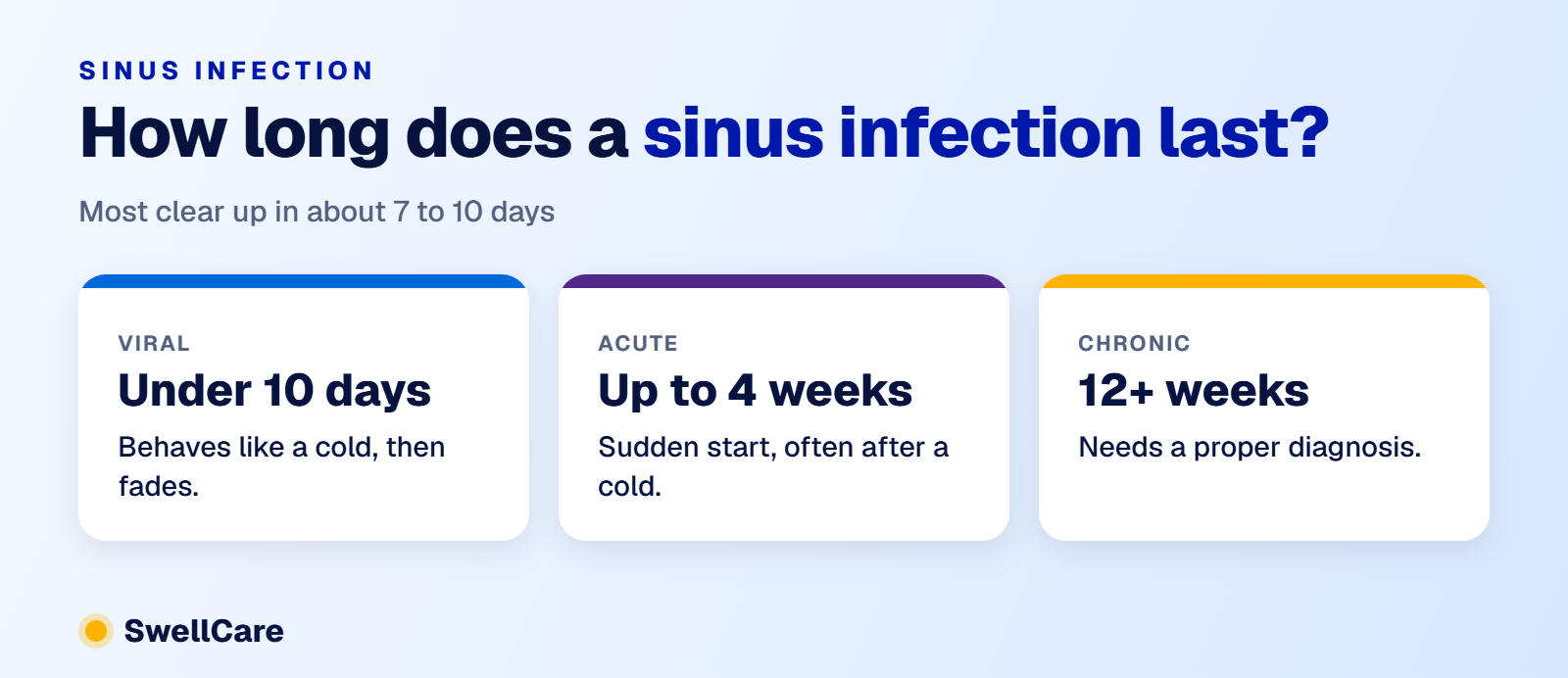
The medical groups draw the lines like this for a sinus infection.
| Type | How long it lasts | What it means |
|---|---|---|
| Viral episode | Usually under 10 days | Behaves like a cold; mucus and pressure peak, then fade |
| Acute sinusitis | Up to 4 weeks | Sudden start, often right after a cold |
| Chronic sinusitis | 12 weeks or longer | Ongoing inflammation of the sinuses that needs a proper diagnosis |
The acute and chronic cutoffs come from the American Academy of Otolaryngology guideline. Other organizations draw them a little differently, which is why you’ll see slightly different numbers online. Four to twelve weeks? A gray zone doctors sort out case by case.
A day-by-day sinus infection timeline
Think of it as three phases, from a plain viral cold to a possible bacterial infection. Which one you’re in tells you whether to keep resting or pick up the phone.
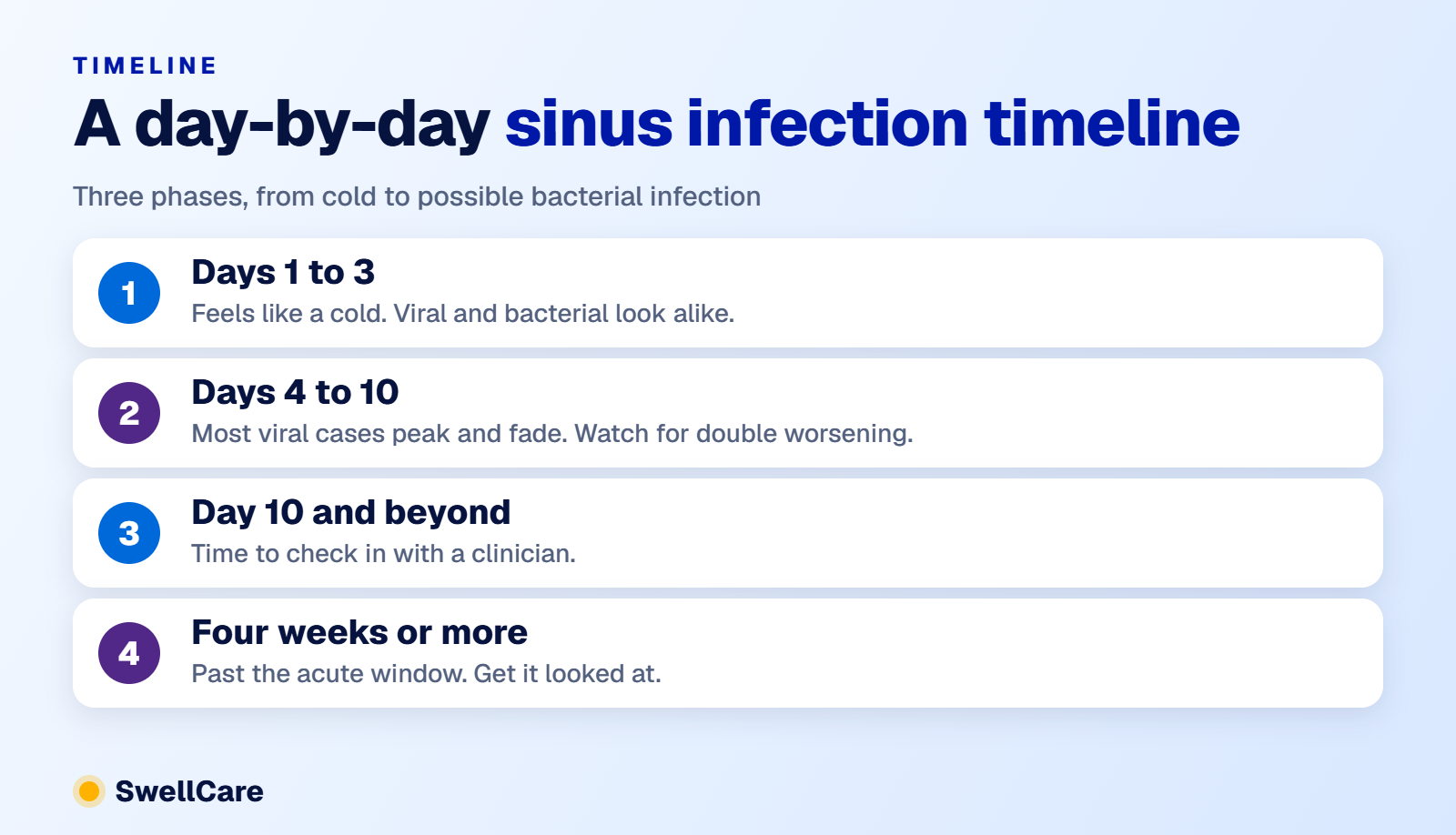
Days 1 to 3: it feels like a cold
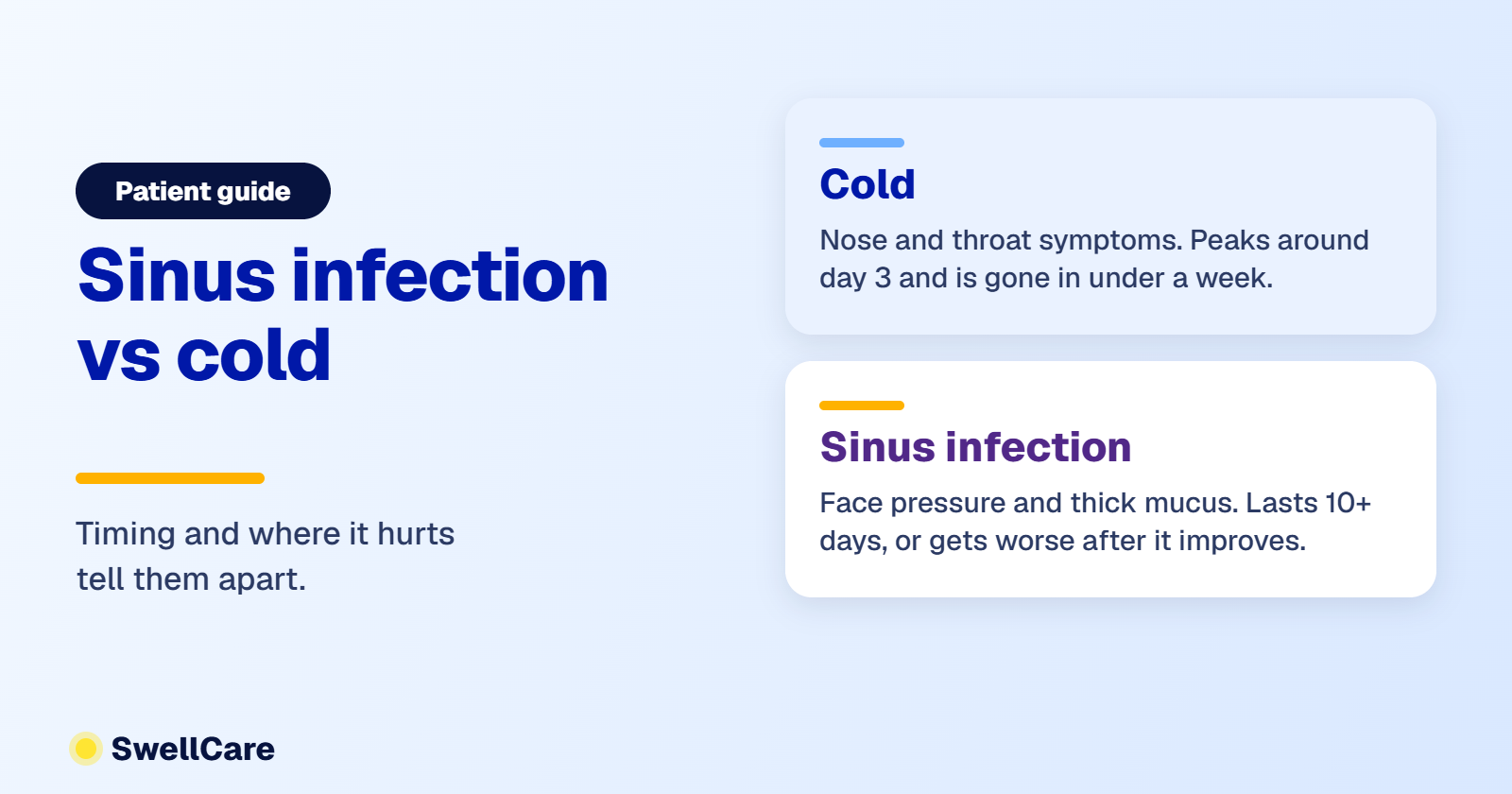
You’ll notice congestion, a runny nose, pressure behind your cheeks or forehead, and maybe a sore throat or a low fever. Viral and bacterial infections look identical this early, so a sinus infection at this stage is really just a cold that’s settled in your sinuses. Clinicians don’t try to tell them apart yet, and AAFP guidance says the same.
Days 4 to 10: the turning point
Here most viral cases peak and start to fade. The mucus may turn yellow or green. That color alone doesn’t prove bacteria, so don’t treat it as a verdict.
The pattern to watch is double worsening. You start to feel better, then your symptoms come back harder, usually somewhere between days 5 and 10. That pattern is consistent with a bacterial infection.
Day 10 and beyond: time to check in
Symptoms that haven’t improved by then are the standard trigger for a visit, whether it’s a cold gone long or true acute sinusitis. At that point the odds of a bacterial infection rise to roughly 60 percent, according to the AAFP review. It doesn’t mean you need a prescription. It means someone should look.
Why some sinus infections drag on
Your sinuses are small, air-filled spaces behind your cheeks, nose and forehead. When the lining swells, the drainage openings narrow, mucus backs up, and bacteria get a place to settle. Anything that keeps that inflammation going stretches the timeline, and the sinuses are slow to drain once they’re blocked.
Common culprits include seasonal or year-round allergies, a deviated septum, nasal polyps, and a weakened immune system. Allergies are sneaky. Swollen sinuses look like an infection that never leaves. A deviated septum, meaning the wall between your nostrils sits off-center, can keep one side from draining. Nasal polyps, soft growths in the lining, do the same. Managing allergies can help the sinuses settle. If a cold turns into sinusitis once or twice a year, that’s ordinary. Three or four infections a year is a reason to ask about an ear, nose and throat referral.
Chronic sinusitis is a separate condition, and chronic sinusitis often needs a specialist plus imaging. The AAO guideline requires 12 weeks or more of at least two symptoms, such as thick drainage, congestion, facial pressure or a reduced sense of smell, plus objective evidence of inflammation. You can’t diagnose that from your couch.
What helps you feel better faster
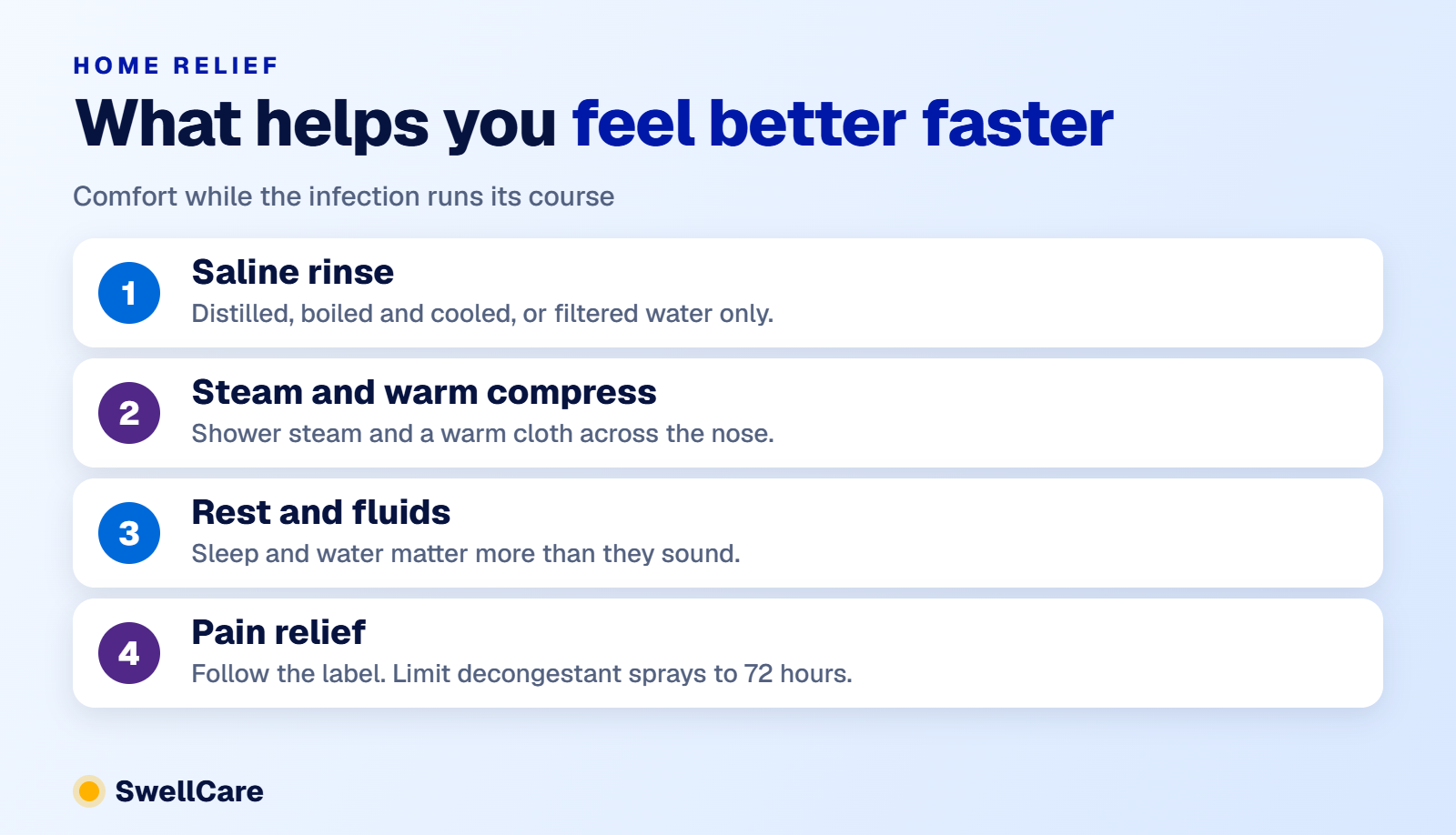
Treatment for most people is about comfort while the infection runs its course. Nothing on a pharmacy shelf is likely to shorten a viral sinus infection by much, but good home treatment makes the days easier.
A saline rinse thins mucus and clears out debris. A saline spray works too if a full rinse feels like too much. Use distilled, boiled-and-cooled or filtered water, never straight tap water, because of a rare but serious amoeba risk the AAFP flags. Steam from a hot shower and a warm compress across your nose and forehead can ease pressure. A humidifier helps if your air is dry. Sleep and water matter more than they sound. Boring? Yes. It works.
Over-the-counter pain relievers can take the edge off a headache or a facial ache. Use over-the-counter products as the label says. Decongestants can help with congestion, but topical decongestant sprays shouldn’t be used longer than 72 hours because rebound stuffiness is real. If you have high blood pressure, ask a pharmacist before taking oral decongestants.
Antibiotics are the part people get wrong. They do nothing against a virus, and taking antibiotics anyway adds side effects without speeding recovery. Antibiotics only earn their place when bacteria are the likely cause. When a bacterial infection is likely, clinicians often start with amoxicillin, sometimes combined with clavulanate, for about 5 to 10 days. Many will also offer watchful waiting first for 7 to 10 days, as long as follow-up is easy. If symptoms haven’t improved after several days of antibiotics, call your doctor, who may reassess or switch the medicine. Ask your doctor what treatment fits.
When to see a doctor for a sinus infection
See a doctor, or book a virtual visit, if any of these fit:
- Your symptoms haven’t improved after 10 days
- A fever lasts three to four days or longer
- You improved, then got worse
- You have a severe headache or facial pain
- You keep getting sinus infections
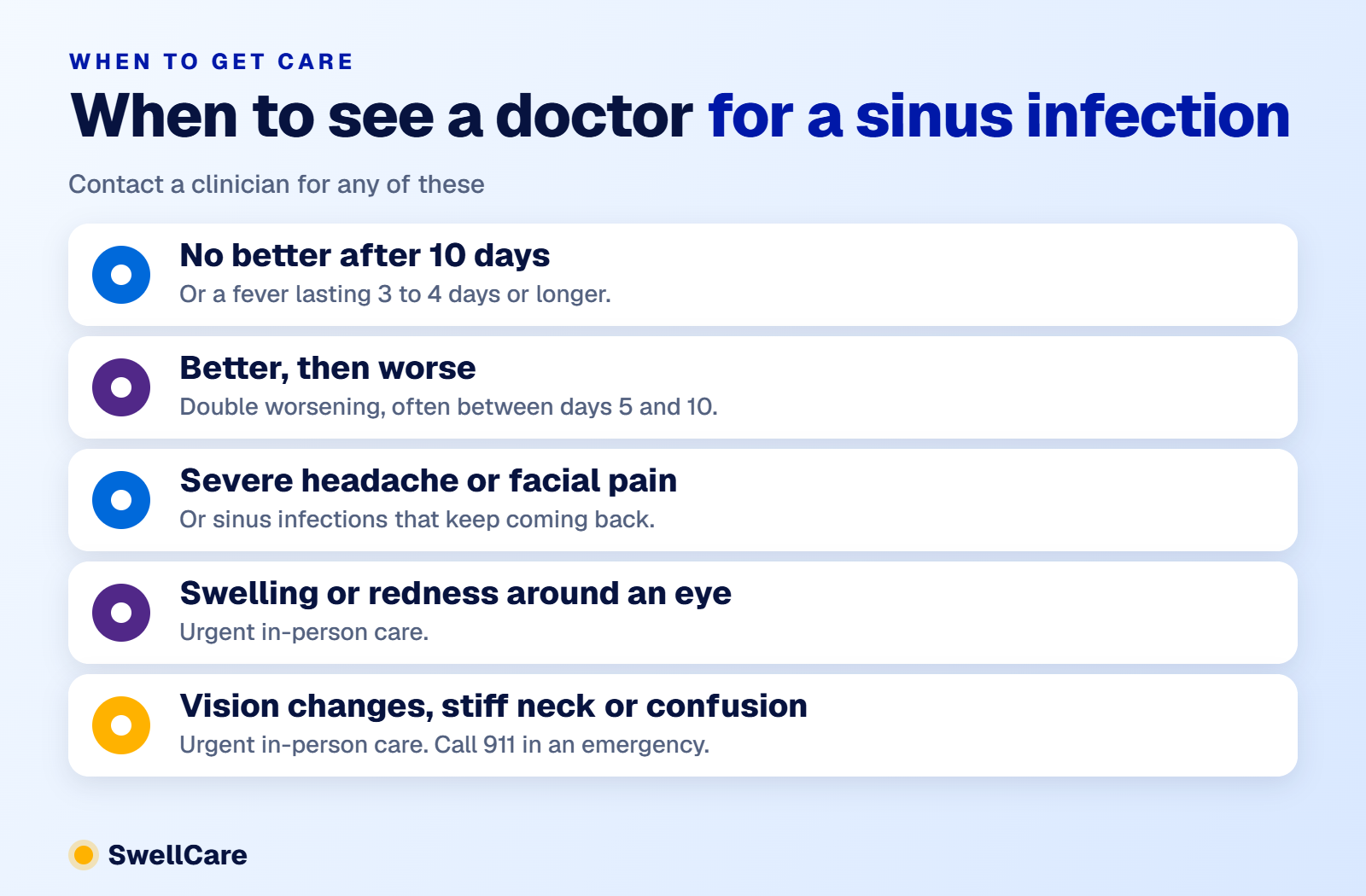
Some signs are different. Swelling or redness around an eye, vision changes, a stiff neck or confusion call for urgent in-person care. Complications like these are rare, roughly one in a thousand episodes by the AAFP’s estimate, but they’re not something to wait out. In an emergency, call 911.
Get care for sinus symptoms with SwellCare
Not sure if your sinus infection has crossed the line, or whether your sinuses just need more time? SwellCare’s online urgent care offers clinician-led, non-emergency care around the clock by video or chat. A clinician can look at your timeline, decide whether you need treatment, and tell you when to be seen in person. Prescriptions are never guaranteed. See how it works.
Questions people ask about sinus infection length
Can a sinus infection last 3 weeks?
Yes. Acute sinusitis can run up to four weeks. But a sinus infection that’s still going at three weeks isn’t typical of a plain cold, so it deserves a clinician’s attention. Don’t wait for week four if you’re getting worse, or if you haven’t improved at all since the second week.
Is a sinus infection contagious?
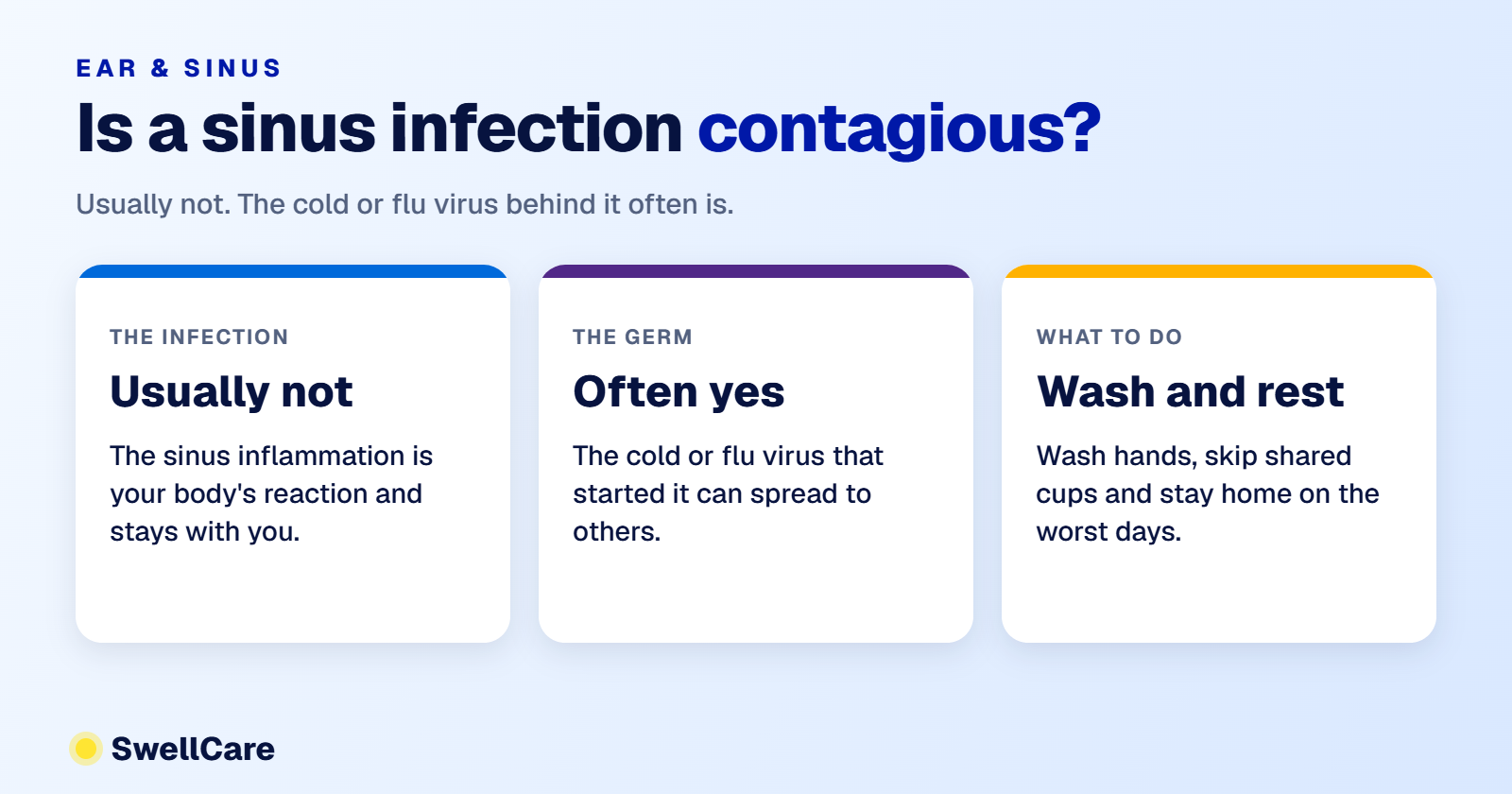
Sinusitis itself usually isn’t contagious, but the cold virus behind many cases is. Wash your hands, cover coughs and give people some space for the first several days. Our guide has more on whether a sinus infection is contagious.
Will a sinus infection go away on its own?
Often, yes. Most are viral and improve within about 7 to 10 days, and the CDC says most sinus infections get better without antibiotics. If your symptoms haven’t improved by then, or you improve and then slide back, get it checked.
How long should you wait before seeing a doctor?
Give a mild infection a week or so, since most acute sinusitis eases without a prescription. If you’re unsure which kind you have, a clinician can sort it out in one short visit, and that visit is worth it when a sinus infection is hanging around with a fever or worsening facial pain. Go sooner if you have a fever past three or four days, severe pain or symptoms that worsen after improving. Anything involving your eye, vision or neck means don’t wait at all.
Trusted references
Public-health, research, and medical-society resources related to this guide.