It’s 2 a.m., your head is pounding, and the thermometer just read 102. You want it down now. Here’s how to lower a fever fast and safely: take the right fever-reducing medicine at the right dose, drink fluids, shed extra layers and rest. None of it needs a prescription. Below you’ll find the order that works best, the mistakes that backfire, and the exact signs that mean it’s time to stop home care and call a doctor.
Is your fever dangerous, or is it doing its job?
A fever is your body turning up its own heat to fight an infection, viral or bacterial. Usually that means your immune system is working. A mild fever under 101°F often needs no treatment at all, and Mayo Clinic says adults at 102°F or below can generally just rest and drink fluids.
So why treat it? Comfort. Reach for medicine when the fever comes with a headache, body aches, chills or broken sleep, or when your temperature keeps climbing. The goal isn’t to erase the fever. It’s to bring your body temperature down enough that you can recover, as MedlinePlus explains. Use a digital thermometer by mouth so you’re working from a real number, not a guess, and note your temperature every few hours.
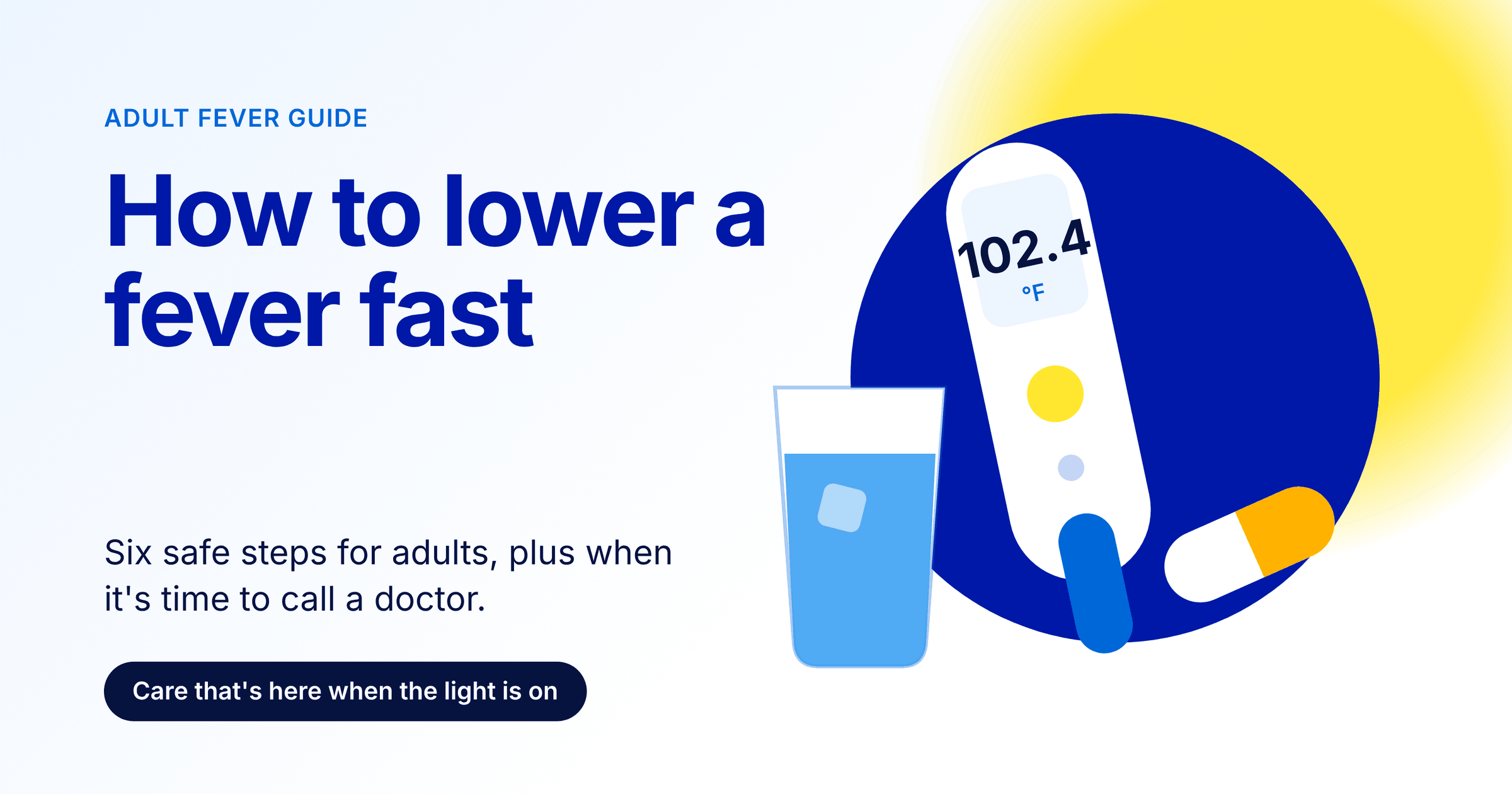
How to lower a fever fast: 6 steps that work
Start at the top. Each step builds on the one before it, and your thermometer should stay within reach.
1. Take acetaminophen or ibuprofen the right way
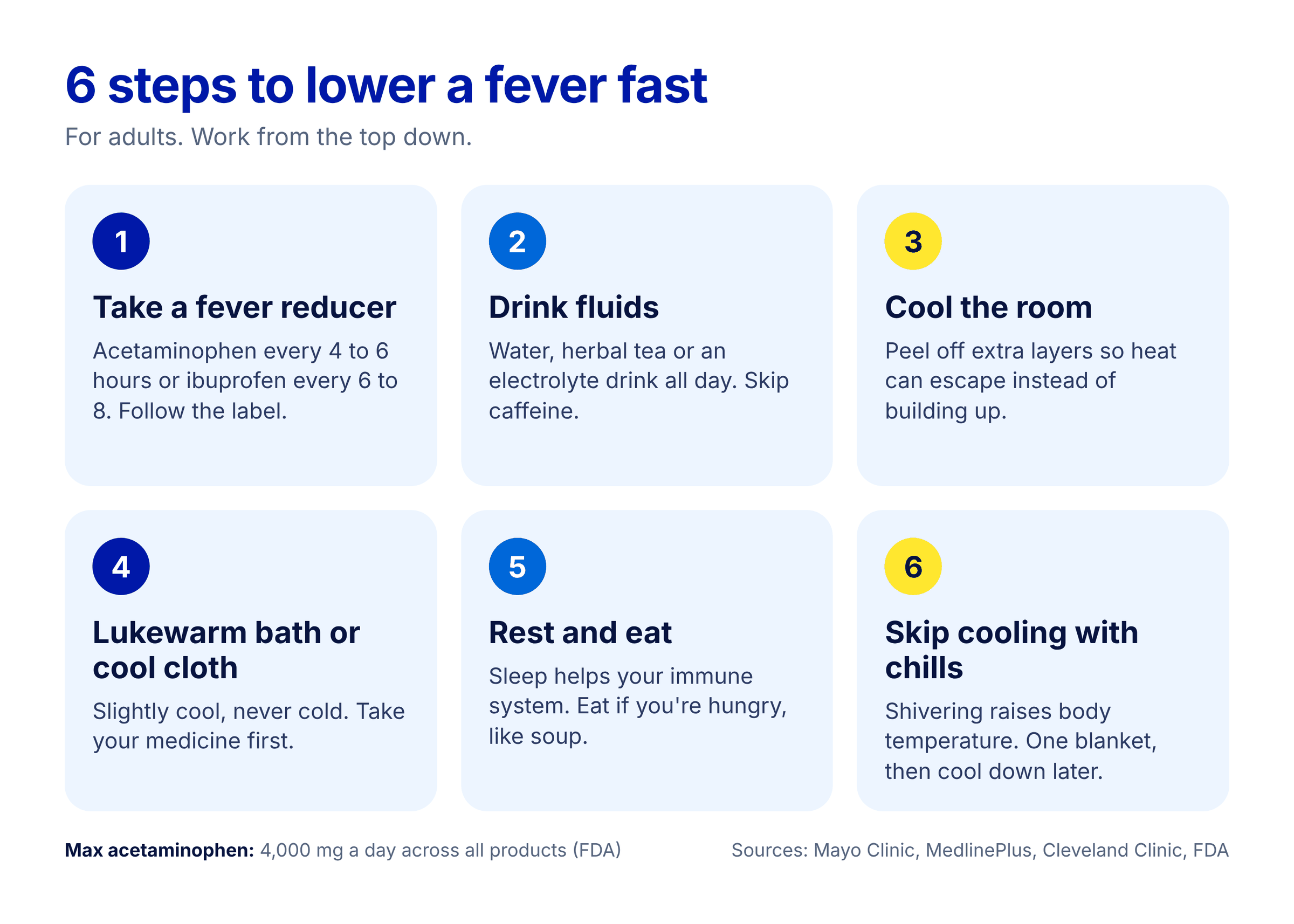
Medicine is the quickest route. Acetaminophen (Tylenol) and ibuprofen (Advil, Motrin) both lower a fever, and adults can take acetaminophen every 4 to 6 hours or ibuprofen every 6 to 8 hours, according to MedlinePlus. Follow the label for your dose.
Count every product you swallow. The FDA caps adults at 4,000 milligrams of acetaminophen a day across all medicines, and plenty of cold formulas hide a dose. If you have liver disease or drink three or more alcoholic drinks a day, ask a clinician first.
Aspirin also lowers a fever in adults. Never give aspirin to anyone under 18, because of the risk of Reye’s syndrome.
2. Drink fluids early and often
Fever makes dehydration easy to slip into, and a dehydrated body feels worse than it has to. Sip water, herbal tea or an electrolyte drink all day. Skip caffeine, which makes you urinate more, per Cleveland Clinic.
3. Cool the room and dress light
Peel off extra layers and keep the room comfortable. Bundling up traps heat and can leave you sweating, which raises your risk of dehydration.
4. Use a lukewarm bath or cool cloth
A damp, cool cloth on your forehead or neck takes the edge off. So does a lukewarm bath. Aim for water that feels slightly cool, never cold, and take your medicine first, since the bath works best afterward. Cleveland Clinic also lists a cold pack under the arm for up to 10 minutes.
5. Rest and eat when you can
Rest is when your immune system does its heaviest lifting. Pushing through your day can drag the infection out. Eat if you’re hungry (chicken soup is a fine choice), and don’t force it if you’re not.
6. Skip the cooling when you have chills
Shivering is your body trying to warm up. If you’re in the middle of chills, use one blanket and save the cool cloth for later. Piling on layers is the opposite mistake.
Mistakes that keep a fever high
Cold baths, ice and alcohol rubs backfire. They set off shivering, and shivering pushes your body temperature up, as MedlinePlus notes.
Stacking medicines is the other big one. A nighttime cold remedy plus extra Tylenol can push you past the safe acetaminophen limit without you noticing. Check labels for “acetaminophen” or “APAP.” Write down each thermometer reading and the time before you call a doctor, too.
And don’t take a pill just to get through the workday. Cleveland Clinic points out that you can stay contagious for at least 24 hours after a fever breaks on its own.
When a fever needs a doctor
Most adults can handle a fever at home. Some can’t, and the line is clearer than people think.
| Temperature or sign | What to do |
|---|---|
| Up to 102°F by mouth | Home care. Medicine only if you’re uncomfortable. |
| Above 102°F | Take a fever reducer for comfort and follow the label. |
| 103°F or higher | Call your doctor. |
| Lasts longer than 3 days | Call your doctor. |
| Doesn’t budge with medicine | Call your doctor. |
Those numbers come from Mayo Clinic, and MedlinePlus says to call right away at 105°F or higher. Seek medical attention sooner if you have a weakened immune system, are on chemotherapy, had surgery recently, or live with heart or lung disease.
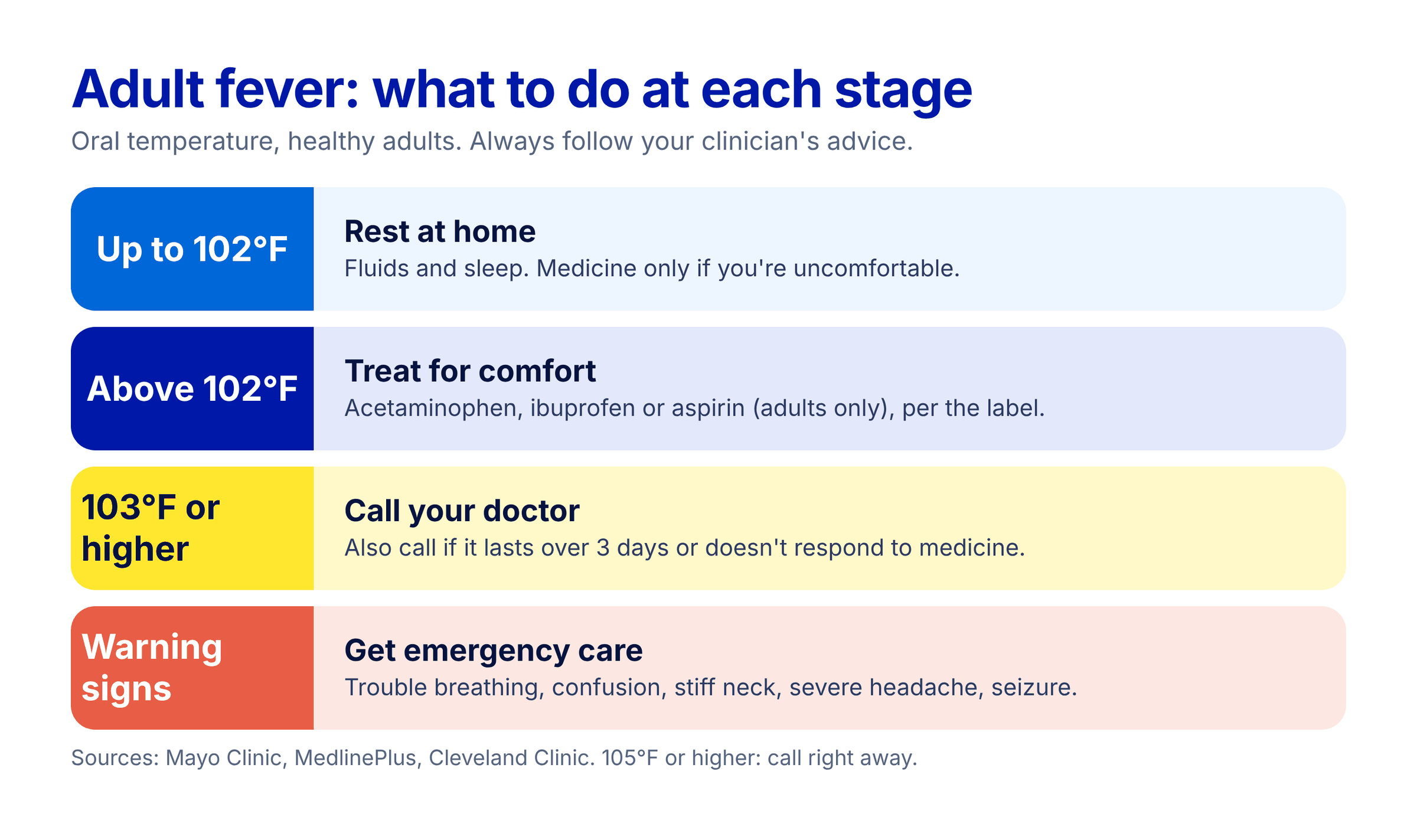
Get emergency medical attention if the fever comes with trouble breathing, confusion, a stiff neck, a severe headache, a seizure, belly pain or a rash. Those symptoms can point to a serious infection, so don’t wait on medical attention. A doctor may check for one that needs antibiotics, which won’t touch a simple virus.
Can’t get an appointment tonight? Talk to Swell
When your doctor’s office is closed and you can’t tell if home care is enough, Swell’s urgent care is open 24/7. The initial screening is free. A completed consultation is $45, with medication and lab costs separate. A clinician can look at your symptoms, tell you whether you’re fine at home and say when you need to be seen in person. Start a visit with Swell.
Questions people ask about lowering a fever fast
Should I go to the ER with a fever of 102?
Usually not for the number alone. Mayo Clinic says adults can manage 102°F at home, and it recommends a call to your doctor at 103°F or higher. Go to the ER if the fever arrives with trouble breathing, confusion, a stiff neck, a severe headache or a seizure. Not sure? Call a clinician first.
Is 101 a high fever for adults?
Not really. Cleveland Clinic calls anything under 101°F a mild fever that usually doesn’t need treatment. It still counts as a fever, since an adult oral temperature above roughly 99 to 99.5°F qualifies, per MedlinePlus. Home care is enough unless you feel awful.
What is the 24-hour rule for fever?
It’s a common rule of thumb: stay home until you’ve been fever-free for 24 hours without medicine. Cleveland Clinic notes that illness can stay contagious for at least 24 hours after a fever breaks naturally, which is why taking a pill to head into work isn’t a good idea.
What will make a fever worse?
Dehydration, heavy blankets that leave you sweating, pushing through your day without rest, and cold baths that trigger shivering. Skipping fluids is the easiest one to get wrong.
Trusted references
Public-health, research, and medical-society resources related to this guide.