No. A yeast infection isn’t an STD. It’s an overgrowth of a fungus your body already carries, and plenty of people get one without ever having had sex.
Here’s the catch. The itching, burning and thick discharge of a yeast infection look a lot like the symptoms of real sexually transmitted infections, and a yeast infection can occasionally pass between partners. So if you’re typing “is a yeast infection an STD?” at midnight, mid-itch, you deserve more than a one-word answer. You deserve to know which look-alikes matter and what to do next.
Is a yeast infection an STD? The short answer
Is a yeast infection an STD by the medical definition? No. A yeast infection is not classified as a sexually transmitted infection. The CDC’s STI treatment guidelines cover it because it shows up so often when people go in for vaginal symptoms, but they say plainly that this kind of infection usually isn’t caught through sex. It’s what happens when Candida, a yeast that lives in small numbers in the vagina, multiplies faster than your body keeps it in check.
How common is that? According to the CDC’s candidiasis guidance, about 75% of women will have at least one episode, and 40% to 45% will have two or more. Roughly 10% to 20% of women carry Candida with no symptoms at all.
That last number matters. If a lab finds yeast but you feel fine, you don’t need treatment. A vaginal yeast infection is a diagnosis made from your history plus a test, not from the mere presence of yeast.
Why a yeast infection gets mistaken for an STD
Because the symptoms overlap, and because the timing can look suspicious.
The hallmark is itching in and around the vagina, often with burning, redness, and a swollen, sore vulva. Sex or urination can sting. Discharge, when there is any, tends to be thick, white and clumpy like cottage cheese, with little or no smell, a pattern the Office on Women’s Health describes too. Some people have a mild case; others feel miserable.
Now read that list again and imagine you’ve just started seeing someone new. Burning during sex? Itching? Anything unusual down there? Your mind goes straight to an STD. That’s a reasonable leap, and it’s why so many people search this question.
The medical name is vulvovaginal candidiasis, and doctors use it for a yeast infection of the vagina and vulva. Candida albicans is the usual cause. Other forms of candidiasis, like thrush in the mouth, are the same fungus in a different place. The vaginal kind is the one that causes the STD confusion.
Several things can bring on a yeast infection without a new partner being involved:
- A recent course of antibiotics or steroids
- High blood sugar
- Pregnancy
- A birth control pill with more estrogen
- An immune system weakened by illness, including HIV
- Douching or scented vaginal sprays
None of those is sexual. Antibiotics are the classic yeast infection trigger, because they clear out the friendly bacteria that keep Candida in check.
Can you give a yeast infection to a partner?
Sometimes, yes. This is the part most “is a yeast infection an STD” articles gloss over.
A yeast infection can pass through vaginal, oral or anal sex. Roughly one in seven men who have unprotected sex with someone who has an active infection end up with an itchy, red penis, a condition called balanitis; the Office on Women’s Health puts the figure near 15%. Uncircumcised men and men with diabetes are likelier to get it. Condoms and dental dams lower the odds.
So is a yeast infection an STD in the official sense? No, but it can travel. What should you do about it?
The CDC says the data don’t support routinely treating sex partners for an uncomplicated yeast infection. A male partner with redness or itching on the head of the penis can get relief from a topical antifungal. A female partner with itching or a thick coating should be checked and treated herself. If your partner feels fine, they usually don’t need anything.
Yeast infection vs STD: how the symptoms compare
Here’s the side-by-side most people are really looking for. Use it as a guide, not a diagnosis, because the overlap is real and many infections cause no symptoms at all.
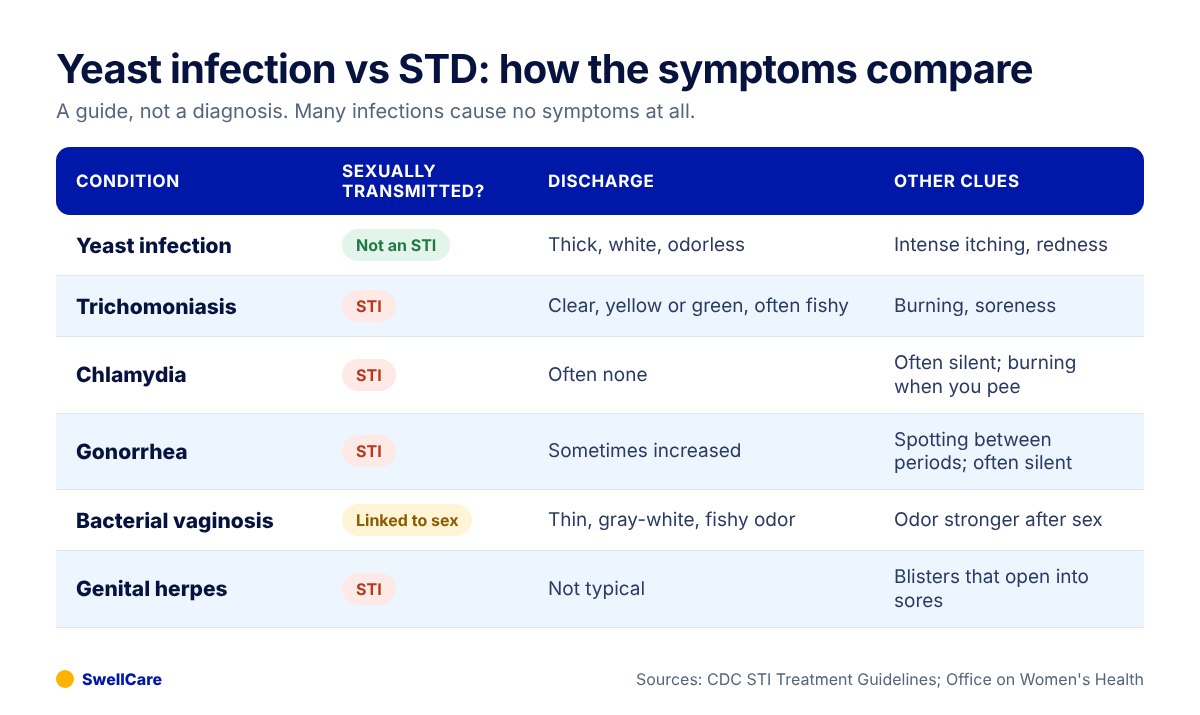
| Condition | Sexually transmitted? | Discharge | Other clues |
|---|---|---|---|
| Yeast infection | Not classified as an STI | Thick, white, odorless | Intense itching, redness, swelling |
| Trichomoniasis | Yes | Clear, white, yellow or green, often fishy | Burning with urination, soreness |
| Chlamydia | Yes | Sometimes abnormal; often none | Burning with urination; often silent |
| Gonorrhea | Yes | Sometimes increased | Bleeding between periods; often silent |
| Bacterial vaginosis | Linked to sex, not a classic STI | Thin, gray-white, fishy odor | Odor stronger after sex |
| Genital herpes | Yes | Not typical | Blisters that break into painful sores |
Trichomoniasis and chlamydia
Trichomoniasis is the one that most often passes for a yeast infection. The CDC reports more than 2 million US infections in 2018, yet roughly 70% of people never notice a thing. Those who do may feel itching, burning or soreness and see discharge that runs from clear to white, yellow or green, often with a fishy smell. It’s curable with prescription medicine, and anyone you’ve slept with needs treatment at the same time. About 1 in 5 people get it again within three months.
Chlamydia is quieter. The CDC says it often causes no symptoms, yet left untreated it can lead to pelvic inflammatory disease, ectopic pregnancy and infertility. The CDC’s advice: test every year if you’re sexually active and under 25, and from 25 on, test yearly if you have a new partner, several partners, or a partner diagnosed with an STI.
Gonorrhea and herpes
Most women with gonorrhea have no symptoms, and when they do show up they’re mild and easy to blame on a bladder or vaginal infection: a sting when you pee, extra discharge, spotting between periods. CDC guidance adds that drug-resistant strains are rising, so go back to your provider if problems linger after treatment.
Herpes usually looks different from yeast. The CDC describes blisters that open into sore, painful patches that can linger for a week or longer. But most people with genital herpes have no or very mild symptoms, so a small irritated patch gets written off as an ingrown hair. There’s no cure, though antiviral medicine can shorten or prevent outbreaks.
Bacterial vaginosis
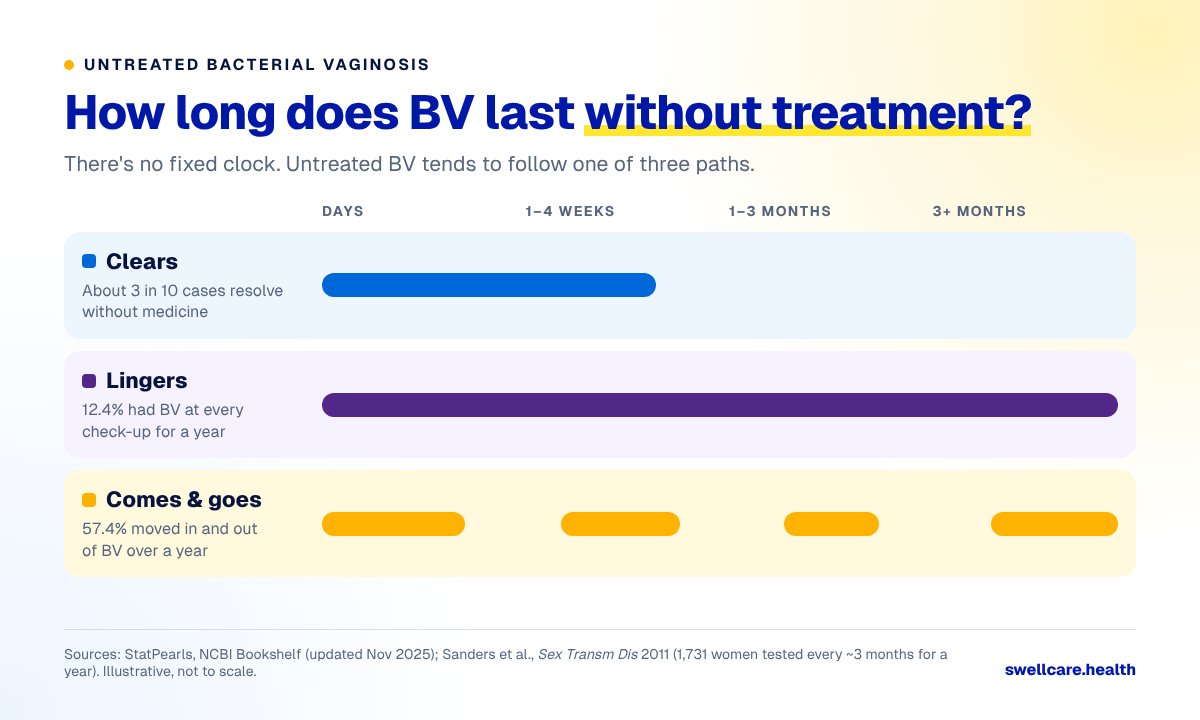
Bacterial vaginosis (BV) isn’t a classic STI either. It’s an imbalance in the bacteria of the vagina, a shift in which kinds of bacteria live there, with bacteria that aren’t normally dominant taking over, and the CDC says its exact cause isn’t fully understood. It’s associated with new or multiple partners and with douching. The tell is the smell, and the vaginal discharge looks different too: a fishy odor and thin, gray-white discharge, rather than the thick, odorless discharge of a yeast infection. It needs antibiotics, so treating it with an antifungal cream won’t help.
How to tell what you actually have
You can’t reliably spot a yeast infection by symptoms alone, and that’s true even for doctors. Candida is normal to find; it’s the overgrowth of Candida that counts. A few clues help, though.
Discharge is the first one. Thick and clumpy usually points to a yeast infection. Thin vaginal discharge with a fishy smell points to BV or trichomoniasis. Sores or blisters point to herpes. A normal amount of discharge with burning when you pee could be chlamydia, gonorrhea, or a urinary tract infection.
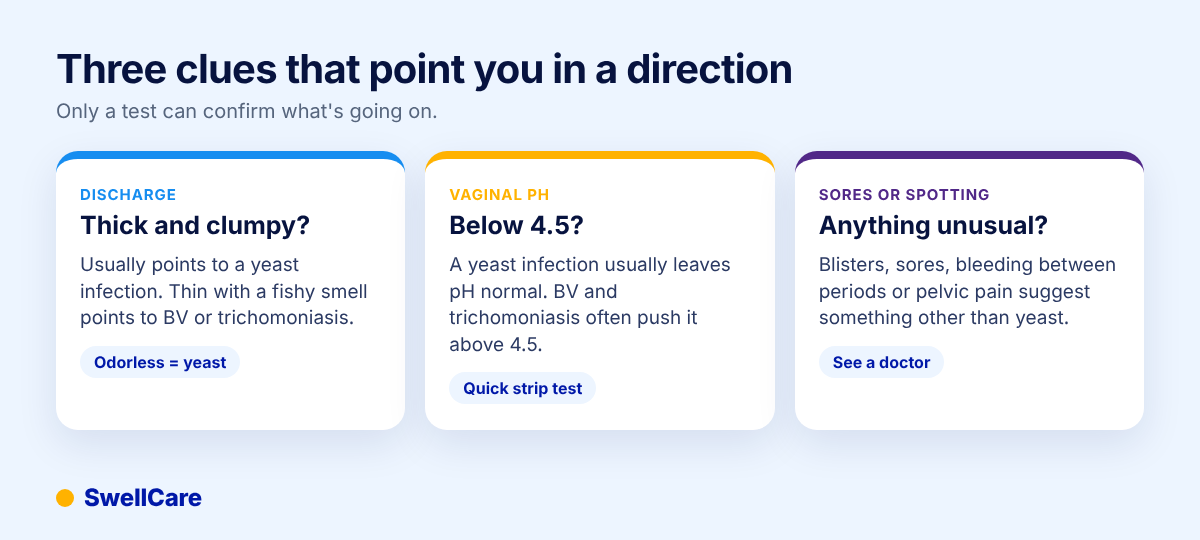
The second is vaginal pH. A yeast infection typically leaves the pH normal, below 4.5, while BV and trichomoniasis often push it above 4.5. That one number rules a yeast infection in or out faster than any symptom. A doctor checks this in seconds with a test strip.
The third is a lab look. A doctor can examine a sample under a microscope for yeast, and they can send urine or a swab for STI testing. Microscopy misses roughly half of trichomoniasis and yeast cases, according to the CDC, so a negative result with ongoing itching or burning deserves a culture or a repeat look.
Why guessing is a risky move
Reaching for an over-the-counter antifungal feels like the quick fix. Even if you’re sure the answer to “is a yeast infection an STD” is no, treating a yeast infection you don’t have is the most common mistake.
The Office on Women’s Health notes that about two-thirds of women buying yeast infection medicine turn out not to have a yeast infection. Antifungals you don’t need can build drug resistance, and meanwhile the real problem, maybe BV or trichomoniasis, goes untreated and keeps causing trouble.
There’s a second risk. Chlamydia and gonorrhea can silently damage the reproductive system while you treat the wrong thing. And if you’ve had four or more infections in a year, that points to recurrent yeast infections, which usually call for a longer course of treatment and a look at underlying causes like diabetes.
If this is your first time with these symptoms, if you’re pregnant, or if you aren’t sure, get it confirmed. It takes a short visit and saves weeks of frustration.
How a yeast infection is treated, and how STDs are treated
Treating a yeast infection looks nothing like treating an STD, which is why the diagnosis matters.
For a yeast infection, treatment is an antifungal. The CDC lists several routes: store-bought clotrimazole or miconazole as a cream or suppository, prescription terconazole or butoconazole, or a single 150 mg fluconazole tablet. Short courses ease the itching and clear the infection in 80% to 90% of people who finish them. Oil-based creams can weaken latex condoms, so use another form of protection during treatment. Fluconazole by mouth shouldn’t be used in pregnancy; vaginal miconazole or clotrimazole is the safer route. Some doctors also use boric acid for stubborn cases, but only under guidance. A vaginal yeast infection that keeps coming back needs a different plan than a one-off yeast infection, because the Candida overgrowth often has a trigger behind it.
For bacterial STIs and BV, treatment is antibiotics. Chlamydia, gonorrhea and trichomoniasis are all curable. BV is treated with metronidazole or clindamycin. Herpes can’t be cured, but antiviral treatment keeps it manageable.
Some sexually transmitted infections never announce themselves. HIV, syphilis and HPV can all go unnoticed for a long time, which is why a quiet week isn’t the same as a negative test, and why STI testing is worth asking your doctor about even when you feel fine. Ask what a routine exam covers, since syphilis and HPV checks aren’t always automatic.
The golden rule for any STI: finish the medicine, skip sex until both of you are treated, and get retested about three months later. Reinfection is common.
When to see a doctor
Don’t wait it out if any of these apply to you:
- It’s your first suspected yeast infection or your first time with these signs
- Your yeast infection doesn’t improve after over-the-counter treatment
- You’ve had four or more infections in a year
- You’re pregnant or have a weakened immune system
- You have sores, blisters, a fishy odor, fever, or pelvic pain
- A partner has been diagnosed with an STI
Pelvic pain and fever are worth a same-day call to your doctor. Tell your doctor about any new partner, recent antibiotics, and any long-term health condition. They can signal pelvic inflammatory disease, which is far more serious than a yeast infection.
How to prevent yeast infections and lower your STD risk
A few habits help prevent a yeast infection and cut your STD risk at the same time. Start with the ones that protect your natural balance:
- Skip douching and scented washes or sprays. They upset the balance that keeps yeast in check.
- Choose cotton underwear, and don’t sit around in a damp swimsuit or sweaty gym clothes.
- Swap tampons and pads often and wipe front to back.
- If you have diabetes, keep your glucose in range.
Then add the sexual-health basics:
- Use condoms and dental dams with new partners, and get tested between partners. If you’re pregnant, tell your doctor about any symptoms early; a weakened immune system also deserves a conversation.
- Take antibiotics only when you need them, and ask your doctor about yeast prevention if you get an infection after each course.
Prevention of yeast infections and STIs isn’t about hygiene perfection. It’s about not disrupting a system that mostly takes care of itself.
Get answers without waiting: a SwellCare virtual visit
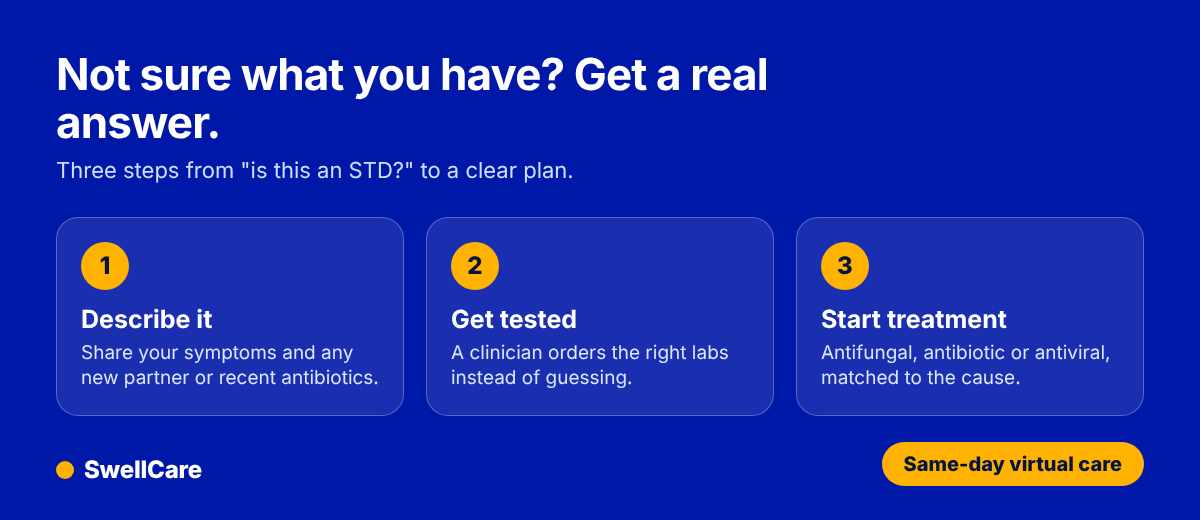
If you’re stuck in the “is this a yeast infection or an STD?” loop, the quickest way out is to have a doctor look at what you’re feeling and order the right tests.
SwellCare offers same-day virtual care by secure chat or video, 24/7, in all 50 states and DC, with lab orders, results and follow-up. Start a visit at SwellCare and get a clear answer, an honest treatment plan, and no judgment.
Questions people ask about yeast infections and STDs
Does a yeast infection mean you have an STD?
No. A yeast infection comes from an overgrowth of Candida that already lives in your body, often triggered by antibiotics, hormones, or blood sugar changes. Having one doesn’t mean you caught anything from a partner. Because the signs resemble those of an STD, getting tested is still the only way to be sure.
Can a yeast infection be passed to a man?
Yes, sometimes. A yeast infection can pass to a male partner, and roughly one in seven men exposed without protection develop an itchy, red penis. Being uncircumcised raises the odds. A topical antifungal usually clears it. Men who feel fine generally don’t need treatment.
Can chlamydia feel like a yeast infection?
It can, though chlamydia more often causes nothing noticeable at all. When it does, you may notice unusual fluid and a sting when you pee. Itching with thick, clumpy discharge points more toward a yeast infection, but you can’t be certain without testing. If there’s any chance of exposure, get testing done soon, because a yeast infection and chlamydia can look alike.
Will a yeast infection go away on its own?
Mild yeast infections sometimes clear up without treatment, but you shouldn’t count on it. Untreated yeast infections can drag on and keep itching and burning going. If your symptoms are new, severe, or don’t ease within a few days, see a doctor rather than waiting.
Why do I keep getting yeast infections?
Recurrent yeast infections, four or more in a year, often trace back to diabetes, a weakened immune system, repeated antibiotics, or hormone changes. Sometimes the problem isn’t yeast at all. A doctor can confirm the cause and may recommend a longer antifungal course.
How do I know if it’s a yeast infection or an STD?
You can’t know from symptoms alone. Thick, odorless discharge with intense itching suggests a yeast infection. Fishy odor, sores, bleeding between periods, or pelvic pain suggest something else. A quick exam, pH check and lab testing give you a real answer.
Trusted references
Public-health, research, and medical-society resources related to this guide.