The ball hit your fingertip, or the car door caught it. Now the finger throbs, the middle joint is puffy, and you’re staring at it wondering if it’s a bad jam or a break.
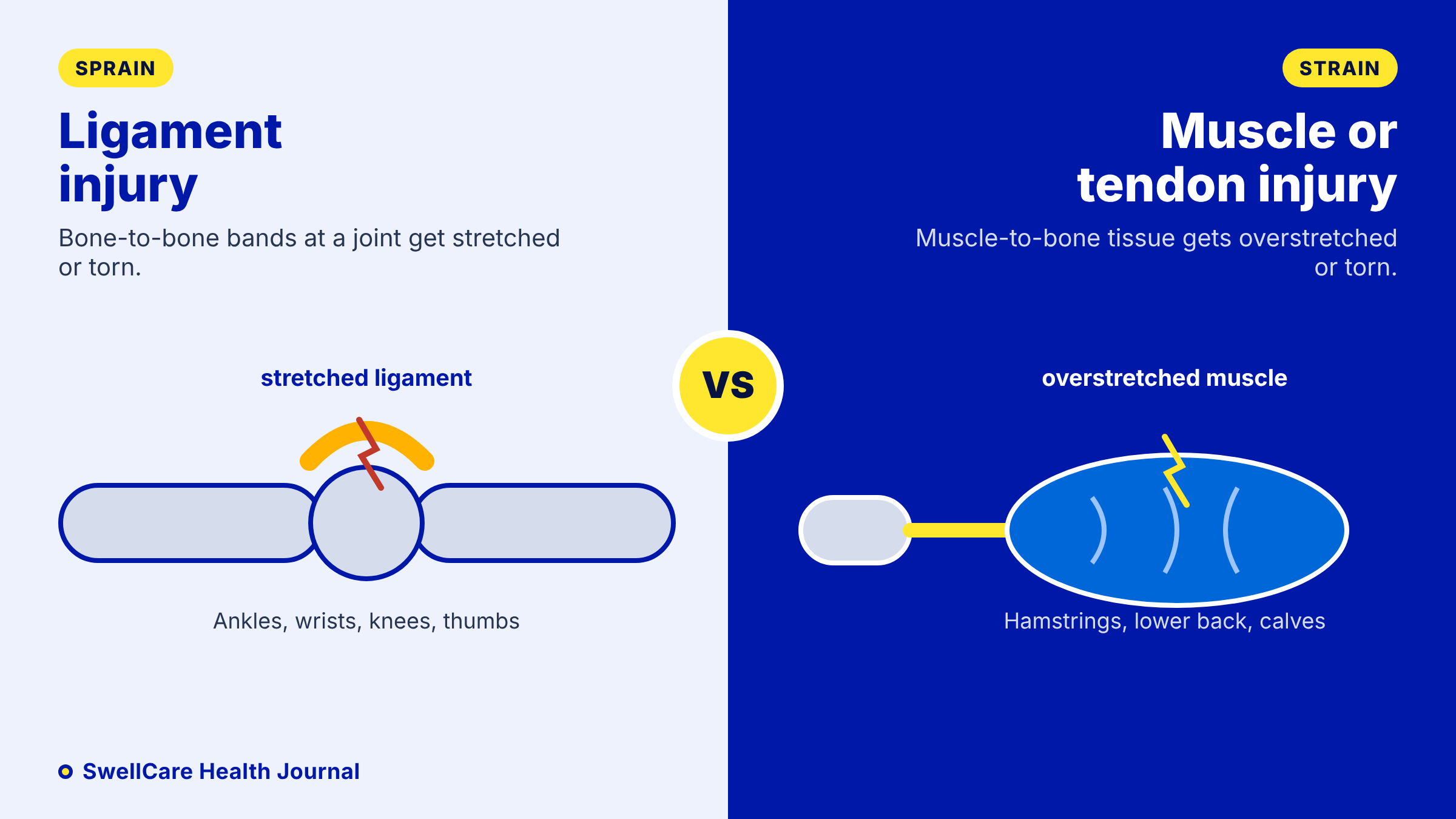
Here’s the blunt answer. Pain and swelling can’t settle the jammed finger vs broken question, because both injuries cause them. A jam is a sprain: a stretched or torn ligament. A break is a crack in the bone. Neither one announces itself with a label. What separates them is how the finger looks and moves, and the only way to be sure is an X-ray.
Quick answer: a crooked finger, a finger that won’t bend, numbness, or pain right over the bone points to a fracture. Swelling that stays mostly around a joint, with a finger that still moves, points to a sprain. If you can’t tell, treat it as broken until an X-ray says otherwise.
Jammed finger vs broken: the quick comparison
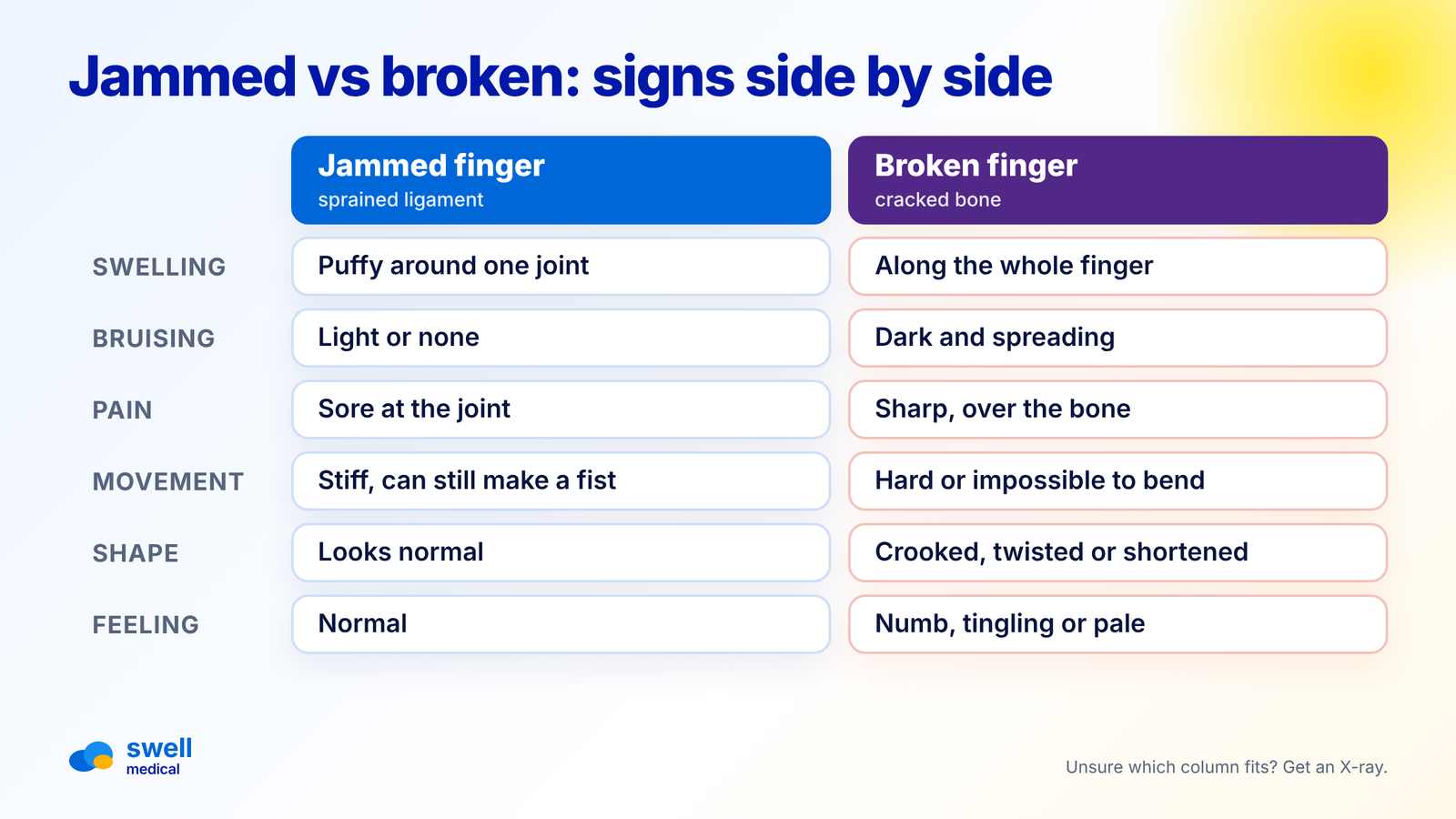
Most people can sort a jammed finger vs broken finger injury into one column of this table. Some land in both, and that’s your cue to get it checked.
| What you notice | More like a jammed finger | More like a broken finger |
|---|---|---|
| Swelling | Puffy around one joint | Swollen along the whole finger |
| Bruising | Light or none | Dark, spreading, often within hours |
| Pain | Sore at the joint, worse when bending | Sharp, pinpoint pain over the bone |
| Movement | Stiff but you can make a fist | Hard or impossible to bend |
| Shape | Looks normal | Crooked, twisted or shortened |
| Sensation | Normal | Numb, tingling or pale fingertip |
Signs of a jammed finger
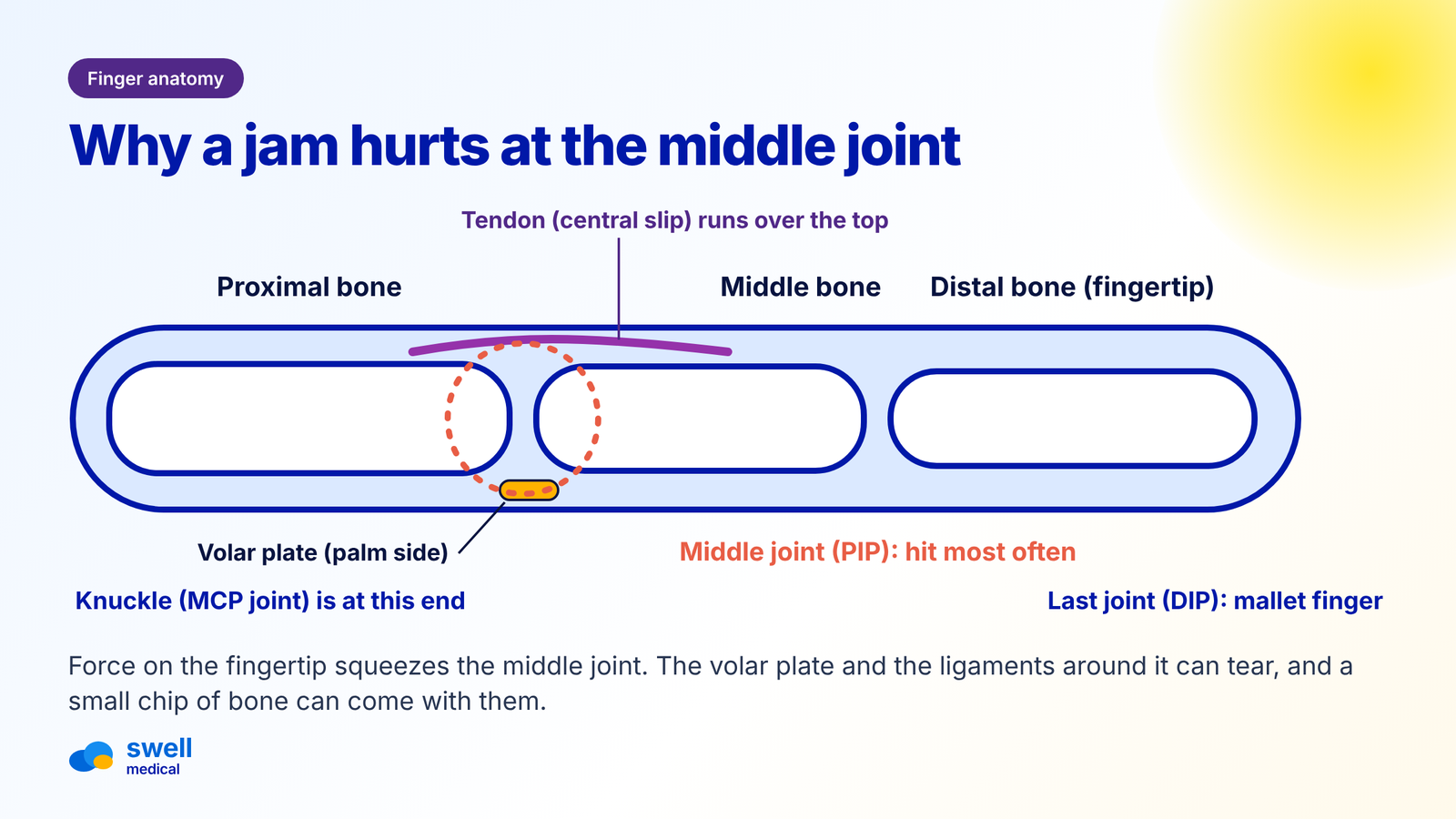
Jams happen when force pushes the fingertip toward your wrist and the joint gets squeezed or bent backward. The middle joint takes the hit most often, according to the American College of Emergency Physicians. The ligament stretches or tears, so a sprained finger shows tenderness at the joint, swelling and some stiffness. The pain is usually worst when you bend or press on the knuckle itself. Think of it as a sprain, the same kind of injury you’d get in an ankle, only smaller. The pain can feel out of proportion to the damage.
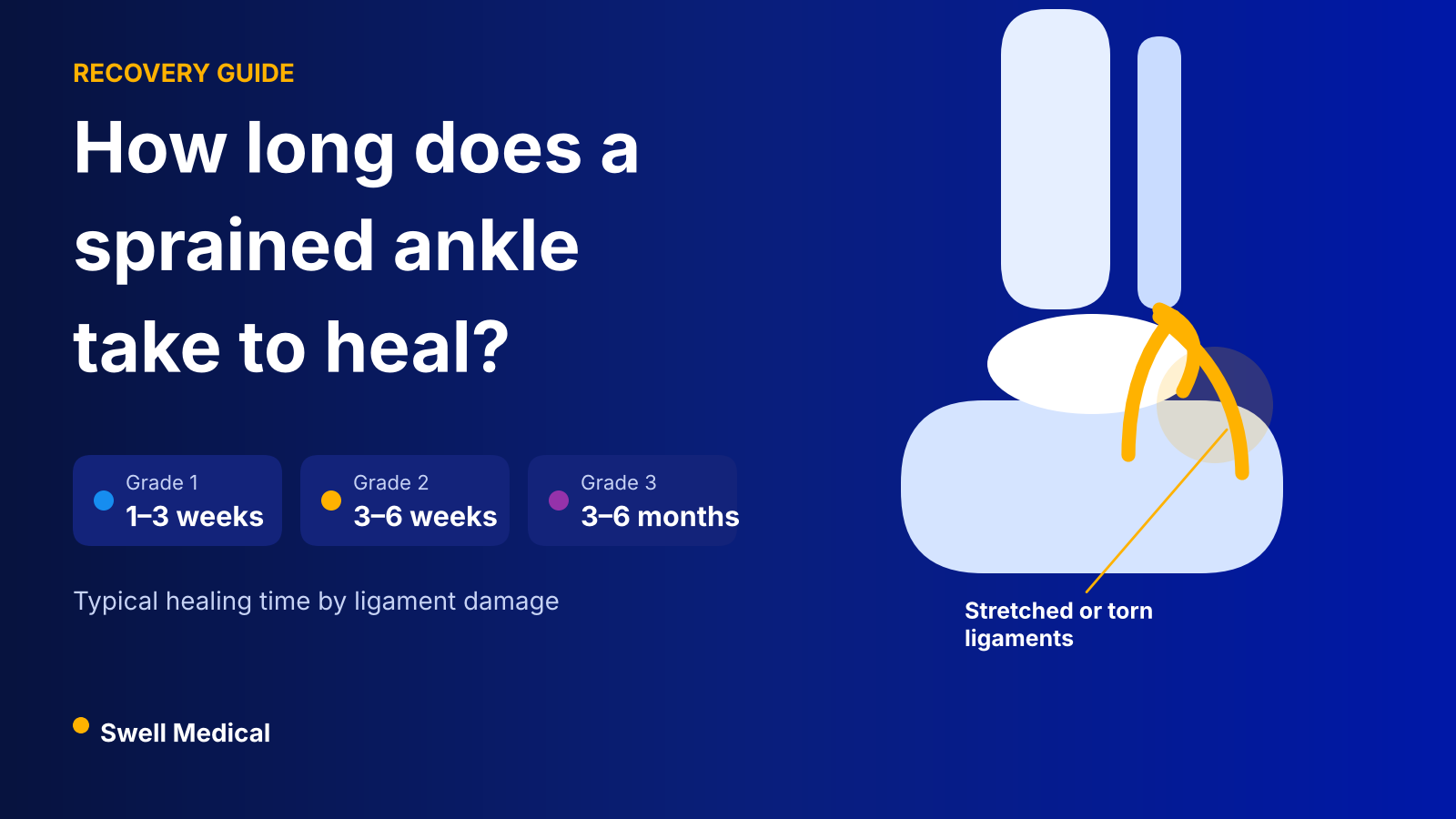
Cleveland Clinic grades each sprained finger by how much ligament is torn. A mild one heals in one to two weeks; a severe tear takes at least three to six weeks. The finger stays in line and you can still bend it, even if it hurts. Treatment for a mild jammed finger is simple: rest, ice, support and time. Doctors call a ligament injury at this level grade 1, and the joint stays stable.
Signs of a broken finger
A fracture often shows itself fast. The American Academy of Orthopaedic Surgeons lists swelling, tenderness and bruising at the break, trouble moving the finger, and sometimes a visible deformity. Swelling often runs the length of the finger rather than sitting at one joint, and the pain stays sharp even at rest. Look for a finger that points sideways or crosses its neighbor when you curl your hand into a fist. Doctors call that scissoring, and it often means the bone has rotated.
Numbness or a blue, cold fingertip is a different story. That’s a circulation or nerve problem, and it can’t wait.
When a jam is more than a sprain
Here’s what most “jammed or broken” articles gloss over: plenty of injuries sit in the gray zone. The finger isn’t crooked, yet a tendon or ligament has torn, or a chip of bone has come loose. Each of these needs treatment beyond a strip of tape.
- Mallet finger. The tendon that straightens your fingertip tears or pulls off a bit of bone. The tip droops and won’t lift on its own, a clear case where a jam isn’t just a sprained finger. OrthoInfo says it needs a splint worn full time for six to eight weeks, and ideally a hand specialist within a week.
- Volar plate injury. This thick pad on the palm side of the middle (PIP) joint adds stability and stops it from bending backward. When it tears, it can take a chip of bone with it (an avulsion fracture). If that chip covers more than about 30% of the joint surface, the joint may be unstable and could need surgery.
- Central slip injury. A tendon on top of the middle joint gets damaged. Miss it, and the finger can slowly bend into a boutonnière deformity.
- Dislocation. The joint is knocked out of place. Never yank it back yourself, since a dislocation can bring a torn volar plate or a small fracture along with it.
- Jersey finger. The opposite problem: a tendon on the palm side tears away from the fingertip, usually when a grabbed jersey or strap yanks the finger straight. You can’t bend the tip.
Three checks you can run at home
These aren’t a diagnosis. They tell you how worried to be.
- Look at alignment. Hold both hands out flat, then curl them into loose fists. Fingers should point toward the same spot near your wrist. A finger that crosses over or pulls away is a red flag.
- Test the range of motion. Gently bend the finger as far as it will go without forcing it. A sprained knuckle is stiff but moves. A finger that locks, droops at the tip or refuses to move needs a closer look.
- Press along the bone. Tenderness in one tiny spot over the bone, rather than around the knuckle, leans toward a fracture.
Fail any of the three, or feel numbness, and skip the wait-and-see plan.
What happens if a broken finger is treated like a jam
Fingers are small, but they’re unforgiving. Put a displaced fracture in the wrong splint position and it can heal crooked or shortened, which weakens your grip and changes how the finger lines up with its neighbors. Stiffness is the most common complication after a finger fracture, and it gets worse the longer the joint sits immobilized.
How doctors treat a broken finger
Treatment depends on the break. A stable fracture gets a splint or buddy taping for about three weeks. Displaced ones are realigned first, and some need surgery. Treatment for a joint fracture is less forgiving, and fractures that reach a joint carry extra risk. OrthoInfo notes that these often need surgery, because untreated ones can lead to lasting damage and arthritis. The fix for a missed break caught early might be a few weeks in a splint. Caught late, it can mean pins, screws or a re-break.
Phalanx fractures aren’t rare, either. They make up about 10% of all fractures, according to StatPearls, and most heal without surgery when someone spots them in time.
What to do in the first 24 hours
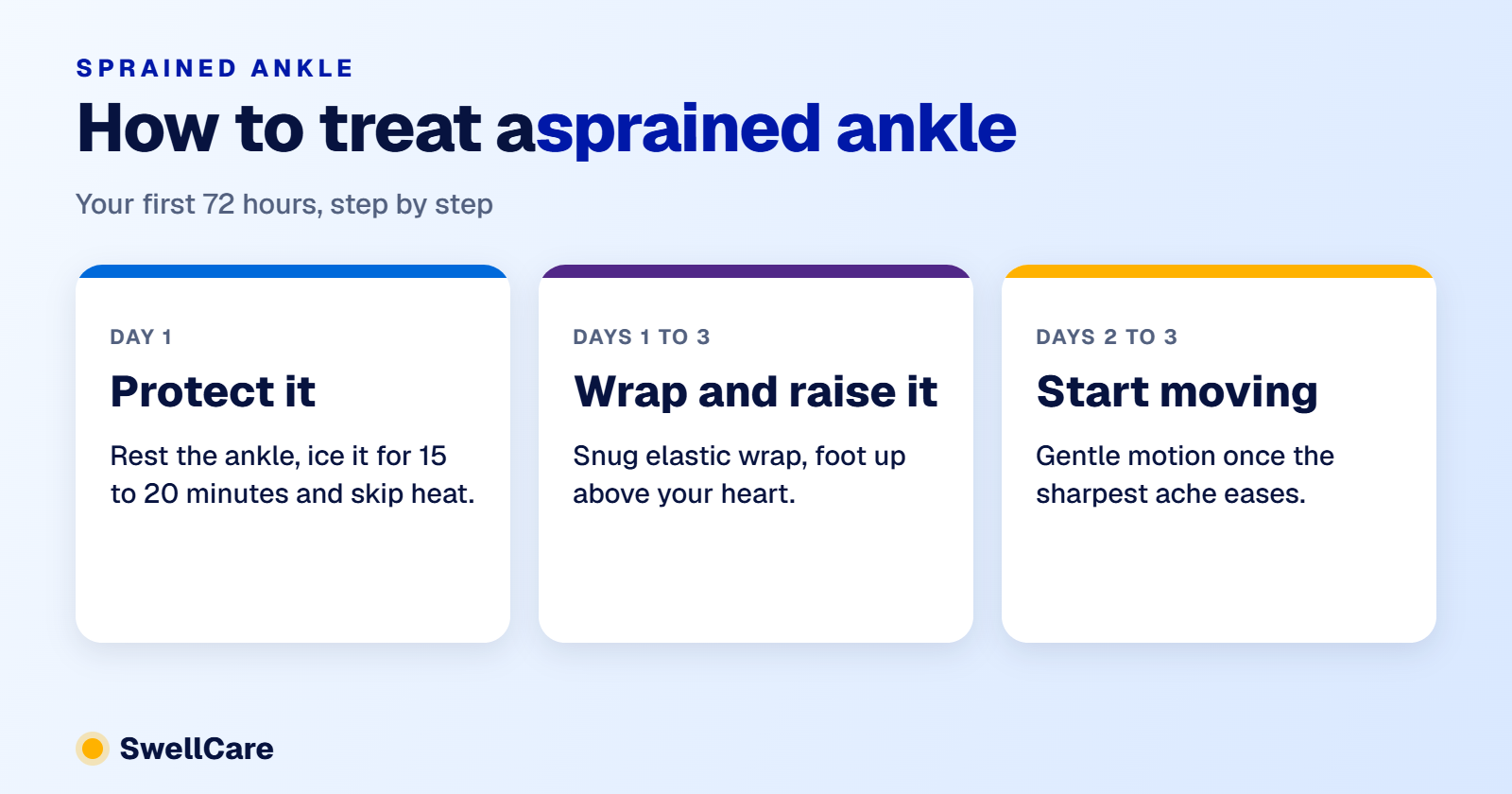
Whether it’s a jam or a break, the first day looks much the same, and it follows the RICE routine: rest, ice, compression and elevation.
- Rest it. Stop the game, the workout or the lifting. Give the finger a real break from gripping for a day or two.
- Ice it. Wrap an ice pack in a towel and use it for 15 to 20 minutes at a time; never press ice straight on skin. The NHS suggests repeating every two to three hours.
- Raise your hand above heart level to calm the swelling.
- Take off rings before the finger swells further.
- Support it. Tape the sore finger to its healthy neighbor, or use a padded splint.
A gentle elastic wrap adds compression, but keep it loose.
Should you buddy tape a jammed finger?
Buddy taping is fine for a stable, straight finger. It’s the wrong move for a crooked one, or for a tip that droops. Don’t tape over a finger that’s turning white or blue.
Over-the-counter pain relievers can help with the pain. Follow the label, and ask a clinician if you take other medicines.
When you need an X-ray or the ER
Plan on imaging if any of these apply:
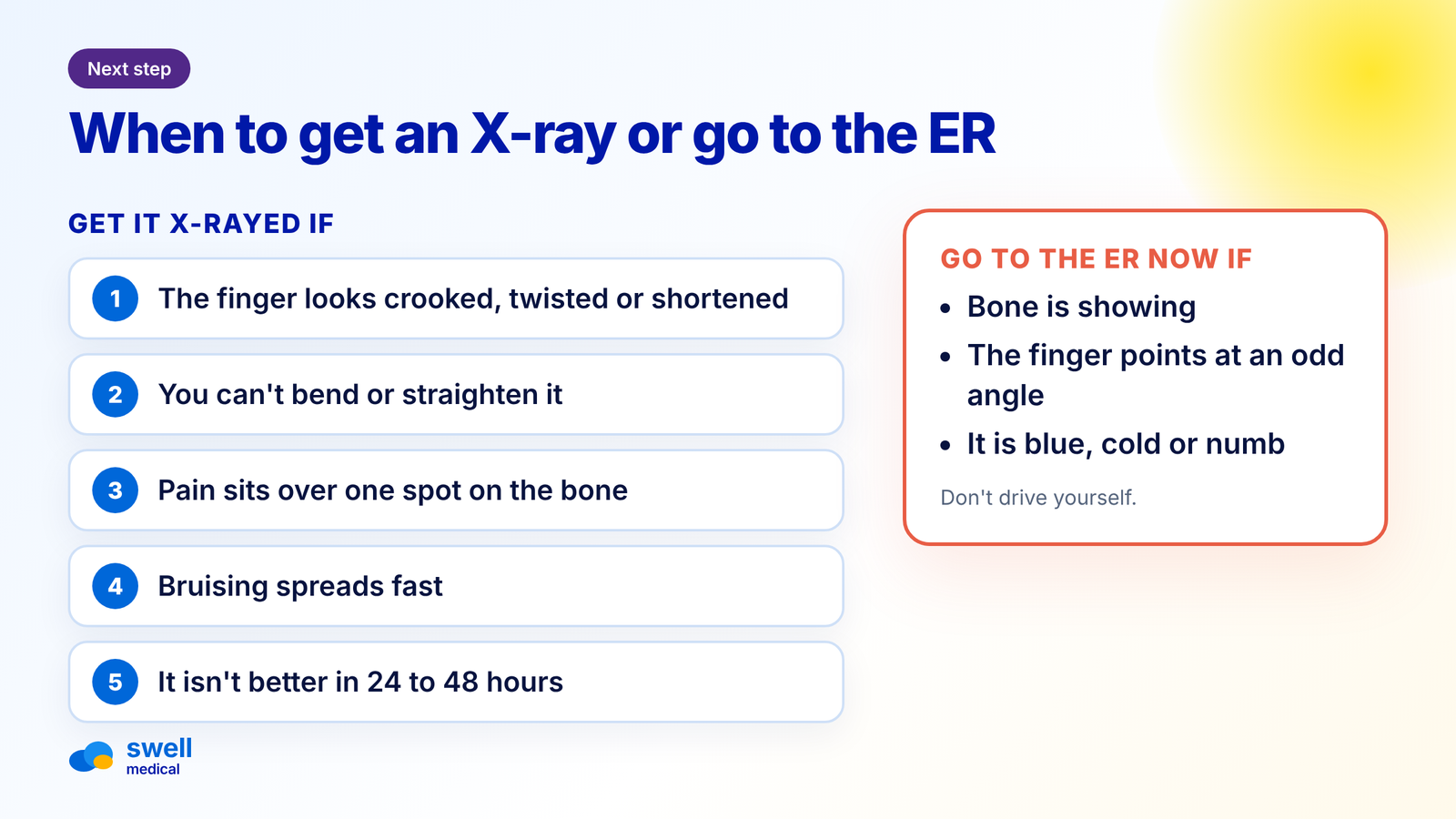
- The finger looks crooked, twisted or shortened.
- You can’t bend or straighten it.
- The pain sits over one spot on the bone.
- Bruising spreads fast, or the whole finger swells.
- Symptoms don’t improve within 24 to 48 hours, or they get worse.
The X-ray is the standard test for a suspected fracture, and it shows whether the bone is aligned. Doctors also check nearby tendons, nerves and ligaments, since those often get hurt along with the bone. Treatment starts with that picture. If the film is clean but the pain and swelling stick around, a hand specialist may order an MRI to look at the soft tissue for a hidden sprain or torn ligament.
Go to the emergency room now, and don’t drive yourself, if bone is visible, the finger is pointing at an odd angle, or it’s blue, cold or numb. An open cut over a break needs prompt care to prevent infection. A hand specialist handles anything that needs surgery or careful splinting, so ask for a referral if the ER doctor flags a joint fracture.
How long does a jammed finger take to heal?
Mild jams often feel better in one to two weeks. For a severe sprain, expect three to six weeks, and the joint may stay swollen and tender even longer. Broken fingers usually take six to eight weeks to heal, and full hand strength can take three to four months to come back, according to the NHS. Treatment after the splint comes off matters as much as the splint. Plan for a stiff finger afterward. Gentle motion exercises, sometimes guided by a hand therapist, bring the range back.
Can Swell help with a jammed finger?
Yes, up to a point, and here is where that point is. A virtual urgent care visit can look at how the injury happened, check your symptoms, and tell you whether home treatment is reasonable or whether you need to be seen in person. A virtual visit can’t X-ray you through a screen. If the story sounds like a break, a clinician will say so and point you to an in-person X-ray.
Swell is open 24/7, and a completed consultation is $45 total. That’s often the fastest way to learn if tonight’s finger is a “tape it and rest” problem or a “get it imaged today” one. Start with Swell urgent care, and read how a visit works first if you’d like to know what to expect.
Severe symptoms like numbness, a bent finger or exposed bone are emergencies. Call 911 or head to the ER.
Questions people ask about jammed and broken fingers
Will a jammed finger heal on its own?
Mild sprains usually do, with rest, ice and a few days of buddy taping. The catch is that some injuries that look like jams, such as mallet finger or a volar plate fracture, don’t heal right without a splint. If the finger isn’t clearly better in two days, get it looked at.
Can you wiggle your finger if it’s broken?
Sometimes, yes, which is why wiggling proves nothing. Hairline fractures can bend with pain, while a bad sprain can feel frozen. Judge by the shape, the pinpoint tenderness and the bruising, not by movement alone.
How long is a finger supposed to be jammed?
Expect one to two weeks for a mild jam. A severe one runs three to six weeks, and swelling can hang around beyond that. If pain or stiffness is still bothering you after a few weeks, ask a hand specialist to check for an injury that was missed.
Should I go to the ER for a jammed finger?
Usually not, unless the finger is deformed, numb, cold, or bone is showing. For a finger that’s sore and swollen but straight, an urgent care or a virtual visit is a sensible first step, with imaging if anything points to a fracture.
Trusted references
Public-health, research, and medical-society resources related to this guide.