You rolled your ankle, it swelled up fast, and now every step hurts. If this is your first sprained ankle, the first thing you want to know is simple: how long does a sprained ankle take to heal? Most mild sprains (grade 1) settle in one to three weeks, moderate sprains (grade 2) take three to six weeks, and a severe ligament tear can take three to six months.
That range is wide because an ankle sprain is not one injury, and your ankle sprain recovery time depends on which kind you have. It is a stretch or tear of the ligaments that hold your ankle joint stable, and the damage can be anything from a few overstretched fibers to a complete rupture. The good news is that most people recover fully with the right early treatment and a short, steady rehabilitation plan.
This guide gives you the realistic timeline for each grade of ankle sprain, shows what happens inside the ligament week by week, and explains what actually speeds recovery. You will also learn the warning signs that mean your ankle sprain could really be a fracture, so you can get the right care early and avoid a weak, unstable ankle later.
How long does a sprained ankle take to heal? The short answer
Healing time depends on how badly the ligament is damaged. Doctors sort every ankle sprain into three grades, and each grade has its own typical recovery time. Use the ranges below as a guide, not a promise, because every ankle heals at its own pace.
| Sprain grade | What is happening | Typical recovery time |
|---|---|---|
| Grade 1 (mild) | Ligament stretched, tiny tears, mild swelling and pain | 1 to 3 weeks |
| Grade 2 (moderate) | Partial tear, more swelling, bruising, some instability | 3 to 6 weeks |
| Grade 3 (severe) | Complete tear, major swelling and bruising, ankle feels loose | 3 to 6 months |
| High ankle sprain | Injury to the ligaments above the ankle joint | 6 weeks or longer |
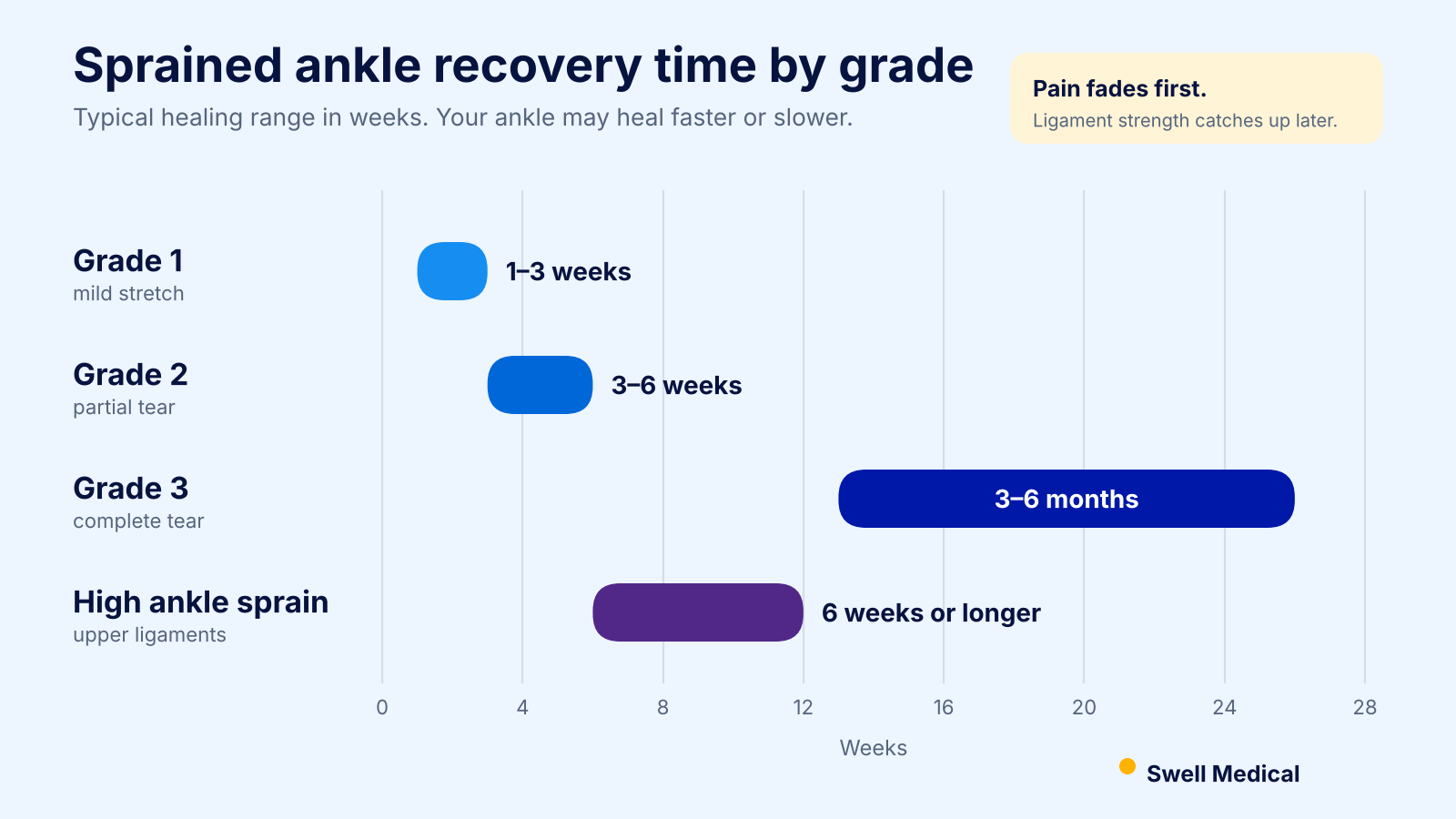
Keep one thing in mind: feeling better is not the same as being healed. Pain often fades before the ligament has regained its full strength, which is why returning to sports too early is a common cause of repeat sprains.
Ankle sprain grades: recovery time for each
Knowing your grade is the fastest way to estimate your own sprained ankle recovery time. A clinician grades the ankle sprain by checking swelling, bruising, tenderness and how stable the joint feels when moved.
Grade 1 ankle sprain: 1 to 3 weeks
A grade 1 ankle sprain is a mild stretch of the ligament with microscopic tears. You will notice mild swelling and tenderness, but you can usually walk with little pain. With sensible early treatment, most people heal and return to normal activity within one to three weeks.
Grade 2 ankle sprain: 3 to 6 weeks
A grade 2 ankle sprain is a partial tear. In a grade 2 ankle sprain you can expect clear swelling, visible discoloration, more pain when you put weight on the foot, and some instability in the joint. Recovery time is typically three to six weeks, and a brace, supported walking and physical therapy help the ligament heal in the right position.
Grade 3 ankle sprain: 3 to 6 months
A grade 3 ankle sprain is a complete tear of one or more ligaments. The ankle swells heavily, bruises widely, and often feels unstable or cannot bear weight. Immobilization in a boot or brace is common at first, and a clinician may confirm the tear with an MRI. Healing usually takes three to six months, sometimes longer. A few people with lasting instability need a specialist’s opinion about surgery, especially if chronic ankle instability develops.
High ankle sprain: slower than the rest
This type of ankle sprain affects the ligaments between the two lower leg bones, just above the ankle joint. It often happens with a twisting injury during sports and tends to hurt when you push off or rotate the foot. Because these ligaments carry so much load, it commonly needs six weeks or more to settle.
What happens week by week as your ankle heals
Ligaments heal in overlapping stages, and each stage has its own job. Understanding them helps you know when to rest and when to start moving.
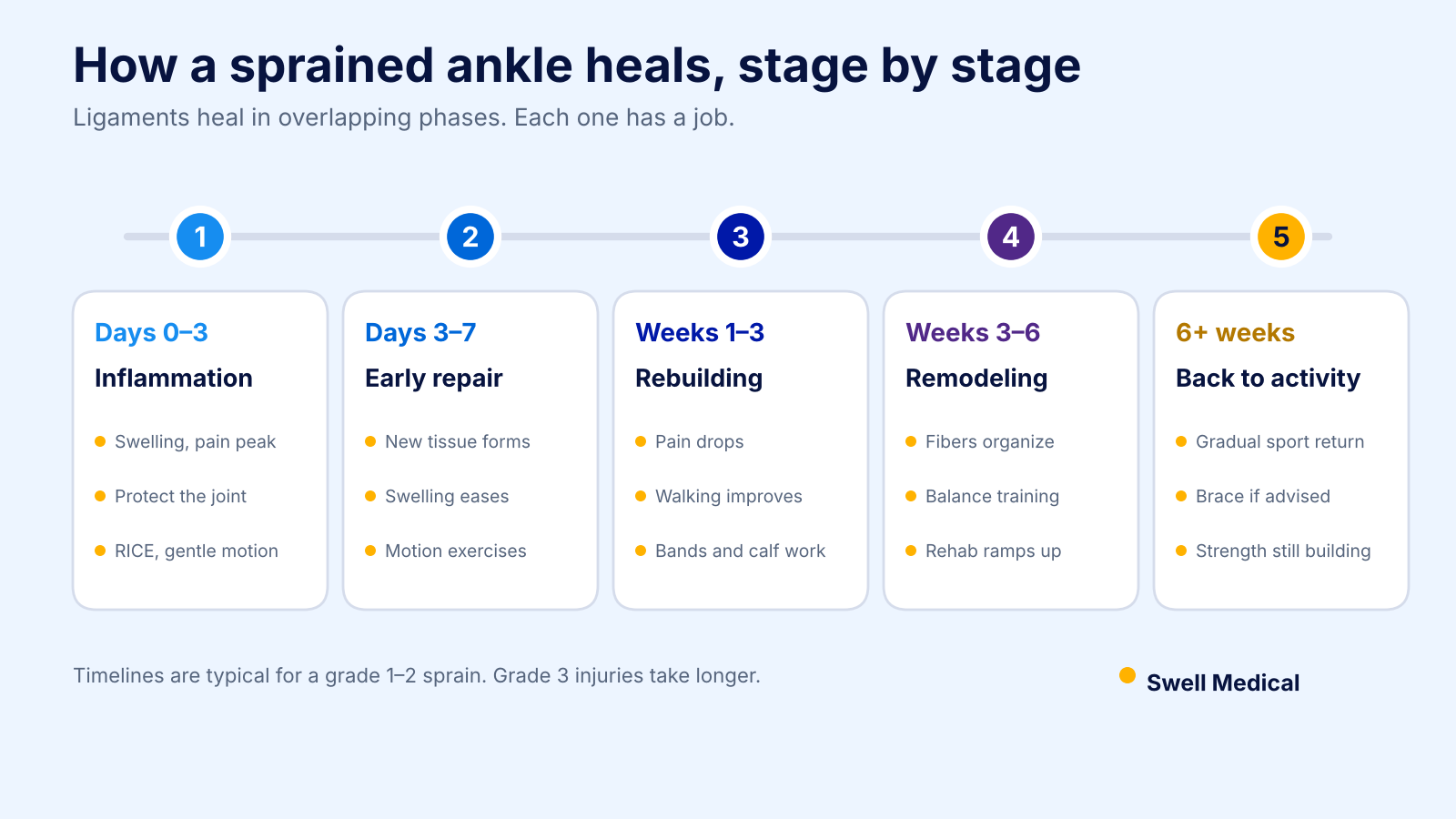
Days 0 to 3: inflammation. Inflammation is your body’s cleanup crew, and swelling, pain and bruising peak. Protect the joint, limit weight bearing if it hurts, and begin gentle movement as pain allows.
Days 3 to 7: early repair. New tissue starts to form and inflammation begins to ease. Gentle range of motion work, such as tracing the alphabet with your toes, keeps the joint from stiffening. This is also when early rehab begins.
Weeks 1 to 3: building strength with rehabilitation. Pain drops and walking improves. Resistance bands and calf work start to rebuild strength, and full weight bearing usually becomes comfortable after a mild or moderate sprain.
Weeks 3 to 6: remodeling and rehabilitation. The new fibers organize and strengthen. Balance training matters most here, because the ankle has to relearn where it is in space, a skill called proprioception.
Six weeks and beyond: return to activity. Running, cutting and jumping come back gradually. Full ligament strength can take several months, even when the ankle feels fine, so a gradual return protects against re-injury.
What changes your sprained ankle recovery time
Two people with the same grade can recover at different speeds. These factors matter most:
- Severity of the tear. A complete tear takes far longer than a stretched ligament. This is the biggest factor in how long a sprained ankle takes to heal.
- How soon you start treatment. Early protection and gentle movement shorten the recovery time.
- Activity level. Athletes and people on their feet all day face a longer road back to full duty.
- Age and health. Younger, active people often heal faster, while diabetes and poor circulation can slow healing.
- Following the plan. Skipping rehab is the most common reason for a repeat injury.
- Earlier sprains. A previously injured ankle is more likely to suffer re-injury and stay unstable.
How to heal a sprained ankle faster
You cannot rush biology, but you can remove what slows it down. The right treatment in the right order makes a real difference, and treatment changes with the grade: mild sprains need compression and early movement, while severe sprains may need short-term immobilization before rehabilitation.
The first 72 hours
Follow the RICE method for the first few days. This simple RICE routine is the standard first treatment for any ankle sprain:
- Rest: protect the ankle and avoid activities that hurt.
- Ice: apply for 15 to 20 minutes several times a day, with a cloth between ice and skin.
- Compression: wrap the ankle snugly with an elastic bandage or compression sleeve, not so tight that your toes tingle.
- Elevation: keep the foot raised above heart level to reduce swelling.
Ice and compression ease swelling, while over-the-counter pain relievers such as ibuprofen or acetaminophen can help with pain. Check with a clinician if you have stomach, kidney or heart conditions.
Rehab, balance work and bracing
Prolonged rest is no longer the advice. Gentle movement, early supported walking and a structured rehabilitation program help the ligament heal stronger. Good rehab includes ankle circles, calf raises, resistance band work and balance drills. Physical therapy builds strength, range of motion and proprioception, which is your ankle’s sense of position. Balance exercises, such as standing on one leg, cut the risk of the next sprain, and a brace or tape adds support during the first weeks back to activity.
Sprain or fracture? Red flags that need care
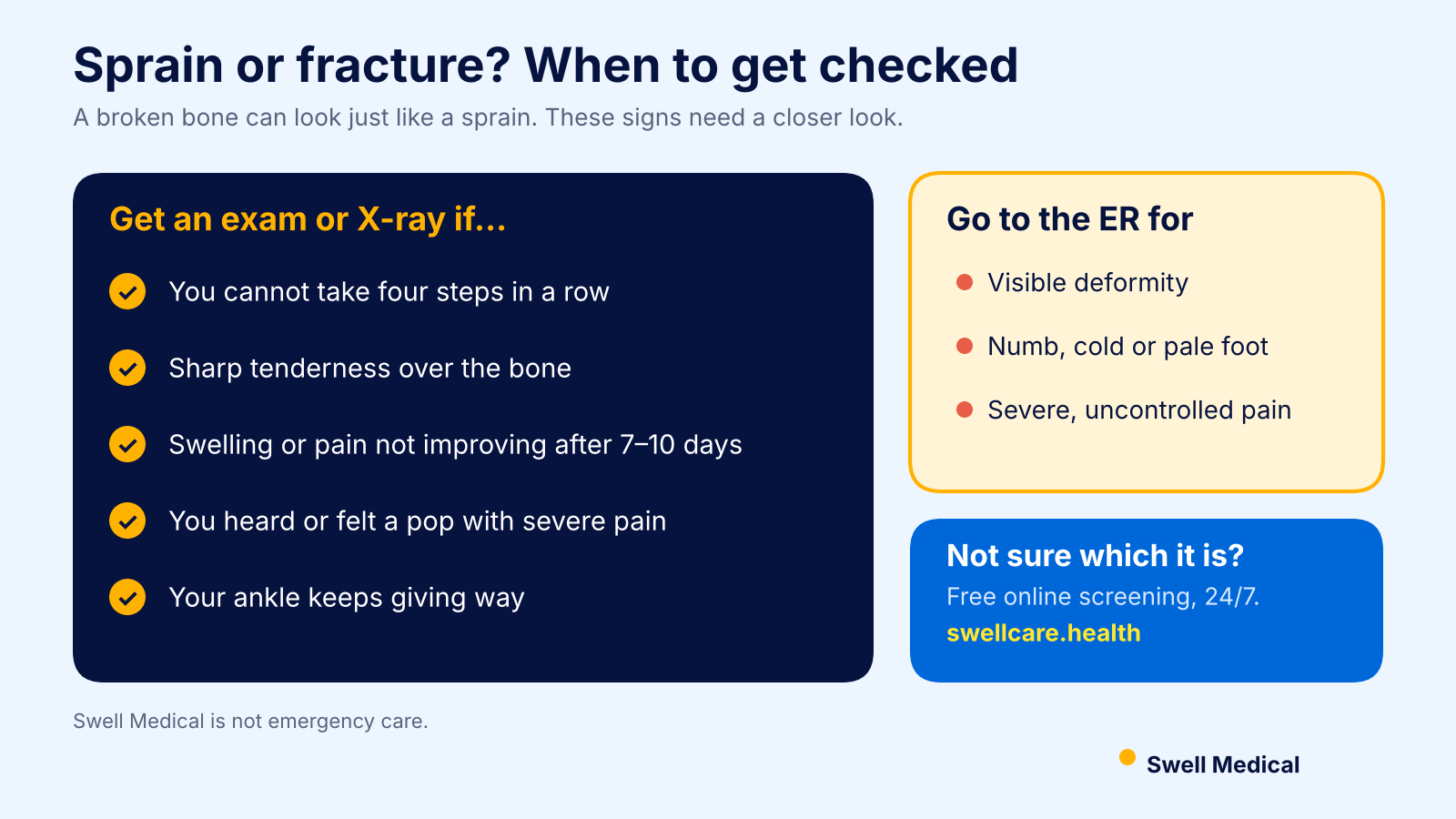
Not every swollen ankle is a sprain. A fracture can look and feel almost the same, and missing one delays proper treatment and healing. Get an in-person exam and an X-ray if you notice any of these:
- You cannot take four steps in a row, either right after the injury or when you are examined.
- You feel sharp tenderness over the bone at the back or tip of the ankle or in the midfoot.
- The ankle looks deformed, or your foot feels numb, cold or pale.
- You heard or felt a pop followed by severe pain.
- Symptoms are not improving after a week to ten days.
Go to the emergency department right away for deformity, numbness, a cold or discolored foot, or severe pain. If your ankle keeps giving way weeks later, ask about an evaluation for chronic ankle instability, which can follow an untreated sprain. An X-ray checks the bones, and a clinician may recommend an MRI to look at the ligaments directly, especially if pain lingers or you suspect a severe tear.
Get your ankle checked today with Swell Medical
If you are unsure whether your ankle is a simple sprain, you do not have to wait days for an appointment. Swell Medical connects you with real clinicians online, 24/7, in all 50 states and DC. Your screening is free, and each completed consultation is $45 with no membership.
A clinician can review your symptoms, help you understand the likely grade of your sprained ankle, build a home treatment plan, and tell you clearly when you need an in-person X-ray or a specialist. Swell Medical is not emergency care, and no outcome is guaranteed, but you will leave with clear next steps.
Start your free screening at swellcare.health
Sprained ankle healing time FAQs
How long does a sprained ankle take to heal?
A grade 1 sprain usually heals in one to three weeks, a grade 2 in three to six weeks, and a grade 3 in three to six months. A high ankle sprain often takes six weeks or more.
Is it OK to walk on a sprained ankle?
Often yes, if you can walk without sharp pain, and early weight bearing is part of modern treatment. Gentle, supported walking helps recovery after a mild or moderate sprain. If you cannot take four steps, or the pain is severe, stop and get the ankle checked for a fracture.
How long should swelling last after a sprain?
Swelling is worst in the first few days and usually fades over one to two weeks after a mild sprain. Mild puffiness and stiffness at the end of the day can linger for several weeks, especially after a more severe injury.
Do I need physical therapy after an ankle sprain?
Mild sprains often recover with home exercises. Moderate and severe sprains usually benefit from physical therapy to restore strength, balance and range of motion, and to lower the chance of re-injury. Think of it as the treatment that protects your ankle long term.
Why does my ankle keep rolling after a sprain?
A ligament that healed loose, or weak balance and muscle control, can leave the ankle unstable and open to re-injury. This is called chronic ankle instability, and it affects some people after a sprain. Rehabilitation, bracing and, in some cases, a specialist visit with an MRI can help.
Trusted references
Public-health, research, and medical-society resources related to this guide.