Short answer: a little, for some people. Metformin for weight loss isn’t a miracle, and it isn’t nothing either. In the largest trial that tracked it, people on metformin lost about 2 kg (roughly 4.5 pounds) more than people on placebo. Some lost much more. Plenty lost nothing at all.
If you saw a headline promising 20 pounds from a $10 pill, you deserve the real numbers. Here they are, along with the side effects, the safety limits, and how metformin stacks up against newer GLP-1 medications. Take it slow. A doctor should look at your history before you decide anything.
So, does metformin help you lose weight?
Yes, modestly. Metformin is FDA-approved to treat type 2 diabetes, and doctors have long noticed that people taking it tend to drift down a few pounds instead of up. Using it purely to lose weight is “off-label,” which means a prescriber is applying the drug to a goal it wasn’t officially approved for. That’s legal and common. It also means your prescriber has to weigh the evidence with you, since no label spells it out.
Here’s the plain version of what the data shows:
- Most people lose a small amount, often 2 to 6 kg (about 4 to 13 pounds) over a year or more.
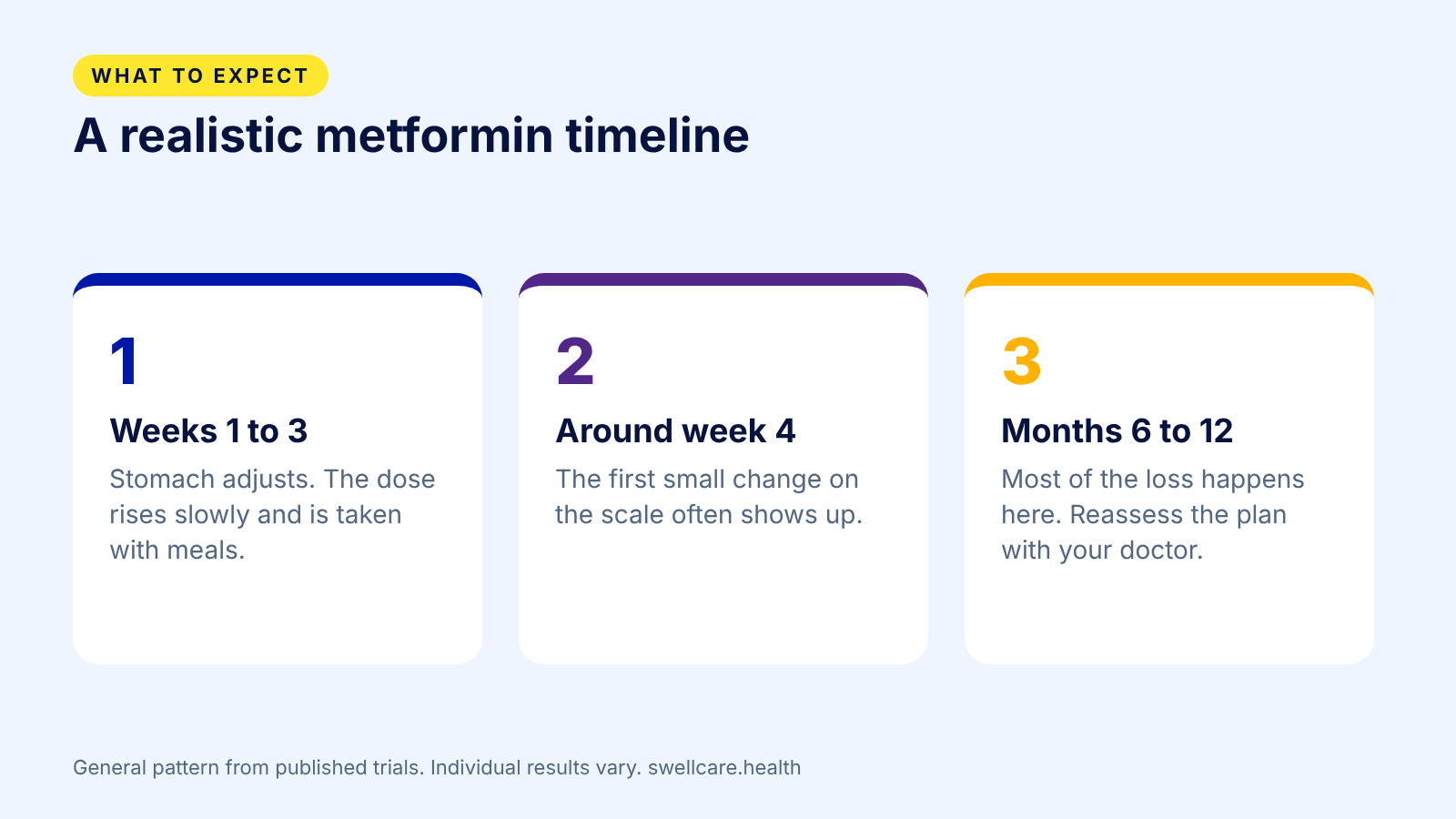
- The loss tends to start after about four weeks and builds over the first 6 to 12 months.
- People with higher insulin resistance seem to respond better.
- Appetite often drops a little, and that’s where most of the effect seems to come from.
- It works best next to food and activity changes, not instead of them.
One more point worth sitting with. Metformin was never designed as a weight loss drug. It was built to lower blood sugar in people with type 2 diabetes. The scale moving is a side benefit that varies a lot from person to person.
What the research says about metformin and weight loss
You’ll see bold claims online. The studies are quieter. They’re also more useful, because they tell you what to expect.
The Diabetes Prevention Program numbers
The best-known data comes from the Diabetes Prevention Program, a US trial that followed 3,234 adults at high risk for type 2 diabetes. One group took 850 mg of metformin twice a day. Another followed an intensive lifestyle plan. A third took a placebo.
According to a Cleveland Clinic Journal of Medicine review, average weight change in the first 2.8 years was about 2.1 kg lost with metformin, 5.6 kg lost with the lifestyle program, and 0.1 kg lost with placebo. Metformin also cut the risk of developing diabetes by 31%, compared with 58% for lifestyle changes.
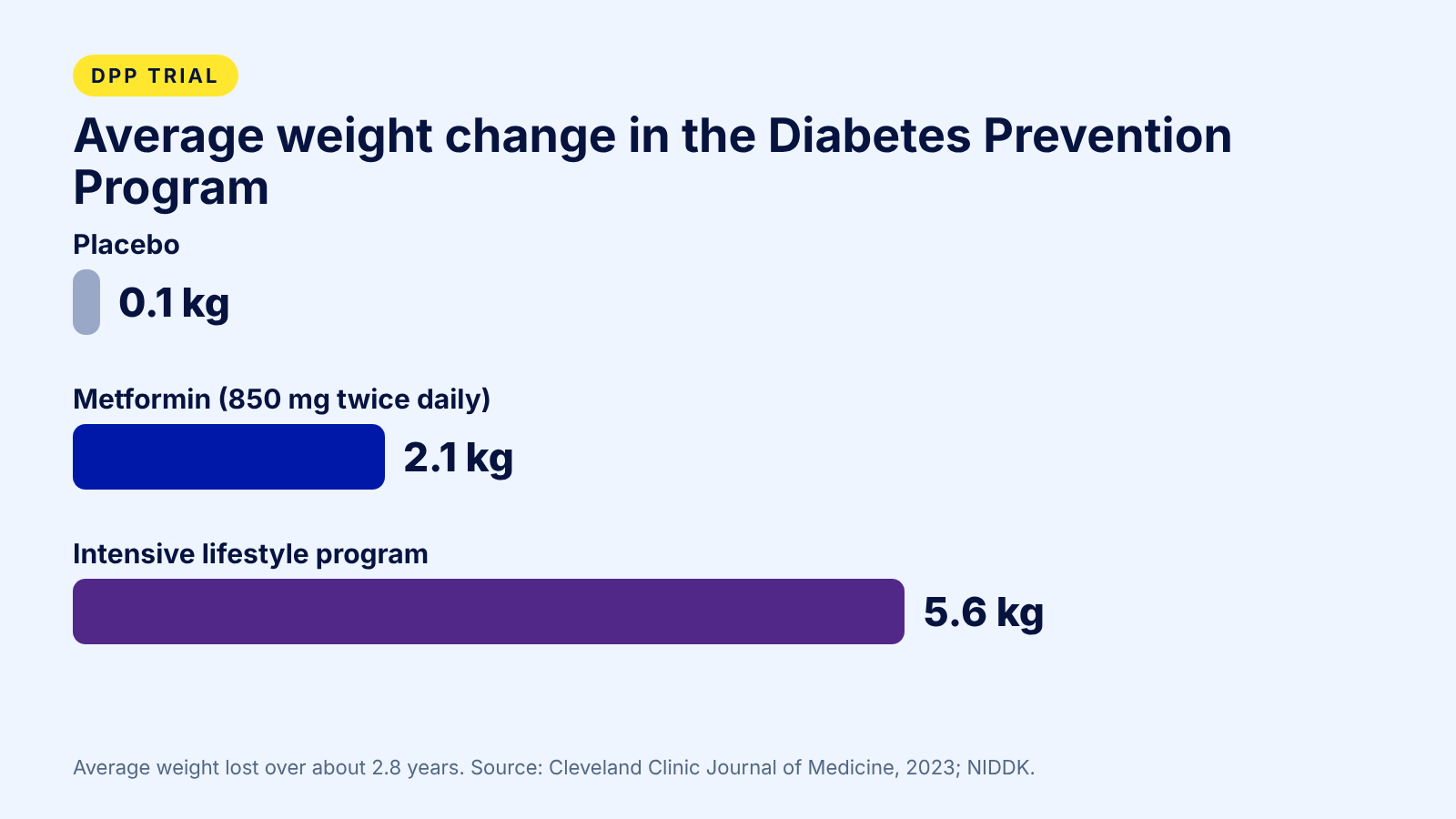
Notice what that chart says. Lifestyle change beat metformin on weight. But metformin’s loss lasted. The same review notes that people in the metformin group kept their loss over long follow-up, while the lifestyle group gradually regained some.
Who tends to respond more
Not everyone responds the same way. The research points to a few groups:
- Prediabetes. Metformin cut diabetes risk most in people with a BMI of 35 or higher, people under 60, and women with a history of gestational diabetes.
- Insulin resistance. A real-world study of 154 metformin users found they lost an average of 5.8 kg, while 45 comparison patients gained 0.8 kg. It wasn’t randomized, so treat it as a hint, not proof. The pattern held, though: the more insulin resistant someone was, the more they lost.
- PCOS. Polycystic ovary syndrome often brings insulin resistance, and metformin is commonly used there for cycles, ovulation and weight.
- Antipsychotic weight gain. A pooled analysis of 12 studies found people lost about 3.3 kg more than on placebo.
How metformin may change appetite and weight
Doctors don’t fully agree on the mechanism. Several things seem to be happening at once.
Metformin lowers the amount of glucose your liver releases and makes your muscles use glucose more effectively. Researchers track this through fasting glucose and A1c. Steadier glucose after meals also means smaller insulin swings. With lower insulin levels, many people report feeling less driven to snack. That shift in appetite is probably the biggest piece of the puzzle.
Researchers are chasing other leads too. Metformin changes the gut microbiome, and each person’s gut microbiome may help explain who responds. It also appears to raise a hormone signal related to fullness. A Stanford Medicine study in mice linked metformin’s weight effect to a molecule called lac-phe, which the body also makes after hard exercise. Mouse results don’t always translate to people, so it’s an interesting clue and nothing more.
The takeaway is simple. Metformin nudges appetite and blood sugar. It doesn’t melt fat on its own.
Metformin vs. GLP-1 medications like semaglutide and tirzepatide
This is the question behind most searches. Which one is better?
On weight alone, the injectables win by a wide margin. In the STEP 1 trial, adults on semaglutide 2.4 mg lost an average of 14.9% of body weight over 68 weeks, versus 2.4% on placebo (NEJM). In SURMOUNT-1, tirzepatide produced average losses of 15.0% to 20.9% at 72 weeks, depending on the dose, versus 3.1% on placebo (NEJM).
Metformin’s 2.1 kg in the DPP works out to roughly 2% of the group’s average starting weight.
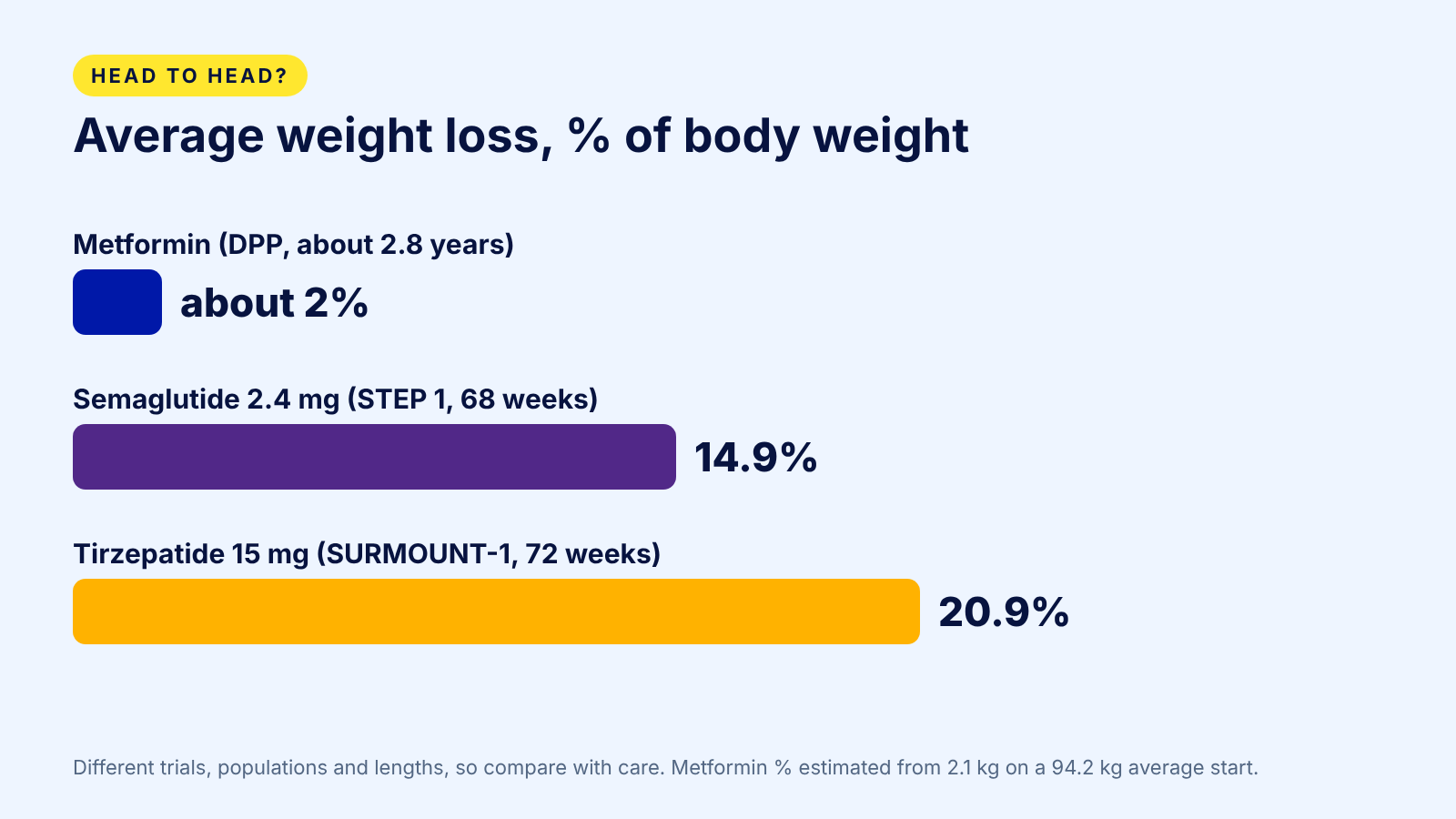
| Metformin | Semaglutide (STEP 1) | Tirzepatide (SURMOUNT-1) | |
|---|---|---|---|
| Average weight loss | About 2% (DPP, ~2.8 years) | 14.9% (68 weeks) | 15.0% to 20.9% (72 weeks) |
| How it’s taken | Daily tablet | Weekly injection | Weekly injection |
| Approved for weight loss | No, off-label | Yes, at the weight-management dose | Yes, at the weight-management dose |
| Typical cost | Low, often about $10 for 90 days | High without coverage | High without coverage |
| Main side effects | Stomach upset | GI effects | GI effects |
So why would anyone choose metformin? Cost, mostly. It’s cheap, has decades of safety history, and some people can’t get or can’t afford the injectables. Others can’t take GLP-1 drugs for medical reasons. Some prescribers also combine them. The Cleveland Clinic authors describe metformin as a reasonable add-on to approved anti-obesity medications when there’s no reason to avoid it.
Metformin side effects and who should not take it
This is one of the most studied drugs in the world. That doesn’t make it free of trouble.
Common side effects
Most side effects hit the stomach. The MedlinePlus drug page lists diarrhea, nausea, stomach discomfort, gas, indigestion and a change in taste as common. Diarrhea is the one people complain about most. It usually eases after a few weeks, and slow dose increases, taking it with meals, and choosing an extended-release tablet all help.
Long-term use can also lower vitamin B12. One review put it at around 7% of patients. It’s usually silent and reversible, but your doctor may check your level periodically.
Rare but serious risks
It carries a boxed warning for lactic acidosis, a rare but dangerous buildup of acid in the blood. It’s far more likely in people with poor kidney function, so your lab numbers are the gatekeeper. It’s contraindicated when eGFR falls below 30, and the Cleveland Clinic authors suggest that many prescribers avoid starting it below 45 when it’s being used for weight loss.
Call a doctor right away if you have extreme tiredness, vomiting, stomach pain, fast or deep breathing, dizziness or feeling cold. MedlinePlus also says the drug may need to be paused around X-ray procedures that use iodinated contrast dye, and for severe dehydration or heavy alcohol use.
You shouldn’t take it without a clinician’s sign-off if you have kidney disease, liver disease, heart failure, or a history of lactic acidosis.
How metformin is usually dosed
Don’t self-dose. Please. Your prescriber picks the starting amount and the pace based on your labs, your other medicines and how your stomach reacts.
That said, knowing the general pattern helps you ask better questions. Studies of metformin for weight loss mostly used 1,500 to 1,700 mg a day. Prescribers usually start lower and raise the dose every one to two weeks, which gives your gut time to adjust. Immediate-release tablets are taken two or three times a day with meals. The extended-release version is a single dose with the evening meal, and it’s swallowed whole. Don’t crush or split it.
Expect to wait. A few weeks to start, months to see the full effect. If nothing has changed after six months at a proper dose, a good doctor will talk with you about other options, not push the dose higher.
Is metformin a good fit for you?
Here’s Swell’s honest take. Metformin may be worth discussing if you have prediabetes, insulin resistance, PCOS, a BMI of 35 or higher, or weight gain from an antipsychotic. It can also make sense if cost is the main barrier to other treatments.
It’s a weaker fit if you’re hoping for a dramatic drop, if you have significant kidney or liver problems, or if you want it as a shortcut with no changes to eating or movement. The studies that showed benefit paired the drug with real habits.
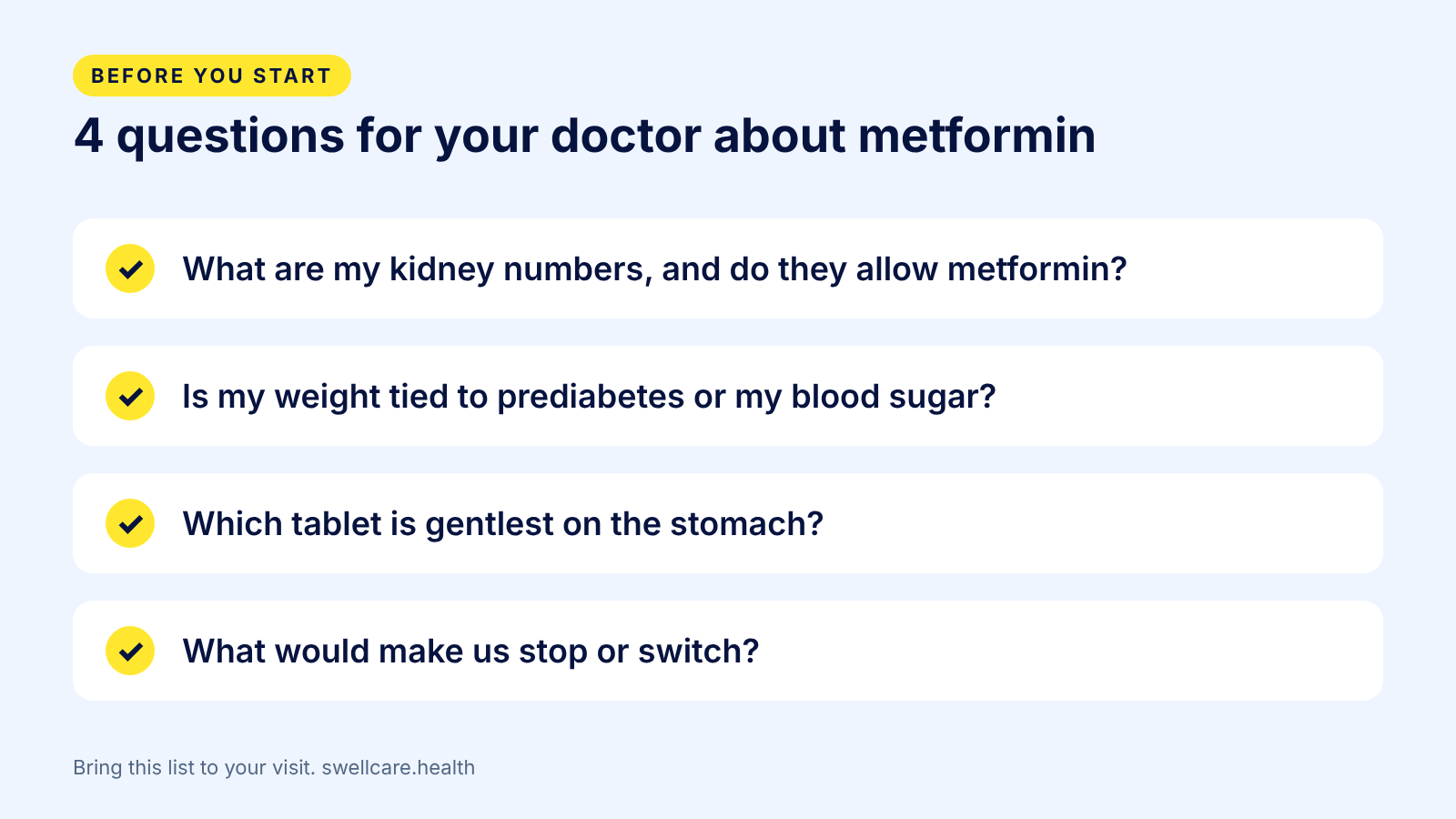
A few questions to bring to your appointment:
- What are my kidney numbers, and do they allow metformin?
- Is my weight tied to prediabetes or my blood sugar?
- Which tablet is gentlest on the stomach, and when should I take it?
- What would make us stop?
When to talk to a doctor
Book a visit before you start, not after. Tell your doctor about every medicine and supplement you take, any liver or long-term condition, and whether you drink heavily or are pregnant or planning to be.
Seek urgent care if you develop persistent vomiting, severe stomach pain, rapid breathing or unusual weakness while taking it. Those can be signs of lactic acidosis, and it’s an emergency.
Get a clinician’s opinion on weight care
You don’t have to guess whether metformin or something else fits your body. At Swell, a licensed clinician reviews your history, explains what can be handled safely online, and tells you the next step. The first screening is free. If a visit makes sense, a completed consultation is $45, with no monthly membership.
Nothing is guaranteed, and a prescription isn’t automatic. A licensed provider makes every care decision, and if you need an in-person exam or labs, you’ll hear it plainly. Start with the free screening at swellcare.health and bring your questions.
Questions people ask about metformin for weight loss
Can you lose 20 pounds on metformin?
Some people do, but it isn’t typical. The average in the largest trial was closer to 4 to 5 pounds, and results vary widely. Larger losses usually show up in people with significant insulin resistance who also change how they eat and move. Treat 20 pounds as an outlier, not a promise.
Which is better, metformin or Ozempic?
For weight loss alone, the drug in Ozempic and Wegovy produces far larger average losses than metformin. Metformin costs much less and has a longer safety record. The better choice depends on your health, budget, insurance and goals, so talk it through with a clinician.
Can I take metformin just to lose weight?
A prescriber can legally prescribe it off-label for weight loss, usually when there’s a reason such as prediabetes or polycystic ovary syndrome. It isn’t FDA-approved for that purpose, and your kidneys and other health factors need checking first. Don’t borrow someone else’s prescription.
How much metformin should you take to lose weight?
Your clinician sets the dose. Studies mostly used 1,500 to 1,700 mg per day, reached by increasing slowly from a lower starting amount. Lab results can lower the ceiling, and extended-release tablets are often easier on the stomach. Never raise the dose on your own.
How long does metformin take to cause weight loss?
Many people see the first small change after about four weeks. Most of the loss happens over the first 6 to 12 months. If the scale hasn’t moved after several months at an adequate dose, it’s reasonable to revisit the plan with your clinician.
Does metformin work without diet and exercise changes?
It can, a little, but the effect is smaller. In the Diabetes Prevention Program, the lifestyle group lost more than the metformin group. The two approaches aren’t rivals. Many prescribers use the drug to support habits rather than replace them.
Trusted references
Public-health, research, and medical-society resources related to this guide.