You tilt your head back, aim a phone flashlight at your throat, and there they are. White spots on tonsils that weren’t there yesterday. Your first thought is strep. Your second might be something much worse.
Take a breath. Most of the time it’s one of four things: strep throat, a viral infection, tonsil stones, or a yeast overgrowth called oral thrush. Three of those are easy to treat, and the fourth, a virus, mostly just needs time.
This guide shows you how to match your symptoms to a likely cause, which signs mean you shouldn’t wait, and what to do today if your throat hurts and you can’t get in anywhere.
What are those white spots on your tonsils?
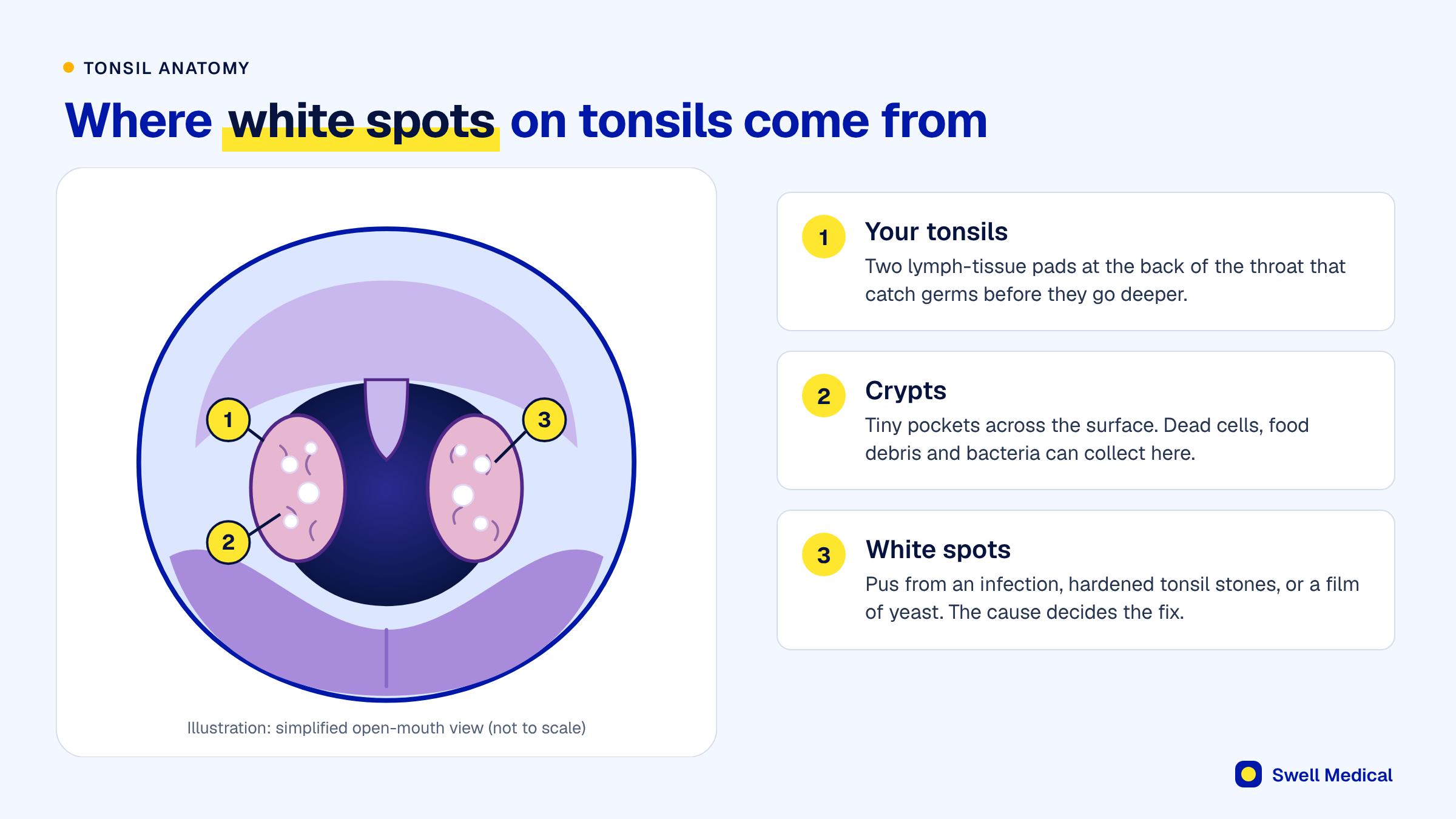
Your tonsils are two lumps of lymph tissue at the back of your throat, part of the same network as the lymph nodes in your neck. Their job is to catch germs. They’re also bumpy, with small pockets called crypts, and those pockets collect things: dead cells, food debris, bacteria, and sometimes pus when an infection takes hold.
That’s why white spots, and the symptoms around them, look different from person to person. You might see tiny specks, a few streaks, or a film over a whole tonsil. The look is a clue, never the whole answer. The other symptoms you have matter just as much, and the rest of this page is built around them.
Common causes of white spots on tonsils
Here are the usual suspects, roughly in the order a clinician would think of them.
Strep throat
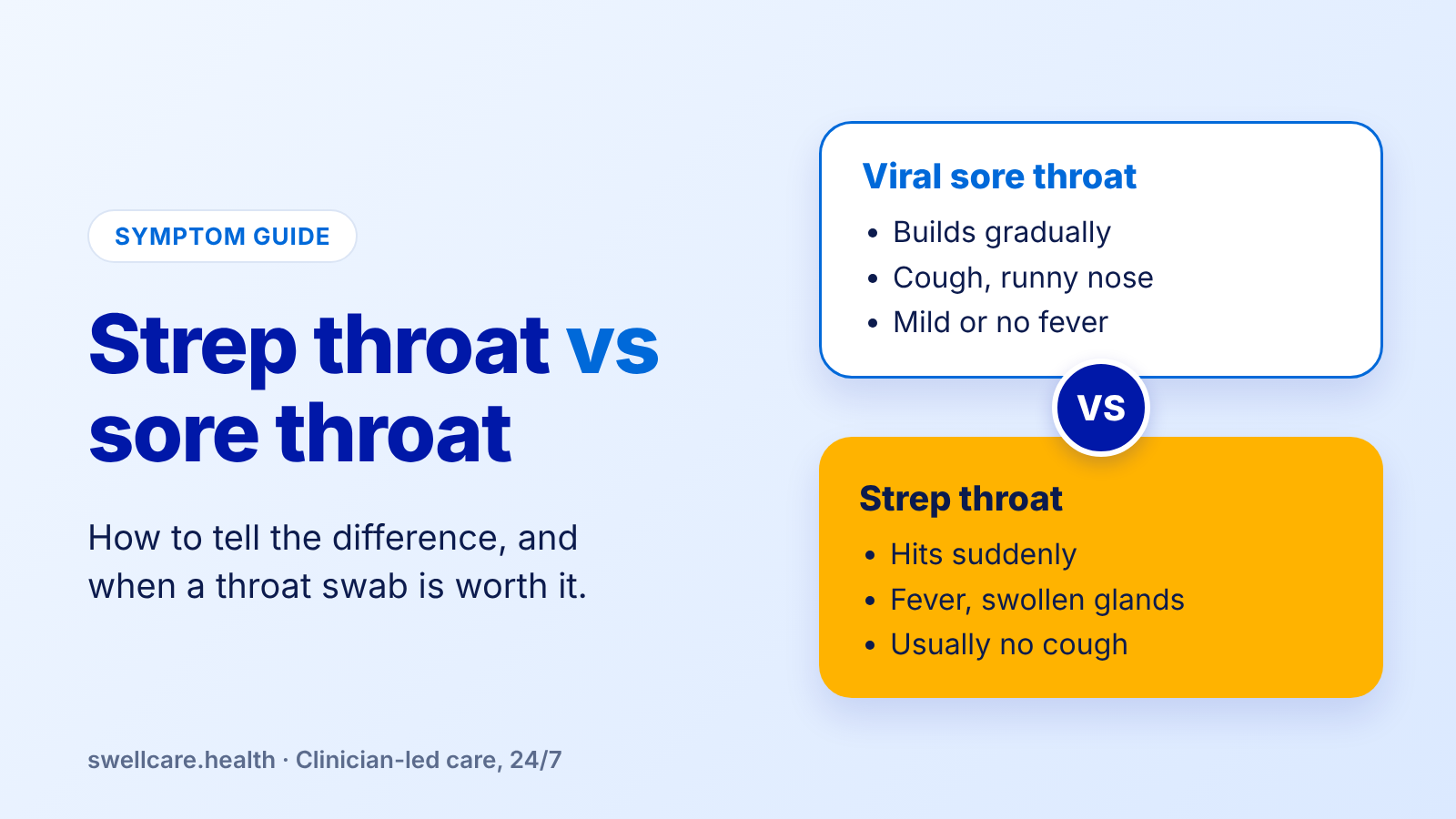
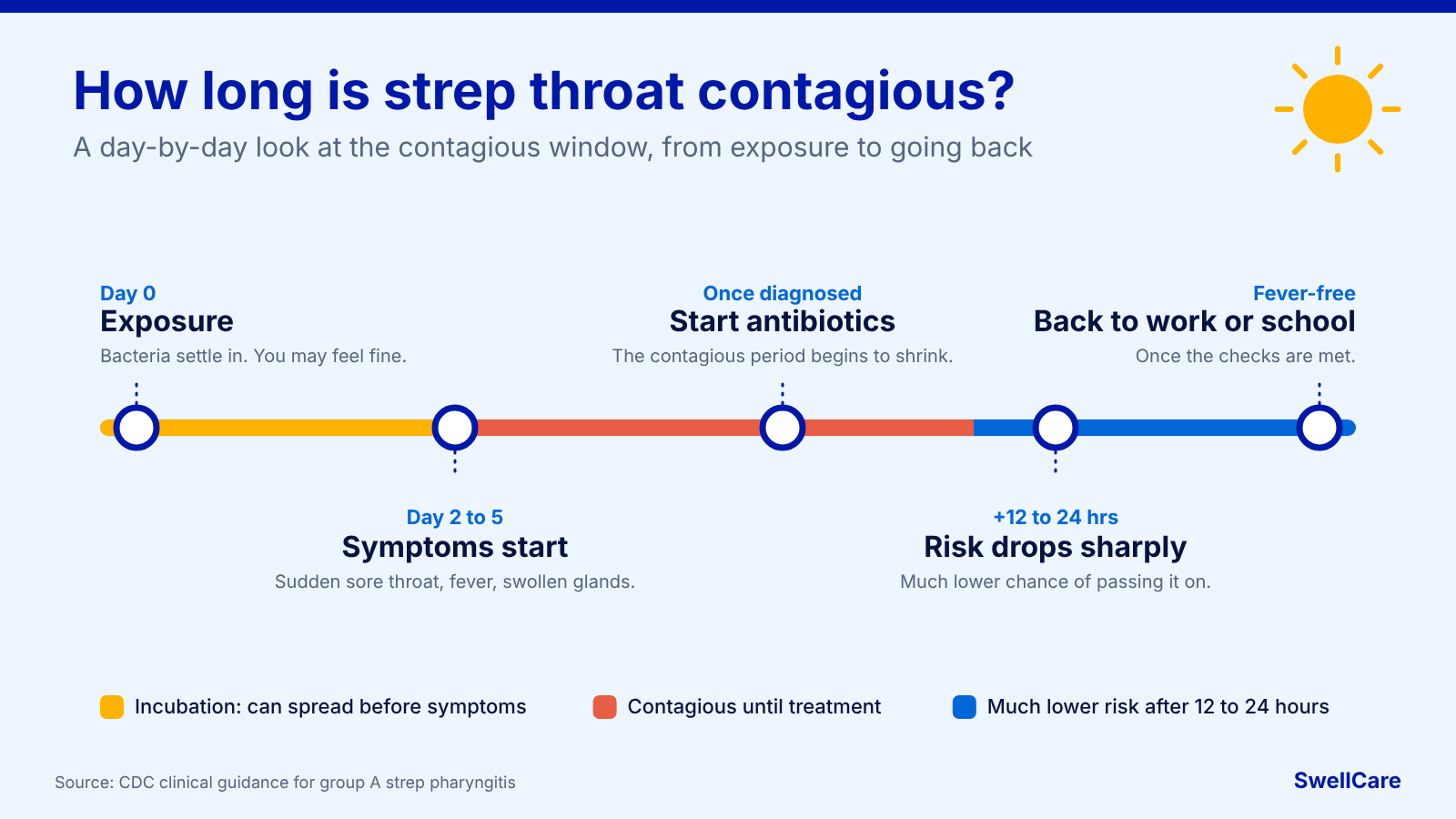
Strep is the one everyone worries about, and it does deserve some respect. Group A strep bacteria cause this infection, and the CDC says symptoms usually begin two to five days after exposure. Pain arrives fast. Swallowing hurts, you run a fever, your tonsils turn red with white patches or streaks, and the lymph nodes in your neck swell. Tiny red dots on the roof of your mouth are another clue, and a headache or body aches often tag along.
Here’s the twist. Viruses cause most sore throats. The CDC estimates that only about 1 in 10 adults with a sore throat has strep, compared with roughly 3 in 10 children. A cough, runny nose, hoarse voice or pink eye all point toward a virus instead. Strep calls for a prescription, and an untreated infection can occasionally lead to rheumatic fever, kidney inflammation or an abscess near the tonsil, according to Mayo Clinic. So confirm it rather than guess.
Viral tonsillitis and mono
Tonsillitis simply means inflammation of the tonsils, and a viral infection is behind most cases. Bacteria cause the rest. You get a painful throat, painful swallowing, maybe a fever, and sometimes pus on the tonsils. It looks a lot like bacterial tonsillitis, which is exactly why doctors test. The NHS says tonsillitis usually clears in three to four days, though it can drag on.
Infectious mononucleosis is the viral cause that surprises people. It comes from the Epstein-Barr virus and spreads through saliva, so think kissing and shared drinks. Mayo Clinic says symptoms show up four to seven weeks after exposure. Along with swollen tonsils you feel wiped out, with a fever, a headache, swollen lymph nodes and sometimes a rash. The pain tends to ease within a month. The fatigue can hang around longer.
Tonsil stones
Tonsil stones are small, pebble-like lumps that form in the crypts. Cleveland Clinic describes them as hardened calcium minerals mixed with food debris and bacteria, and they look like tiny white or yellow pebbles. There’s usually no fever. Stones rarely cause symptoms beyond bad breath, sometimes with a bad taste or the feeling that something’s stuck in your throat.
They’re more likely if you’ve had a lot of tonsillitis, you have deeper crypts, or you’re dehydrated. They’re also harmless. If you swallow one, nothing happens.
Oral thrush
Thrush is a yeast infection caused by Candida albicans, a fungal overgrowth in the mouth. The patches look creamy white and slightly raised, and they can bleed a little if you scrape them. They often start on the tongue and inner cheeks and can spread toward the tonsils. Mayo Clinic lists the risk factors: inhaled corticosteroids, recent antibiotics, uncontrolled diabetes, dentures, dry mouth and a weakened immune system. If you use a steroid inhaler, rinsing your mouth afterward helps prevent it, according to the CDC.
Less common causes
A few other things can leave white patches in the throat. Postnasal drip can coat the back of your throat with mucus. Smoking and long-term irritation can cause leukoplakia, a thick white patch that doesn’t wipe away. Certain infections passed through oral sex can also affect the throat, and a clinician can test for them privately. And rarely, a patch that won’t heal is an early sign of oral or throat cancer. That’s why the next two sections matter.
Strep, stones, thrush or mono: how to tell them apart
Use this as a rough guide, not a diagnosis. The overlap is real, and only a test can confirm strep.
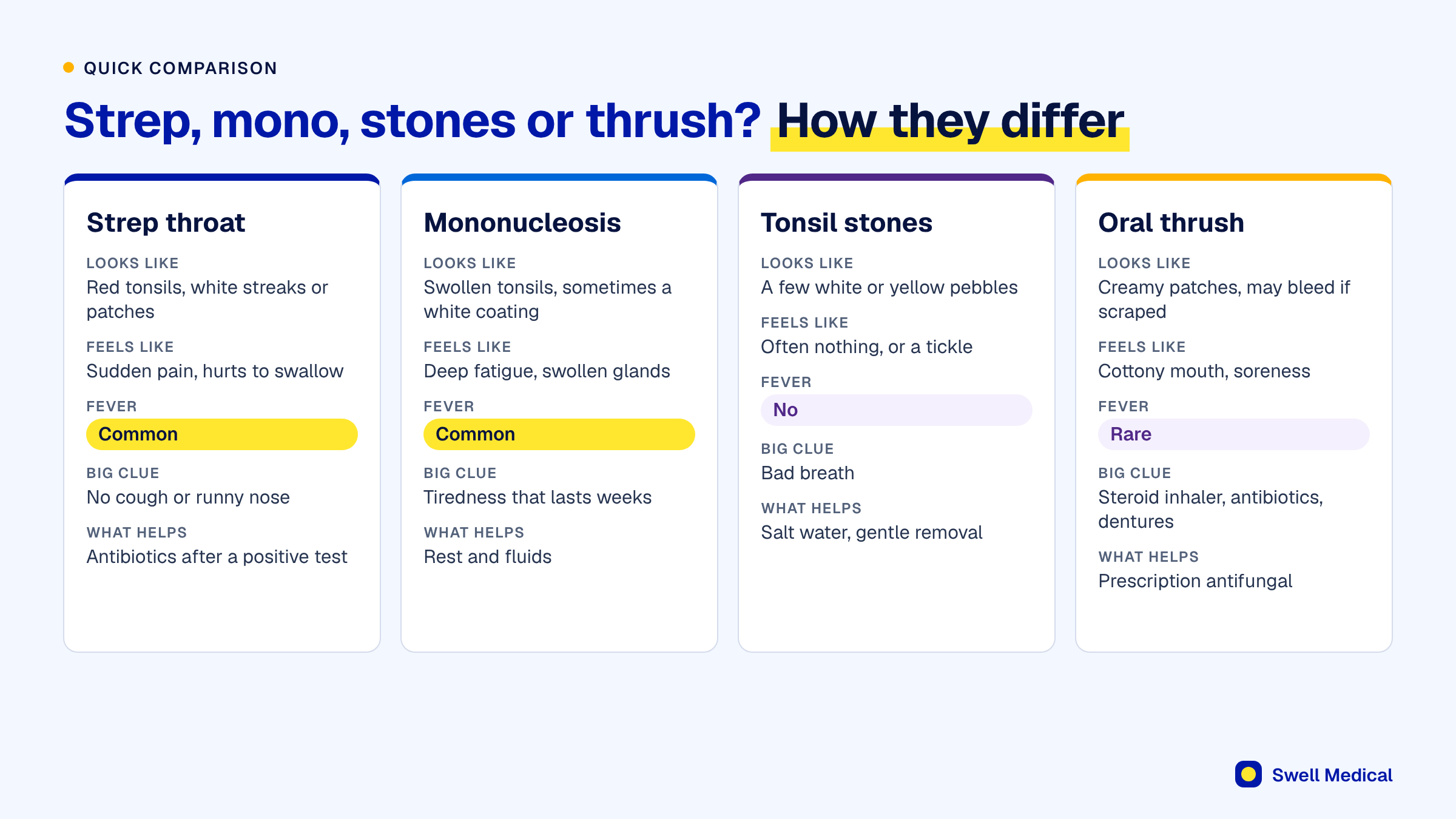
| Strep throat | Mononucleosis | Tonsil stones | Oral thrush | |
|---|---|---|---|---|
| What you see | Red tonsils, white streaks or patches | Swollen tonsils, sometimes a white coating | A few white or yellow pebbles of trapped debris | Creamy white patches, may bleed when scraped |
| Main symptoms | Sudden sore throat, painful swallowing | Deep fatigue, scratchy throat | Often nothing, or a tickle | Cottony mouth, soreness |
| Fever | Common | Common | No | Rare |
| Big clue | No cough or runny nose | Tiredness for weeks | Bad breath | Steroid inhaler, antibiotics, dentures |
| Treatment | Antibiotics after a positive test | Rest and fluids | Salt water, gentle removal | Prescription antifungal |
When to worry about white spots on tonsils
Most white spots aren’t an emergency. A few situations are, and the cutoff is clearer than you’d think. Here’s when to see a doctor, and how fast.
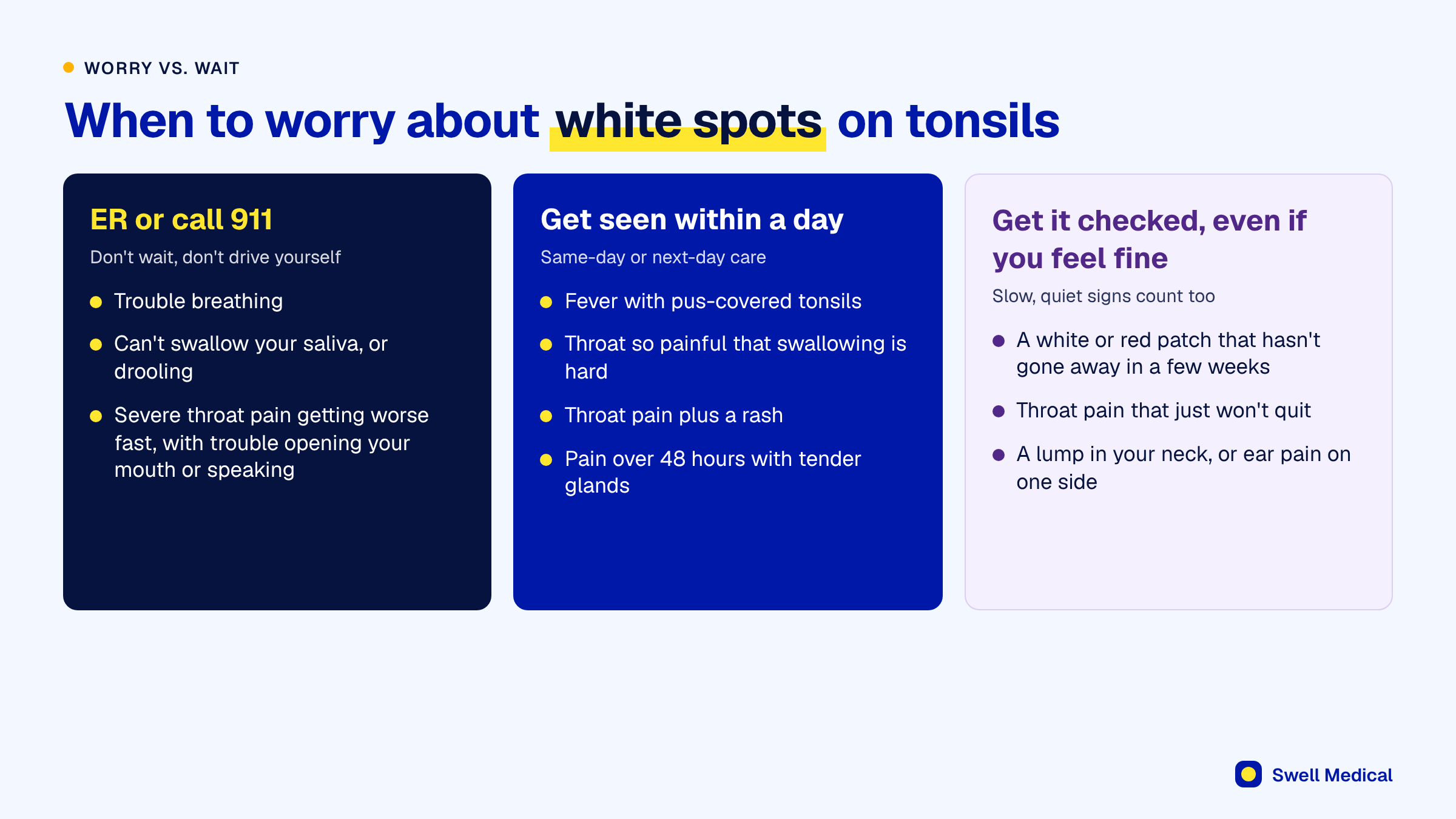
Go to the ER or call 911 if you have:
- Trouble breathing
- So much swelling that you can’t swallow your own saliva, or you’re drooling
- Severe throat pain that’s quickly getting worse, with trouble opening your mouth or speaking
Mayo Clinic and the NHS both name these symptoms. The last one can mean a deep infection behind the tonsil, called an abscess, which needs urgent drainage.
Get seen within a day if you have:
- A fever with pus-covered tonsils
- A throat so painful that swallowing food and drink is hard
- Throat pain plus a rash, or pain that’s lasted more than 48 hours with tender glands
- Sudden sharp pain in the upper left side of your belly while you’re sick with mononucleosis, which can signal a spleen problem
Get it checked even if you feel fine:
- A white or red patch that hasn’t gone away in a few weeks
- Throat pain that just won’t quit, a lump in your neck, or ear pain on one side
The American Cancer Society lists a persistent white or red patch in the mouth or throat as one reason to see a doctor, and suggests not waiting more than a few weeks. Tonsil cancer is rare. But it’s the one thing here you really don’t want to sit on.
What actually helps: home care and treatment
Treatment depends on the cause, which is why guessing is a bad plan. Home remedies won’t fix strep, and antibiotics won’t fix a virus. Here’s how it breaks down.
Strep throat needs antibiotics. If you’re not clearly better 48 hours after starting them, call your clinician. Viral tonsillitis and mononucleosis get rest and fluids, because antibiotics only work on bacteria, not a virus. Thrush is fungal, so it needs an antifungal, usually a lozenge or liquid, with a pill reserved for stubborn cases, per the CDC. And tonsil stones often fall out by themselves.
Some home remedies ease symptoms no matter what’s causing the pain:
- Gargle with warm salt water, about half a teaspoon in a cup. It can calm inflammation and rinse out debris.
- Drink more fluids than you think you need. Warm tea or broth feels good.
- Take ibuprofen or acetaminophen for pain and fever, following the label.
- Rest. Sleep is how your immune system does its best work.
For tonsil stones, Cleveland Clinic suggests gentle coughing, salt water gargles, a water flosser on its lowest setting, or a cotton swab pressed softly. Skip anything sharp. Picking at a tonsil can cause bleeding and make the problem worse. If stones keep coming back or bother you daily, ask your doctor about removal. A tonsillectomy is usually only considered when stones or infections keep returning.
Good oral hygiene helps prevent the stone-and-yeast kind. Brush twice a day, clean your tongue, floss, and stay hydrated. For the infectious kind, wash your hands often and don’t share drinks or utensils.
Can a virtual visit sort this out?
It’s 11 p.m. Your throat hurts, urgent care closed an hour ago, and you’re wondering whether this can wait until morning. That’s the gap virtual care fills.
Swell is clinician-led virtual care, available 24/7. You tell a licensed clinician what’s going on, they review it, and they tell you what can be handled online and what needs an in-person visit. Swell lists a completed consultation at $45, with no monthly membership.
Be clear about the limits. Telehealth can’t swab your throat through a screen, so if strep throat is a real possibility you’ll likely need a rapid strep test in person, and a virtual visit isn’t a final diagnosis for it. What a virtual visit does well is the sorting. Does this sound like a viral infection, stones, a yeast infection, or something that needs a swab today? What treatment makes sense for comfort in the meantime? Do your symptoms cross any of the red-flag lines above?
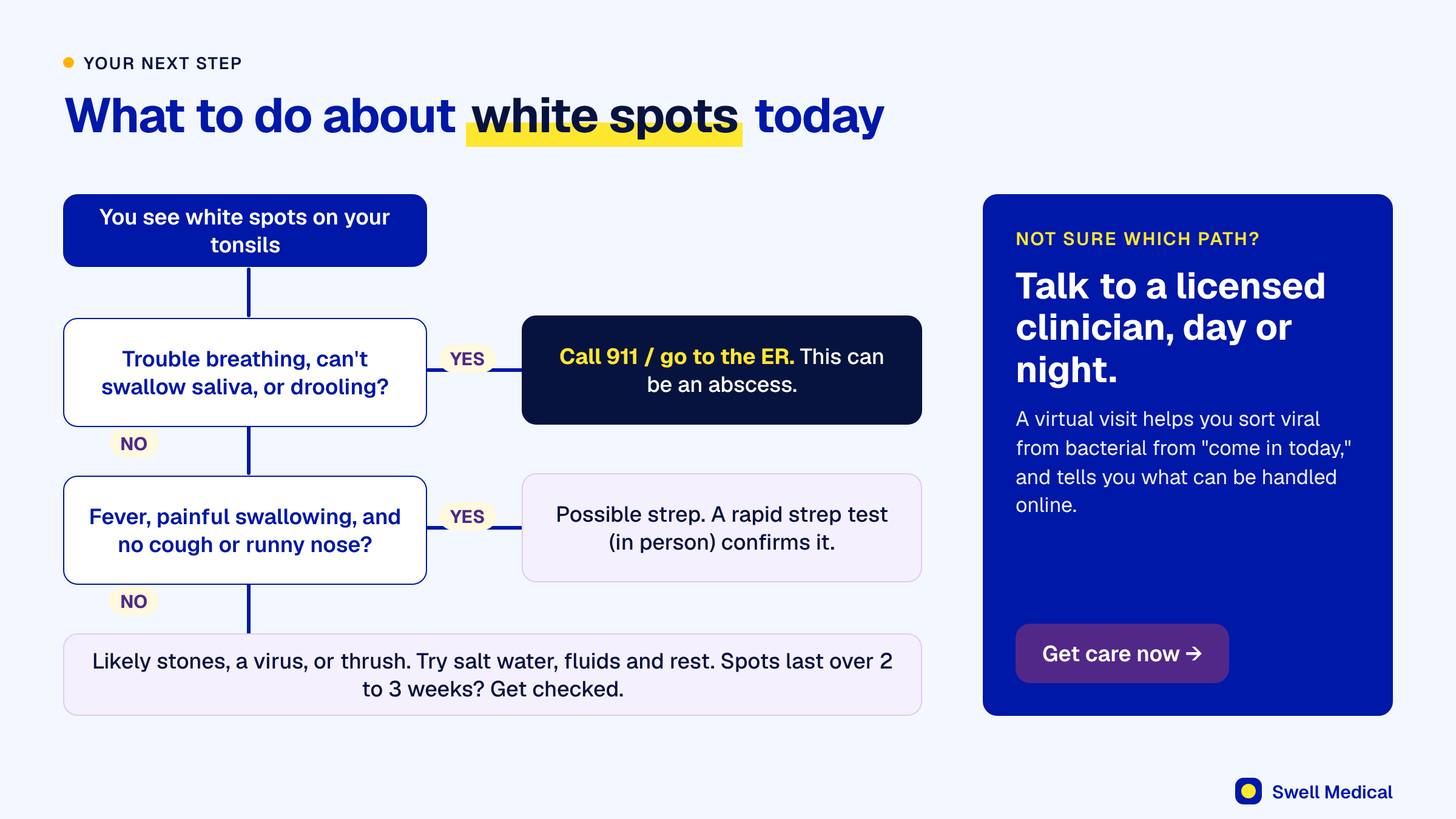
If you’re worried about those white spots, get care now with a Swell clinician. It’s not for emergencies. If you can’t breathe or swallow, call 911.
Questions people ask about white spots on tonsils
Should I be worried about white spots on my tonsils?
Usually not, but pay attention to the symptoms that come with them. White spots with a fever and throat pain could be strep throat and are worth testing. White spots with bad breath and no fever are more likely tonsil stones. See a doctor promptly for trouble swallowing or breathing, or if the spots last more than a couple of weeks.
Can you have white spots on tonsils without strep throat?
Yes, and it’s the more likely situation. Most sore throats are viral, and tonsil stones, thrush and mono can all cause white spots. The CDC says only about 1 in 10 adults with a sore throat actually has strep throat. A rapid strep test is the only way to know for sure.
Can white spots on tonsils go away on their own?
Often, yes. Viral tonsillitis typically clears within a few days, and tonsil stones can fall out by themselves. Strep and thrush don’t reliably clear without treatment, though. If the spots haven’t improved in a week, or you feel steadily worse, get checked.
Are those white spots contagious?
It depends on the cause. Strep, viral tonsillitis and mono are contagious, with mono spreading through saliva. Tonsil stones aren’t contagious at all. Thrush usually isn’t a concern between healthy adults. Skip sharing drinks and utensils until you know what you’re dealing with.
How do I get rid of white spots on my tonsils?
Match the fix to the cause. Strep needs a prescription, thrush needs antifungal medicine, and viral tonsillitis needs rest and fluids. Home remedies like gargling help comfort in every case, and good oral hygiene keeps stones from returning. Stones that keep coming back may lead to a tonsillectomy discussion. Never pick at your tonsils with sharp objects.
Can white spots mean tonsil cancer?
It’s possible but uncommon. Cancer usually shows up as a white or red patch that doesn’t heal, often with lingering throat pain, a swollen neck gland or ear pain on one side. If a patch or throat pain has lasted more than a few weeks, book a visit and have it looked at.
Trusted references
Public-health, research, and medical-society resources related to this guide.