You’re holding a paper towel against a cut that isn’t gushing, but isn’t tiny either. Now you’re stuck. Do you head to the waiting room, or do you tape it up and hope for the best?
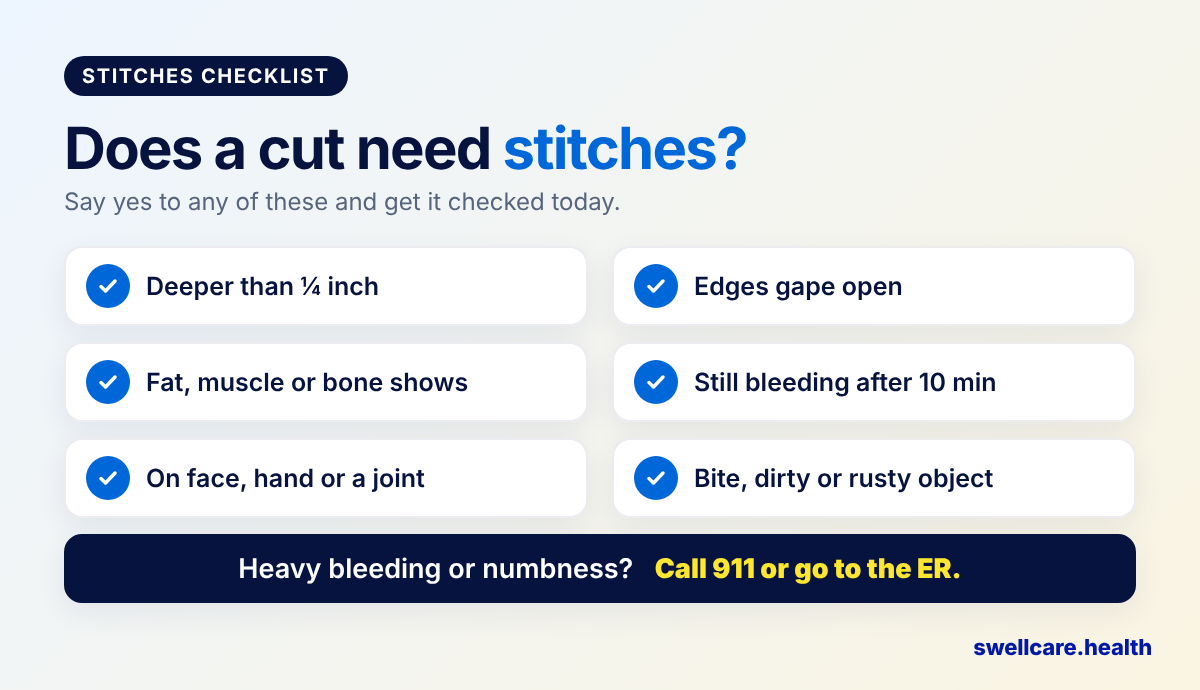
So, does a cut need stitches? Probably yes if it’s deeper than about a quarter inch, gaping open, still bleeding after 10 minutes of firm pressure, or sitting on your face, hand or a joint. Probably not if it’s shallow, the edges meet on their own and the bleeding has slowed. Below is a checklist you can run in about a minute.
Does a cut need stitches? The 60-second answer
Most people just want a straight answer, so here it is. Find your cut in the table.
| What you’re seeing | What it usually means |
|---|---|
| Heavy blood loss that won’t stop after 10 minutes of pressure, numbness, or something stuck in the wound | Call 911 or go to the emergency room |
| Deep or gaping cut, a cut on the face, hand or joint, a bite, or a dirty wound | Get seen today at urgent care or the ER |
| Shallow cut, edges touch, blood flow slows quickly | Home care is usually fine |
If you land in the first two rows, skip the rest and go. Read on if you’re somewhere in the middle.
The simple checklist: signs a cut needs stitches
Stitches (doctors call them sutures) hold the edges of a wound together so it can heal cleanly. A laceration, which is just the medical word for a cut through the skin, that can’t close on its own is the classic candidate. These are the questions clinicians ask first.
It’s deep or the wound edges gape open
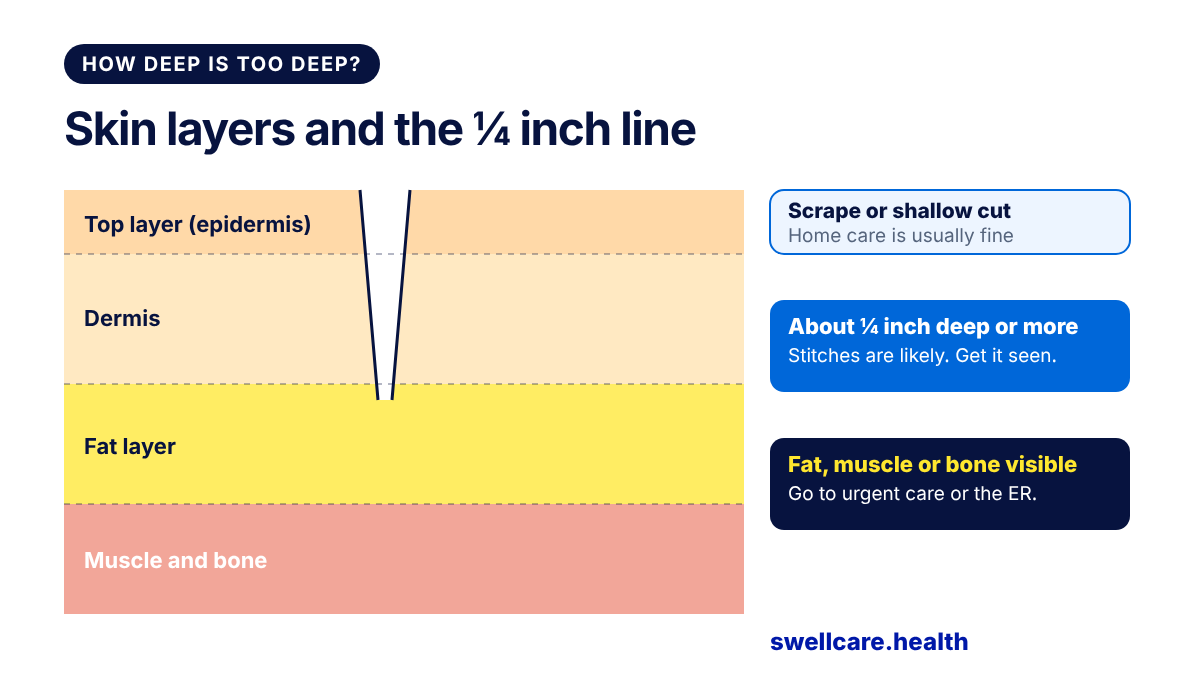
Look straight into the cut. If you can see yellow fatty tissue, muscle or bone, it’s too deep for a bandage. MedlinePlus puts the line at roughly a quarter inch deep, and says stitches may also be needed when a wound reaches bone or sits on the face (MedlinePlus). Gently press the sides together. If the wound edges spring apart again, that’s a strong sign you need stitches.
Length matters too. Many clinicians treat about half an inch as a rough point where a cut starts to look like a stitches case. It’s a rule of thumb, not a law, so depth and gaping count more.
The bleeding won’t stop
Press a cloth firmly on the cut and keep it there. Don’t peek every 30 seconds. If blood is still flowing heavily after 10 minutes of direct pressure, that’s an emergency. MedlinePlus says to call 911 in that case.
It’s on your face, hand or a joint
Location changes the answer. Cuts on the face are often closed to limit scarring. Cuts over a knuckle, knee or elbow pull open every time you move, so they heal badly without help. Hands are packed with tendons and nerves, which is why a “small” cut there deserves a second look.
Other red flags: the cut came from a bite, something dirty or rusty, or a crush injury. Anything that leaves a foreign object in the skin counts too. Those wounds need medical attention even when they look small, because the damage under the skin can be worse than the surface suggests.
Cuts that usually don’t need stitches
Plenty of cuts heal fine at home. Shallow ones, where the edges sit together and the bleeding slows within a few minutes, are the usual example. Paper cuts and small kitchen nicks fall here, along with scrapes that only took the top layer of skin.
A bandage and a little ointment are normally enough, and healing takes care of the rest. Keep an eye on the injury for a few days, though. A cut that looked fine on Monday can show new redness by Thursday, and tissue that’s hot or sore means it’s time to check in. Steri-Strips can hold a small, clean gap together, and keeping it clean is your best defense against infection.
What to do right now: first aid for a cut
Whatever the verdict, start the same way. This is basic first aid, and it matters even if you’re headed to a clinic, because it limits blood loss and keeps dirt out of the injury.
Stop the bleeding
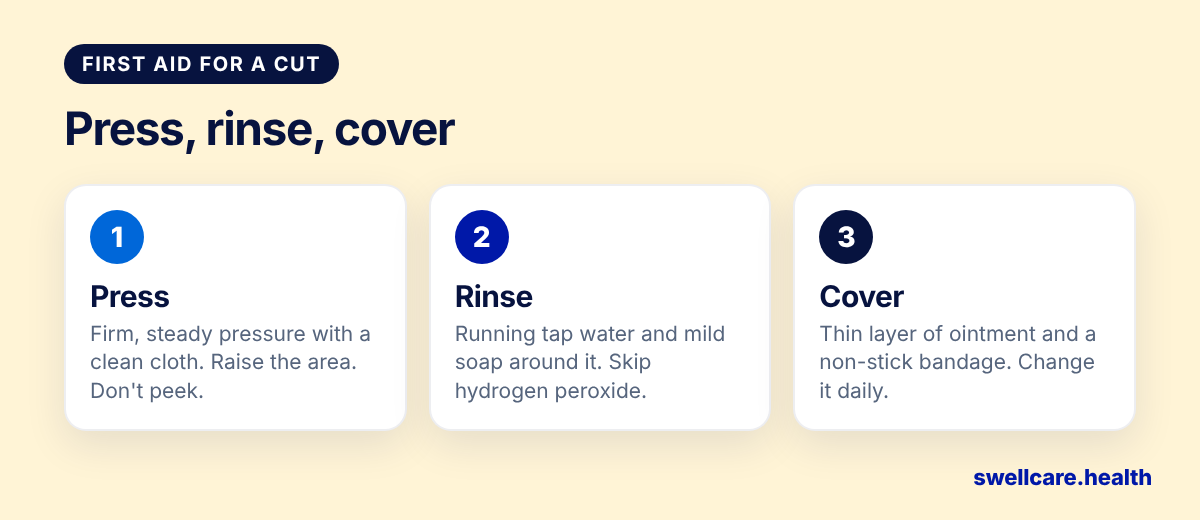
Wash your hands if you can, then press a clean cloth or gauze directly on the cut. Elevate the injured area above your heart and hold steady pressure. Don’t lift the cloth to check. If blood soaks through, add another layer on top instead of removing the first one.
Clean it, then cover it
Once the bleeding stops, rinse the wound under running tap water. Doctors say ordinary tap water works as well as sterile saline for flushing a cut (AAFP). Wash the skin around it with mild soap, but keep soap out of the wound. Skip hydrogen peroxide and iodine, which can irritate healing tissue. Then add a thin layer of ointment and a non-stick bandage, and change it daily.
How long can you wait to get stitches?
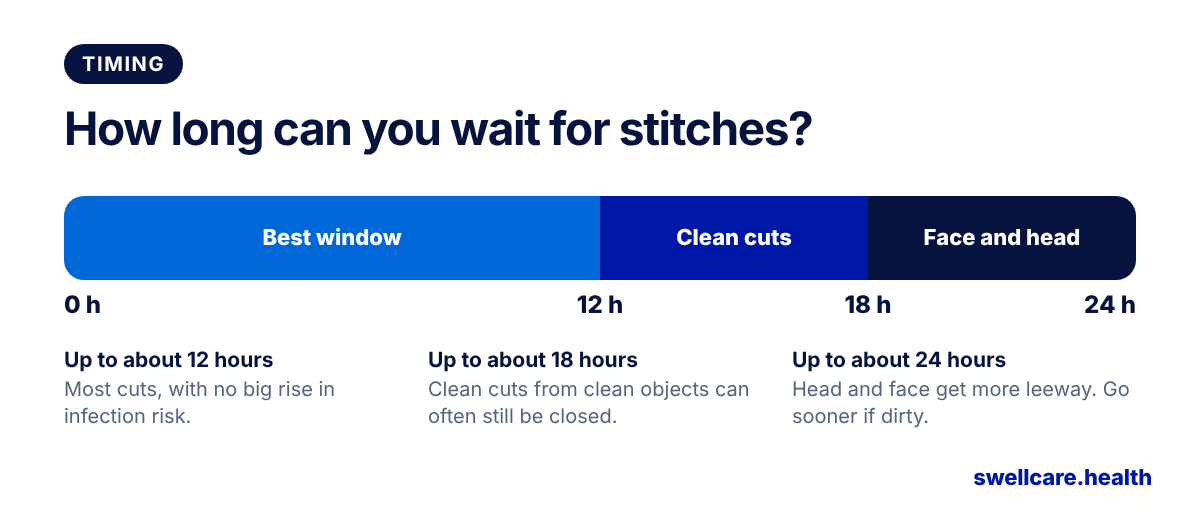
Not forever. The usual window is about 12 hours for most wounds, and clean cuts can often be closed up to about 18 hours after the injury. Cuts on the head and face get more slack, up to roughly 24 hours, because they have a rich blood supply (AAFP).
Those are guides. Dirty wounds, bites, cuts longer than about two inches and cuts on the legs all raise the risk of infection, so waiting hurts more. Don’t hold out until morning to save a copay. Go to urgent care or the emergency room sooner rather than later.
What happens if you skip stitches you needed?
Two things, mostly. A wound that can’t close gives bacteria an open door, so infection becomes more likely, and an infection can turn a simple fix into a week of antibiotics, with more pain and slower healing. And the healing is slower and messier, so scarring tends to be thicker and more visible. Some deep cuts also hide damaged tendons or nerves, which can affect how a finger or hand works later.
None of this is certain. Many people skip stitches and do fine. But if the checklist says “yes” and you shrug it off, you’re gambling with the wound’s healing, and it’s the kind of injury where medical attention early beats a lot of regret later.
Stitches, skin glue or strips: what you may be offered
Good news: “needs closing” doesn’t always mean needles. Depending on the cut, a clinician may use:
- Sutures (stitches) for deeper or higher-tension wounds. They’re numbed first.
- Skin glue, a medical adhesive, for clean, straight, low-tension cuts.
- Steri-Strips, thin adhesive strips, for small wounds that stay closed on their own.
- Staples, which are common on the scalp, and quicker to place than sutures.
Removal timing depends on where the cut is. Facial stitches typically come out in 3 to 5 days, while hand and foot stitches can stay for 10 to 14 days (AAFP).
Tetanus and infection: what to watch for
Ask yourself when you last had a tetanus shot. The CDC says a booster is advised if it’s been 10 or more years for a clean, minor wound, or 5 or more years for a dirty or major one (CDC). An antibiotic pill usually isn’t needed for simple, non-bite cuts, though a dab of antibiotic ointment is fine. Bites are different, and clinicians sometimes prescribe an antibiotic for them.
Call a clinician if you notice redness that spreads, warmth, swelling, pain that keeps getting worse, pus, a red streak or a fever. Those are signs the wound is infected.
ER, urgent care or home? When to see a doctor
Go to the emergency room or call 911 for bleeding that won’t stop, a cut that has numbed or weakened a hand or foot, or a serious injury elsewhere. Urgent care works for most other cuts that need stitches. That means a deep cut that’s no longer bleeding, a cut with a clean edge, or a cut you aren’t sure about, and many urgent care centers do closures all day, no appointment needed.
Stay home when the cut is shallow, closes by itself and stays clean. You’re not wasting anyone’s time by checking, though. Doctors would rather see a cut that turned out fine than a wound that went bad.
Not sure? Your next step with Swell
Here’s something honest. A video visit can’t put in a stitch. What it can do is help you decide fast whether you need to go in person, what to do on the way, and whether you need a tetanus booster. That’s often the piece people are missing at 10 p.m. with a bandage in hand.
If you’re unsure, talk to a Swell clinician through online urgent care. If the cut is bleeding hard or looks very deep, skip the app and go to the nearest emergency room.
Questions people ask about stitches
Do I need stitches if the cut stopped bleeding?
Maybe. Bleeding that stops doesn’t mean a cut is safe. A deep or gaping wound can stop bleeding and still need closing to heal properly. Check depth, edges and location first, and don’t judge by blood alone.
Can a deep cut heal without stitches?
It can, slowly. The body fills the gap from the bottom up, which takes longer and usually leaves a wider scar. Infection risk is higher too. For a truly deep cut, closing it is the better bet.
How deep does a cut have to be for stitches?
A cut deeper than about a quarter inch, or one where you can see fat, muscle or bone, usually needs stitches. If you’re unsure how deep it is, treat it as deep and get it checked.
Is it too late to get stitches after a day?
Often, yes, for ordinary closure. Past roughly 12 to 24 hours, many clinicians leave a wound open and treat it instead, since closing it can trap bacteria. Go in anyway. A clinician can still clean it, check for infection and choose the safest option.
Trusted references
Public-health, research, and medical-society resources related to this guide.